
AERO-420 · Lesson 5 of 12 · 27 min
Plane changes and rendezvous
Lesson 4 changed the size and shape of an orbit with burns along the velocity. This lesson turns to the two other kinds of manoeuvre that every mission analyst must master: rotating the orbit plane, and bringing two spacecraft together. Plane changes are among the most expensive manoeuvres in spaceflight, so much so that missions are designed to avoid them. Rendezvous is the art of meeting another object in orbit, and it underlies crew and cargo flights to space stations, satellite servicing and the active removal of debris that Lesson 12 discusses.
For Crocus-1 the plane question is practical. The rideshare drops satellites into an orbit whose inclination is set by the launch provider, and the provider guarantees the inclination only to within about 0.1 degrees. A sun-synchronous orbit needs its inclination right to within a few hundredths of a degree, as Lesson 6 explains, or the local time of the orbit drifts. Dr. Nakamura must decide whether to carry propellant for an inclination trim. Rendezvous enters through a second question from Dr. Watanabe: could a future servicing vehicle reach Crocus-1 to refuel it or to tow it down at the end of its life?
The cost of turning the plane
Changing the inclination of an orbit means rotating the velocity vector about the radius vector without changing its magnitude. If the speed is \(v\) and the plane turns through \(\Delta i\), the velocity change is the third side of an isosceles triangle:
For small angles this is nearly \(v\,\Delta i\) with the angle in radians. In low Earth orbit, where \(v\) is about 7.6 km/s, each degree of plane change costs about 132 m/s, ten times the whole Crocus-1 orbit raising budget. A 10-degree change costs 1.32 km/s, a large fraction of what a small launcher's upper stage delivers. This is why satellites are launched as close as possible to their final inclination, and why the inclination of a low orbit is effectively fixed by the launch.
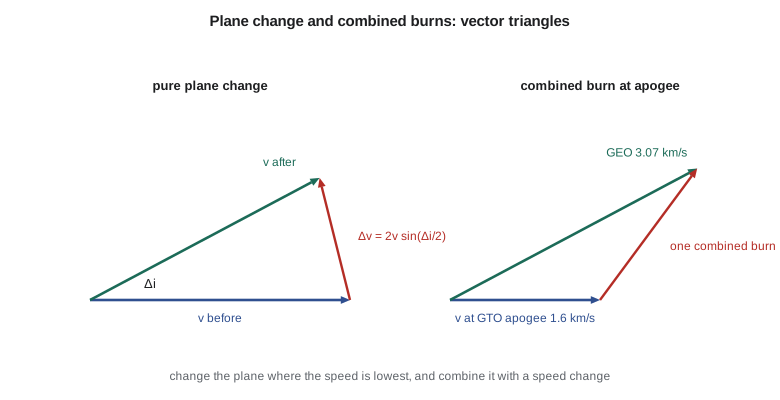
Two rules follow from the formula. First, change the plane where the speed is lowest, because the cost is proportional to speed. On an elliptical orbit that means near apogee. Second, combine a plane change with any burn that also changes the speed, because the vectors add like the sides of a triangle and the combined burn is shorter than the two separate ones. By the law of cosines, a burn that takes the speed from \(v_1\) to \(v_2\) while turning the plane by \(\Delta i\) costs
Both rules shape geostationary missions. A launch from Florida reaches a transfer orbit inclined at about 28.5 degrees, the latitude of the site, and the satellite must reach zero inclination at geostationary altitude. At transfer-orbit apogee the speed is only 1.6 km/s, so that is where the plane change is made, combined with the circularization burn.
Inclination and node
A burn normal to the orbit plane does not always change the inclination. Made at a node, where the orbit crosses the equator, it changes the inclination only. Made at the highest point of the orbit, 90 degrees from the nodes, it rotates the plane about a line through that point, which changes the right ascension of the ascending node instead, with the inclination unchanged. At points in between it changes both. A pure node change at 550 km costs as much as an inclination change of the same angle multiplied by the sine of the inclination, so moving a polar orbit's node by 1 degree costs nearly 132 m/s. For a sun-synchronous satellite that is one more reason never to fight the node with propellant: Lesson 6 shows how the Earth's oblateness moves the node for free.
# Plane changes and rendezvous: inclination trim, combined GTO circularization, and Clohessy-Wiltshire relative motion.
import math
MU = 398600.4418; RE = 6378.137
def plane_change(v, di_deg): return 2*v*math.sin(math.radians(di_deg)/2)
v550 = math.sqrt(MU/(RE + 550))
for di in (0.05, 0.1, 1.0, 10.0):
    print(f"pure plane change of {di:5.2f} deg at 550 km: {plane_change(v550, di)*1000:8.1f} m/s")
# GTO apogee burn from 28.5 deg (Florida) or 51.6 deg launch site latitude-limited inclination
rp, ra = RE + 250, 42164.0
a = (rp + ra)/2; va = math.sqrt(MU*(2/ra - 1/a)); vgeo = math.sqrt(MU/ra)
for inc in (28.5, 51.6):
    sep = vgeo - va + plane_change(vgeo, inc)
    comb = math.sqrt(va**2 + vgeo**2 - 2*va*vgeo*math.cos(math.radians(inc)))
    print(f"GTO at {inc} deg: separate burns {sep:.3f} km/s, combined burn {comb:.3f} km/s")
# Clohessy-Wiltshire: a servicing tug starts 1 km behind a target in a 550 km circular orbit
n = math.sqrt(MU/(RE + 550)**3)
def cw(x0, y0, vx0, vy0, t):
    s, c = math.sin(n*t), math.cos(n*t)
    x = (4 - 3*c)*x0 + s/n*vx0 + 2/n*(1 - c)*vy0
    y = 6*(s - n*t)*x0 + y0 + 2/n*(c - 1)*vx0 + (4*s - 3*n*t)/n*vy0
    return x, y
T = 2*math.pi/n
# Two-impulse transfer that closes 1 km along-track in half an orbit: solve for the start velocity
x0, y0, t = 0.0, -1.0, T/2
s, c = math.sin(n*t), math.cos(n*t)
row1 = [s/n, 2/n*(1-c)]
row2 = [2/n*(c-1), (4*s - 3*n*t)/n]
A = [row1, row2]
b = [0 - (4-3*c)*x0, 0 - 6*(s - n*t)*x0 - y0]
det = A[0][0]*A[1][1] - A[0][1]*A[1][0]
vx = (b[0]*A[1][1] - A[0][1]*b[1])/det; vy = (A[0][0]*b[1] - b[0]*A[1][0])/det
print(f"orbit period {T/60:.2f} min; to close 1 km in half an orbit start with vx = {vx*1000:.3f} m/s, vy = {vy*1000:.3f} m/s")
for frac in (0.125, 0.25, 0.375, 0.5):
    x, y = cw(x0, y0, vx, vy, frac*T)
print(f" t = {frac:5.3f} T: radial {x*1000:7.1f} m, along-track {y*1000:8.1f} m")pure plane change of 0.05 deg at 550 km: 6.6 m/s pure plane change of 0.10 deg at 550 km: 13.2 m/s pure plane change of 1.00 deg at 550 km: 132.4 m/s pure plane change of 10.00 deg at 550 km: 1322.2 m/s GTO at 28.5 deg: separate burns 2.986 km/s, combined burn 1.833 km/s GTO at 51.6 deg: separate burns 4.148 km/s, combined burn 2.429 km/s orbit period 95.65 min; to close 1 km in half an orbit start with vx = -0.274 m/s, vy = 0.000 m/s t = 0.125 T: radial -176.8 m, along-track -853.6 m t = 0.250 T: radial -250.0 m, along-track -500.0 m t = 0.375 T: radial -176.8 m, along-track -146.4 m t = 0.500 T: radial 0.0 m, along-track 0.0 m
The first block confirms the scale of plane changes. A trim of 0.05 degrees costs 6.6 m/s and a trim of 0.1 degrees 13.2 m/s. Dr. Nakamura budgets 13 m/s for an inclination trim, which covers the full launch tolerance. With the 13.7 m/s for orbit raising, this leaves about 32 m/s for the rest of the mission from Crocus-1's 3.5 kg of propellant, which gives about 59 m/s in all at 220 s. The second block shows the benefit of combining burns at transfer apogee. From a Florida launch, separate circularization and plane-change burns would cost 2.99 km/s, while a single combined burn costs 1.83 km/s. From a site whose transfer orbit is inclined at 51.6 degrees the combined burn is 2.43 km/s. Launch sites near the equator, such as Kourou in French Guiana at 5 degrees north, have a strong advantage for geostationary missions for exactly this reason.
Launching into a plane
Because plane changes are so costly, a spacecraft that must join an existing orbit plane, such as a cargo vehicle bound for a space station or a satellite joining a constellation plane, is launched at the moment its launch site passes through that plane. The Earth's rotation carries the site under the target plane twice a day, once on the northbound and once on the southbound side, provided the plane's inclination is at least the site latitude. Each opportunity is a launch window, and its length depends on how much plane error the launcher can absorb with its own steering. Missions to the International Space Station from Florida or Kazakhstan typically have instantaneous or few-minute windows. For a rideshare such as Crocus-1's the window is chosen by the primary customer, and the smaller payloads accept whatever node the launch time produces.
The phase along the orbit matters too. A cargo vehicle reaching the station's plane must also catch the station itself, and the launch time is set so that the vehicle arrives in a lower orbit some distance behind the station. It then closes the gap by phasing, the technique from Lesson 4, over anything from a few hours to two days. Faster rendezvous profiles need more precise launch timing and more onboard computation, which modern vehicles now provide.
Relative motion
Rendezvous is the problem of bringing a chaser spacecraft to a target. Far apart, both follow ordinary orbits and the planning uses Lambert's problem from Lesson 3. Close in, within a few tens of kilometres, it is more convenient to describe the chaser's motion relative to the target, in a frame that moves with the target: one axis points radially outward, one along the target's velocity, and one normal to its orbit. For a target on a circular orbit, and a chaser close to it, the relative motion obeys the Clohessy–Wiltshire equations, published in 1960 for the early rendezvous programmes:
where \(x\) is radial, \(y\) along-track, \(z\) normal to the plane and \(n\) the target's mean motion. The equations are linear and have closed-form solutions, which makes them ideal for onboard guidance. They also explain the counter-intuitive behaviour of orbital rendezvous. A chaser that thrusts forward, toward a target ahead of it, rises to a higher orbit, slows down on average and drifts backward. To catch a target ahead, the chaser must first drop lower. The normal motion is a simple oscillation once per orbit, so a small cross-track offset is harmless.
The last block of the code solves a simple approach. A servicing vehicle sits 1 km behind Crocus-1 and wants to arrive at the target in half an orbit. A single radial burn of 0.274 m/s toward Earth does it: the vehicle dips 250 m below the target's orbit at the quarter point, sweeps forward, and arrives back at zero offset after 48 minutes, where a second burn stops it. A pure radial impulse \(\dot{x}_0\) produces an along-track shift of \(4\dot{x}_0/n\) after half an orbit, so closing 1 km needs \(\dot{x}_0 = n/4\) times 1 km. Real approaches use a sequence of such hops with holding points between them, so that the chaser can stop and check sensors and lighting before moving closer.
Safe approach design
Rendezvous with a crewed station or a valuable satellite is designed around passive safety. Every hop is chosen so that if the chaser loses control, its free drift carries it away from the target rather than into it. Approaches along the radial direction, called R-bar approaches, are naturally braked by orbital mechanics, while approaches along the velocity direction, called V-bar approaches, need continuous small burns. Cargo vehicles visiting the International Space Station use defined approach ellipsoids and keep-out spheres, with go and no-go decisions at each holding point. Servicing missions to satellites that were never designed to be serviced add the problem of capturing a target that may be tumbling, and many study missions plan inspection orbits around the target before contact.
Commercial servicing is no longer hypothetical. In 2020 Northrop Grumman's Mission Extension Vehicle docked with an Intelsat geostationary satellite to extend its life, and a second vehicle followed in 2021. In 2024 the Japanese ADRAS-J spacecraft approached and inspected a spent H-IIA upper stage in low Earth orbit, and space agencies have contracted missions to capture and remove such objects. For Crocus-1, Dr. Watanabe asks Marcus Webb to add a simple docking fixture and reflective markers to the structure. The extra mass is under 0.5 kg, and it would allow a future servicing vehicle to capture the satellite if its own propulsion failed.
| Manoeuvre | Where it is cheapest | Cost at 550 km |
|---|---|---|
| Inclination change | At a node, at low speed | about 132 m/s per degree |
| Node change | At the highest latitude point | about 132 m/s per degree times sin i |
| Combined speed and plane change | Where both are needed, at apogee | less than separate burns |
| Close approach hop of 1 km | Any time, using relative motion | about 0.27 m/s per burn |
Worked problem
Inclination trim
What does a 0.1 degree inclination trim cost at 550 km, where \(v = 7.585\) km/s?
Show solution
- \(\Delta v = 2(7585)\sin(0.05^\circ) = 2(7585)(8.727\times10^{-4})\).
- \(\Delta v = 13.2\) m/s.
Answer: 13.2 m/s.
Worked problem
Combined burn at transfer apogee
At apogee of a transfer orbit inclined 28.5 degrees, \(v_1 = 1.597\) km/s; the geostationary speed is \(v_2 = 3.075\) km/s. Find the combined burn.
Show solution
- \(\Delta v^2 = 1.597^2 + 3.075^2 - 2(1.597)(3.075)\cos 28.5^\circ = 2.550 + 9.456 - 8.645\).
- \(\Delta v^2 = 3.361\), so \(\Delta v = 1.83\) km/s.
Answer: 1.83 km/s, against 2.99 km/s for separate burns.
Worked problem
Radial hop
How large a radial burn closes a 1 km along-track gap in half an orbit at 550 km?
Show solution
- \(n = 2\pi/5739 = 1.095\times10^{-3}\) rad/s.
- Along-track shift after half an orbit \(= 4\dot{x}_0/n\), so \(\dot{x}_0 = n(1000)/4 = 0.274\) m/s.
Answer: 0.274 m/s, toward Earth when the chaser is behind.
Common mistakes
MistakeMaking plane changes in low orbit when an elliptical orbit is available.
InsteadChange the plane near apogee, where the speed is low.
MistakeDoing plane change and circularization as separate burns.
InsteadCombine them; the vector sum is shorter.
MistakeThrusting directly toward a target ahead.
InsteadThat raises the orbit and the chaser drifts back; drop lower to catch up.
MistakeUsing Clohessy–Wiltshire equations far from the target.
InsteadThey are valid only for small separations on a near-circular target orbit.
MistakeDesigning approach hops that collide if a burn fails.
InsteadChoose passively safe trajectories that drift clear.
Summary and key terms
- A plane change rotates the velocity vector and costs \(2v\sin(\Delta i/2)\), about 132 m/s per degree in low Earth orbit, so it is done at low speed and combined with other burns.
- A burn normal to the orbit changes inclination at the nodes and the node at the highest point of the orbit.
- Rendezvous close to a target uses the Clohessy–Wiltshire equations, which show that a chaser must drop lower to move ahead.
- Approaches are built from hops between holding points, designed to be passively safe.
- Crocus-1 budgets 13 m/s for an inclination trim and carries a simple docking fixture.
- Plane change
- A manoeuvre that rotates the orbit plane.
- Combined burn
- A single burn that changes both speed and direction.
- Node change
- A rotation of the orbit plane about the polar axis, changing the ascending node.
- Rendezvous
- Bringing a chaser spacecraft to the position and velocity of a target.
- Clohessy–Wiltshire equations
- Linear equations for relative motion near a circular orbit.
- R-bar
- The radial direction from the target.
- V-bar
- The direction of the target's velocity.
- Passive safety
- Designing a trajectory so that a failed burn leaves the chaser drifting clear.
Practice problems
Work each problem on paper first, then reveal the answer to check.
What does 1 degree of plane change cost in low Earth orbit?
Show answer
About 132 m/s.
Where on a transfer orbit should the plane change be made?
Show answer
At apogee, combined with circularization.
Why do equatorial launch sites suit geostationary missions?
Show answer
Their transfer orbits need little plane change.
A chaser 1 km behind the target thrusts forward. What happens?
Show answer
It rises, slows on average and drifts further back.
What is the cross-track motion in the Clohessy–Wiltshire solution?
Show answer
A simple oscillation once per orbit.
What did the Mission Extension Vehicle do in 2020?
Show answer
It docked with a geostationary communications satellite to extend its life.
Lesson quiz · 5 questions
Score 60% or more to complete this lesson.
Create a free account to save your progress, take quizzes and earn a certificate.