
AERO-420 · Lesson 12 of 12 · 28 min
Space environment and debris
Space is not empty. Above the atmosphere a spacecraft meets a vacuum that boils volatile materials out of plastics and lubricants, temperature swings of a hundred degrees each orbit, atomic oxygen that erodes surfaces, energetic charged particles that damage electronics and solar cells, and a growing population of objects, most of them debris, moving at kilometres per second. This lesson surveys the natural environment that shapes spacecraft design and then turns to the problem every operator now shares: the debris in low Earth orbit and the rules for not adding to it. It ends with Crocus-1's end-of-life plan and the licences the mission must hold.
Dr. Watanabe opens the final design review by asking every subsystem lead one question: what in the environment could end the mission early, and what has the team done about it? The answers range from radiation-tolerant parts to a drag sail.
Vacuum, atomic oxygen and ultraviolet
In vacuum, materials outgas: adsorbed water and low-molecular-weight compounds leave plastics, adhesives and composites over weeks to months. The vapour can condense on cold optical surfaces and degrade a camera's transmission, so materials are selected by their total mass loss and collected volatile condensable materials in a standard vacuum test, and Crocus-1's camera has a heater to keep its optics slightly warm during the first months. Lubricants must be chosen for vacuum, and metals in contact can cold weld without the oxide films that air maintains.
Between about 200 and 700 km the main constituent of the thin atmosphere is atomic oxygen, produced when ultraviolet light splits oxygen molecules. A spacecraft moving at 7.6 km/s meets these atoms with an energy of about 5 electron-volts, enough to oxidize and erode polymers such as Kapton and the binders in paints. Exposed surfaces use protected films or coatings that resist erosion. Solar ultraviolet light darkens many coatings over time, raising their absorptance, which is why Lesson 10's thermal design uses end-of-life surface properties for the hot case.
Radiation
The Earth's magnetic field traps charged particles in the Van Allen belts: an inner belt dominated by energetic protons, centred around 3000 km, and an outer belt of electrons, roughly from 13,000 to 60,000 km. In low Earth orbit the inner belt dips closest to the surface over the South Atlantic, in a region called the South Atlantic Anomaly, where Crocus-1 will pass several times a day. Polar orbits also see solar energetic particles and auroral electrons at high latitudes. Galactic cosmic rays, very energetic nuclei from outside the solar system, arrive from every direction.
Radiation affects spacecraft in three ways. Total ionizing dose accumulates over the mission and slowly shifts the properties of transistors; it is measured in krad and Crocus-1 expects a dose of a few krad behind typical shielding over five years. Displacement damage knocks atoms out of crystal lattices and degrades solar cells and image sensors, the cause of the 2.75 percent a year array degradation in Lesson 10. Single-event effects occur when one energetic particle deposits enough charge to flip a memory bit, disturb a circuit or, in the worst case, latch a device into a high-current state that can destroy it. Designers use radiation-tolerant parts, error-correcting memory, watchdog timers and current-limiting circuits, and the flight software is designed to recover from resets, which are routine in the South Atlantic Anomaly.
Charging is a related hazard. Spacecraft surfaces collect charge from the surrounding plasma, and different surfaces charge to different voltages; if the difference is large enough, a discharge can damage electronics. Surface charging is most severe in geostationary orbit during geomagnetic storms. Internal charging, from electrons that penetrate the outer skin and accumulate in insulators, is a risk for satellites crossing the outer belt. Grounding all conductive surfaces to a common structure and avoiding large insulating areas are the standard defences.
Space weather
The Sun's activity changes the whole environment. Solar flares and coronal mass ejections drive geomagnetic storms that heat the thermosphere, raising drag as Lesson 6 described, and boost the radiation belts and the flux of solar energetic particles. The May 2024 geomagnetic storm, the strongest in about two decades, produced aurorae far to the south and caused large, sudden changes in satellite drag that disrupted orbit predictions for many operators for several days. The NOAA Space Weather Prediction Center and the Canadian Space Weather Forecast Centre issue forecasts and alerts, and Crocus-1's operations plan includes procedures for storms: delaying non-essential manoeuvres, refreshing the orbit more often and checking collision warnings with care.
The debris population
Since 1957 more than 6,000 launches have put over 20,000 satellites into orbit, and most of the objects now tracked are not working spacecraft. The European Space Agency's Space Environment Report 2025 counts about 40,000 objects tracked by surveillance networks, of which about 11,000 are active payloads. Statistical models put the number of objects larger than 10 cm at more than 50,000 and larger than 1 cm at more than 1.2 million, with far more smaller fragments. The debris comes from spent upper stages, dead satellites, mission-related objects such as lens covers and adapters, and above all from fragmentations: explosions of stages with leftover propellant or batteries, and collisions.
Two events dominate the history. In 2007 a deliberate destructive test against a weather satellite at about 860 km created more than 3,000 tracked fragments, many of which will remain for decades. In 2009 the active Iridium 33 and the defunct Cosmos 2251 collided accidentally at about 790 km, the first collision between two intact satellites, creating more than 2,000 tracked fragments. Both happened in the altitude band most used for Earth observation. The fear of a cascade, in which collisions produce fragments that cause further collisions, was set out by Donald Kessler and Burton Cour-Palais in 1978 and is now called the Kessler syndrome. Models suggest that some altitude bands are already near the point where the debris population would grow even with no new launches, unless large objects are removed.
At orbital speeds, even small debris is dangerous. A 1 cm aluminum sphere at a relative speed of 10 km/s carries about 71 kJ, the kinetic energy of a 1000 kg car at about 40 km/h, and can disable a satellite. Objects of 1 mm or less erode surfaces and can puncture insulation or cables. The International Space Station carries multi-layer Whipple shields that break up particles up to about 1 cm; small satellites like Crocus-1 cannot carry such shielding, so they accept a small risk from untracked debris and avoid tracked objects by manoeuvring.
# Orbital lifetime by drag with an exponential atmosphere, and collision probability with debris flux.
import math
MU = 398600.4418e9; RE = 6378.137e3
# Piecewise exponential density (kg/m^3) for moderate solar activity (illustrative values)
TABLE = [(300e3, 2.4e-11, 53e3), (400e3, 3.7e-12, 58e3), (500e3, 6.9e-13, 64e3), (600e3, 1.5e-13, 71e3), (700e3, 3.6e-14, 88e3), (800e3, 1.1e-14, 124e3)]
def rho(h):
    base = TABLE[0]
    for row in TABLE:
        if h >= row[0]: base = row
    h0, r0, H = base
    return r0*math.exp(-(h - h0)/H)
def lifetime(h0, m, A, Cd=2.2):
    B = Cd*A/m; h = h0; t = 0.0; dt = 3600.0
    while h > 180e3:
        r = RE + h
        da = -B*rho(h)*math.sqrt(MU*r)*dt      # circular-orbit decay rate da/dt = -rho*B*sqrt(mu*a)
        h += da; t += dt
        if t > 200*365.25*86400: return float("inf")
        if h < 400e3: dt = 600.0
    return t/(365.25*86400)
m, A_avg = 130.0, 0.9
for h0 in (400, 450, 500, 550, 600):
    life = lifetime(h0*1e3, m, A_avg)
    print(f"{h0} km: natural decay in about {life:5.1f} years")
life_sail = lifetime(550e3, m, A_avg + 4.0)
print(f"550 km with a 4 m^2 drag sail deployed: about {life_sail:.1f} years")
# Collision probability: P = 1 - exp(-F*A*t) with flux F of objects larger than 1 cm (illustrative 1e-5 per m^2 per year)
for F in (1e-6, 1e-5):
    for years in (5, 25):
        p = 1 - math.exp(-F*A_avg*years)
print(f"flux {F:.0e} /m^2/yr over {years:2d} years: collision probability {p*100:.4f} %")400 km: natural decay in about 0.6 years 450 km: natural decay in about 1.4 years 500 km: natural decay in about 3.5 years 550 km: natural decay in about 7.8 years 600 km: natural decay in about 17.3 years 550 km with a 4 m^2 drag sail deployed: about 1.4 years flux 1e-06 /m^2/yr over 5 years: collision probability 0.0004 % flux 1e-06 /m^2/yr over 25 years: collision probability 0.0022 % flux 1e-05 /m^2/yr over 5 years: collision probability 0.0045 % flux 1e-05 /m^2/yr over 25 years: collision probability 0.0225 %
The collision estimate treats impacts as random events with a flux \(F\) of objects per square metre per year, so the probability of at least one impact on a cross-section \(A\) in time \(t\) is \(1 - e^{-FAt}\). The flux values in the code are illustrative, chosen to bracket the range that models such as ESA's MASTER give for objects larger than about 1 cm near 550 km. Even at the higher flux, the chance that Crocus-1 is hit by such an object in five years is a few hundredths of a percent. The risk is small for one satellite, but it is not small for the environment as a whole, which now holds tens of thousands of active satellites, and it grows with every year an object stays in orbit.
Collision avoidance
Tracked objects can be avoided. Surveillance networks, including the US Space Force's catalogue shared through the space-track.org service and commercial tracking providers, screen every active satellite against the catalogue and issue conjunction data messages when two objects are predicted to pass close. Each message gives the time of closest approach, the miss distance and the covariance, the uncertainty ellipsoid of each object's position, and the operator computes a probability of collision. A common threshold for action is a probability of 1 in 10,000. If it is exceeded, the operator plans a small manoeuvre, often a few centimetres per second about half an orbit before the encounter, which shifts the along-track timing enough to open the miss distance.
Crocus-1's operations team expects a few actionable warnings a year at 550 km, an altitude now shared with large communication constellations. Dr. Nakamura holds 5 m/s of the propellant margin for collision avoidance. The team registers its satellite with screening services, shares its planned manoeuvres and operator contact details, and coordinates with other operators when both objects can manoeuvre, so that the two do not dodge into each other.
Mitigation and disposal
The international guidelines, developed by the Inter-Agency Space Debris Coordination Committee and endorsed by the United Nations Committee on the Peaceful Uses of Outer Space in 2007, rest on a few principles: limit debris released during normal operations, minimize the chance of break-ups by passivating spacecraft and stages at the end of life, venting propellant and discharging batteries, avoid collisions, and remove spacecraft from the protected regions of low Earth orbit and geostationary orbit after their missions. For low Earth orbit, the long-standing guideline was re-entry within 25 years after the end of the mission. The US Federal Communications Commission adopted a five-year rule in September 2022 for satellites it licenses, effective for satellites launched from September 2024, and agencies and operators increasingly treat five years as the standard of good practice. Compliance has improved, but ESA's 2025 report notes that many objects still do not meet the guidelines, especially at higher altitudes.
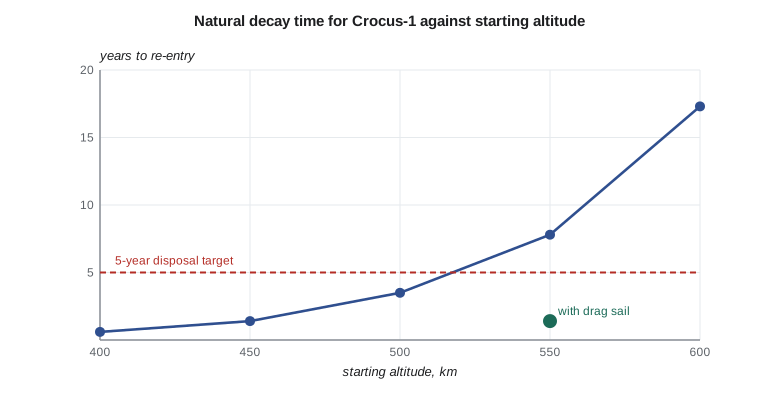
The code estimates Crocus-1's natural lifetime with a simple exponential atmosphere at moderate solar activity: about 0.6 years from 400 km, 3.5 years from 500 km, 7.8 years from 550 km and 17 years from 600 km. Real lifetimes can be half or double these values, depending on where in the solar cycle the decay happens. At 550 km Crocus-1 would not reliably meet a five-year target on its own. The team has two remedies. The first is a deorbit burn with the remaining propellant. About 25 m/s should be left at the end of the mission, enough to lower perigee by about 90 km to roughly 460 km, which cuts the remaining life to around two years; lowering perigee all the way to 300 km, for re-entry within months, would need about 70 m/s. The second, for the case where the propulsion has failed, is a 4 m² drag sail that deploys on command or automatically if the spacecraft stops responding for a set time. With the sail, decay from 550 km takes about 1.4 years. Carrying both gives the redundancy that regulators and the operator's own debris policy expect.
Licences and responsibility
Under the Outer Space Treaty of 1967, states bear international responsibility for national activities in space, including those of private companies, and must authorize and supervise them. The Liability Convention of 1972 makes the launching state liable for damage caused by its space objects, and the Registration Convention of 1975 requires space objects to be registered with the United Nations. National licensing systems are how states meet these obligations.
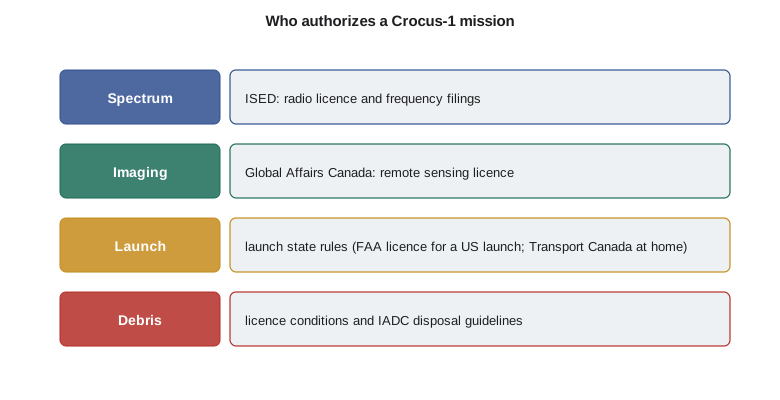
Crocus-1 needs several approvals. Its radio frequencies must be coordinated through the International Telecommunication Union and licensed by Innovation, Science and Economic Development Canada (ISED) under the Radiocommunication Act. As an imaging satellite it needs an operating licence under the Remote Sensing Space Systems Act, administered by Global Affairs Canada, which sets conditions on data distribution and operations. Its launch is covered by the launch state's rules, and for a launch from the United States the US launch provider, which holds a Federal Aviation Administration launch licence. Debris mitigation enters through licence conditions and international guidelines, and the operator files the orbital data needed for registration. Élise Fournier, as chief engineer, signs the debris mitigation plan, and a professional engineer licensed with Engineers Geoscientists Manitoba reviews the safety case for the drag sail and the propulsion system.
| Hazard | Effect on Crocus-1 | Response |
|---|---|---|
| Vacuum outgassing | Contamination of optics | Low-outgassing materials; warm optics |
| Atomic oxygen | Erosion of polymers | Protected films and coatings |
| Radiation | Dose, cell degradation, single-event effects | Tolerant parts, error correction, recovery from resets |
| Space weather | Drag surges; prediction errors | Storm procedures; frequent orbit updates |
| Tracked debris | Collision risk | Screening and avoidance manoeuvres |
| End of life | Long natural decay at 550 km | Deorbit burn plus drag sail |
Worked problem
Collision probability
For \(F = 10^{-5}\) per m² per year, \(A = 0.9\) m² and \(t = 5\) years, find the probability of at least one impact.
Show solution
- \(FAt = 10^{-5} \times 0.9 \times 5 = 4.5\times10^{-5}\).
- \(P = 1 - e^{-4.5\times10^{-5}} \approx 4.5\times10^{-5}\).
Answer: About 0.0045 percent.
Worked problem
Deorbit burn
Estimate the burn to lower Crocus-1's perigee from 550 km to 300 km.
Show solution
- \(r_a = 6928\) km, \(r_p = 6678\) km, \(a = 6803\) km.
- Apogee speed on the new ellipse \(= \sqrt{398600(2/6928 - 1/6803)} = 7.515\) km/s; circular speed \(= 7.585\) km/s.
Answer: About 70 m/s for a full lowering to 300 km; a 25 m/s burn lowers perigee by about 90 km, to roughly 460 km, still shortening the life to well under five years.
Worked problem
Kinetic energy of a fragment
Find the kinetic energy of a 1 cm aluminum sphere, density 2700 kg/m³, at 10 km/s.
Show solution
- Mass \(= 2700 \times (4/3)\pi(0.005)^3 = 1.41\times10^{-3}\) kg.
- \(E = 0.5 \times 1.41\times10^{-3} \times (10^4)^2\).
Answer: About 71 kJ, the energy of a 1000 kg car at about 40 km/h.
Common mistakes
MistakeTreating vacuum as benign.
InsteadOutgassing, cold welding and atomic oxygen all need design attention.
MistakeUsing beginning-of-life parts data for a five-year mission.
InsteadDesign for total dose and single-event effects with margin.
MistakeAssuming natural decay always meets disposal rules.
InsteadAt 550 km decay can take more than five years; plan a burn or sail.
MistakeLeaving propellant or charge on board at end of life.
InsteadPassivate: vent tanks and discharge batteries.
MistakeIgnoring conjunction warnings with low probability.
InsteadTrack their evolution; probabilities change as the orbit solutions improve.
Summary and key terms
- The space environment includes vacuum, atomic oxygen, ultraviolet light, radiation from trapped particles, solar events and cosmic rays, and the effects of space weather.
- Debris now outnumbers working satellites, with about 40,000 tracked objects and over a million larger than 1 cm, and collisions can cascade.
- Operators screen for conjunctions and manoeuvre to avoid tracked objects, and they passivate and dispose of spacecraft, increasingly within five years.
- Crocus-1 combines a deorbit burn with a drag sail, and operates under spectrum, remote sensing and launch licences.
- Outgassing
- Release of volatile compounds from materials in vacuum.
- Atomic oxygen
- Single oxygen atoms in the upper atmosphere that erode surfaces.
- Total ionizing dose
- Accumulated radiation energy that degrades electronics.
- Single-event effect
- A disturbance caused by one energetic particle.
- South Atlantic Anomaly
- The region where the inner radiation belt dips closest to Earth.
- Kessler syndrome
- A cascade of collisions that increases debris.
- Conjunction
- A predicted close approach between two space objects.
- Passivation
- Removing stored energy from a spacecraft at end of life.
Practice problems
Work each problem on paper first, then reveal the answer to check.
What is the main constituent of the atmosphere at 550 km?
Show answer
Atomic oxygen.
Where does the inner radiation belt come closest to Earth?
Show answer
Over the South Atlantic.
How many tracked objects did ESA's 2025 report count?
Show answer
About 40,000.
What was the first accidental collision between two intact satellites?
Show answer
Iridium 33 and Cosmos 2251 in 2009.
What is Crocus-1's natural lifetime from 550 km?
Show answer
About 7.8 years at moderate solar activity.
What does passivation involve?
Show answer
Venting propellant and discharging batteries.
Lesson quiz · 5 questions
Score 60% or more to complete this lesson.
Create a free account to save your progress, take quizzes and earn a certificate.