
AERO-360 · Lesson 5 of 12 · 25 min
Polymer matrix composites
A polymer matrix composite is made of strong, stiff fibres held in place by a polymer resin. The fibres carry the load; the matrix transfers load between fibres, protects them and holds them in position so they do not buckle in compression. In aerospace the dominant system is carbon fibre in an epoxy matrix, carbon fibre reinforced plastic or CFRP, which makes up about half the structural weight of recent wide-body airliners and much of the structure of new business jets and light aircraft. The Tern Block 2's aileron, flaps, fairings and its new rear fuselage cone are CFRP, and the Swift 900 study proposes a CFRP wing. This lesson covers what composites are and how their properties are predicted; Lesson 6 covers how they are made.
Fibres and matrices
Carbon fibres are made by stretching and heating a polymer precursor, usually polyacrylonitrile, until almost pure carbon remains in long, aligned graphitic ribbons. Standard-modulus fibres have a modulus of about 230 GPa and a tensile strength of about 4 to 5 GPa; intermediate-modulus fibres, at about 290 GPa, are now standard on primary airliner structure; high-modulus fibres reach 400 GPa or more for satellites and stiffness-critical parts. Each fibre is about 5 to 7 µm across, and they come in tows of thousands of filaments, 12 000 in a 12K tow. Glass fibres are cheaper, tougher and electrically insulating but heavier and less stiff, at about 72 to 86 GPa; they appear in radomes, fairings and many light aircraft. Aramid fibres are very tough and light but weak in compression and absorb moisture; they are used in impact-prone panels and ballistic protection.
The matrix is usually a thermoset. Epoxies cured at about 180 °C dominate primary structure; 120 °C cure epoxies serve secondary parts; bismaleimides and polyimides serve hotter areas such as engine nacelles. Thermosets cross-link permanently during cure and cannot be remelted. Thermoplastic matrices such as PEEK, PEKK and PAEK are tougher, can be stored without refrigeration, and can be reshaped and welded by melting, but they need much higher processing temperatures, about 300 to 400 °C. Thermoplastic composites are gaining ground for clips, brackets and, in development programs, fuselage panels joined by welding instead of fasteners.
Plies, laminates and stacking sequences
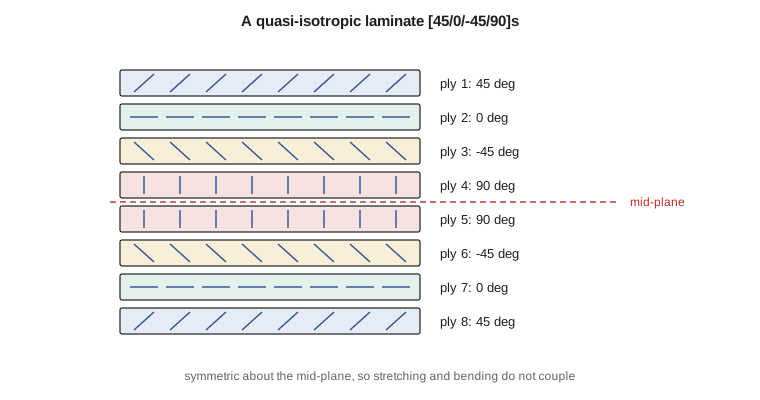
A unidirectional ply is extremely anisotropic. Along the fibres a typical carbon/epoxy ply has a modulus of about 135 GPa; across them only about 9 GPa, and its in-plane shear modulus is about 5 GPa. Its strength across the fibres is set by the resin and is only a few percent of its strength along them. Structural laminates are therefore built from plies at several angles, usually 0, +45, −45 and 90 degrees. The 0-degree plies carry axial load, the ±45 plies carry shear and stabilise the laminate against buckling, and the 90-degree plies carry transverse load and protect against splitting.
Stacking rules turn decades of experience into design practice. Laminates are kept symmetric about their mid-plane, so that stretching does not cause bending or warping during cure. They are balanced, with as many +45 as −45 plies, so that tension does not cause shear distortion. At least about 10 percent of plies are placed in each of the four directions. No more than three or four plies of the same angle are stacked together, to limit delamination. And ±45 plies are placed on the outer surfaces, where they resist impact damage and make bolted repairs easier.
Predicting ply and laminate stiffness
The rule of mixtures predicts the modulus of a ply along the fibres from the fibre and matrix moduli and the fibre volume fraction \(V_f\): \(E_1 = E_f V_f + E_m(1 - V_f)\). Across the fibres, an inverse rule \(1/E_2 = V_f/E_{f2} + (1 - V_f)/E_m\) gives a rough lower estimate; measured transverse moduli are usually higher. Laminate stiffness then follows from classical lamination theory: each ply's stiffness is rotated to the laminate axes and added up through the thickness. For in-plane loads on a symmetric laminate, the result is the A matrix, the sum of each ply's rotated stiffness times its thickness, from which the laminate's effective modulus follows.
# Laminate stiffness for the Tern aileron spar cap: rule of mixtures, ply stiffness and classical lamination.
import math
Ef, Em, Vf = 230.0, 3.5, 0.58             # carbon fibre and epoxy moduli (GPa), fibre volume fraction
E1 = Ef * Vf + Em * (1 - Vf)
E2 = 1 / (Vf / 15.0 + (1 - Vf) / Em)      # transverse fibre modulus about 15 GPa (inverse rule, rough)
G12, v12 = 4.8, 0.30
print(f"ply E1 rule of mixtures {E1:.1f} GPa, E2 inverse rule {E2:.1f} GPa (measured E2 is usually higher)")
E1, E2 = 135.0, 9.0                       # use typical measured ply values from here on
v21 = v12 * E2 / E1
Q11, Q22, Q12, Q66 = E1/(1-v12*v21), E2/(1-v12*v21), v12*E2/(1-v12*v21), G12
def Qbar(th):
    c, s = math.cos(math.radians(th)), math.sin(math.radians(th))
    q11 = Q11*c**4 + 2*(Q12+2*Q66)*s*s*c*c + Q22*s**4
    q22 = Q11*s**4 + 2*(Q12+2*Q66)*s*s*c*c + Q22*c**4
    q12 = (Q11+Q22-4*Q66)*s*s*c*c + Q12*(s**4+c**4)
    q66 = (Q11+Q22-2*Q12-2*Q66)*s*s*c*c + Q66*(s**4+c**4)
    return q11, q22, q12, q66
def laminate(angles, t_ply=0.184):
    A = [0, 0, 0, 0]
    for th in angles:
        q = Qbar(th)
        for i in range(4): A[i] += q[i] * t_ply
    h = t_ply * len(angles)
    a11, a22, a12 = A[0]/h, A[1]/h, A[2]/h
    Ex = a11 - a12**2 / a22
    return Ex, h
for name, lay in (("quasi-isotropic [45/0/-45/90]2s", [45,0,-45,90]*2 + [90,-45,0,45]*2),
                  ("spar cap [45/0/-45/0/0/90/0/0]s, 62% 0-deg", [45,0,-45,0,0,90,0,0] + [0,0,90,0,0,-45,0,45]),
                  ("all 0-deg, 16 plies", [0]*16)):
    Ex, h = laminate(lay)
print(f"{name:42s} thickness {h:5.2f} mm Ex {Ex:6.1f} GPa")ply E1 rule of mixtures 134.9 GPa, E2 inverse rule 6.3 GPa (measured E2 is usually higher) quasi-isotropic [45/0/-45/90]2s thickness 2.94 mm Ex 51.9 GPa spar cap [45/0/-45/0/0/90/0/0]s, 62% 0-deg thickness 2.94 mm Ex 93.5 GPa all 0-deg, 16 plies thickness 2.94 mm Ex 135.0 GPa
The program gives a ply modulus of about 135 GPa from the rule of mixtures, matching typical measured values. A quasi-isotropic laminate, equal in all in-plane directions, comes out at about 52 GPa, close to aluminium's 70 GPa but at about 57 percent of its density. The aileron spar cap from AERO-310, with about 62 percent of its plies at 0 degrees, reaches about 94 GPa along the span, and an all-0-degree laminate reaches the full 135 GPa but would split and be useless against shear and off-axis loads. Marcus Webb's structures group chose the spar cap layup because it carries the bending stiffness the aileron needs while keeping enough ±45 and 90-degree plies for shear, bearing at the fittings and damage tolerance.
Designing with composites changes how engineers think about parts. A metal rib is a standard shape cut from plate; a composite rib can have its plies tailored so that each region carries exactly the loads it sees, with extra plies at fittings, fewer in lightly loaded webs, and ply drops arranged gradually so that thickness changes do not start delaminations. The ability to tailor stiffness also allows aeroelastic tailoring, in which the plies of a wing skin are angled so that the wing twists favourably as it bends, reducing loads or delaying flutter.
The same freedom brings complexity. Each ply in a large skin may have its own shape and position, defined in a ply book that runs to hundreds of pages, and a single misplaced ply can change stiffness or strength. Design software, laser projection on the shop floor and automated inspection exist to keep that complexity under control. Marcus notes that the Tern's composite parts were deliberately kept simple, with few ply drops, because a small program cannot afford long qualification of complicated layups.
Sandwich structure and hybrid laminates
Many composite parts are sandwich panels: two thin laminate face sheets bonded to a light core. The faces carry bending as tension and compression, like the flanges of an I-beam, and the core carries shear and keeps the faces apart. A sandwich with a core only 10 mm thick can be ten or more times stiffer in bending than a solid laminate of the same weight. Cores are aluminium or aramid paper honeycomb, or polymer foam. Sandwich panels form floors, control surfaces, fairings, interior panels and much of the structure of light aircraft and helicopters. Their weaknesses are moisture entry into the core, which can freeze and disbond the faces, and difficult repair, so their edges are carefully sealed and designers avoid them where water collects.
Hybrid laminates mix fibre types. A layer of glass fabric between carbon plies and aluminium fittings isolates the aluminium galvanically, as Lesson 11 explains. Fibre metal laminates such as GLARE, thin aluminium sheets bonded with glass fibre layers, combine aluminium's impact resistance and repairability with the composite's resistance to fatigue crack growth and fly in fuselage panels of one large airliner. Some fan blades and propellers combine carbon with titanium leading edges for erosion and bird-strike resistance.
Lightning adds another layer to many carbon skins. Carbon fibre conducts electricity, but far less well than aluminium, so a lightning strike on a bare CFRP skin can burn through the resin and damage the laminate. Exterior CFRP skins in strike zones carry a fine copper or bronze mesh or expanded foil in the outer ply, bonded with the laminate, and fasteners through fuel tank skins are designed so that current does not spark inside the tank. The Tern's composite aileron has a copper mesh outer ply and bonding straps across its hinges.
Strength, damage and environment
Composite strength is harder to predict than stiffness. Failure may start as matrix cracking in off-axis plies, then delamination between plies, then fibre breakage. Ply-by-ply criteria such as maximum strain or the Tsai-Wu criterion estimate when first-ply failure occurs, and designers often work instead to strain allowables, for example a few thousand microstrain, set by tests on laminates with impact damage and open holes. Composites do not yield, so stress concentrations at holes and notches are not relieved as they are in ductile metals.
The biggest practical difference from metals is damage. A tool dropped on a CFRP skin may leave almost no visible mark on the surface while cracking and delaminating the plies underneath, cutting compression strength by half. This barely visible impact damage, BVID, is assumed present in design: certification rules, set out by Transport Canada and in the widely used composite structure advisory circular AC 20-107B, require that structure with BVID carry ultimate load for the life of the aircraft, and that larger, detectable damage be found and repaired before strength falls below limit load. Composites also absorb moisture, typically up to about 1 percent by weight, which lowers the resin-dominated properties at high temperature. Allowables are therefore set in the hot-wet condition, the worst combination of temperature and absorbed moisture.
| Property | Carbon/epoxy unidirectional ply | Quasi-isotropic laminate | 2024-T3 aluminium |
|---|---|---|---|
| Density, g/cm³ | 1.58 | 1.58 | 2.78 |
| Modulus, GPa | 135 along, 9 across | about 52 | 73 |
| Tensile strength, MPa | about 2000 along, 50 across | about 600 | 483 |
| Fatigue | excellent in tension | good; sensitive to compression after impact | needs inspection for cracks |
| Corrosion | none, but corrodes aluminium in contact | none | needs protection |
| Main design concern | transverse and shear weakness | impact damage, hot-wet, bearing | fatigue cracks and corrosion |
Worked problem
Rule of mixtures
Carbon fibre with a modulus of 230 GPa is combined with an epoxy of 3.5 GPa at a fibre volume fraction of 0.58. Estimate the ply modulus along the fibres.
Show solution
- \(E_1 = 230 \times 0.58 + 3.5 \times 0.42 = 133.4 + 1.5 = 134.9\) GPa.
Answer: About 135 GPa.
Worked problem
Density of a ply
Fibre density is 1.78 g/cm³ and resin density 1.25 g/cm³. Find the ply density at a fibre volume fraction of 0.58.
Show solution
- \(\rho = 1.78 \times 0.58 + 1.25 \times 0.42 = 1.032 + 0.525 = 1.56\) g/cm³.
Answer: About 1.56 g/cm³, close to the 1.58 used for typical prepreg.
Worked problem
Ply count in each direction
A 20-ply laminate has 10 plies at 0 degrees, 4 at +45, 4 at −45 and 2 at 90. Does it meet a 10 percent minimum in each direction and the balance rule?
Show solution
- Percentages: 50, 20, 20 and 10 percent; every direction has at least 10 percent.
- Balance: 4 plies at +45 and 4 at −45, so it is balanced.
Answer: Yes, it meets both rules, and it would also need to be stacked symmetrically.
Common mistakes
MistakeTreating a composite like a metal with one modulus.
InsteadPlies are strongly anisotropic; properties depend on direction and stacking.
MistakeAssuming a surface with no visible dent is undamaged.
InsteadBarely visible impact damage can delaminate the plies underneath and halve compression strength.
MistakeUsing room-temperature dry allowables.
InsteadResin-dominated properties are lowest hot and wet, and allowables reflect that.
MistakeMaking a laminate unsymmetric.
InsteadUnsymmetric laminates warp during cure and couple stretching with bending.
Summary and key terms
- Polymer matrix composites combine strong, stiff fibres, usually carbon, with a resin matrix, usually epoxy.
- A unidirectional ply is very stiff and strong along its fibres and weak across them, so laminates combine 0, ±45 and 90-degree plies and follow rules for symmetry, balance and minimum ply percentages.
- The rule of mixtures predicts ply stiffness and classical lamination theory predicts laminate stiffness.
- Design must allow for barely visible impact damage, hot-wet conditions and the lack of yielding at holes.
- CFRP
- Carbon fibre reinforced plastic, carbon fibres in a polymer matrix.
- Fibre volume fraction
- The fraction of a composite volume occupied by fibres.
- Quasi-isotropic laminate
- A laminate with equal in-plane stiffness in all directions, such as [45/0/−45/90]s.
- Symmetric laminate
- A laminate whose stacking is mirrored about the mid-plane.
- BVID
- Barely visible impact damage, internal damage with little surface indication.
- Hot-wet condition
- The combination of high temperature and absorbed moisture that gives the lowest resin-dominated properties.
Practice problems
Work each problem on paper first, then reveal the answer to check.
In the program, what is the effective modulus of the quasi-isotropic laminate?
Show answer
About 52 GPa.
Why does the spar cap not use all 0-degree plies?
Show answer
It needs ±45 and 90-degree plies for shear, bearing and damage tolerance.
What rule requires as many +45 as −45 plies?
Show answer
The balance rule.
Why are ±45 plies often placed on the outer surfaces?
Show answer
They resist impact and make bolted repairs easier.
Name one advantage of thermoplastic matrices.
Show answer
Toughness, no refrigerated storage, or the ability to be welded and reformed.
Which advisory circular is widely used for certifying composite structure?
Show answer
AC 20-107B.
Lesson quiz · 5 questions
Score 60% or more to complete this lesson.
Create a free account to save your progress, take quizzes and earn a certificate.