
AERO-360 · Lesson 2 of 12 · 26 min
Aluminium alloys
Aluminium alloys have made up most of the structural weight of transport aircraft since the 1930s, and they still form the wing boxes and fuselages of most of the world's fleet, including the Tern Block 2's wing. They are light, stiff enough, easy to machine and form, well understood, and cheap compared with titanium and composites. This lesson explains how the alloy series and tempers differ, why different parts of the same wing use different alloys, and how newer aluminium-lithium alloys compete with composites. Arjun Mehta's first assignment in Odile Marchetti's group is to check the alloy and temper calls on the Tern's wing drawings against the loads that AERO-310 established.
Alloy series and designations
Wrought aluminium alloys carry a four-digit designation from the Aluminum Association, used in both Canada and the United States. The first digit names the main alloying element. The 1xxx series is nearly pure aluminium, used for cladding. The 2xxx series uses copper and is strong, tough and fatigue-resistant but prone to corrosion. The 5xxx series uses magnesium, is weldable and corrosion-resistant but not heat-treatable. The 6xxx series uses magnesium and silicon and is a good general-purpose, weldable, heat-treatable family. The 7xxx series uses zinc with magnesium and copper and gives the highest strength. Aluminium-lithium alloys sit mostly in the 2xxx series, for example 2198 and 2050, with lithium added to cut density and raise stiffness.
The temper suffix tells how the metal was processed. F means as fabricated, O annealed, H strain-hardened for the non-heat-treatable alloys, and W the unstable state just after solution heat treatment and quenching. The T tempers describe heat-treated conditions: T3 is solution treated, cold worked and naturally aged at room temperature; T6 is solution treated and artificially aged to peak strength; T73 and T76 are over-aged to trade some strength for much better resistance to stress corrosion cracking; and T8 is solution treated, cold worked and artificially aged. Extra digits such as T7451 describe stress relief by stretching, which reduces distortion when thick plate is machined.
How heat treatment strengthens aluminium
Heat-treatable alloys gain their strength by precipitation hardening. The metal is heated to about 490 to 530 °C so that the alloying elements dissolve, then quenched in water so they stay trapped in solution. During ageing, at room temperature or at about 120 to 190 °C, the dissolved atoms cluster into tiny precipitates that block the movement of dislocations and raise the strength severalfold. Ageing too long lets the precipitates grow coarse, which lowers strength but improves toughness and corrosion resistance. That is the logic of the over-aged T7 tempers.
The process has practical consequences on the shop floor. Freshly quenched W-temper sheet is soft and easy to form for a few hours before natural ageing hardens it, which is why some shops keep formed parts in freezers to delay ageing until forming is done. Quenching thick sections leaves residual stresses that make machined parts warp, which is why stretched T351 and T7451 plate is used for parts machined from thick stock. And any later heating, by welding, paint curing at high temperature or fire, can over-age and weaken the metal.
Matching alloys to wing locations
A wing's lower skin is in tension in flight, and every flight is a fatigue cycle. Its critical properties are fatigue resistance, slow crack growth and high fracture toughness, so that cracks found at inspection are still far from critical. The upper skin is in compression, so its critical properties are compressive yield strength and stiffness against buckling. Spars and ribs combine both. Fittings that carry concentrated loads, such as engine mounts or landing gear attachments, need high strength and good toughness in thick sections.
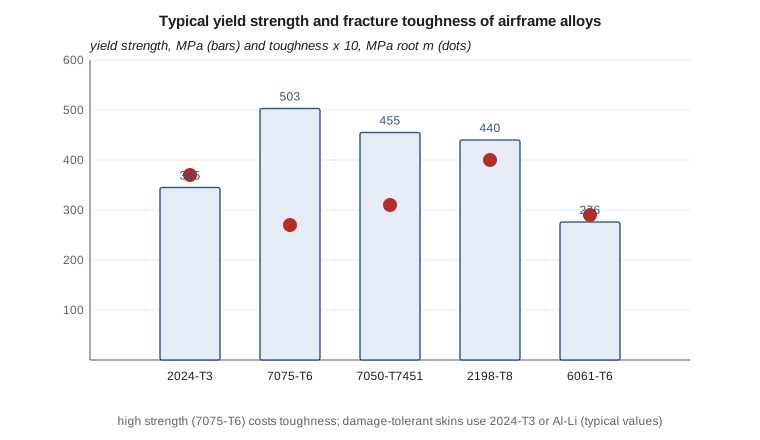
That logic gives the classic pairing still used on many aircraft: 2024-T3 for the lower wing skin and fuselage, and a 7xxx alloy such as 7075-T6 or 7150 for the upper wing skin and stringers. 7075-T6 is about 45 percent stronger than 2024-T3 but much less tough, and in the T6 temper it is susceptible to stress corrosion cracking in thick sections loaded through the thickness. Thick fittings are therefore made from 7050-T7451, which keeps most of the strength while resisting stress corrosion and tolerating damage better.
# Aluminium alloy and temper selection for Tern Block 2 wing parts (typical values, illustrative).
alloys = {  # name: (yield MPa, ultimate MPa, K_Ic MPa sqrt(m), density kg/m3, fatigue-crack-growth rating 1 to 5)
    "2024-T3":     (345, 483, 37, 2780, 5),
    "7075-T6":     (503, 572, 27, 2810, 2),
    "7050-T7451":  (455, 524, 31, 2830, 3),
    "2198-T8":     (440, 490, 40, 2700, 5),
    "6061-T6":     (276, 310, 29, 2700, 3),
}
def critical_crack(K, stress):            # through crack in a wide plate: a_c = (K / (Y*sigma))^2 / pi, Y = 1
    import math
    return (K / stress) ** 2 / math.pi * 1000   # mm, half-length
print(f"{'alloy':12s} {'yield':>6s} {'UTS':>5s} {'K_Ic':>5s} {'a_c at 2/3 yield, mm':>22s} {'growth':>7s}")
for n, (ys, uts, K, rho, cg) in alloys.items():
    print(f"{n:12s} {ys:6d} {uts:5d} {K:5d} {critical_crack(K, 2 / 3 * ys):22.1f} {cg:7d}")
# Lower wing skin is tension-dominated and fatigue-critical; upper skin is compression-critical.
def score(n, w_strength, w_tough, w_growth):
    ys, uts, K, rho, cg = alloys[n]
    return w_strength * ys / 503 + w_tough * K / 40 + w_growth * cg / 5
for part, w in (("lower skin", (0.2, 0.4, 0.4)), ("upper skin", (0.7, 0.15, 0.15))):
    best = max(alloys, key=lambda n: score(n, *w))
    print(f"\n{part}: weights strength/toughness/growth = {w} -> best {best}")
for n in alloys: print(f" {n:12s} {score(n, *w):.2f}")alloy yield UTS K_Ic a_c at 2/3 yield, mm growth 2024-T3 345 483 37 8.2 5 7075-T6 503 572 27 2.1 2 7050-T7451 455 524 31 3.3 3 2198-T8 440 490 40 5.9 5 6061-T6 276 310 29 7.9 3 lower skin: weights strength/toughness/growth = (0.2, 0.4, 0.4) -> best 2198-T8 2024-T3 0.91 7075-T6 0.63 7050-T7451 0.73 2198-T8 0.97 6061-T6 0.64 upper skin: weights strength/toughness/growth = (0.7, 0.15, 0.15) -> best 2198-T8 2024-T3 0.77 7075-T6 0.86 7050-T7451 0.84 2198-T8 0.91 6061-T6 0.58
The program puts numbers on the trade. At two-thirds of yield stress, a through crack in a wide 2024-T3 plate becomes critical at a half-length of about 8 mm, against only about 2 mm for 7075-T6. That four-to-one margin is why 2024-T3 forgives fatigue cracks long enough for inspections to find them. Al-Li 2198-T8 scores highest for both skins in the program because it combines high strength with toughness and slow crack growth, about 3 percent lower density and about 4 percent higher stiffness. Arjun notes that the score leaves out cost: aluminium-lithium plate costs roughly twice as much as conventional alloys, and scrap must be kept separate because lithium contaminates ordinary aluminium recycling streams.
For the Tern Block 2, Odile's group keeps 2024-T3 for the lower skins, as AERO-310 assumed, and 7075-T6 for the upper skins and stringers, because the program is a derivative and requalifying the skins would cost more than the small weight saving. For the Swift 900 study, a clean-sheet design where every kilogram counts, the group recommends a 2xxx aluminium-lithium alloy for the lower wing skin and fuselage skins, and 7055 or a similar high-strength 7xxx alloy for the upper wing.
Product forms and cladding
Aluminium reaches the factory as sheet, thinner than about 6 mm, plate, extrusions for stringers and floor beams, and forgings for fittings and frames. Each product form has its own allowables in MMPDS, because properties differ with thickness and grain direction. Properties in the short transverse direction, through the thickness of a plate, are lower, especially for elongation and stress corrosion resistance, which matters for thick machined fittings loaded across their thickness.
Sheet for fuselage skins is often clad: a thin layer of nearly pure aluminium, a few percent of the thickness, is rolled onto each face. The pure layer is anodic to the core and corrodes sacrificially, protecting the strong but corrosion-prone 2024 underneath. Cladding lowers strength and fatigue strength slightly, so allowables for clad sheet are lower, and it can be scratched through during handling.
Aluminium-lithium alloys
Each percent of lithium added to aluminium lowers density by about 3 percent and raises modulus by about 6 percent. Early aluminium-lithium alloys from the 1980s, such as 8090 and 2090, disappointed: they were anisotropic, had poor toughness in some directions and were hard to recycle. The third-generation alloys, with lower lithium contents and careful additions of copper, silver, magnesium and zirconium, fixed most of those problems. They now fly in fuselage skins, floor beams and wing structure on recent airliners and business jets, and they remain the aluminium industry's answer to composites: lighter structure using the same factories, fasteners, inspection methods and repair practices as conventional aluminium.
Forming, machining and repair of aluminium parts
Aluminium's manufacturing advantages are as important as its properties. Sheet is formed on stretch presses, which pull it over a die to make curved skins and leading edges, and in rubber-pad presses, which push it into simple shapes for ribs and clips. Large parts such as wing ribs, spars and fuselage frames are increasingly machined from thick plate on high-speed milling machines, which remove up to 90 percent of the metal but replace dozens of formed and riveted pieces with one part. Thick-section machining is the reason stretched T7451 plate matters: without stress relief, the residual stresses from quenching would bend the part as metal is removed.
Wing skins are tapered in thickness along the span, thick at the root where bending is high and thin at the tip, either by machining or by chemical milling, which etches away metal through a mask. Fuselage skins are often chemically milled to leave thicker lands around window cutouts and frame attachments. Shot peen forming bends thick wing skins into their final aerodynamic shape by bombarding one surface with steel shot, which stretches that surface and curves the panel without dies.
Repair is where aluminium shows its long track record. A dented or cracked skin can be blended out within limits, or cut out and patched with a doubler riveted over the damage, using procedures published in the structural repair manual that every aircraft type carries. Mechanics around the world know how to do it with simple tools. That ease of repair, more than any single property, is why operators value aluminium structure and why composite structure has had to develop equally practical repair methods before airlines would accept it.
Arjun's drawing review turns up one problem. A drawing for a Tern flap-track support calls for 7075-T6 machined from 75 mm plate, loaded across the plate thickness. Odile's group changes it to 7050-T7451, the standard choice for thick parts loaded in the short transverse direction, and the change is recorded through the program's engineering change process so the stress report and the parts list are updated together.
Limits of aluminium
Aluminium alloys have three main weaknesses. They corrode, so they need sealing, primers and careful drainage, covered in Lesson 11. They lose strength above about 120 °C, which keeps them out of engine areas and limits them on fast aircraft whose skins heat up aerodynamically. And they fatigue: aluminium has no true endurance limit, so every load cycle adds damage, and fuselages must be designed and inspected for widespread fatigue damage late in life. Composites avoid the first and third problems but bring their own, as later lessons show.
Worked problem
Critical crack length
A 2024-T3 skin with a fracture toughness of 37 MPa√m carries 230 MPa. Treat it as a wide plate with a central through crack and a geometry factor of 1. Find the critical half-length.
Show solution
- For a central through crack in a wide plate, \(a_c = (K_{Ic}/\sigma)^2/\pi\).
- \((37/230)^2 = 0.0259\) m; divided by \(\pi\): \(a_c = 0.00824\) m.
Answer: About 8.2 mm half-length, so a total crack of about 16 mm.
Worked problem
Density saving
An aluminium-lithium alloy with 1.5 percent lithium replaces 2024-T3 in a 120 kg skin. Using about 3 percent lower density per percent of lithium, estimate the weight saved if the gauge is unchanged.
Show solution
- Density reduction \(\approx 1.5 \times 3 = 4.5\) percent.
- Saving \(= 0.045 \times 120 = 5.4\) kg.
Answer: About 5 kg, before any gauge reduction from higher strength or stiffness.
Worked problem
Temper choice
A thick machined landing gear fitting is loaded across the plate thickness. Why choose 7050-T7451 over 7075-T6?
Show solution
- 7075-T6 is prone to stress corrosion cracking in the short transverse direction.
- The over-aged T74 temper resists stress corrosion, and the 51 suffix means the plate was stretched to relieve quench stresses before machining.
Answer: 7050-T7451 trades a little strength for stress corrosion resistance and low machining distortion.
Common mistakes
MistakeAssuming the strongest alloy is always best.
InsteadLower skins and pressurized fuselages are governed by fatigue and toughness, where 2024-T3 and Al-Li alloys outperform 7075-T6.
MistakeForgetting that later heating changes temper.
InsteadWelding, high-temperature curing or fire can over-age aluminium and lower its strength.
MistakeUsing sheet allowables for thick plate.
InsteadAllowables depend on product form, thickness and grain direction.
MistakeMixing aluminium-lithium scrap with ordinary scrap.
InsteadLithium contaminates conventional recycling, so the scrap must be segregated.
Summary and key terms
- Aluminium alloys are designated by series, where 2xxx uses copper, 6xxx magnesium and silicon, 7xxx zinc, and Al-Li alloys mostly sit in 2xxx.
- Tempers such as T3, T6 and T7 describe solution treatment, quenching and ageing.
- Precipitation hardening gives the strength, and over-ageing trades strength for toughness and stress corrosion resistance.
- Tension-dominated lower wing skins and fuselages use tough, fatigue-resistant 2024-T3 or Al-Li alloys; compression-dominated upper skins use strong 7xxx alloys; thick fittings use 7050-T7451.
- Aluminium's limits are corrosion, temperature above about 120 °C and fatigue.
- Temper
- The suffix describing how an alloy was processed, for example T3 or T6.
- Precipitation hardening
- Strengthening by fine particles that form from a supersaturated solid solution during ageing.
- Over-ageing
- Ageing past peak strength to improve toughness and stress corrosion resistance.
- Cladding
- A thin pure aluminium surface layer that protects a stronger alloy core by sacrificial corrosion.
- Short transverse direction
- The direction through the thickness of a rolled plate, usually its weakest.
- Aluminium-lithium alloy
- An aluminium alloy with lithium added to lower density and raise stiffness.
Practice problems
Work each problem on paper first, then reveal the answer to check.
In the program, what is the critical half-crack length of 7075-T6 at two-thirds of yield?
Show answer
About 2.1 mm.
Which alloy does the program pick for the lower skin, and what does the score leave out?
Show answer
2198-T8; it leaves out cost and recycling.
What does the 51 in T7451 mean?
Show answer
The plate was stress relieved by stretching after quenching.
Why is W-temper sheet sometimes kept in a freezer?
Show answer
To delay natural ageing so it stays soft enough to form.
Why is clad sheet used on fuselages?
Show answer
The pure aluminium layer corrodes sacrificially and protects the stronger core.
Why does aluminium need fatigue inspections late in life?
Show answer
It has no endurance limit, so every cycle adds damage.
Lesson quiz · 5 questions
Score 60% or more to complete this lesson.
Create a free account to save your progress, take quizzes and earn a certificate.