
AERO-360 · Lesson 3 of 12 · 25 min
Titanium alloys
Titanium sits between aluminium and steel in density, at about 4.4 g/cm³, but rivals many steels in strength, keeps that strength to about 350 to 550 °C, barely corrodes, and does not react galvanically with carbon fibre. Those properties make it the metal of choice for engine fan and compressor parts, hot structure near engines, landing gear components and fittings that join composite structure. Its drawbacks are cost and difficulty: titanium sponge is expensive to produce, the metal is hard to machine, and it reacts with oxygen and nitrogen at high temperature. In this lesson Arjun follows a titanium bracket for the Swift 900 study's engine pylon from material choice to cost.
Where titanium is used
On a modern airliner titanium makes up roughly 6 to 15 percent of structural weight, and the share grows as composite content grows, because composite wings and fuselages need titanium fittings and fasteners where aluminium would corrode. Typical applications include engine pylons and firewalls, which see heat; landing gear beams and parts of the gear itself, which see high loads; floor beams in wet areas near galleys and lavatories; the frames where composite wings attach to the fuselage; and fan blades, compressor discs and blades in the engines. On the Tern Block 2, titanium appears in the firewall around the turboshaft generator, the exhaust duct support and the fittings that attach the carbon fibre aileron.
Alloy types: alpha, beta and alpha-beta
Pure titanium changes crystal structure at about 882 °C. Below it, titanium is alpha phase, hexagonal close-packed; above it, beta phase, body-centred cubic. Alloying elements shift that transition. Aluminium, oxygen and nitrogen stabilise alpha; vanadium, molybdenum, iron and chromium stabilise beta. The alloys therefore fall into three families. Alpha and near-alpha alloys keep strength and creep resistance at high temperature and are used in compressor parts. Beta alloys are very strong after ageing and easy to cold form, and are used for springs, fasteners and some landing gear parts. Alpha-beta alloys, led by Ti-6Al-4V, balance strength, toughness and manufacturability.
Ti-6Al-4V, also called Grade 5, alone accounts for well over half of all titanium used in aerospace. Its typical annealed properties are a yield strength of about 880 MPa, an ultimate strength of about 950 MPa and a modulus of 114 GPa. A version with lower oxygen and iron, called ELI for extra-low interstitial, has better toughness and is used in fracture-critical parts. Commercially pure titanium grades, weaker but easy to form and very corrosion-resistant, appear in ducts and non-structural parts.
Why titanium is expensive
Titanium is the ninth most abundant element in the Earth's crust, but turning its ore into metal is slow and energy-hungry. The usual Kroll process reduces titanium tetrachloride with molten magnesium in batches to make porous titanium sponge. The sponge is crushed, blended with alloying elements and scrap, and melted, often two or three times, in vacuum arc remelting furnaces to make clean, uniform ingots. Each melt guards against inclusions such as hard alpha, nitrogen-rich particles that can start fatigue cracks; a hard alpha inclusion in a titanium fan disc led to a fatal airliner accident in 1989 and drove much of the industry's later melt practice and inspection rules. Ingots are then forged and rolled into billet, plate and bar.
The second cost is machining. Titanium conducts heat poorly, so heat from cutting stays at the tool tip; it reacts chemically with tool materials at high temperature; and its low modulus lets thin walls spring away from the cutter. Cutting speeds are typically five to ten times lower than for aluminium, as Lesson 8 shows. The third cost is waste. A machined titanium fitting may start as a billet or plate ten or more times heavier than the finished part. The ratio of material bought to material that flies is called the buy-to-fly ratio, and it is one of the most closely watched numbers in titanium part design.
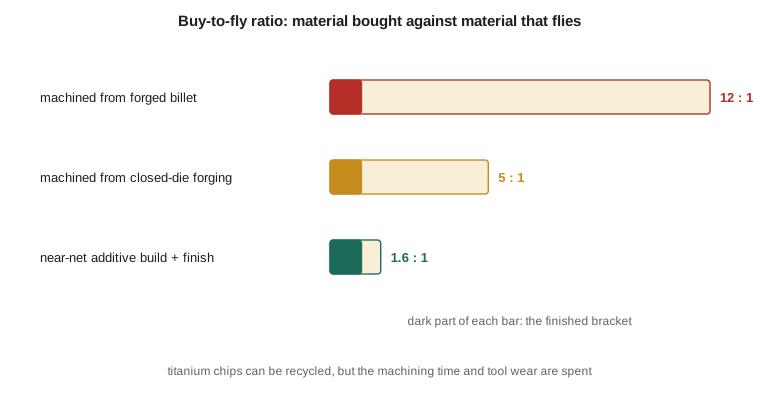
# Titanium bracket for the Swift 900 study engine pylon: buy-to-fly ratio, machining time and cost.
rho = 4430.0                               # Ti-6Al-4V density, kg/m3
part_mass = 1.8                            # finished bracket, kg
routes = {  # name: (buy-to-fly, raw material cost per kg, material removal rate cm3/min, extra process cost)
    "machined from plate": (12.0, 60.0, 30.0, 0.0),
    "closed-die forging":  (5.0, 85.0, 30.0, 900.0),
    "additive near-net":   (1.6, 250.0, 30.0, 1400.0),
}
rate = 2.4                                 # machine cost per minute including tooling, currency units
for n, (btf, cpk, mrr, extra) in routes.items():
    bought = part_mass * btf
    removed_cm3 = (bought - part_mass) / rho * 1e6
    t = removed_cm3 / mrr
    cost = bought * cpk + t * rate + extra
    print(f"{n:22s} buy {bought:5.1f} kg  remove {removed_cm3:6.0f} cm3  machining {t:5.0f} min  cost {cost:7.0f}")
# Titanium is chosen over steel where weight, temperature and galvanic compatibility with CFRP matter.
for n, s_, r, tmax in (("Ti-6Al-4V", 880, 4430, 350), ("steel 4340", 1470, 7850, 300), ("Al 7075-T6", 503, 2810, 120)):
print(f"{n:11s} specific strength {s_*1e3/r:5.0f} kN m/kg usual maximum service temperature about {tmax} C")machined from plate buy 21.6 kg remove 4470 cm3 machining 149 min cost 1654 closed-die forging buy 9.0 kg remove 1625 cm3 machining 54 min cost 1795 additive near-net buy 2.9 kg remove 244 cm3 machining 8 min cost 2140 Ti-6Al-4V specific strength 199 kN m/kg usual maximum service temperature about 350 C steel 4340 specific strength 187 kN m/kg usual maximum service temperature about 300 C Al 7075-T6 specific strength 179 kN m/kg usual maximum service temperature about 120 C
The result surprised Arjun. At the prices assumed, machining the bracket from plate is cheapest for a single part, about 1650 currency units, even though it buys 21.6 kg of titanium and removes 4470 cm³ of chips. The closed-die forging and the additive part each carry a one-time process cost that only pays back across production. Odile explains that the program leaves out three things. Forging dies are shared across hundreds of parts, which cuts the per-part forging cost. Plate lead times can stretch to many months in a busy year, while an additive part can be built in days. And a forging's grain flow follows the part shape, which improves fatigue life. The study recommends a closed-die forging for production, with additive parts for the prototype aircraft.
Heat treatment and processing
Alpha-beta alloys are used annealed or solution treated and aged. Solution treatment just below the beta transus, the temperature above which the alloy becomes fully beta, followed by quenching and ageing at about 480 to 600 °C, raises strength. Processing above the beta transus produces coarse, plate-like grains with good crack growth resistance and toughness but lower ductility and fatigue strength; processing below it gives a fine, equiaxed structure with better fatigue strength. Designers choose the microstructure for the part: fine equiaxed for rotating engine parts limited by low-cycle fatigue, coarser lamellar for damage-tolerant airframe fittings.
Titanium must be protected from air when hot. Above about 500 °C, oxygen diffuses into the surface and forms alpha case, a hard brittle layer that cracks under fatigue loading. Heat treatment is done in vacuum or argon, and any alpha case left by forging or welding must be removed by chemical milling or machining. Welding requires full inert gas shielding of both the weld and the hot metal around it, often in a chamber filled with argon.
Forging, forming and additive titanium
Titanium is forged at temperatures just below or above its beta transus, depending on the microstructure wanted, and forging dies are often heated so that the thin parts of a forging do not chill and crack before the die fills. Isothermal and hot-die forging, in which die and workpiece are kept at nearly the same temperature, make near-net shapes with thinner webs and less machining, at the cost of expensive die materials. The largest closed-die presses in the world, rated at tens of thousands of tonnes, exist largely to forge titanium and aluminium aircraft parts such as landing gear beams and wing attachment frames.
Titanium sheet is formed hot, because it springs back badly and cracks if formed cold. Superplastic forming exploits the ability of fine-grained Ti-6Al-4V to stretch several hundred percent at about 900 °C: a sheet is clamped over a heated die and blown into shape with argon pressure, making complex ducts and panels in one piece. Combined with diffusion bonding, in which clean titanium sheets bond into one under heat and pressure without melting, the process makes hollow, stiffened structures such as fan blades and access panels.
Additive manufacturing, covered in Lesson 10, is reshaping titanium economics. Building a near-net part from powder or wire cuts the buy-to-fly ratio from ten or more to below two, and it removes the long lead times of forgings. The trade is the cost of qualification: every machine, powder lot, parameter set and post-process must be controlled and proved, and properties depend on build direction and porosity. For the Swift 900 study, Odile's group plans additive pylon brackets for the prototypes, where lead time matters most, and forgings once production rates justify the dies.
Fire is a specific titanium hazard that shapes engine design. Under some conditions, such as a compressor blade rubbing hard against its casing at high pressure and temperature, titanium can ignite and burn, and a titanium fire can spread through an engine in seconds. Engine designers therefore limit titanium in the rear, hottest compressor stages, use fire-resistant coatings or steel and nickel casings around titanium blades, and keep tip clearances controlled. On the Tern's turboshaft generator, the compressor uses titanium blades only in its front stages.
Titanium chips and fines also burn, so machining shops collect them dry or under coolant and store them away from ignition sources. Clean, sorted titanium scrap is valuable: it is remelted into new ingots, and machine shops that segregate and protect their chips recover a significant part of the material cost. Odile's group writes the scrap handling requirements into the supplier's purchase order for the Swift 900 study's titanium parts, so that recycled value is captured and contaminated chips do not reach the melt.
Titanium and composites
Titanium's close galvanic match to carbon fibre is one of its biggest advantages. Carbon fibre is electrically conductive and noble, so aluminium in contact with it corrodes quickly when moisture is present, as Lesson 11 explains. Titanium sits close to carbon in the galvanic series. Its thermal expansion is also closer to that of carbon fibre laminates than aluminium's, which reduces thermal stresses in joints. Titanium fasteners, fittings and frames are therefore standard wherever composites carry load, which is why titanium demand grew with the move to composite airliners.
| Alloy | Type | Typical use | Notes |
|---|---|---|---|
| Ti-6Al-4V | alpha-beta | fittings, frames, fan blades, pylons | about half or more of aerospace titanium |
| Ti-6Al-4V ELI | alpha-beta | fracture-critical parts | lower oxygen and iron for toughness |
| Ti-6Al-2Sn-4Zr-2Mo | near-alpha | compressor discs and blades | creep resistance to about 540 C |
| Ti-10V-2Fe-3Al | near-beta | landing gear parts | very high strength in thick sections |
| Ti-15V-3Cr-3Sn-3Al | beta | formed sheet parts, springs | cold formable, then aged |
| CP titanium Grade 2 | commercially pure | ducts, non-structural parts | easy to form, very corrosion resistant |
Worked problem
Buy-to-fly
A 2.4 kg titanium fitting is machined from a 26 kg block. Find the buy-to-fly ratio and the volume of chips at 4430 kg/m³.
Show solution
- Buy-to-fly \(= 26/2.4 = 10.8\).
- Chips \(= (26 - 2.4)/4430 = 0.00533\) m³ \(= 5330\) cm³.
Answer: About 11 to 1, with over 5 litres of chips to recycle.
Worked problem
Specific strength
Compare the specific strength of Ti-6Al-4V (880 MPa, 4430 kg/m³) with a 4340 steel (1470 MPa, 7850 kg/m³).
Show solution
- Ti-6Al-4V: \(880 \times 10^6/4430 = 199\) kN m/kg.
- 4340: \(1470 \times 10^6/7850 = 187\) kN m/kg.
Answer: Titanium is slightly better per unit mass, and it adds corrosion resistance and galvanic compatibility with composites.
Worked problem
Machining time
A part needs 3000 cm³ removed. Aluminium can be cut at 300 cm³/min and titanium at 30 cm³/min. Compare the times.
Show solution
- Aluminium: \(3000/300 = 10\) min.
- Titanium: \(3000/30 = 100\) min.
Answer: Titanium takes ten times longer, which is why near-net shapes matter so much.
Common mistakes
MistakeChoosing titanium for stiffness.
InsteadIts specific stiffness is about the same as aluminium's; titanium earns its place by strength, temperature capability and compatibility with composites.
MistakeHeat treating titanium in air.
InsteadOxygen pick-up forms brittle alpha case that must be avoided or removed.
MistakeComparing routes on material cost alone.
InsteadMachining time, tooling, lead time and production quantity can reverse the ranking.
MistakeAssuming every titanium alloy is Ti-6Al-4V.
InsteadNear-alpha, beta and commercially pure grades suit different jobs.
Summary and key terms
- Titanium alloys combine high specific strength, temperature capability to about 350 to 550 °C, excellent corrosion resistance and galvanic compatibility with carbon fibre.
- Alloys are alpha, alpha-beta or beta; Ti-6Al-4V dominates.
- Titanium is expensive because of the Kroll process, repeated vacuum melting, slow machining and high buy-to-fly ratios.
- Microstructure from processing above or below the beta transus is chosen for fatigue or damage tolerance, and hot titanium must be shielded from oxygen to avoid alpha case.
- Beta transus
- The temperature above which a titanium alloy is fully beta phase.
- Alpha case
- A hard, brittle oxygen-enriched surface layer formed on titanium heated in air.
- Buy-to-fly ratio
- The mass of material bought divided by the mass of the finished part.
- Kroll process
- The batch process that reduces titanium tetrachloride with magnesium to make titanium sponge.
- ELI
- Extra-low interstitial, a grade with reduced oxygen and iron for better toughness.
- Hard alpha inclusion
- A brittle nitrogen- or oxygen-rich particle in titanium that can start fatigue cracks.
Practice problems
Work each problem on paper first, then reveal the answer to check.
In the program, how much metal is removed when the bracket is machined from plate?
Show answer
About 4470 cm³.
Why might a closed-die forging still be chosen when plate is cheaper for one part?
Show answer
Die costs are shared over production, lead times are shorter, and grain flow improves fatigue life.
Name two places titanium appears on the Tern Block 2.
Show answer
Examples: the firewall, the exhaust duct support, the aileron fittings.
Why is titanium preferred over aluminium for fittings on CFRP structure?
Show answer
It is galvanically compatible with carbon and closer in thermal expansion.
What melting process is repeated to make clean titanium ingots?
Show answer
Vacuum arc remelting.
What microstructure suits a rotating engine disc limited by low-cycle fatigue?
Show answer
A fine equiaxed structure from processing below the beta transus.
Lesson quiz · 5 questions
Score 60% or more to complete this lesson.
Create a free account to save your progress, take quizzes and earn a certificate.