
ACCT-222 · Lesson 7 of 12 · 28 min
Joint and by-product costing
Some production processes yield several products at once from a single input. Crude oil is refined into gasoline, diesel, jet fuel and asphalt; a cow yields beef, hides and by-products; milk is separated into cream and skim milk; logs become lumber, chips and sawdust. The costs of the shared process are joint costs, and they pose a problem that cannot be solved by cause and effect: no amount of analysis can say how much of the cost of a barrel of crude oil was incurred to make the gasoline rather than the asphalt, because one cannot be made without the other. This lesson explains the methods used to allocate joint costs for inventory valuation and reporting, why those allocations should never drive sell-or-process-further decisions, and how by-products are accounted for.
Halden's resin recovery line
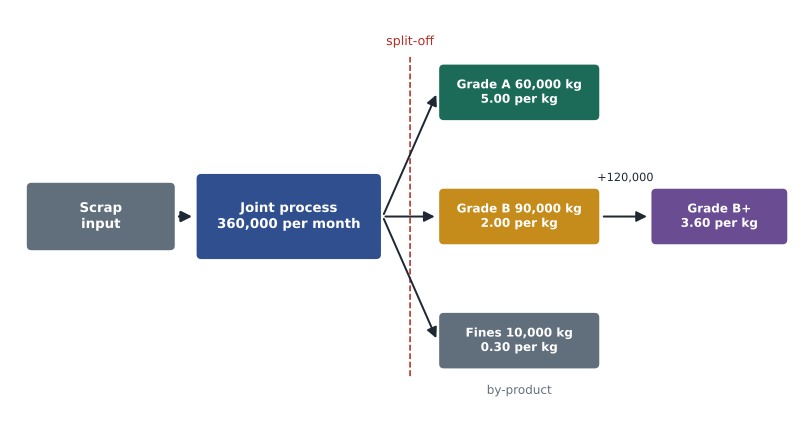
Halden recently acquired a small polymer recovery operation next to its plant. The line takes in scrapped pump housings, impellers and covers from Halden's own production and from a municipal recycling contract, grinds and washes them, and separates the material in a flotation process. Each month the joint process costs $360,000 for collection, grinding, washing, separation and drying, and it yields three outputs at the split-off point, the point at which the products become separately identifiable:
- Grade A resin, 60,000 kg, a high-purity engineering polymer that Halden uses for impellers or sells to plastics processors at $5.00 per kg.
- Grade B resin, 90,000 kg, a mixed polymer that sells at split-off for $2.00 per kg, or can be processed further with ultraviolet stabilizers and pelletized into Grade B+ at an additional cost of $120,000, after which it sells for $3.60 per kg.
- Fines, 10,000 kg of dust and small particles that sell to a composite-board manufacturer for $0.30 per kg.
Grade A and Grade B are joint products: each has significant sales value relative to the other. Fines are a by-product: they have low sales value compared with the joint products. The classification matters because joint products receive an allocation of joint cost, whereas by-products usually do not. Any by-product revenue is credited to the joint process instead. The line between joint products and by-products is a matter of judgement and can change over time; if composite-board prices tripled, fines might become a joint product.
Why allocate joint costs?
Joint cost allocations are needed to value inventory and cost of goods sold for financial reporting, because accounting standards require production costs, including joint costs, to be included in inventory.
IAS 2, and ASPE Section 3031 in the same terms, address this directly: when the costs of joint products are not separately identifiable, they are allocated on a rational and consistent basis, such as the relative sales value of each product at split-off or on completion. Most by-products, being immaterial, are measured at net realizable value and that value is deducted from the cost of the main product.
Allocations are also needed for internal reporting by product line, for insurance claims when a product's inventory is destroyed, for regulatory rate-setting in some industries, and for cost-based contracts. None of these purposes requires the allocation to be correct in a cause-and-effect sense, because no such allocation exists. What they require is a method that is reasonable, consistent and well documented.
Four allocation methods
There are two broad approaches. Physical-measure methods allocate joint costs using a common physical measure such as weight or volume. Market-based methods allocate using the revenue each product can generate. Market-based methods are generally preferred, because they reflect the benefit each product receives from the joint process and they avoid making low-value products look unprofitable.
- The physical-measure method allocates joint cost in proportion to output in kilograms, litres or units.
- The sales value at split-off method allocates joint cost in proportion to each product's sales value at the split-off point. It requires that a market price exist at split-off.
- The net realizable value (NRV) method allocates joint cost in proportion to each product's final sales value less the separable costs of processing it further and selling it. It is used when some products have no market at split-off or are routinely processed further.
- The constant gross-margin percentage NRV method allocates joint cost so that every joint product earns the same gross margin percentage on its final sales value. Unlike the other methods, it can allocate negative joint cost to a product.
For the methods that use sales values, Halden's managers assume that Grade B is processed further into Grade B+, because that is the current practice (we test whether it should be below). Fines, as a by-product, are handled by deducting their revenue from the joint cost before allocation: $360,000 − (10,000 × $0.30) = $357,000 of net joint cost to allocate between Grade A and Grade B.
# Allocating Halden's net joint cost of $357,000 four ways (illustrative)
joint = 360_000 - 10_000 * 0.30             # by-product revenue deducted
kg = {"A": 60_000, "B": 90_000}
split_price = {"A": 5.00, "B": 2.00}
final_price = {"A": 5.00, "B": 3.60}
separable = {"A": 0, "B": 120_000}

def share(weights):
    total = sum(weights.values())
    return {k: joint * w / total for k, w in weights.items()}

methods = {
    "Physical units": share(kg),
    "Sales value at split-off": share({k: kg[k] * split_price[k] for k in kg}),
    "Net realizable value": share({k: kg[k] * final_price[k] - separable[k] for k in kg}),
}
# Constant gross-margin percentage NRV
final_rev = {k: kg[k] * final_price[k] for k in kg}
total_cost = joint + sum(separable.values())
gm_pct = 1 - total_cost / sum(final_rev.values())
methods["Constant gross-margin %"] = {k: final_rev[k] * (1 - gm_pct) - separable[k] for k in kg}

for name, alloc in methods.items():
    print(f"{name:<26} A {alloc['A']:>10,.0f}   B {alloc['B']:>10,.0f}")
print(f"Overall gross margin % used: {gm_pct:.2%}")Physical units A 142,800 B 214,200 Sales value at split-off A 223,125 B 133,875 Net realizable value A 212,500 B 144,500 Constant gross-margin % A 229,327 B 127,673 Overall gross margin % used: 23.56%
The four methods give strikingly different answers from the same facts. The physical-measure method loads 60 per cent of the joint cost onto Grade B because it is 60 per cent of the weight, even though it is the lower-value product. The sales-value methods load more onto Grade A, which generates more revenue. The constant gross-margin method makes both products earn the same percentage margin, about 23.6 per cent, which is the margin of the joint process as a whole on final sales.
| Method | Joint cost to Grade A | Joint cost to Grade B |
|---|---|---|
| Physical units | $142,800 | $214,200 |
| Sales value at split-off | $223,125 | $133,875 |
| Net realizable value | $212,500 | $144,500 |
| Constant gross-margin % NRV | $229,327 | $127,673 |
Product-line income under each method
The allocation determines each product's reported gross margin. Under the physical-measure method, Grade A earns $300,000 − $142,800 = $157,200, a margin of 52 per cent, while Grade B+ earns $324,000 − $214,200 − $120,000 = −$10,200, an apparent loss. A manager reading that report might conclude that Halden should stop selling Grade B+. That would be a mistake: Grade B+ cannot be made without making Grade A, and the joint cost would still be incurred. Under the NRV method, Grade B+ earns $324,000 − $144,500 − $120,000 = $59,500, a margin of about 18 per cent; under the constant gross-margin method both products earn about 23.6 per cent of final sales value.
None of these product margins is the true profit of the product, because the true profit of a joint product does not exist. The only meaningful profit figure is the profit of the joint process as a whole: total revenue of $300,000 + $324,000 + $3,000 = $627,000, less total costs of $360,000 + $120,000 = $480,000, gives $147,000 a month regardless of how the joint cost is divided. The allocation affects inventory values when products are unsold at period-end, and therefore the timing of reported income, but not the total.
# Gross margin by product under each method, and the joint process total (illustrative)
rev = {"A": 300_000, "B+": 324_000}
separable = {"A": 0, "B+": 120_000}
alloc = {
    "Physical units":           {"A": 142_800, "B+": 214_200},
    "Sales value at split-off": {"A": 223_125, "B+": 133_875},
    "Net realizable value":     {"A": 212_500, "B+": 144_500},
    "Constant gross-margin %":  {"A": 229_327, "B+": 127_673},
}
for name, a in alloc.items():
    gm = {k: rev[k] - a[k] - separable[k] for k in rev}
    pct = {k: gm[k] / rev[k] for k in rev}
    print(f"{name:<26} A {gm['A']:>9,} ({pct['A']:6.1%})   B+ {gm['B+']:>9,} ({pct['B+']:6.1%})")
total = sum(rev.values()) + 3_000 - 360_000 - 120_000
print(f"Joint process profit (all methods): ${total:,}")Physical units A 157,200 ( 52.4%) B+ -10,200 ( -3.1%) Sales value at split-off A 76,875 ( 25.6%) B+ 70,125 ( 21.6%) Net realizable value A 87,500 ( 29.2%) B+ 59,500 ( 18.4%) Constant gross-margin % A 70,673 ( 23.6%) B+ 76,327 ( 23.6%) Joint process profit (all methods): $147,000
Choosing a method
When market prices exist at split-off, the sales value at split-off method is usually preferred. It uses a measure of benefit, it is simple, and it does not depend on decisions about further processing, which may change. When some products have no market at split-off, the NRV method is the practical choice, although it requires estimates of future separable costs and selling prices. The constant gross-margin method has the appeal that all products look equally profitable, which avoids misleading product rankings, but it assumes all profit comes from the joint process and none from further processing, which may not be true. The physical-measure method is easy and objective but can produce absurd results when products differ greatly in value per kilogram, as here. It is used mainly when prices are volatile or regulated, or for products such as some agricultural commodities where physical yields are the main measure.
The sell-or-process-further decision
The decision whether to sell Grade B at split-off or process it into Grade B+ is a relevant-cost decision, and joint costs are irrelevant to it. The joint cost of $360,000 is incurred whether Grade B is sold at split-off or processed further, so it cannot affect the choice. The only relevant items are the incremental revenue from processing further and the incremental (separable) cost of doing so.
Worked problem
Should Halden process Grade B further?
Grade B sells for $2.00 per kg at split-off or $3.60 per kg as Grade B+ after $120,000 of further processing. Should Halden process further? Would the answer change if the Grade B+ price fell to $3.20?
Show solution
- Incremental revenue = 90,000 × ($3.60 − $2.00) = $144,000.
- Incremental cost = $120,000.
- Incremental operating income = $144,000 − $120,000 = $24,000 a month in favour of processing further.
- At $3.20: incremental revenue = 90,000 × $1.20 = $108,000, less $120,000 = −$12,000; Halden should sell Grade B at split-off.
- The break-even Grade B+ price is $2.00 + $120,000 ÷ 90,000 ≈ $3.33 per kg.
Answer: Process further at $3.60 (gain $24,000 a month); sell at split-off if the Grade B+ price falls below about $3.33.
The joint cost allocation is irrelevant even though, under some methods, Grade B+ appears to lose money. A manager who used the physical-measure report to decide would stop processing Grade B further and lose $24,000 a month. This is the single most important lesson about joint costs: allocations are for inventory valuation and reporting, never for decisions about individual joint products. The same reasoning applies to the decision whether to run the joint process at all. That decision compares total revenue from all products with total joint and separable costs, as in the $147,000 monthly profit above.
Qualitative factors also enter. Processing Grade B into Grade B+ ties up the pelletizing line, which may have other uses; Grade B+ customers may sign longer contracts than spot buyers of Grade B; and the extra processing uses energy. Halden's environmental group has noted that pelletizing allows Grade B+ to replace virgin resin in Halden's own covers, which supports the company's recycled-content targets.
Accounting for by-products
By-products are accounted for in one of two ways. Under the production method, the by-product is recognized when it is produced: its net realizable value is recorded as inventory and deducted from the joint cost before allocation, as Halden did with the fines. Under the sales method, nothing is recorded until the by-product is sold; the revenue is then reported as other income, as a reduction of cost of goods sold, or as additional revenue. The production method is conceptually better, because it matches the by-product's value to the period in which it is produced and puts the by-product under inventory control. The sales method is simpler and is acceptable when the amounts are immaterial.
# By-product accounting: production method versus sales method (illustrative)
joint, byp_kg, byp_price = 360_000, 10_000, 0.30
sold_share = 0.40          # only 40% of this month's fines sold by month-end
main_rev, main_cost_share_sold = 627_000 - 3_000, 1.0   # assume main products all sold

prod_method_joint = joint - byp_kg * byp_price
prod_inventory = byp_kg * (1 - sold_share) * byp_price
sales_method_income = byp_kg * sold_share * byp_price
print(f"Production method: joint cost to allocate {prod_method_joint:,.0f}; "
      f"fines inventory at month-end {prod_inventory:,.0f}")
print(f"Sales method: joint cost to allocate {joint:,}; "
f"by-product revenue recognized {sales_method_income:,.0f}")Production method: joint cost to allocate 357,000; fines inventory at month-end 1,800 Sales method: joint cost to allocate 360,000; by-product revenue recognized 1,200
In this example the difference is small: $3,000 of by-product value in total, of which $1,800 sits in inventory at month-end under the production method. Under the sales method the full $360,000 of joint cost is allocated to Grade A and Grade B, and only the $1,200 of fines actually sold is recognized. Over time both methods recognize the same total income; they differ in timing and in how clearly the by-product is controlled.
Joint costs in service and regulated settings
Joint costs are not limited to manufacturing. A hospital's operating room serves surgeries for several departments; a cable network carries television, internet and telephone services over the same lines; an airline flight carries passengers and cargo. In regulated industries, joint cost allocations can determine the prices customers pay, so regulators prescribe allocation methods and scrutinize them closely. In environmental reporting, joint costs and joint emissions raise the same issue: when a process produces several products, the emissions must be allocated among them to report a carbon footprint per product, and standards such as the Greenhouse Gas Protocol's product standard set out acceptable approaches, typically physical or economic allocation. The lesson is the same in every setting: allocations of joint costs are conventions, and decisions should rest on incremental analysis.
Common mistakes
MistakeUsing joint cost allocations to decide whether to process a product further.
InsteadCompare incremental revenue with separable cost only; joint costs are irrelevant.
MistakeDropping a joint product because it shows a loss after allocation.
InsteadEvaluate the joint process as a whole; one joint product cannot be dropped without affecting the others.
MistakeAllocating joint costs by weight when products differ greatly in value per kilogram.
InsteadPrefer market-based methods such as sales value at split-off or NRV.
MistakeAllocating joint cost to an immaterial by-product.
InsteadDeduct the by-product's net realizable value from joint cost, or recognize its revenue when sold.
MistakeForgetting separable costs when computing NRV.
InsteadNRV equals final sales value less separable processing and selling costs.
Summary and key terms
- Joint costs are the costs of a single process that yields several products; they cannot be traced to products by cause and effect.
- Joint products have significant sales value; by-products have low relative sales value.
- Joint costs are allocated for inventory valuation, reporting, contracts and regulation, not for product decisions.
- The main methods are physical measure, sales value at split-off, NRV and constant gross-margin percentage NRV.
- Market-based methods are generally preferred; the physical method can make low-value products appear unprofitable.
- Sell-or-process-further decisions compare incremental revenue with separable costs; joint costs are irrelevant.
- By-products are recognized at production (NRV deducted from joint cost) or at sale (revenue or cost reduction).
- Joint cost
- The cost of a production process that yields several products simultaneously.
- Split-off point
- The point at which joint products become separately identifiable.
- Separable cost
- A cost incurred after split-off that is assignable to a single product.
- Joint products
- Products of a joint process that each have significant sales value.
- By-product
- A product of a joint process with low sales value relative to the main products.
- Sales value at split-off method
- Allocating joint cost in proportion to each product's sales value at split-off.
- Net realizable value method
- Allocating joint cost in proportion to final sales value less separable costs.
- Constant gross-margin percentage NRV method
- Allocating joint cost so that each product earns the same gross margin percentage.
- Physical-measure method
- Allocating joint cost in proportion to a physical measure of output.
- Sell-or-process-further decision
- Deciding whether to sell a product at split-off or process it further, using incremental analysis.
Practice problems
Work each problem on paper first, then reveal the answer to check.
Joint cost is $80,000; products X (4,000 kg, $15/kg at split-off) and Y (6,000 kg, $5/kg). Allocate by physical units.
Show answer
X $32,000; Y $48,000.
Allocate the same joint cost by sales value at split-off.
Show answer
Sales values $60,000 and $30,000; X $53,333; Y $26,667.
Y can be processed further for $20,000 and sold at $9/kg. Should it be?
Show answer
Incremental revenue 6,000 × $4 = $24,000 > $20,000; yes, gain $4,000.
For Halden, compute Grade B's NRV if processed further.
Show answer
$324,000 − $120,000 = $204,000.
Why can the constant gross-margin method allocate negative joint cost?
Show answer
If a product's separable costs are large relative to its revenue, the formula may require a negative joint share to give the common margin.
What happens to Halden's total monthly profit if it switches from the NRV to the physical-measure method?
Show answer
Nothing; total profit stays $147,000 if all output is sold. Only product-line margins change.
When would the method choice change reported profit for a period?
Show answer
When some joint products remain in ending inventory, because the allocation sets their inventory value.
Fines prices rise to $3.00 per kg. Should fines still be treated as a by-product?
Show answer
Probably not: $30,000 a month is significant relative to the other products, so fines might become a joint product.
Under the sales method, how is by-product revenue reported?
Show answer
As other income, as a reduction of cost of goods sold, or as additional revenue when sold.
Give a service-sector example of a joint cost.
Show answer
A flight carrying passengers and cargo; a hospital operating room used by several departments; a network carrying several services.
Lesson quiz · 5 questions
Score 60% or more to complete this lesson.
Create a free account to save your progress, take quizzes and earn a certificate.