
ACCT-222 · Lesson 3 of 12 · 32 min
Spoilage, rework and scrap
No production process is perfect. Castings crack as they cool, seals leak under pressure testing, and offcuts of steel bar fall on the floor of the machine shop. The process costing reports in lesson 2 assumed every unit that entered a department came out as a good unit. This lesson shows how cost systems handle units that do not: spoiled units that are discarded or sold for salvage, reworked units that are repaired and sold as good units, and scrap material of minimal value. The accounting matters for two reasons. It determines how much cost good units carry into inventory, and it determines whether the cost of poor quality is visible to managers or buried inside product costs where no one can see it.
Definitions
Spoilage is units of production, whether fully or partly completed, that do not meet the specifications required by customers and are discarded or sold for reduced prices. Rework is units that do not meet specifications but are repaired and sold as acceptable finished goods. Scrap is residual material left over from making a product, with low sales value compared with the product itself, such as metal shavings, offcuts and sprues from the foundry. The three categories call for different treatments, and within spoilage and rework the key distinction is between normal and abnormal amounts.
Normal spoilage is spoilage inherent in a particular production process that arises even when the process is operated efficiently. Some loss is unavoidable given the materials, equipment and tolerances chosen. Because it cannot be avoided in the short run, normal spoilage is treated as part of the cost of making good units. Abnormal spoilage is spoilage that should not arise under efficient operating conditions: a machine set up wrongly, a batch of defective alloy, an untrained operator. Because it is avoidable and controllable, abnormal spoilage is not a cost of good units. It is recognized as a loss in the period in which it occurs, so that managers see it.
Accounting standards reach the same conclusion. Under IAS 2 Inventories, and under ASPE Section 3031, abnormal amounts of wasted materials, labour or other production costs are excluded from the cost of inventory and recognized as expenses when incurred. Normal losses remain part of the cost of the good units produced.
Setting the normal rate and the inspection point
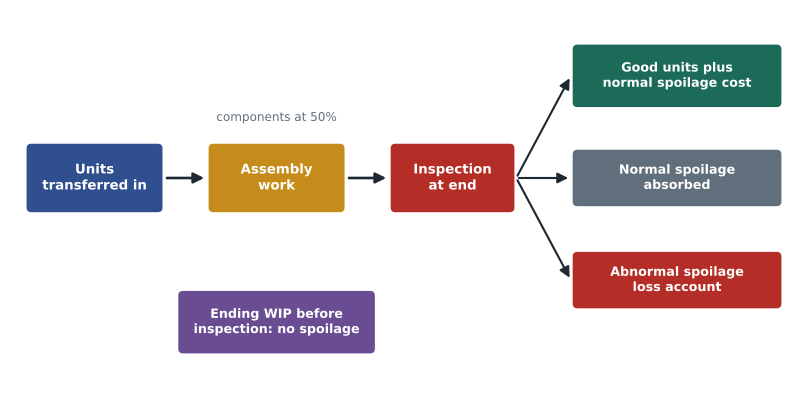
Normal spoilage is usually expressed as a percentage of good units passing inspection, not of total units, because the inspection point is where good and bad units are separated. Halden's assembly department pressure-tests every S-100 pump at the end of assembly. Engineering studies show that, with the current seal design and test rig, about 2 per cent of the good units passing the test will be accompanied by spoiled units that fail it. So if 19,000 good pumps pass in a month, normal spoilage is 2% × 19,000 = 380 units. Any spoilage beyond that is abnormal.
The inspection point matters for two reasons. First, spoiled units are counted in equivalent units only up to the inspection point, because no further work is done on them. Second, the cost of normal spoilage is assigned only to the good units that have passed the inspection point during the period. Units in ending work in process that have not yet reached inspection carry no share of normal spoilage, because they may yet turn out to be spoiled themselves.
Spoilage in a process costing report
November data for the assembly department are shown below. The department uses the weighted-average method; the same logic applies under FIFO, with equivalent units counting only current-period work.
| Item | Units | Transferred-in | Components | Conversion |
|---|---|---|---|---|
| Beginning WIP, 1 November (60% converted) | 1,000 | $86,000 | $47,000 | $13,800 |
| Received from casting | 20,000 | $1,720,000 | ||
| Good units completed | 19,000 | |||
| Spoiled units (found at final inspection) | 600 | |||
| Ending WIP, 30 November (40% converted) | 1,400 | |||
| Costs added in November | $900,000 | $470,000 |
Worked problem
Equivalent units with spoilage
Compute weighted-average equivalent units, including spoiled units.
Show solution
- Spoiled units reached the end of the process before inspection, so they count as complete in every category: 600 transferred-in, 600 components, 600 conversion.
- Transferred-in: 19,000 good + 600 spoiled + 1,400 ending = 21,000.
- Components: 19,000 + 600 + 0 (ending WIP at 40 per cent has not reached the 50 per cent point) = 19,600.
- Conversion: 19,000 + 600 + 1,400 × 40% = 20,160.
- Normal spoilage = 2% × 19,000 good units = 380; abnormal spoilage = 600 − 380 = 220.
Answer: Equivalent units are 21,000, 19,600 and 20,160; of the 600 spoiled units, 380 are normal and 220 abnormal.
# Assembly department, November: spoilage under weighted average (illustrative)
good, spoiled, end, end_pct = 19_000, 600, 1_400, 0.40
normal_rate = 0.02
costs = {"TI": 86_000 + 1_720_000, "components": 47_000 + 900_000,
         "conversion": 13_800 + 470_000}
eu = {"TI": good + spoiled + end,
      "components": good + spoiled + 0,          # ending WIP before the 50% point
      "conversion": good + spoiled + end * end_pct}
rate = {k: costs[k] / eu[k] for k in costs}
unit = sum(rate.values())
normal = round(normal_rate * good)
abnormal = spoiled - normal
for k in costs:
    print(f"{k:<11} cost {costs[k]:>10,}  EU {eu[k]:>7,.0f}  per EU {rate[k]:8.4f}")
print(f"Cost of a complete unit: {unit:.4f}")
good_cost = good * unit
normal_cost = normal * unit
abnormal_cost = abnormal * unit
ending = end * rate["TI"] + end * end_pct * rate["conversion"]
print(f"Good units {good_cost:,.0f} + normal spoilage {normal_cost:,.0f} "
      f"= transferred out {good_cost + normal_cost:,.0f} "
      f"({(good_cost + normal_cost) / good:.2f} per good pump)")
print(f"Abnormal spoilage loss {abnormal_cost:,.0f}")
print(f"Ending WIP {ending:,.0f}")
print(f"Check: {good_cost + normal_cost + abnormal_cost + ending:,.0f} "
f"= {sum(costs.values()):,}")TI cost 1,806,000 EU 21,000 per EU 86.0000 components cost 947,000 EU 19,600 per EU 48.3163 conversion cost 483,800 EU 20,160 per EU 23.9980 Cost of a complete unit: 158.3143 Good units 3,007,973 + normal spoilage 60,159 = transferred out 3,068,132 (161.48 per good pump) Abnormal spoilage loss 34,829 Ending WIP 133,839 Check: 3,236,800 = 3,236,800
Each complete unit costs about $158.31: $86.00 of casting cost, $48.32 of components and $24.00 of assembly conversion. The 19,000 good pumps cost about $3,007,973 on their own; adding the $60,159 cost of the 380 normally spoiled units gives about $3,068,132 transferred to finished goods, or about $161.48 per good pump. The extra $3.17 per pump is the cost of the normal spoilage that the process inevitably generates. The 220 abnormally spoiled pumps, costing about $34,829, are charged to a Loss from Abnormal Spoilage account and reported to the plant manager. Ending work in process of about $133,839 carries no spoilage cost because it has not yet been inspected.
If the spoiled units have a salvage value, for example because the motors can be recovered, the recoverable amount is recorded as inventory (or as a receivable if the units are sold immediately) and deducted from the cost of spoilage before the remainder is assigned. Suppose each spoiled pump yields a motor worth $40. Normal spoilage cost would then be 380 × ($158.31 − $40) ≈ $44,958, and the abnormal loss would be 220 × ($158.31 − $40) ≈ $26,029.
When inspection happens part-way through
Many plants inspect at an earlier point to avoid adding more work to units that are already bad. Suppose Halden moved the pressure test to the 50 per cent point, just before the components are added. Spoiled units would then count as 50 per cent complete for conversion and would receive no components. More importantly, ending work in process at 70 per cent complete would have passed inspection, so it would share in the cost of normal spoilage along with the units completed. The normal spoilage cost is spread over all good units that passed inspection this period, in proportion to their number.
Moving inspection earlier is often worthwhile even if it adds testing cost, because every spoiled unit caught early saves the components and conversion that would otherwise be wasted on it. In Halden's case each pump caught before components are added saves about $48 of components and about $12 of assembly conversion. With 600 spoiled pumps a month, that is roughly $36,000 a month, which could pay for a second test rig. Cost systems that report spoilage separately make this kind of analysis possible.
Spoilage in job costing
Job costing distinguishes three cases. When normal spoilage arises because of the specific requirements of a particular job, such as unusually tight tolerances requested by a customer, its cost (net of any disposal value) stays with that job. When normal spoilage is common to all jobs, because it is inherent in the process, it is budgeted into the predetermined overhead rate, and actual normal spoilage is charged to manufacturing overhead control rather than to the job on which it happened to occur; every job then bears a share through applied overhead. Abnormal spoilage is charged to a loss account in both cases.
Worked problem
Spoilage on a C-900 custom job
Job C-917 for a water utility called for five C-900 pumps with an unusually tight impeller balance specification. One pump failed final testing after incurring $1,640 of cost. Its motor and frame can be recovered for $420. How should the spoilage be recorded (a) if the failure is due to the job's special specification, (b) if it reflects the normal failure rate for all custom jobs, and (c) if it occurred because a technician used the wrong balancing weights?
Show solution
- Net cost of the spoiled pump = $1,640 − $420 = $1,220. In every case the $420 recovered goes to materials inventory.
- (a) Job-specific normal spoilage: the $1,220 remains in Job C-917, so the job's good pumps carry it.
- (b) Normal spoilage common to all jobs: credit Job C-917 for $1,640, debit materials inventory $420 and manufacturing overhead control $1,220. The overhead rate was set to include an allowance for such failures.
- (c) Abnormal spoilage: credit Job C-917 for $1,640, debit materials inventory $420 and Loss from Abnormal Spoilage $1,220.
Answer: The treatment depends on whether the spoilage is normal and whether it belongs to the job or to all jobs.
Rework
Rework follows the same three-way logic. Halden's P-300 pumps occasionally leak at a seal joint during the pressure test; a technician disassembles the joint, replaces the seal and retests the pump, at an average rework cost of $45. Normal rework common to all P-300 production is charged to manufacturing overhead and spread through the overhead rate. Rework caused by a particular job's specifications is charged to that job. Abnormal rework, such as a whole batch reworked because the wrong seal compound was used, is charged to a loss account.
Rework raises a decision question as well as an accounting one: is it worth repairing a defective unit, or should it be scrapped? The relevant comparison is the additional cost of rework against the additional value of a good unit compared with a defective one. Costs already incurred on the unit are sunk and irrelevant to this choice, although they matter for evaluating the process.
# Rework or scrap? Relevant analysis for a leaking P-300 pump (illustrative)
rework_cost = 45          # seal, technician time and retest
good_value = 390          # net selling price of a good P-300 to a dealer
salvage_value = 110       # recovered motor and housing if scrapped
sunk_cost = 304           # cost already in the pump (irrelevant to the decision)

gain_from_rework = (good_value - rework_cost) - salvage_value
print(f"Rework: receive {good_value - rework_cost} net; scrap: receive {salvage_value}")
print(f"Advantage of reworking: ${gain_from_rework}")
print(f"(Sunk cost of ${sunk_cost} is the same either way and is ignored.)")

# Capacity matters: if rework uses a bottleneck test rig, include the
# contribution of the good pump that could have been tested instead.
lost_contribution = 120
print(f"Advantage if the test rig is a bottleneck: ${gain_from_rework - lost_contribution}")Rework: receive 345 net; scrap: receive 110 Advantage of reworking: $235 (Sunk cost of $304 is the same either way and is ignored.) Advantage if the test rig is a bottleneck: $115
Reworking a leaking P-300 is clearly better than scrapping it when capacity is plentiful: the company gains $235 compared with selling the parts for salvage. If the test rig is a bottleneck, however, each hour spent retesting a reworked pump is an hour not spent testing a new one, and the contribution of the displaced pump becomes an opportunity cost of rework. The analysis then narrows to $115 in favour of rework. ACCT-102 lesson 9 developed this kind of constrained-resource reasoning; it applies equally to quality decisions.
Scrap
Scrap has some value, but much less than the main product. The accounting questions are when to recognize its value and how to credit it. There are two broad approaches. Under the first, scrap is recognized when it is sold: the proceeds are credited to the specific job if scrap can be traced to it, to manufacturing overhead if it is common to all jobs, or simply to other income if amounts are immaterial. Under the second, scrap is recognized when it is produced: it is recorded as inventory at its net realizable value, with the same credit to the job or to overhead, and production costs are reduced immediately. The second approach is preferred when scrap is valuable or held for a long time, because it puts the scrap under inventory control.
Halden's foundry produces runners, risers and sprues each time it pours castings, along with machining chips from the machine shop. The foundry melts most of its own returns, which reduces purchases of alloy, while machining chips are sold to a metals recycler. For the S-100 line, chips are worth about $1.80 per pump at current metal prices. Because the amounts are material over a year (about $36,000 for 20,000 pumps) and the chips are stored in bins until a full truckload is ready, Halden records them as inventory at estimated net realizable value when they are produced and credits manufacturing overhead.
| Item | Treatment of cost | Treatment of recovery |
|---|---|---|
| Normal spoilage, process costing | Added to the cost of good units passing inspection | Disposal value deducted before assignment |
| Normal spoilage, job-specific | Remains in the job | Credited to the job |
| Normal spoilage, common to all jobs | Charged to manufacturing overhead | Credited to overhead |
| Abnormal spoilage | Loss account in the period | Deducted from the loss |
| Rework | Same three-way split: job, overhead or loss | Not applicable |
| Scrap | No cost assigned | Credited to job, overhead or revenue, at sale or at production |
Making the costs of poor quality visible
The most important managerial point about spoilage accounting is visibility. If all spoilage were folded into the cost of good units, a plant could gradually lose control of quality while reported unit costs crept up for no apparent reason. Separating normal from abnormal spoilage, and reporting abnormal spoilage as a distinct loss, puts the problem in front of the managers who can fix it. Setting the normal rate is therefore a management decision with consequences: a generous normal rate hides waste, while a rate set at a world-class level that the plant cannot yet reach labels routine losses as abnormal and may demoralize supervisors.
Many companies now aim for the normal rate itself to fall over time, through better design, mistake-proofing and process control. Lesson 11 places spoilage and rework within a broader cost of quality report, which groups prevention, appraisal, internal failure and external failure costs and shows how spending on prevention can reduce total quality costs. Halden's pressure test is an appraisal cost; the spoiled and reworked pumps are internal failure costs; and pumps that fail in customers' buildings, generating warranty calls for Halden Service, are external failure costs, often the most expensive of all.
Common mistakes
MistakeCalculating normal spoilage as a percentage of all units started.
InsteadBase the normal rate on good units passing inspection, as engineering standards specify.
MistakeAssigning normal spoilage cost to ending WIP that has not reached inspection.
InsteadOnly good units that have passed the inspection point share normal spoilage cost.
MistakeIncluding abnormal spoilage in the cost of finished goods.
InsteadRecognize abnormal spoilage as a loss in the period; IFRS, ASPE and US GAAP all exclude abnormal waste from inventory.
MistakeCounting the cost already incurred when deciding whether to rework.
InsteadPrior costs are sunk; compare the cost of rework with the extra value of a good unit over salvage.
MistakeCharging common normal spoilage to whichever job it happened on.
InsteadCharge common normal spoilage to overhead so that all jobs share it through the overhead rate.
Summary and key terms
- Spoilage is unacceptable units that are discarded or sold cheaply; rework is repaired units; scrap is low-value residual material.
- Normal spoilage is inherent in an efficient process and becomes part of the cost of good units; abnormal spoilage is a period loss.
- Normal spoilage is usually a percentage of good units passing inspection, and spoiled units count in equivalent units up to the inspection point.
- Only good units that have passed inspection, including ending WIP beyond the inspection point, share the cost of normal spoilage.
- In job costing, job-specific normal spoilage stays with the job, common normal spoilage goes to overhead and abnormal spoilage is a loss.
- Rework decisions compare the cost of rework with the extra value gained, ignoring sunk costs but including opportunity costs on bottlenecks.
- Scrap can be recognized at sale or at production; separating these costs makes poor quality visible.
- Spoilage
- Units that fail to meet specifications and are discarded or sold for reduced prices.
- Normal spoilage
- Spoilage inherent in a process operated efficiently; part of the cost of good units.
- Abnormal spoilage
- Spoilage that would not arise under efficient conditions; recognized as a loss.
- Rework
- Defective units repaired and sold as acceptable finished goods.
- Scrap
- Residual material with low sales value compared with the main product.
- Inspection point
- The stage of production at which good and spoiled units are identified.
- Disposal value
- The amount recoverable from spoiled units, deducted from spoilage cost.
- Net realizable value
- Estimated selling price less costs to complete and sell.
- Internal failure cost
- The cost of defects found before products reach customers.
- Loss from abnormal spoilage
- The account charged with the cost of abnormal spoilage.
Practice problems
Work each problem on paper first, then reveal the answer to check.
A department completes 40,000 good units and the normal spoilage rate is 1.5 per cent of good units. Spoilage found is 800 units. Split it into normal and abnormal.
Show answer
Normal 600; abnormal 200.
A complete unit costs $25 and inspection is at the end. What is the abnormal loss for the previous question?
Show answer
200 × $25 = $5,000.
If spoiled units can be sold for $6 each, what is the normal spoilage cost added to good units?
Show answer
600 × ($25 − $6) = $11,400.
Inspection occurs at 60 per cent. Ending WIP is 50 per cent complete. Does it share normal spoilage?
Show answer
No, it has not passed inspection.
If ending WIP were 80 per cent complete with inspection at 60 per cent, would it share normal spoilage?
Show answer
Yes, because it has passed inspection.
A custom job's customer demanded tolerances that cause extra failures. Where does the normal spoilage cost go?
Show answer
To the specific job.
Rework costs $30, a good unit sells for $150 and a defective unit can be salvaged for $70. Should the unit be reworked?
Show answer
Yes: rework yields $120 net versus $70, a $50 advantage.
In the previous question, the rework uses a bottleneck that would otherwise earn $60 of contribution. Decide again.
Show answer
Scrap: the $50 advantage becomes a $10 disadvantage.
Halden records machining chips as inventory when produced. Give the entry for $3,000 of chips common to all jobs.
Show answer
Debit scrap inventory $3,000; credit manufacturing overhead control $3,000.
Why might a plant manager prefer a generous normal spoilage rate, and why is that a problem?
Show answer
It makes performance look better by hiding waste in product costs; it reduces visibility and incentive to improve quality.
Lesson quiz · 5 questions
Score 60% or more to complete this lesson.
Create a free account to save your progress, take quizzes and earn a certificate.