
WLD-330 · Lesson 5 of 12 · 17 min
Welder performance qualification and continuity
A qualified procedure proves that a weld can be made; a welder qualification proves that a particular person can make it. Devon has taken several tests in the last three years, and his cards and records sit in a binder in Lucia's office. In this lesson he learns what each of those records actually allows him to weld, how long it lasts, and what happens when it lapses. Lucia hands him the binder on Monday and asks him to write, on one page, every process, position, thickness and diameter he may weld in production today, under which code, and when each one will expire. It takes him most of the afternoon and two questions to Elena.
Why welders are qualified separately
The procedure test shows that the variables on the sheet produce a sound weld in the hands of a competent welder. It does not show that every welder in the shop is competent in every position. Welder qualification tests a person's skill with a process, in a position, on a joint type and within a range of thickness and diameter. The test is usually harder than most production work: a groove weld in a difficult position, examined by bending or radiography, so that a welder who passes can be trusted with the easier welds the test covers. The record of the test lists what was done and what it qualifies.
The codes differ in who keeps the qualification. Under AWS D1.1 and ASME Section IX, the employer, or the contractor, qualifies its own welders and keeps the records, and an inspector reviews them; a qualification is not a personal license. AWS also runs a Certified Welder program at accredited test facilities, whose results a contractor can accept if its code allows. A welder who changes employers may need to requalify unless the new employer accepts the previous records under the code's rules, which Section IX allows when the records are properly transferred.
What a test qualifies
Each code sets out the essential variables for welders, which are different from the procedure's. For a welder, the things that matter are the process, the position and progression, the type of joint, whether backing is used, the filler group, the deposited weld metal thickness and, for pipe, the diameter. A change in any of these beyond the range the test covers needs a new test. Changes that matter for the procedure, such as the steel's strength or the preheat, usually do not matter for the welder, because they do not change the skill needed.
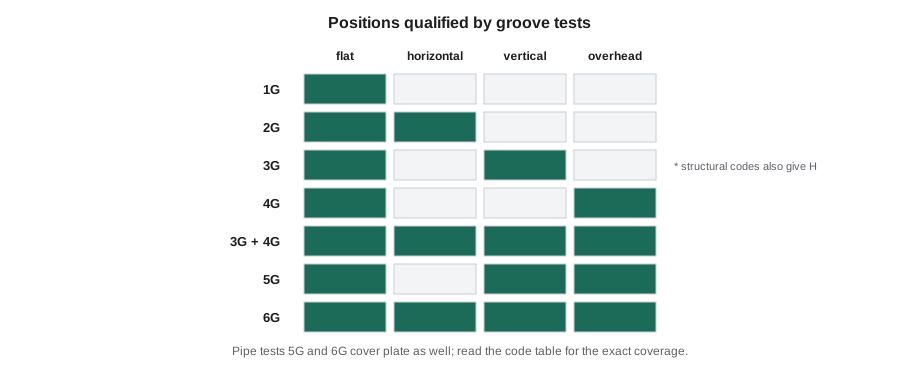
Positions are the variable welders talk about most. A groove test in the flat position qualifies flat only. Horizontal qualifies flat and horizontal. Vertical and overhead each qualify their own position and flat, with the codes differing on whether vertical also covers horizontal. Passing both vertical and overhead plate tests qualifies all positions on plate, and the fixed pipe test at 45 degrees, the 6G, qualifies all positions on pipe and plate. Groove qualifications also cover fillet welds in the positions qualified, but fillet tests cover only fillets.
Thickness and diameter
For a welder, thickness means the deposited weld metal, not the plate. A test in which the welder deposits a thin layer qualifies up to about twice that thickness; a test of enough thickness, with the required number of layers, qualifies any thickness. For pipe, a small-diameter test is needed to weld small pipe, because the skill of welding around a tight curve does not follow from welding plate or large pipe. Codes set diameter breakpoints: a test on small pipe qualifies that size and larger, and a test on larger pipe qualifies down to a stated diameter only. Devon met this in the pipe course, when his 6G test on larger pipe did not cover the small-bore lines and he took a separate small-pipe test.
# What a welder's groove test qualifies (general pattern of the codes; read the real tables before relying on it)
U = 'in'
POS = {'1G': {'F'}, '2G': {'F', 'H'}, '3G': {'F', 'V'}, '4G': {'F', 'O'},
       '5G': {'F', 'V', 'O'}, '6G': {'F', 'H', 'V', 'O'}}

def thickness_qualified(t_dep, layers):
    return 'unlimited' if t_dep >= 0.5 and layers >= 3 else round(2 * t_dep, 2)

def diameter_qualified(od):
    if od < 1:
        return f'{od} {U} and over'
    if od < 2.875:
        return f'{1} {U} and over'
    return f'{2.875} {U} and over'

tests = [('plate test', 'SMAW', '3G', 0.375, 4, None), ('plate test', 'SMAW', '4G', 0.375, 4, None), ('6G pipe', 'SMAW', '6G', 0.562, 5, 6.625), ('small bore', 'GTAW', '6G', 0.154, 2, 2.375)]
allowed = set()
for name, proc, pos, t_dep, layers, od in tests:
    allowed |= POS[pos]
    line = f"{name:<12} {proc:<6} {pos}: positions {''.join(sorted(POS[pos]))}, thickness up to {thickness_qualified(t_dep, layers)}"
    if od:
        line += f", pipe {diameter_qualified(od)}"
    print(line)
print('positions covered by all tests together:', ''.join(sorted(allowed)))plate test SMAW 3G: positions FV, thickness up to 0.75 plate test SMAW 4G: positions FO, thickness up to 0.75 6G pipe SMAW 6G: positions FHOV, thickness up to unlimited, pipe 2.875 in and over small bore GTAW 6G: positions FHOV, thickness up to 0.31, pipe 1 in and over positions covered by all tests together: FHOV
The output lists what each of Devon's tests covers and what they cover together. His small-bore test deposited only 0.154 in of weld metal in two layers, so it qualifies him for twice that thickness on small pipe, which is enough for the instrument tubing and drains he welds. The breakpoints in the program follow the general pattern in Section IX; the actual values are in its tables, and structural codes have their own.
Testing methods for welders
Welder tests are judged by visual examination and then either by bending specimens or by radiography or ultrasonics, as the code allows. Bend tests stretch the weld and show lack of fusion, slag and porosity as open cracks on the bent surface; the codes limit the size of any opening and the total of all openings. Radiography can replace bends for many groove tests and shows the whole weld, but it does not show some kinds of lack of fusion well and is not allowed for every process. Fillet tests use a fillet break test or macro-etch sections. A welder who fails may retest under conditions the code sets, usually an immediate retest of two coupons or a retest after further training.
The test has to be run properly to mean anything. The coupon is marked with the welder's identification and the position, and the top of a pipe coupon is stamped so that specimens can be taken from the right places. The welder works to a procedure, usually a qualified or prequalified one. The person who witnesses the test checks that the welder makes the whole weld, keeps the coupon in position, does not repair it except as allowed, and cleans only as the procedure permits. Lucia has turned away a coupon because the welder rotated the pipe between passes; a 6G test that is not fixed is not a 6G test.
Continuity and expiry
A qualification does not last forever. Under D1.1 and Section IX, a welder's qualification stays in force while the welder keeps using the process; it lapses if the welder has not welded with that process for six months, and it can be revoked at any time if there is a specific reason to question the welder's ability, such as a run of rejected welds. AWS Certified Welder cards have their own maintenance rules. Hartwell's records show the date each welder last used each process, and Lucia updates them every month from the weld logs.
Continuity is easy to lose by accident. A welder who moves to fitting for a winter, or who spends months welding with one process and none with another, may find that a qualification has lapsed without anyone noticing. The codes allow continuity to be shown by records of production welding with the process, which is why every weld record names the welder. Hartwell's system flags any welder within a month of a six-month gap, so that Glen can schedule some production welding with that process or a retest before it lapses.
# Continuity tracker: flag qualifications near or past a six-month gap
from datetime import date, timedelta
today = date(2026, 11, 2)
GAP = 182   # days, about six months
WARN = 30   # flag a month before the gap is reached
records = [
    # welder, process, last production use
    ('Devon Okafor', 'SMAW', date(2026, 10, 28)),
    ('Devon Okafor', 'GTAW', date(2026, 9, 14)),
    ('Rob Haldane', 'FCAW', date(2026, 5, 20)),
    ('Rob Haldane', 'SMAW', date(2026, 4, 2)),
    ('Marta Kowalchuk', 'GMAW', date(2026, 6, 8)),
]
for welder, proc, last in records:
    days = (today - last).days
    due = last + timedelta(days=GAP)
    if days > GAP:
        status = f'LAPSED on {due}: retest before welding'
    elif days > GAP - WARN:
        status = f'due {due}: weld with {proc} or schedule a test'
    else:
        status = f'current until {due}'
print(f"{welder:<16} {proc:<5} last used {last} {status}")Devon Okafor SMAW last used 2026-10-28 current until 2027-04-28 Devon Okafor GTAW last used 2026-09-14 current until 2027-03-15 Rob Haldane FCAW last used 2026-05-20 due 2026-11-18: weld with FCAW or schedule a test Rob Haldane SMAW last used 2026-04-02 LAPSED on 2026-10-01: retest before welding Marta Kowalchuk GMAW last used 2026-06-08 current until 2026-12-07
The tracker flags Rob Haldane's stick qualification as lapsed and Marta's gas metal arc qualification as due within the month. Rob spent the summer on the flux-cored erection crew and had not struck a stick electrode since April. He will take a test before welding any pressure joint with that process. Marta will be put on the next gas metal arc job before the end of the month, and the weld log will show the date.
The same lapse would stop Rob welding structural stick welds under D1.1, because D1.1 uses the same six-month rule. Lucia's records keep the processes separate, so his flux-cored qualification, which he has used every week, is unaffected.
Welding operators and tack welders
Codes also qualify people who are not manual welders. A welding operator runs mechanized or automatic equipment, such as a submerged arc tractor or an orbital pipe welder, and is qualified on that equipment rather than on hand skill. A tack welder, who places tack welds that will become part of the finished weld, must be qualified at least for tacking, though usually with a simpler test. Newer code editions also add rules for robotic welding, covering the people who program and run the robot cell. The idea is the same in every case: anyone whose work becomes part of the weld has shown that they can do it.
Keeping the records
A qualification record must show the welder's name and identification, the date, the procedure followed, every essential variable as it was in the test, the tests made and their results, and what the test qualifies. It is signed by the person responsible for the shop's welding. Production records then link each weld to a welder who was qualified at the time. An inspector checking a weld can follow the chain: weld number on the weld map, welder's stamp or identification on the weld, welder's qualification record, and the continuity log that shows the qualification was in force.
When a welder fails a test
Failing a qualification test is common, and the codes plan for it. A welder who fails may usually retest at once by welding two coupons, both of which must pass, or may retest later after further training or practice, with a single coupon. The rules differ between codes and editions, so Lucia reads the retest clause before she lets anyone take a second coupon. What she will not allow is a retest without a reason to expect a different result: if a bend opened at a slag line from poor cleaning, the welder practices cleaning first; if the root was short of fusion, the welder runs practice roots until Marta is satisfied.
A failed test is also information. Hartwell records the reason for every failed coupon, and over a year the reasons show where training is weak. In Devon's second year the list showed that most failures were at tie-ins in vertical roots, so Marta added an hour of tie-in practice to every apprentice's week, and the failure rate on vertical roots fell by half the next year. The test does not only judge the welder; it helps the shop teach.
Common mistakes
MistakeThinking a plate test covers small-diameter pipe.
InsteadSmall pipe needs a test on small pipe; check the diameter range.
MistakeMeasuring qualified thickness from the plate thickness.
InsteadFor welders, the range comes from the deposited weld metal thickness.
MistakeAssuming a qualification lasts until the card expires.
InsteadPressure and D1.1 qualifications lapse after six months without using the process.
MistakeRotating a pipe coupon during a fixed-position test.
InsteadA fixed-position test must stay fixed, or it does not qualify the position.
MistakeKeeping no record of production welding by process.
InsteadContinuity is proved by production records that name the welder and process.
Summary and key terms
- Welder qualification tests a person's skill with a process, position, joint type and range.
- Welder essential variables differ from procedure essential variables.
- The 6G pipe test qualifies all positions; plate tests qualify their own positions and flat.
- Deposited thickness and pipe diameter set the welder's ranges.
- Qualifications lapse after six months without using the process, or when there is a reason to question them.
- Records link every weld to a welder who was qualified at the time.
- Welder qualification
- Proof by test that a person can make sound welds within a stated range.
- Continuity
- Evidence that a welder has kept using a process often enough to stay qualified.
- 6G
- A fixed pipe test with the axis at 45 degrees, qualifying all positions.
- Deposited thickness
- The thickness of weld metal the welder deposits in the test, which sets the range qualified.
- Welding operator
- A person qualified to run mechanized or automatic welding equipment.
- Check test
- A shorter test that renews a qualification before it expires.
Practice problems
Work each problem on paper first, then reveal the answer to check.
A welder passed 3G and 4G plate tests. Which positions may he weld on plate?
Show answer
All positions on plate.
Rob last used SMAW in April. It is November. Can he weld a D1.1 SMAW joint?
Show answer
No; the six-month gap has passed, so he must requalify.
A small-bore test deposited 0.154 in of weld metal in two layers. What thickness is qualified?
Show answer
Up to about 0.31 in.
Lesson quiz · 5 questions
Score 60% or more to complete this lesson.
Create a free account to save your progress, take quizzes and earn a certificate.