
WLD-330 · Lesson 1 of 12 · 18 min
How welding codes, standards and specifications work
Devon Okafor has spent three years learning to make welds that pass. In his last level at Hartwell Fabrication he learns how the people who decide whether a weld passes do their work. Elena Marchetti, the shop's welding engineer, runs an evening block on codes and qualification, and Lucia Ferreira, the inspector who has tested every coupon he has broken, takes him around the shop on her inspection rounds two mornings a week. Elena opens the first class by putting the job book for the Riverside pedestrian bridge on the table: a contract, a specification, forty drawing sheets, a welding standard, a stack of procedure sheets and a quality manual. “Every one of these tells you something about the same weld,” she says. “Your job this term is to learn which one to open, what it can and cannot tell you, and what to do when two of them disagree.” This lesson sets out what codes, standards and specifications are, how they are given legal force, how editions work, and how the documents on a job fit together.
Codes, standards, specifications and practices
The words are often used loosely on the shop floor, but they mean different things. A standard is a document, written by a recognized standards body through a consensus process, that sets requirements or gives methods for a product, process or service. A code is a standard written so that it can be adopted into law or into a contract: it uses mandatory language and covers a whole class of work, such as the welding of steel structures or the construction of boilers. A specification is a document written for a particular purchase or project that states what the buyer requires; it often calls up codes and standards and adds to them. A recommended practice or guide gives advice and accepted methods but does not by itself require anything.
Language matters in these documents. “Shall” means a requirement; “should” means a recommendation; “may” means a permission. A welder reading a code clause that says the root opening shall not exceed a value is reading a limit; one that says the root should be back-gouged is reading advice that a specification or procedure may turn into a requirement. Notes, figures marked as informative and annexes labeled non-mandatory explain and help but do not add requirements, unless the job's specification makes them mandatory.
| Document | Written by | Purpose | Example on Hartwell's jobs |
|---|---|---|---|
| Code | Standards body, by consensus | Mandatory requirements for a class of work | AWS D1.1 for structural welding of steel |
| Standard | Standards body | Requirements or methods for a product or process | AWS A5.1 for filler metals |
| Specification | Owner or engineer, for one project | What this buyer requires on this job | The Riverside bridge project specification |
| Recommended practice or guide | Standards body or industry group | Accepted methods and advice | A guide to weld inspection practice |
| Procedure | The fabricator | How the shop will make a particular weld | A welding procedure specification |
How a code gets the force of law
A code on its own is only a book. It becomes binding in one of two ways: a government adopts it by reference in a law or regulation, or a contract calls it up. In the United States, most states and cities adopt the International Building Code, which refers to the AISC steel specifications, and those require structural welding to AWS D1.1. A fabricator welding structural steel for a building in Texas is therefore working to D1.1 because the adopted building code requires it, not just because the engineer wrote it down. Pressure equipment works the same way through a different chain: states adopt the ASME Boiler and Pressure Vessel Code and the National Board Inspection Code in their boiler laws, and state inspectors or authorized inspection agencies enforce them.
Contracts add a second layer. An owner can require a code that no law requires, such as a refinery that insists its piping be welded to ASME B31.3 and that every welder be qualified under ASME Section IX, or an owner that calls for extra testing beyond the code. Where a contract and a law both apply, the fabricator must meet both, and the stricter requirement governs in practice. Where a contract asks for less than the law requires, the law still applies.
Editions, addenda and interpretations
Codes are revised on a cycle, usually every few years, and each edition is identified by its year. The edition that applies to a job is not necessarily the newest one. A building code adopts a particular edition of each standard it references, and a contract usually names an edition or says “the edition in force on the date of the contract.” A shop that builds to the edition on its own shelf, rather than the one the job requires, can be wrong in either direction: a newer edition may relax a rule the job's edition still enforces, or tighten one the job does not require. The first thing Lucia checks when a new job arrives is the edition list in the specification, and the shop keeps the older editions it still works to.
Between editions, standards bodies issue errata, addenda and formal interpretations. AWS publishes interpretations of D1.1 in response to written inquiries, and ASME publishes interpretations of each section of the Boiler and Pressure Vessel Code. An interpretation explains what an existing requirement means; it does not change the requirement. A shop that has a real question about a clause can submit an inquiry, but it must keep working to its best reading of the code, or ask the engineer of record, while it waits.
Codes also allow for things their writers did not foresee. Most structural and pressure codes let the engineer of record or the authority having jurisdiction accept an alternative that gives equal safety, provided it is documented and approved. This is not a loophole for convenience; it is how new processes and materials enter practice before the next edition catches up. On the shop floor the rule is simple: an alternative is accepted only when it is accepted in writing by the person the code names.
The documents on one job
Elena walks the class through the Riverside job book. The contract names the owner, the general contractor and Hartwell, and lists the documents that form part of the agreement. The project specification has a section on structural steel that names the welding code and edition, the inspection the owner will do, the extra non-destructive testing it wants, and the documents Hartwell must submit before welding starts. The drawings show each weld with a welding symbol, the material grades and the tolerances. Hartwell's own documents complete the stack: the quality manual, the procedure sheets for each process and joint, the welder qualification records and the inspection and test plan.
Each document answers different questions. The drawing says what weld goes where and how big it is. The code says what that weld must be made with, how the procedure and welder must be qualified, and what the finished weld must look like to be accepted. The specification says what the owner requires beyond the code, such as ultrasonic testing of all flange splices instead of a sample. The procedure specification says exactly how Hartwell will make that weld: process, filler, current range, preheat and passes. The inspection and test plan says who checks what, when and against which document.
| Question | Document that answers it |
|---|---|
| What size is this weld and where is it? | Drawings, welding symbol |
| How must the procedure and the welder be qualified? | Code (AWS D1.1) |
| What does an acceptable weld look like? | Code acceptance criteria, unless the specification is stricter |
| What testing does the owner want? | Project specification and contract |
| How will this shop make this joint? | Hartwell's welding procedure specification |
| Who checks it, and when? | Inspection and test plan, quality manual |
Order of precedence and conflicts
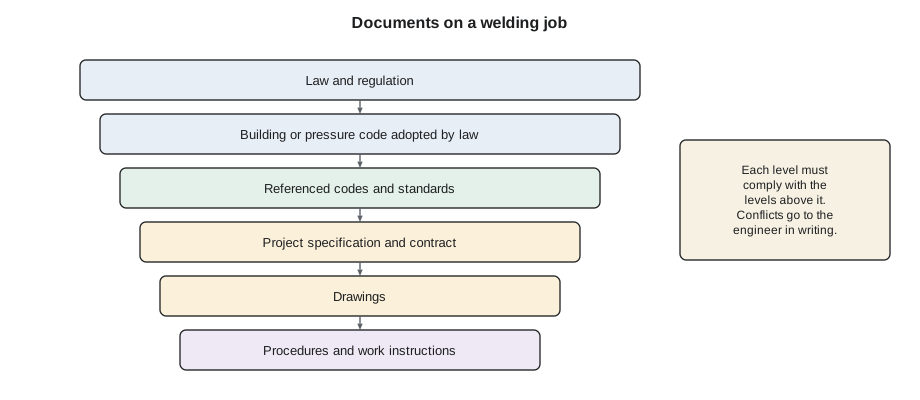
Documents sometimes disagree. A drawing may show a fillet size smaller than the code minimum for the plate thickness, or the specification may call for an inspection method the code does not describe for that joint. Contracts usually include an order of precedence that says which document governs when two conflict, typically the contract itself first, then the specification, then the drawings, with the referenced codes setting a floor below which nothing may go. The order of precedence settles which document wins on paper; it does not let a shop quietly pick the easier one. Hartwell's rule, written in its quality manual, is that any conflict found on a job is raised in writing as a request for information to the engineer of record, and work on the affected weld waits for the answer.
Lucia shows Devon an example from the bridge. Sheet S-14 shows a 3/16 in fillet joining a 1 in bearing stiffener to a 7/8 in web. The code's table of minimum fillet sizes calls for a larger weld on that thickness unless the procedure uses enough preheat to avoid cracking. Raj Bhullar, the detailer, had copied the size from an earlier job with thinner plate. The question went to the engineer as a request for information, the answer came back the next day raising the weld to the code minimum, and the drawing was revised. Nobody on the shop floor decided the answer; they only made sure the question was asked.
# Order of precedence: which document governs each item on a job
precedence = ['contract', 'specification', 'drawings', 'shop procedure']
floor = 'code'   # the referenced code sets the minimum; nothing may go below it

items = [
    # item, {document: value}, code minimum, larger is stricter?
    ('fillet on stiffener (in)', {'drawings': 0.1875}, 0.3125, True),
    ('UT of flange splices (%)', {'specification': 100, 'shop procedure': 25}, 0, True),
    ('preheat for thick plate (deg F)', {'shop procedure': 150}, 150, True),
]
for name, values, code_min, bigger_is_stricter in items:
    governing = next(d for d in precedence if d in values)
    v = values[governing]
    low = (v < code_min) if bigger_is_stricter else (v > code_min)
    if low:
        print(f"{name}: {governing} gives {v}, below the code minimum {code_min} -> raise a request for information")
    else:
print(f"{name}: {governing} governs with {v} (code minimum {code_min}) -> ok")fillet on stiffener (in): drawings gives 0.1875, below the code minimum 0.3125 -> raise a request for information UT of flange splices (%): specification governs with 100 (code minimum 0) -> ok preheat for thick plate (deg F): shop procedure governs with 150 (code minimum 150) -> ok
The program picks the governing document for each item from the order of precedence and compares it with the code floor. The fillet on the stiffener fails the comparison, so it becomes a request for information; the owner's specification asks for more ultrasonic testing than Hartwell's procedure planned, and the specification governs; the preheat in the shop procedure meets the code minimum. Real conflicts are rarely this tidy, but the habit of asking which document governs, and whether it meets the floor, is the same.
Who does what under a code
Codes assign duties to named parties, and much of the confusion on jobs comes from forgetting who owns which decision. The engineer of record designs the structure, specifies the welds and approves alternatives and repairs to members. The fabricator or contractor is responsible for making welds that meet the code, for qualifying its procedures and welders, and for its own inspection, often called fabrication or contractor's inspection. The owner, or an inspector acting for the owner, may do verification inspection to confirm the fabricator's work; this does not relieve the fabricator of its own duty. For pressure equipment there is a further party, the authorized inspector or safety codes officer, who must accept the work before it can be stamped or registered.
At Hartwell, Lucia does the fabricator's inspection and signs the inspection records. On the Riverside bridge the owner's inspector, from an engineering firm hired by the city, visits weekly and witnesses the ultrasonic testing of the flange splices. On pressure work for the refinery, the authorized inspector from the refinery's inspection agency must see certain hold points before a vessel can be stamped. Devon learns to ask, at every hold point on the inspection and test plan, who must be there and who signs.
Reading a code
Codes are long and densely cross-referenced, and nobody reads them front to back. The skill is finding the clause that governs a question and reading it with the clauses it points to. Elena gives the class a method. Start from the scope at the front, to make sure the code covers the work at all. Use the table of contents to find the part that covers the topic, such as qualification, fabrication or inspection. Read the clause and every clause, table and figure it refers to. Check the definitions, because ordinary words often have narrow meanings in a code. Check whether the clause applies to all structures or only to some, such as statically loaded or cyclically loaded ones. Then check the project specification for anything that changes it.
She also warns against two habits. The first is quoting a code from memory or from a summary; the book on the shelf is the authority, and summaries, including the ones in training courses, simplify. The second is reading only the table. A table of acceptance criteria often has notes and conditions in the clause above it that change how it applies, and the numbers alone can be misread. In this course, code clauses are described in plain words and their numbers are given so that you can find them, but the requirement itself is always what the current edition says.
Common mistakes
MistakeTreating every document as equal.
InsteadUse the contract's order of precedence, and never go below the referenced code.
MistakeWorking to the newest edition on the shelf.
InsteadWork to the edition the job's code or contract names.
MistakeFixing a conflict on the shop floor.
InsteadRaise it in writing to the engineer of record and wait for the answer.
MistakeReading “should” as a requirement.
Instead“Shall” is a requirement; “should” is a recommendation unless the specification makes it mandatory.
MistakeAssuming the owner's inspector replaces the shop's.
InsteadThe fabricator's own inspection is still required.
Summary and key terms
- A code is a standard written for adoption by law or contract; a specification states one buyer's requirements.
- Codes become binding when a law or a contract calls them up.
- The edition that applies is the one the job names, not the newest one.
- An order of precedence settles conflicts on paper, but conflicts are raised in writing, not decided on the floor.
- Engineers, fabricators, owners and authorized inspectors each have duties the code assigns.
- Read a clause with its definitions, cross-references and the project specification.
- Code
- A standard written in mandatory language so that it can be adopted by law or contract.
- Specification
- A document stating the requirements for a particular project or purchase.
- Edition
- A dated version of a code; the job names the edition that applies.
- Order of precedence
- The contract clause that says which document governs when two conflict.
- Engineer of record
- The engineer responsible for the design, who approves alternatives and repairs.
- Verification inspection
- Inspection done for the owner to confirm the fabricator’s own inspection.
Practice problems
Work each problem on paper first, then reveal the answer to check.
A drawing shows a 3/16 in fillet; the code minimum for the thickness is 5/16 in. What do you do?
Show answer
Raise a request for information to the engineer of record and hold the weld until it is answered.
What does “should” mean in a code clause?
Show answer
A recommendation, not a requirement, unless another document makes it mandatory.
Which document tells you how Hartwell will make a particular joint?
Show answer
The welding procedure specification for that joint.
Lesson quiz · 5 questions
Score 60% or more to complete this lesson.
Create a free account to save your progress, take quizzes and earn a certificate.