
WLD-330 · Lesson 12 of 12 · 17 min
Capstone: auditing a fabricator's welding quality program
Hartwell's annual AISC audit is booked for the first week of December, and Elena gives Devon's class a capstone that runs alongside it. Each apprentice prepares one part of the evidence, sits in on the part of the audit that covers it, and writes up the findings and the corrective actions afterward. Devon's part is the welders: their qualifications, their continuity and the match between what each welder is qualified for and what each is welding. Lucia warns him that this is where audits find the most problems, because welders move between jobs every week and the records have to keep up.
Planning the internal audit
A shop should never meet its external auditor without having audited itself first. Hartwell's quality manual calls for an internal audit of each part of the system every year, and the week before the external audit Elena runs one on the welding system with the apprentices as her team. The plan lists what is to be checked, against which requirement, by whom, and how evidence will be chosen. Evidence is chosen by sampling, because nobody can check every weld and every record, and the sample must be random enough that a problem has a fair chance of showing up.
| Area | Requirement | Evidence | Apprentice |
|---|---|---|---|
| Procedures | Approved WPS for every joint welded | Procedures posted at booths against the approved list | Aisha |
| Welders | Qualified for process, position, filler and range; continuity | Qualification records against current work | Devon |
| Consumables | Correct filler, stored and handled to the procedure | Rod ovens, wire storage, certificates | Mateo |
| Inspection | Inspected to the code by certified inspectors | Inspection records, inspector register | Jun |
| Nonconformance | Defects recorded, repaired and closed | Repair log and records | Aisha |
| Calibration | Equipment calibrated and labeled | Meters, gauges, thermometers, yokes | Mateo |
# Draw the audit sample: random welders from the floor and random weld records from each active job
import random
random.seed(20261124)   # recorded on the audit plan so the sample can be reproduced
welders_on_floor = ['M. Kowalchuk', 'R. Haldane', 'D. Okafor', 'K. Mensah', 'S. Bouchard', 'T. Lindgren', 'P. Arsenault', 'J. Whitehorse']
jobs = {'Riverside bridge': 214, 'Coldwater skids': 136, 'Unit 4 spools': 110, 'farm and repair': 18}
pick_welders = random.sample(welders_on_floor, 4)
print('welders to check at their stations:', ', '.join(pick_welders))
for job, n_records in jobs.items():
    k = max(2, round(n_records * 0.03))      # about 3 percent of records, at least 2 per job
    picks = sorted(random.sample(range(1, n_records + 1), k))
print(f"{job:<18} {n_records:>4} weld records -> check {k}: {picks}")welders to check at their stations: D. Okafor, T. Lindgren, M. Kowalchuk, P. Arsenault Riverside bridge 214 weld records -> check 6: [36, 120, 156, 173, 178, 204] Coldwater skids 136 weld records -> check 4: [42, 109, 113, 126] Unit 4 spools 110 weld records -> check 3: [73, 100, 108] farm and repair 18 weld records -> check 2: [3, 8]
The program draws four welders from the eight on the floor and about three percent of the weld records on each active job, at least two from each. Elena writes the random seed on the plan, so that anyone can repeat the selection later and see that nobody picked the easy records. Devon's sample includes K. Mensah, a welder who joined Hartwell six weeks earlier from another shop.
Checking the welders
Devon takes each selected welder in turn. He notes the joint the welder is working on and its WPS, then opens the welder's record. Marta is current in all positions for stick and flux-cored welding, and the weld log shows she used gas metal arc welding last week, which renews her continuity. Rob passed his stick retest two weeks ago after his qualification lapsed, and his record shows the new test. Devon's own record is current. Kofi Mensah's record is the one that stops him. Kofi was hired with qualification records from his previous employer for flux-cored welding in the flat and horizontal positions. On the floor, he is welding vertical gussets on a Coldwater base frame.
Devon checks twice before he says anything: the drawing shows the gussets welded in the vertical position in the fixture, Kofi's record shows no vertical test, and there is no newer record in the office. He tells Lucia, who stops the work at once, tags the base frame on hold and asks Kofi, politely, how he came to be on the job. Kofi had told the foreman of the day that he could weld vertical, which was true: he had welded vertical for years at his old shop. Nobody had checked his record against the job.
The finding is serious, but its consequences are limited if it is handled properly. The welds themselves may be sound; what is missing is the evidence that the welder was qualified to make them. Lucia lists every weld Kofi has made in the vertical position since he started: the weld log shows eleven gusset fillets on two base frames, all statically loaded. Elena decides the disposition with the engineer: each weld is visually reinspected and tested by magnetic particle testing, two are cut out and macro-etched to check fusion, and Kofi takes a vertical test the next morning, witnessed by Lucia as the code allows.
Kofi passes his vertical test. The eleven fillets pass visual and magnetic particle testing, and the two macro-etch sections show full fusion to the root. The welds are accepted with the engineer's written concurrence, and the nonconformance report records the cause, the disposition and the evidence. The base frames are released two days later.
The rest of the internal audit
The other apprentices find smaller things. Mateo finds a clamp-on current meter in the structural bay whose calibration label expired three weeks earlier; it has been used for Lucia's spot checks, so she lists the checks it was used for and repeats two of them with a calibrated meter, which agree. He also finds a two-day gap in the rod oven temperature log over a long weekend, when the oven was on but nobody wrote down the reading. Aisha finds a repair record on the Riverside job with the repair procedure and the final ultrasonic result but no record of the magnetic particle test of the excavation; Annika's own report shows it was done, so the record is completed and cross-referenced. Jun finds nothing wrong in the inspection records and says so, which Elena notes as a finding too: an area that was checked and found in order.
| No. | Finding | Severity | Immediate action |
|---|---|---|---|
| 1 | Welder welding vertical without a vertical qualification | Major | Work stopped, welds reinspected, welder tested |
| 2 | Current meter used after calibration expired | Minor | Meter removed, affected checks repeated |
| 3 | Rod oven log gap over a long weekend | Minor | Log completed from the oven's controller record |
| 4 | Repair record missing excavation test result | Minor | Record completed from the NDE report |
| 5 | Inspection records complete and consistent | None | No action |
Finding the cause
Correcting a finding fixes the instance; finding its cause prevents the next one. Elena asks the team to use a simple method: ask why the problem happened, then ask why that happened, until the answer is something the shop can change. For the Kofi finding the chain runs like this. Kofi welded vertical without a qualification. Why? The foreman of the day assigned him to the gussets. Why? He did not know Kofi's qualifications. Why? The qualification list in the office was up to date, but nobody looked at it when making assignments. Why? Assignments are made at the morning meeting from memory, and the list is kept in a binder in Lucia's office. The cause is that the information the foreman needs is not where he makes the decision.
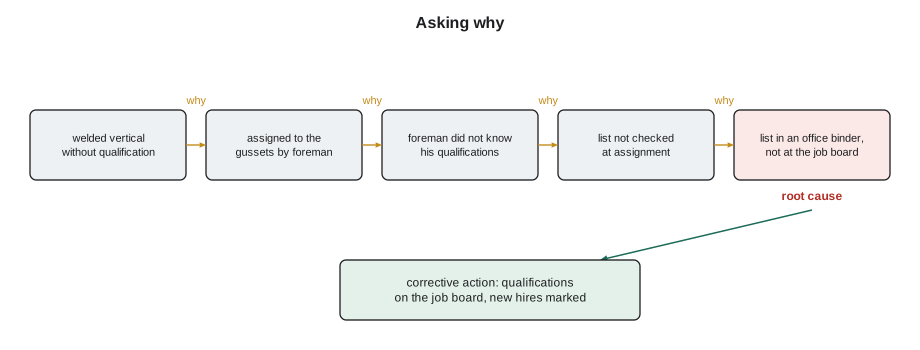
The corrective action follows from the cause. Hartwell adds the qualification of each welder, by process and position, to the job board in the shop where the morning assignments are made, printed from Lucia's register each Monday and whenever it changes, with new hires marked until their records have been checked. The foremen are briefed. For the calibration finding the cause is that labels are small and nobody looks at them; the action is a monthly calibration list sent to each bay with the items due. For the oven log, an electronic logger now records the temperature continuously. Each action has an owner and a date, and Elena will check at the next internal audit that it worked.
# Corrective action register: due dates by severity and status before the external audit
from datetime import date, timedelta
audit_day = date(2026, 12, 3)
DAYS = {'major': 14, 'minor': 30}
actions = [
    # finding, severity, raised, closed (or None)
    ('1 welder qualification check at assignment', 'major', date(2026, 11, 24), date(2026, 11, 28)),
    ('2 calibration list to each bay', 'minor', date(2026, 11, 24), date(2026, 11, 27)),
    ('3 electronic oven temperature logger', 'minor', date(2026, 11, 25), None),
    ('4 repair record cross-reference to NDE report', 'minor', date(2026, 11, 25), date(2026, 11, 26)),
]
for finding, sev, raised, closed in actions:
    due = raised + timedelta(days=DAYS[sev])
    if closed:
        state = f'closed {closed} ({(closed - raised).days} days)'
    elif audit_day > due:
        state = 'OPEN and overdue at audit'
    else:
        state = f'open, due {due}, evidence of progress needed at audit'
    print(f"{finding:<46} {sev:<6} {state}")
open_items = [a for a in actions if a[3] is None]
print(f"{len(actions) - len(open_items)} of {len(actions)} closed before the audit")1 welder qualification check at assignment major closed 2026-11-28 (4 days) 2 calibration list to each bay minor closed 2026-11-27 (3 days) 3 electronic oven temperature logger minor open, due 2026-12-25, evidence of progress needed at audit 4 repair record cross-reference to NDE report minor closed 2026-11-26 (1 days) 3 of 4 closed before the audit
By the morning of the external audit three of the four actions are closed and the fourth, the electronic logger, is ordered and due within its period, with the manual log being kept twice a day until it arrives. Glen prints the register for the auditor.
The external audit
The AISC auditor spends two days at Hartwell. She traces the Riverside and Coldwater jobs from contract review to shipping, checks purchase orders and mill certificates against the steel in the yard, checks the welders she picks on the floor against their records, and looks at calibration, nonconformance control and the internal audit. She asks about the job board, and Glen shows her the internal audit, the Kofi nonconformance report and the corrective action register. She reads them carefully and asks Kofi a few questions about his test.
Her report lists one minor corrective action request of her own: one procedure posted in the pipe shop had been superseded by a revision approved in October, and the old copy had not been withdrawn, although the welder had been using the new values. Hartwell's internal findings are recorded as found and corrected by the company, with no further action required. The certification continues. In her closing meeting she tells Glen that the Kofi finding is the most common problem she sees in shops that hire experienced welders, and that the job board is the best fix she has seen for it.
Elena closes the new finding the same week: a check of every booth for superseded copies, which finds one more in the repair bay, and a change to the revision procedure so that the person who issues a new revision signs for the removal of every old copy on the controlled copy list.
Devon's write-up
Devon's capstone report is four pages. It describes the plan and the sample, the evidence he checked, the Kofi finding with its disposition, cause and corrective action, the external auditor's view, and what he learned. The last section is the one Elena reads aloud to the class. He writes that he used to think inspection and audits were about catching welders out, and that he now thinks they are about making it possible for someone who was not there to trust a weld. Kofi's welds were good, he writes, and the system nearly could not prove it; the fix was not to blame Kofi or the foreman but to put the right information where the decision was made.
He ends with a list of habits he will keep as a journey-level welder: read the procedure before every new joint; know what his own qualifications cover and say so when an assignment falls outside them; keep his welder number on every weld; return electrodes to the oven; record what he measures; ask when something does not match. Lucia signs the report and adds one line: “He asks. That is the whole job.”
What the course has covered
This course has traced the documents and people behind every code weld. Codes, standards and specifications set the rules and are given force by law or contract. Structural and pressure codes divide the work differently, and each sends procedures and welders to a qualification standard. Procedures are written, supported by tests or prequalification, and controlled. Welders are qualified for ranges and keep their qualifications by using them. Visual inspection, surface methods and volumetric methods each find different discontinuities, and acceptance criteria decide which are defects. Inspectors and technicians are certified, independent and accountable. Company certification ties it all together, and audits check that it works. The final course in the program reviews all of it for the certification examination.
Common mistakes
MistakeWaiting for the external auditor to find problems.
InsteadAudit yourself first, with a planned random sample.
MistakeChoosing the records that look best.
InsteadDraw the sample at random and record how it was drawn.
MistakeTreating a missing qualification as a paperwork matter.
InsteadStop the work, reinspect the welds and qualify the welder before continuing.
MistakeCorrecting the instance and moving on.
InsteadFind the cause and change the system so it does not recur.
MistakeBlaming the person who made the mistake.
InsteadPut the information people need where they make decisions.
Summary and key terms
- Internal audits come before external ones and use a planned, random sample.
- Welder qualifications must be checked against the work each welder is actually doing.
- A missing qualification is handled by stopping work, reinspecting, deciding a disposition and testing the welder.
- Root cause analysis asks why until the answer is something the shop can change.
- Corrective actions have owners and due dates by severity, and are checked for effectiveness.
- Auditors look for a system that finds and fixes its own problems.
- Internal audit
- An audit a shop does of its own system before an external one.
- Audit sample
- Records or items chosen, at random, to represent the whole.
- Nonconformance report
- A record of a requirement not met, its disposition and its cause.
- Disposition
- The decision on what to do with nonconforming work: accept, repair, retest or reject.
- Root cause
- The underlying reason a problem happened, which a corrective action removes.
- Corrective action
- A change that removes the cause of a nonconformance so it does not recur.
Practice problems
Work each problem on paper first, then reveal the answer to check.
A welder's record shows flat and horizontal FCAW only, and he is welding vertical. What happens first?
Show answer
Stop the work and tag the affected parts on hold.
Why is the random seed written on the audit plan?
Show answer
So that anyone can reproduce the sample and see it was not chosen to look good.
What was the root cause of the Kofi finding?
Show answer
The qualification information was not where the foreman made assignments.
Lesson quiz · 5 questions
Score 60% or more to complete this lesson.
Create a free account to save your progress, take quizzes and earn a certificate.