
WLD-220 · Lesson 4 of 12 · 17 min
Joint types and edge preparation
Before a welding symbol can make sense, a welder needs the words for what it describes. A joint is the place where two or more pieces meet. A weld is what joins them. The same joint can take several different welds, and the same weld can be used on several kinds of joint, so drawings and codes describe both: the joint type, the shape the edges are prepared to, and the weld that fills them. This lesson sets out the vocabulary: the five basic joint types, the parts of a groove, the common groove shapes, backing and spacers, and the way the structural codes give prequalified joint details with standard designations. The next lessons show how all of this is written in symbol form.
The five basic joints
Every welded joint falls into one of five types, named by how the pieces sit relative to each other.
- Butt joint: two members lying in roughly the same plane, edge to edge. Splices in beams, plates and pipe are butt joints.
- Corner joint: two members meeting at roughly a right angle at their edges, forming an L. The corners of a box section or a tank are corner joints.
- T-joint: one member meeting the face of another at roughly a right angle, forming a T. Stiffeners, gussets and most brackets are T-joints.
- Lap joint: two members overlapping, face to face. Splice plates, doubler plates and many sheet metal joints are lap joints.
- Edge joint: two members side by side with their edges flush, usually thin sheet or flanged edges welded along the edge.
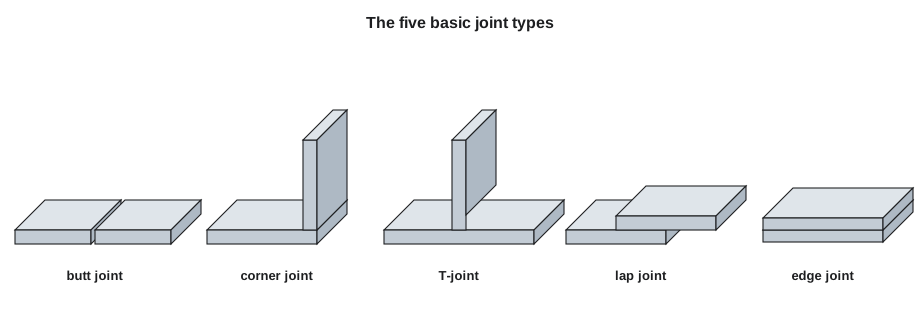
The joint type does not say what weld is used. A T-joint may be welded with fillet welds on one or both sides, with a groove weld after one member is beveled, or with a combination of groove and fillet. A corner joint may have a fillet on the inside, a groove on the outside, or both. The drawing shows which.
Fillet welds and groove welds
Two weld types do almost all the work in structural and plate fabrication.
- A fillet weld has a roughly triangular cross-section and joins two surfaces at approximately right angles to each other, in a T-joint, lap joint or corner joint. The edges are not prepared. Fillet welds are quick, need little fit-up accuracy and are the most common welds in steel fabrication.
- A groove weld is made in a groove between the members, which may be a square edge with a gap or an edge cut to a bevel, V, J or U shape. Groove welds can join the full thickness of the members and are used where a joint must develop the full strength of the plate, carry fatigue loading, or lie flush.
There are other weld types, such as plug, slot, spot, seam, stud, surfacing and edge welds, each with its own symbol, covered later in the course.
A groove weld that fuses through the full thickness of the joint is a complete joint penetration weld, CJP. One that is designed to penetrate only part of the thickness is a partial joint penetration weld, PJP. The difference is a design decision, made by the engineer, and the drawing must make it clear. A PJP weld that is accidentally made as CJP is usually harmless. A CJP weld that is made as PJP is a serious defect, because the joint will not have the strength it was designed for and the missing fusion is buried inside.
The parts of a groove
Groove preparation has its own vocabulary, which the welding symbol uses directly. Using the terms of the welding terminology standard:
| Term | Meaning |
|---|---|
| Root opening | The gap between the members at the root of the joint, also called the root gap |
| Root face | The flat, unbevelled part of the edge at the root, also called the land |
| Bevel angle | The angle between the beveled edge and a line perpendicular to the plate surface |
| Groove angle | The total included angle between the faces of the groove; for a V, twice the bevel angle |
| Depth of bevel | The distance from the plate surface to the bottom of the bevel, where the root face begins |
| Groove radius | The radius at the bottom of a J or U groove |
| Groove face | The surface of a member that is included in the groove |
| Root | The part of the joint where the members are closest together |
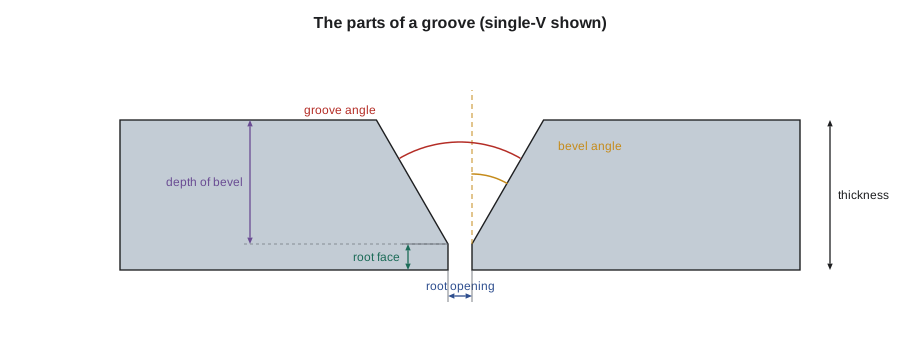
Bevel angle and groove angle are easy to confuse. A single-V groove made of two 30 degree bevels has a 60 degree groove angle. A single-bevel groove has one beveled member and one square member, so the bevel angle and the groove angle are the same, typically 45 degrees. When a drawing says 60 degrees on a V, it means the included angle; each plate is beveled at 30.
Groove shapes
The common groove shapes are named by their cross-section.
- Square groove: the edges are left square, with or without a root opening. Used on thin material and some automatic processes.
- V-groove: both edges are beveled, forming a V. Single-V from one side; double-V from both sides, forming an X.
- Bevel groove: one edge is beveled and the other left square. Very common in T-joints and corner joints, where only one member can be prepared, and in butt joints in the horizontal position.
- J-groove: one edge is cut with a radius at the bottom, forming a J. Less weld metal than a bevel on thick plate, but harder to prepare.
- U-groove: both edges are cut with a radius, forming a U. Used on thick plate and pipe where the volume of weld metal in a V would be too great.
- Flare-V and flare-bevel grooves: grooves formed by the rounded edge of a bar, tube or bent plate against another round or flat surface. Common on light structures, handrails and formed sections.
Double-sided grooves, welded from both sides, use less weld metal than single-sided grooves on thick plate and balance the distortion. On the Riverside girders, the flange splices are double-V grooves, welded alternately from each side and back-gouged to sound metal before the second side is welded.
Backing, spacers and back gouging
A single-sided groove weld has to be supported at the root, or the weld metal will fall through the gap. There are several ways to do this:
- Steel backing: a bar or strip of steel tack-welded under the root, which becomes part of the joint. It must be continuous, fused by the root pass, and of a compatible material. Codes may require it to be removed on some joints, such as those carrying fatigue loads in certain directions.
- Non-fusing backing: ceramic tape, copper bars or flux backing that support the root and are removed afterwards.
- Open root: the root is welded from one side without backing, using a technique that controls the pool, as in pipe welding.
- Back gouging: the first side is welded, the root of the joint is gouged or ground out from the other side to sound metal, and the second side is welded. This is how double-sided CJP welds are made.
A spacer is a strip placed in the root of a double-sided joint to hold the root opening while the first side is welded. It is gouged out before the second side.
Prequalified joint details
The structural welding codes give a set of standard joint details that have been proven by long experience. If a shop uses one of these details within its limits, with a prequalified procedure, it does not need to test the joint. Each detail gives the allowed plate thicknesses, root openings, root faces and groove angles, the welding positions and processes, and any requirements for backing or back gouging.
AWS D1.1 gives prequalified joint details in its figures for CJP and PJP groove welds. Each has a designation such as B-U4a or TC-U4b. The first letters give the joint type: B for butt, C for corner, T for T-joint, and combinations such as TC for a detail that can be used for either. U means a complete joint penetration weld and P a partial joint penetration weld. The number gives the groove shape: 1 square, 2 single-V, 3 double-V, 4 single-bevel, 5 double-bevel, 6 single-U, 7 double-U, 8 single-J, 9 double-J. A letter after it distinguishes variants of the same shape, and a process suffix such as -GF for gas metal and flux-cored welding, or -S for submerged arc welding, marks details limited to those processes. Hartwell's detailer puts the designation in the tail of each groove welding symbol.
Using a prequalified detail does not mean any fit-up will do. The detail gives tolerances on the root opening, root face and groove angle, both as detailed and as fit up. A root opening that is too wide uses more weld metal and increases shrinkage; one that is too tight risks incomplete penetration. Outside the tolerances, the joint is no longer prequalified and either has to be corrected or qualified by testing.
Calculating groove geometry
A fitter preparing a bevel needs to know where to mark the cut line, and an estimator needs to know how much weld metal a groove will take. Both come from the same geometry: the plate thickness, the root face, the bevel angle and the root opening. The width of the groove at the top surface is the root opening plus the horizontal run of each bevel, and the area of the groove is the root opening rectangle plus the triangles of the bevels.
where w is the groove width at the surface, g the root opening, t the plate thickness, f the root face, θ the bevel angle and n the number of beveled members, one for a bevel groove and two for a V.
# Groove width and cross-section area for single-bevel and single-V grooves
import math
def groove(t, f, angle, gap, n_bevels):
    depth = t - f
    run = depth * math.tan(math.radians(angle))      # horizontal run of one bevel
    width = gap + n_bevels * run
    area = gap * t + n_bevels * 0.5 * depth * run    # gap rectangle + bevel triangles
    return run, width, area
cases = [  # name, thickness, root face, bevel angle, root opening, beveled members (in)
    ("bevel, T-joint lug", 1.0, 0.125, 45, 0.25, 1),
    ("single-V, 60 deg included", 0.75, 0.125, 30, 0.125, 2),
    ("single-V, 45 deg included", 0.75, 0.125, 22.5, 0.25, 2),
]
for name, t, f, ang, gap, n in cases:
    run, w, a = groove(t, f, ang, gap, n)
print(f"{name:28} bevel set-back {run:6.3f} in, groove width {w:6.3f} in, area {a:8.3f} in2")bevel, T-joint lug bevel set-back 0.875 in, groove width 1.125 in, area 0.633 in2 single-V, 60 deg included bevel set-back 0.361 in, groove width 0.847 in, area 0.319 in2 single-V, 45 deg included bevel set-back 0.259 in, groove width 0.768 in, area 0.349 in2
Narrowing the V cuts the area of the bevel triangles, but codes require a wider root opening for narrower groove angles so the welder can reach the root, and the wider gap takes the saving back: in this case the 45 degree groove ends up with slightly more weld metal than the 60 degree one. That trade-off is built into the prequalified details: every combination of angle and opening in them has been shown to work. A fitter who narrows the angle to save weld metal without opening the gap is building a joint the code does not recognize.
Joint preparation on the floor
Edges are prepared by thermal cutting with a beveling torch or plasma, by machining on a beveling machine or edge planer, or by grinding. On the Coldwater skid, the lifting lugs are T-joints to the beam flange with a single-bevel CJP groove on the lug, prepared on the plasma table with a bevel head. Devon checks the bevel with a protractor gauge and the root face with a rule before fit-up, and records both on the fit-up check sheet. A bevel that is a few degrees off is still within tolerance. One cut on the wrong face, so that the groove opens away from the side the welder can reach, means a new lug.
Common mistakes
MistakeConfusing bevel angle with groove angle on a V-groove.
InsteadThe groove angle is the included angle; each bevel is half of it on a symmetrical V.
MistakeMaking a CJP groove weld as if it were PJP.
InsteadCJP must fuse through the full thickness; back-gouge or use backing as the procedure requires.
MistakeNarrowing the groove angle without opening the root.
InsteadStay within the prequalified detail's combinations or qualify the joint.
MistakeUsing backing that is not continuous along the joint.
InsteadBacking must be continuous or joined with full-penetration welds.
MistakeAssuming a joint type tells you the weld.
InsteadA T-joint can be filleted, grooved or both; read the symbol.
Summary and key terms
- The five basic joints are butt, corner, T, lap and edge.
- Fillet welds join surfaces at about right angles without edge preparation; groove welds fill a prepared groove.
- CJP welds fuse the full joint thickness; PJP welds penetrate only part of it.
- Groove terms include root opening, root face, bevel angle, groove angle and depth of bevel.
- Common grooves are square, V, bevel, J, U and flare grooves, single or double.
- Single-sided grooves need backing or an open-root technique; double-sided CJP welds are back-gouged.
- Prequalified joint details in the structural codes set allowed dimensions and tolerances.
- Butt joint
- A joint between two members lying approximately in the same plane.
- T-joint
- A joint where one member meets the face of another at approximately a right angle.
- Root opening
- The separation between the members at the root of the joint.
- Root face
- The unbevelled portion of the groove face at the root.
- Groove angle
- The total included angle of the groove between the members.
- Back gouging
- Removing weld and base metal from the other side of a partly welded joint to reach sound metal.
- Prequalified joint
- A joint detail accepted by a code without procedure testing when used within its limits.
Practice problems
Work each problem on paper first, then reveal the answer to check.
A single-V groove has a 60 degree groove angle. What is the bevel angle on each plate?
Show answer
30 degrees.
A 3/4 in plate has a 1/8 in root face and a 45 degree bevel. How far back from the root does the bevel break the top surface?
Show answer
(0.75 - 0.125) x tan 45 = 0.625 in, or 5/8 in.
Which joint type is a stiffener welded to a beam web?
Show answer
A T-joint.
Lesson quiz · 5 questions
Score 60% or more to complete this lesson.
Create a free account to save your progress, take quizzes and earn a certificate.