
WLD-220 · Lesson 11 of 12 · 16 min
Welding procedure specifications and how to read them
The welding symbol says what weld to make. It does not say how to make it: which process, which filler, what current and voltage, what preheat, what travel speed, how many passes. That information is in the welding procedure, a document referenced in the tail of the welding symbol, on the weld map or in the general notes. A welder on code work must follow it, and the inspector checks that they do. The course on gas metal and flux-cored welding followed the qualification of a procedure from the engineer's side. This lesson is about reading procedures from the welder's side: what the documents are called in Canada and the US, what each line on them means, how the drawing points to them, and how to check that what you are doing at the bench is inside what the procedure allows.
Why procedures exist
A weld's strength, toughness and soundness depend on how it was made. Two welders making the same size of fillet on the same plate with different settings, fillers or preheats can produce welds with very different properties, and the difference may not show on the surface. A welding procedure fixes the variables that matter, so that every weld made to it has the properties that were proven, either by long experience or by testing. The code requires a procedure for every weld on code work, the inspector checks that it is followed, and the welder's qualification is tied to the procedures they are allowed to use.
The documents in Canada
Canadian structural fabrication follows a two-level system that is useful to understand, because Hartwell's Canadian sister shop uses it and US welders working on Canadian projects will see it.
- The welding procedure specification, WPS, is a general document for a process. It describes the company's practice for that process: the base metals, filler metals, positions, joint preparation methods, preheat rules, cleaning, technique and quality requirements. A WPS is written by the company's welding engineer and accepted by the Canadian Welding Bureau.
- The welding procedure data sheet, WPDS, gives the specific values for a particular joint or group of joints: the joint detail with its dimensions, the electrode or wire size and classification, the current, voltage, travel speed and wire speed ranges for each pass, the number and order of passes, and the positions. Each WPDS is tied to a WPS. Prequalified joints from CSA W59 can be written on data sheets without testing; others need procedure qualification tests.
On Canadian drawings, the tail of a groove weld symbol gives the data sheet, for example WPDS-31, and the data sheet gives the WPS it belongs to.
The documents in the US
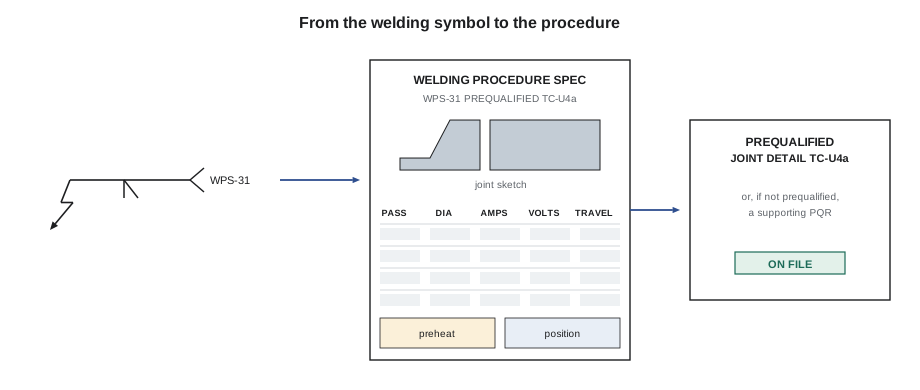
US structural fabrication under AWS D1.1 uses a single document, the welding procedure specification, WPS, which combines the general practice and the specific values. A WPS is either:
- Prequalified: written to meet every requirement of the code's prequalification clause, using a prequalified joint detail, base metal, filler, process and parameter limits. No test is needed, but the WPS must still be written down, and any departure from the prequalified limits means it is no longer prequalified.
- Qualified by test: supported by a procedure qualification record, PQR, which records the actual values used to weld a test plate and the results of the mechanical tests on it. The WPS can then allow ranges around those values within the limits the code sets.
- Pressure work under the ASME code uses its own qualification rules in Section IX, where every WPS must be supported by a PQR, with no prequalified route in the structural sense.
On Hartwell's Pasadena drawings, the tail of a groove weld symbol gives the WPS number, for example WPS-31, often with the prequalified joint designation, such as TC-U4a. The welder works from the WPS posted at the station.
Reading a procedure line by line
Procedures follow a standard layout, with the variables grouped. Whatever the form, these are the items a welder must find and follow:
| Item | What it tells the welder |
|---|---|
| Identification | Document number, revision, date, the procedures it is tied to, and approvals |
| Process and type | For example FCAW, semi-automatic |
| Joint design | Joint type, groove detail and dimensions, backing, back gouging, with a sketch |
| Base metal | Specification or group, and the thickness range the procedure covers |
| Filler metal | Classification, diameter, and any designators for toughness or hydrogen |
| Shielding | Gas mixture and flow rate, or flux |
| Position | The positions allowed, and progression for vertical welds |
| Preheat and interpass | Minimum preheat, maximum interpass temperature, and how they are measured |
| Electrical | Current type and polarity, amperage or wire speed, voltage, contact tip to work distance |
| Travel and technique | Travel speed, stringer or weave, maximum bead width or layer thickness, cleaning between passes |
| Pass sequence | The passes and their order, with values for each |
| Post-weld | Heat treatment, peening or other post-weld steps, if any |
Essential variables
Not every value on a procedure can be changed freely. The code sorts the variables into those that can be adjusted within a range and those whose change makes a new procedure necessary. These are called essential variables. Changes to them can change the properties of the weld, so they need a new or revised procedure, and for a qualified procedure, a new test.
Typical essential variables include a change of process, a change of filler classification or a significant change in diameter, a change of shielding gas, a change of base metal group, thickness outside the qualified range, a change of position or of vertical progression, a reduction in preheat, an increase in heat input beyond a limit, a change from stringer to weave beyond the allowed width, and a change in joint detail outside the tolerances. The welder does not need to know all of the code's rules to stay out of trouble. They need to know one rule: work inside every range on the procedure, and if something will not work inside the ranges, stop and ask.
Ranges and actual values
Most procedures give ranges for the electrical values: a current from one value to another, a voltage band, a travel speed band. Inside the range, the welder adjusts to suit the joint and position. Outside it, the weld is not to the procedure, even if it looks good. Inspectors check by measuring the actual values with a calibrated meter at the arc, timing the travel over a measured length, and reading the preheat with a temperature crayon or contact thermometer. Many newer power sources record the values and the heat input for each weld, which makes the check easier and provides a record.
Heat input is often limited on procedures for steels with toughness requirements, because too much heat coarsens the grain and lowers toughness. Heat input is not set directly; it comes from the current, voltage and travel speed together, so a welder who turns up the current and slows down to fill a joint faster can be outside the heat input limit while every individual value is in range.
# Check actual welding values against the procedure ranges, including heat input
proc = {   # FCAW-G flange splice fill passes, from the procedure (WPS-31)
    "amps": (235, 255), "volts": (25.5, 26.5), "travel": (10, 14),
    "preheat_min": 50, "interpass_max": 450, "heat_input_max": 40,
}
def heat_input(v, a, s):
    return 60 * v * a / (1000 * s)          # arc energy, kJ/in
readings = [  # pass, amps, volts, travel in/min, temperature before pass F
    ("fill 3", 246, 26.0, 12, 250),
    ("fill 4", 252, 26.4, 11, 355),
    ("fill 5", 262, 26.8, 11.5, 400),
    ("fill 6", 244, 26.1, 9.5, 470),
]
for name, a, v, s, temp in readings:
    q = heat_input(v, a, s)
    bad = []
    if not proc["amps"][0] <= a <= proc["amps"][1]: bad.append(f"current {a} A")
    if not proc["volts"][0] <= v <= proc["volts"][1]: bad.append(f"voltage {v} V")
    if not proc["travel"][0] <= s <= proc["travel"][1]: bad.append(f"travel {s}")
    if temp < proc["preheat_min"]: bad.append(f"below preheat at {temp}")
    if temp > proc["interpass_max"]: bad.append(f"over interpass at {temp}")
    if q > proc["heat_input_max"]: bad.append(f"heat input {q:.1f}")
print(f"{name}: {q:.1f} kJ/in " + ("in range" if not bad else "OUT: " + ", ".join(bad)))fill 3: 32.0 kJ/in in range fill 4: 36.3 kJ/in in range fill 5: 36.6 kJ/in OUT: current 262 A, voltage 26.8 V fill 6: 40.2 kJ/in OUT: travel 9.5, over interpass at 470, heat input 40.2
Two of the four passes are out. Fill 5 is over on both current and voltage, which a welder chasing a faster fill can drift into without noticing. Fill 6 is in range on current and voltage but too slow and too hot between passes, and its heat input is over the limit, the case the last paragraph described. Both are reasons to stop, let the joint cool, and tell the inspector, who will decide with the welding engineer whether the passes are acceptable or must be removed.
Welder qualification and the procedure
A procedure says how a weld is to be made. A welder qualification says who is allowed to make it. The two are linked: a welder's qualification test is made to a procedure, and it qualifies them for a range of processes, positions, thicknesses and filler groups. Before starting a weld, a welder should know that their qualification covers the procedure on the symbol.
Under AWS D1.1, welders are qualified by test, often by the fabricator's own inspector, for a process, position, thickness range and filler group. A qualification stays current as long as the welder uses the process within a set period, usually six months, and the employer keeps records of it. Hartwell keeps a matrix on the office wall showing each welder's current qualifications and the date each was last used.
Devon's flux-cored tickets from the last course cover the fillet welds on the base frame but not yet the CJP lifting lug joints in the overhead position, so Glen sets the frame up so that those joints are welded flat.
Where the procedure must be
Codes require the procedure to be available to the welder and the inspector where the welding is done. At Hartwell, each station has a holder for the current data sheets or procedure specifications for the work on it, printed as controlled copies like drawings, or shown on a tablet. A procedure kept in the office, where the welder cannot see it, does the welder no good. Marta's habit is to read the procedure before each new joint, the way she reads the drawing, and to set the machine from it rather than from memory.
Reading a procedure at the station
Before he welds the first lifting lug, Devon reads the procedure posted at the station from top to bottom, and Marta asks him questions about it. Which process? Flux-cored, gas-shielded. Which wire and diameter? The classification on the sheet, 0.045 in. Which gas and how much? The mixture and flow on the sheet, which he checks on the flowmeter at the gun with the trigger pulled. Which positions? Flat and horizontal only, which is why the frame was set up so the lugs are welded flat. What preheat? A minimum that depends on the thickness of the thickest part, which for the lugs is the 1 in plate, so he checks the preheat table on the procedure for that band and reads the plate with a contact thermometer 3 in from the joint. What interpass maximum? The value on the sheet, checked before each pass. How many passes and what for each? The root, hot pass and fills, with the current and voltage ranges for each.
Then she asks the question she always asks: what would make you stop? Devon has three answers ready: if he cannot get the values inside the ranges, if the joint does not match the sketch on the procedure, or if the preheat drops below the minimum. Marta adds a fourth: if anything about the joint surprises you.
Common mistakes
MistakeSetting the machine from memory of a similar job.
InsteadRead the procedure referenced on the symbol and set the machine from it.
MistakeTreating a weld as acceptable because it looks good when the settings were outside the range.
InsteadA weld outside the procedure ranges is not to the procedure, however it looks.
MistakeChecking current and voltage but not travel speed.
InsteadHeat input depends on all three; slow travel can exceed the limit.
MistakeChanging filler classification because the right wire ran out.
InsteadFiller classification is an essential variable; stop and ask.
MistakeStarting a weld without checking that your qualification covers it.
InsteadCheck process, position and thickness against your current qualifications.
Summary and key terms
- The procedure says how a weld is made; the symbol's tail or the weld map says which procedure applies.
- In Canada, a general WPS is supported by specific WPDS data sheets accepted by the Canadian Welding Bureau.
- In the US, a D1.1 WPS is either prequalified or qualified by test with a PQR.
- Procedures list joint design, base metal, filler, shielding, position, preheat, electrical values, technique and passes.
- Essential variables cannot be changed without a new or revised procedure.
- Welders must work inside every range, including heat input, and must be qualified for the procedure.
- WPS
- Welding procedure specification, the document that sets how a weld is to be made.
- WPDS
- Welding procedure data sheet, the Canadian document giving specific values for a joint under a WPS.
- PQR
- Procedure qualification record, the record of a test weld and its results supporting a WPS.
- Prequalified procedure
- A procedure that meets all code prequalification requirements and needs no test.
- Essential variable
- A variable whose change requires a new or requalified procedure.
- Heat input
- The arc energy per unit length of weld, from current, voltage and travel speed.
Practice problems
Work each problem on paper first, then reveal the answer to check.
A procedure allows 235 to 255 A. The meter at the arc reads 260 A. Is the weld to the procedure?
Show answer
No; the current is outside the range.
What is the heat input at 26 V, 250 A and 12 in/min?
Show answer
60 x 26 x 250 / (1000 x 12) = 32.5 kJ/in.
What is the difference between a prequalified WPS and a qualified WPS under AWS D1.1?
Show answer
A prequalified WPS meets the code's prequalification rules without testing; a qualified WPS is supported by a PQR from a test weld.
Lesson quiz · 5 questions
Score 60% or more to complete this lesson.
Create a free account to save your progress, take quizzes and earn a certificate.