
VIS-130 · Lesson 8 of 12 · 27 min
Modernism: Cubism, abstraction, the Bauhaus and Constructivism
In the first decades of the twentieth century, artists across Europe broke apart the window that the Renaissance had built. Cubists showed objects from several viewpoints at once; abstract painters removed recognizable subjects entirely; designers at the Bauhaus in Germany and Constructivists in Soviet Russia argued that art should shape everyday life through architecture, typography, photography and film. Modernism produced the visual language of the twentieth century: the clean sans-serif font, the asymmetric grid, the photomontage poster, the dramatic low-angle photograph and the dynamic film edit. This lesson traces those developments and shows how they still shape graphic design, photography and moving images.
Cubism: breaking the window
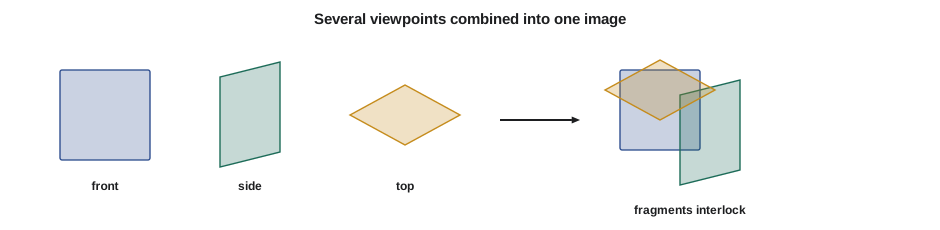
Between about 1907 and 1914 in Paris, Pablo Picasso and Georges Braque developed Cubism. Building on Cézanne's habit of constructing objects from planes and slightly shifting viewpoints, they fragmented subjects into faceted shapes and combined views from several angles in one image. A face might appear in profile and from the front simultaneously; a guitar might be opened out into overlapping planes.
In its first phase, often called Analytic Cubism, around 1909 to 1912, colors were muted browns and grays so that attention focused on the fractured structure. In the later phase, called Synthetic Cubism, from about 1912, Picasso and Braque introduced collage: pasted paper, newspaper, wallpaper and printed labels glued onto the canvas. Collage brought real materials and mass-produced printed matter into fine art, an idea with enormous consequences for later photomontage, graphic design and digital compositing.
Cubism rejected the single fixed viewpoint of Renaissance perspective. It suggested that we understand objects by moving around them over time, an idea closely connected to cinema, where a scene is assembled from many shots taken from different positions.
Futurism: speed and the machine
In Italy, the Futurists, led by the poet Filippo Tommaso Marinetti, who published the Futurist manifesto in 1909, glorified speed, machines, the modern city and, disturbingly, war and violence. Painters such as Giacomo Balla and Umberto Boccioni tried to depict motion by repeating forms in sequence, like a dog's legs blurring as it walks or a sculpture of a striding figure whose body seems to stream through space. They drew on chronophotography, the multiple-exposure motion studies of Étienne-Jules Marey and the sequential photographs of Eadweard Muybridge.
Futurism's fascination with motion blur, repetition and dynamic diagonals connects to long-exposure photography, motion graphics and action editing. Its glorification of violence also became entangled with Italian Fascism, a reminder that avant-garde style and politics can mix dangerously.
Abstraction: removing the subject
Several artists around 1910 to 1920 took the radical step of making images without recognizable subjects at all. Wassily Kandinsky, a Russian working in Munich, believed colors and forms could affect viewers directly, like music, and painted improvisations of free color and line. Kazimir Malevich in Russia founded Suprematism; in 1915 he exhibited a black square painted on a white ground, a work he presented as a zero point of painting. Piet Mondrian in the Netherlands, part of the De Stijl movement founded in 1917, reduced painting to horizontal and vertical black lines and rectangles of primary colors plus white.
Abstraction matters to image makers because it isolates the formal elements, color, line, shape, balance and rhythm, that underlie every image. Mondrian's grids are a lesson in asymmetric balance: unequal rectangles balanced by placement and color weight. His influence runs through graphic design, architecture, fashion and interfaces.
Worked problem
Asymmetric balance with color weight
In a design inspired by Mondrian, a large white rectangle occupies the left two-thirds of the frame, and a small red square sits in the lower right. Explain how the composition can feel balanced despite the unequal sizes.
Show solution
- Recognize visual weight: saturated, warm colors like red carry more visual weight than white or pale areas.
- Recognize position: an element placed far from the center exerts more leverage, like a small weight far from the pivot of a seesaw.
- Combine the two: the small red square's high color weight and its position near the edge counterbalance the large, light white area.
- Check lines: black horizontal and vertical lines dividing the space create a structure that ties the elements together.
Answer: The small red square balances the large white area because saturated red carries strong visual weight and its position near the edge gives it leverage, like a small weight far from a seesaw's pivot. The grid of black lines unifies the parts, producing dynamic asymmetric balance rather than static symmetry.
The Bauhaus: art, craft and industry
The Bauhaus, founded by the architect Walter Gropius in Weimar, Germany, in 1919, aimed to unite art, craft and technology. It moved to Dessau in 1925 into a celebrated modernist building designed by Gropius, then briefly to Berlin, where it closed in 1933 under pressure from the Nazi regime. In just fourteen years, it transformed design education and modern visual culture.
Bauhaus teachers included painters such as Kandinsky and Paul Klee, who taught color and form, and László Moholy-Nagy, a Hungarian artist who championed photography, photograms (cameraless images made by placing objects on photographic paper), photomontage and experimental film. Students took a preliminary course exploring materials, color and composition before specializing in workshops such as metalwork, furniture, textiles, typography and architecture.
| Principle | Meaning | Legacy in image making and design |
|---|---|---|
| Form follows function | design should arise from purpose | clear interfaces, functional layouts |
| Unity of art and technology | embrace industrial production | product design, modern branding |
| Geometric simplicity | circles, squares, triangles, primary colors | logos, icons, flat design |
| Sans-serif typography | clean, legible type without serifs | modern fonts, signage, screen text |
| Asymmetric layouts | dynamic grids instead of centered layouts | posters, magazines, websites |
| New vision photography | unusual angles, close-ups, abstraction | dramatic perspectives, architectural photography |
Many Bauhaus teachers and students emigrated after 1933, especially to the United States. Gropius taught at Harvard, Moholy-Nagy founded the New Bauhaus in Chicago in 1937, later the Institute of Design, and Josef Albers taught at Black Mountain College and Yale, where his book on the interaction of color, published in 1963, became a classic of color education.
The New Vision: modernist photography
In the 1920s, Moholy-Nagy and others promoted a "New Vision" in photography. Rather than imitating painting or the human eye, the camera should reveal the world in new ways: extreme high and low angles, bird's-eye and worm's-eye views, close-ups that turned objects into abstract patterns, diagonal compositions, unusual crops, photograms, and multiple exposures. Photographers such as Germaine Krull photographed iron structures and machines, and Albert Renger-Patzsch made sharp close-ups of plants and industrial objects.
These techniques are now so common that they seem natural: the dramatic upward shot of a skyscraper, the abstract close-up of texture, the overhead flat lay. Each began as a deliberate break from older conventions.
Constructivism: art for a new society
In Russia after the 1917 Revolution, Constructivist artists rejected art for its own sake and set out to build a new socialist society through design. Vladimir Tatlin designed a monumental tower for the Communist International that was never built. Alexander Rodchenko moved from painting to photography and design, taking photographs from extreme angles, looking up at buildings or down from balconies, to shake viewers out of habitual ways of seeing. El Lissitzky designed books, posters and exhibitions with bold geometry, photomontage and dynamic typography.
Constructivist posters combined photographs, bold sans-serif type and diagonal compositions in red, black and white. Their visual language has been endlessly borrowed by advertising, album covers and political campaigns. Constructivist ideas also influenced Soviet cinema, where filmmakers such as Sergei Eisenstein and Dziga Vertov developed montage theories, covered in Lesson 9 and in FILM-101.
Photomontage
Photomontage, combining parts of different photographs into a new image, became a powerful modernist tool. Berlin Dada artists such as Hannah Höch and Raoul Hausmann cut up magazine photographs around 1919 to 1920 to make satirical, chaotic images of Weimar society. John Heartfield made biting anti-Nazi photomontages for magazine covers in the late 1920s and 1930s, using the realism of photographs to deliver sharp political messages. Rodchenko and Lissitzky used photomontage in posters and books.
Photomontage anticipated digital compositing. Every composited film shot, edited advertisement and meme that combines images draws on techniques these artists developed by hand with scissors and glue. It also raised enduring questions about trust: photographs seem to show reality, so combined images can persuade or mislead powerfully.
Worked problem
Analyzing a modernist poster design
A described 1920s-style poster shows a photograph of a factory worker's face cropped at a steep angle in the upper left, a red diagonal band crossing from lower left to upper right, and bold black sans-serif letters running along the band. Identify the modernist techniques and their effect.
Show solution
- Note the cropped, angled photograph: a New Vision or Constructivist approach that makes the image feel urgent and modern.
- Note the diagonal band: diagonals suggest movement and energy rather than stability.
- Note the typography: bold sans-serif type, integrated into the composition rather than centered below an image.
- Note the limited palette of red, black and white: high contrast and strong political associations in Soviet design.
Answer: The poster combines a dramatically cropped photograph, a strong diagonal, bold sans-serif type running along the composition and a red, black and white palette. These Constructivist techniques create energy and urgency, presenting the worker as a dynamic symbol of a modern, forward-moving society.
Modernism in Canada and the United States
Modernism reached the United States through exhibitions such as the 1913 Armory Show in New York, which introduced Cubism and other avant-garde art to American audiences and caused a sensation, and through émigrés who left Europe in the 1930s. Bauhaus teachers reshaped American design education, MoMA, founded in 1929, championed modern art, architecture, design and photography, and by the 1940s New York was becoming a center of the international avant-garde.
What image makers take from modernism
Modernism taught that images can break with single viewpoints, combine fragments and reveal the world from unexpected angles. Abstraction isolates the formal elements that make any image work. The Bauhaus legacy lives in clean typography, grids, geometric logos and functional design. New Vision and Constructivist photography gave us extreme angles, abstract close-ups and diagonal compositions. Photomontage anticipated digital compositing and raised questions of trust that remain urgent. Knowing these origins lets you use modernist devices purposefully instead of as decoration.
Common mistakes
MistakeDescribing Cubism as simply distorted or childish drawing
InsteadUnderstand it as a deliberate combination of multiple viewpoints and planes that rejects single-point perspective
MistakeAssuming asymmetric layouts look unbalanced
InsteadUse color weight, position and grids to achieve dynamic asymmetric balance
MistakeTreating the Bauhaus as only a style of furniture
InsteadRecognize it as a school uniting art, craft and technology, with lasting effects on typography, photography and design education
MistakeUsing extreme low angles without purpose
InsteadRemember Rodchenko used unusual angles to jolt viewers out of habitual seeing, and choose them for a reason
MistakeAssuming photomontage began with digital tools
InsteadTrace it to Dada and Constructivist artists working by hand in the 1910s and 1920s
Summary and key terms
- Cubism, developed by Picasso and Braque from about 1907, combined multiple viewpoints and introduced collage.
- Futurism celebrated speed and machines, drawing on motion photography, but also glorified violence.
- Kandinsky, Malevich and Mondrian created abstract art that isolates color, line, shape and balance.
- The Bauhaus, from 1919 to 1933, united art, craft and technology and shaped modern typography and design education.
- New Vision photography promoted unusual angles, close-ups and abstraction.
- Constructivists used photography, photomontage, diagonals and bold type to serve a new society.
- Photomontage by Höch, Heartfield and others anticipated digital compositing and raised questions of trust.
- Cubism
- An early-twentieth-century movement fragmenting subjects into planes and combining multiple viewpoints
- Collage
- Artwork made by pasting materials such as paper and printed matter onto a surface
- Futurism
- An Italian movement glorifying speed, machines and modern life
- Abstraction
- Art that does not depict recognizable objects and focuses on color, form and line
- De Stijl
- A Dutch movement founded in 1917 using straight lines, right angles and primary colors
- Bauhaus
- A German art and design school from 1919 to 1933 uniting art, craft and technology
- Photogram
- A cameraless image made by placing objects on photosensitive paper and exposing it to light
- New Vision
- A 1920s photographic approach emphasizing unusual angles, close-ups and abstraction
- Constructivism
- A Soviet movement using art and design to build a new society
- Photomontage
- An image made by combining parts of different photographs
Practice problems
Work each problem on paper first, then reveal the answer to check.
How did Cubism break with Renaissance perspective?
Show answer
It combined several viewpoints in one image instead of showing a single fixed eye point.
What did Synthetic Cubism introduce?
Show answer
Collage, pasting real materials such as newspaper into artworks.
What photographic studies influenced the Futurists?
Show answer
Chronophotography by Marey and sequential photographs by Muybridge.
Name two pioneers of abstraction.
Show answer
Examples include Kandinsky, Malevich and Mondrian.
How can a small element balance a large one?
Show answer
Through stronger color weight and placement farther from the center.
When and where was the Bauhaus founded?
Show answer
In Weimar, Germany, in 1919, by Walter Gropius.
What is a photogram?
Show answer
A cameraless image made by placing objects directly on photographic paper and exposing it.
Name two New Vision techniques.
Show answer
Extreme high or low angles, abstract close-ups, diagonal compositions or unusual crops.
Who made anti-Nazi photomontages for magazine covers?
Show answer
John Heartfield.
Name a modernist group or manifesto in your country.
Show answer
Examples include the Automatistes and Refus global in Canada, or the 1913 Armory Show and MoMA in the United States.
Lesson quiz · 5 questions
Score 60% or more to complete this lesson.
Create a free account to save your progress, take quizzes and earn a certificate.