
VIS-130 · Lesson 10 of 12 · 28 min
Postwar art, pop and the mass-media image
After the Second World War, the center of the Western art world shifted from Paris to New York, and art changed again. Abstract Expressionists made huge, gestural canvases that emphasized the act of painting. Within a decade, Pop artists turned to the images of mass media: comic strips, advertisements, celebrity photographs and consumer packaging. Minimalists stripped art to simple geometric forms, and conceptual artists made ideas themselves the work. Photography and television became central to art, and artists began to question how mass-produced images shape desire, identity and politics. This lesson surveys these movements, the rise of photography in the art world, and the legal and ethical questions of appropriation, including the US Supreme Court's 2023 decision in Andy Warhol Foundation v. Goldsmith.
Abstract Expressionism: the act of painting
In New York in the late 1940s and 1950s, painters known as Abstract Expressionists, or the New York School, made large abstract paintings intended to express deep emotions and universal themes. Jackson Pollock laid canvases on the floor and poured, dripped and flung paint from above, creating dense webs of line. The photographer Hans Namuth photographed and filmed Pollock at work in 1950, and these images made the process itself famous; the critic Harold Rosenberg coined the term action painting to describe canvases as arenas in which to act.
Other painters, such as Mark Rothko, made color field paintings: large, soft-edged rectangles of color that seem to glow and envelop the viewer, intended to create contemplative or even spiritual experiences. Rothko asked that his paintings be hung low and viewed from close up so that viewers would be immersed in color. Women artists including Lee Krasner, Helen Frankenthaler and Joan Mitchell made major contributions; Frankenthaler's soak-stain technique, thinning paint so it soaked into raw canvas, influenced a generation of color field painters.
For image makers, Abstract Expressionism offers lessons in scale, immersion and the expressive power of color and gesture. Rothko's insistence on viewing distance is a lesson about how the physical relationship between viewer and image shapes experience, just as cinema screen size and phone screens do.
Pop Art: the images of everyday life
In the late 1950s and 1960s, artists in Britain and the United States reacted against Abstract Expressionism's seriousness by embracing the imagery of consumer culture. In London, the Independent Group, including Richard Hamilton and Eduardo Paolozzi, explored advertising, science fiction and American popular culture; Hamilton's small 1956 collage of a domestic interior filled with consumer goods, a bodybuilder and a television is often called an early work of Pop. Hamilton described Pop Art as popular, transient, expendable, low-cost, mass-produced, young, witty, sexy, gimmicky, glamorous and big business.
In New York, Roy Lichtenstein enlarged comic-strip panels into large paintings, reproducing the benday dots of cheap printing by hand, which made viewers notice the conventions of mass-produced images. Andy Warhol, who had worked as a commercial illustrator, used silkscreen printing to reproduce photographs of celebrities, soup cans, dollar bills and news images of car crashes and electric chairs, often repeated in grids and printed with deliberate misregistrations and flat, artificial color.
| Strategy | Example | What it reveals |
|---|---|---|
| Enlarging cheap printed images | Lichtenstein's comic panels with benday dots | the conventions behind mass imagery |
| Repetition in grids | Warhol's rows of soup cans and celebrity faces | mass production and seriality |
| Silkscreen from photographs | Warhol's portraits of film stars | celebrity as a manufactured image |
| Everyday consumer objects | soup cans, soft drink bottles | consumer culture as subject |
| Flat, artificial color | bright, unnatural tints on faces | the artificiality of media images |
Pop Art blurred the boundary between fine art and commercial art, and its influence on advertising, graphic design and music packaging became circular: advertisers borrowed Pop styles that had themselves borrowed from advertising.
Worked problem
Seriality and the grid
Warhol often repeated the same photographic image in a grid, varying color or print quality. A designer plans a poster showing one portrait repeated in a 4 by 5 grid, each cell in a different color treatment. How many cells are there, and what effects does repetition create?
Show solution
- Count the cells: \(4 \times 5 = 20\) repetitions of the portrait.
- Repetition removes uniqueness: the face becomes a mass-produced image, like a product on a shelf.
- Variation in color draws attention to small differences and to the artificiality of each version.
- The grid evokes film strips, contact sheets, shop shelves and now social media feeds.
Answer: The grid holds 20 repetitions. Repeating the portrait turns the person into a mass-produced image, while the color variations highlight artificiality and difference, an effect that also evokes contact sheets, film strips, supermarket shelves and the scrolling grid of a social media profile.
Photography enters the art world
In the postwar decades, photography moved from the margins to the center of the art world. MoMA's photography department, led by Edward Steichen, staged The Family of Man in 1955, a vast exhibition of more than 500 photographs from 68 countries that toured the world and was seen by millions, though critics later argued it presented a sentimental, universalizing view of humanity. John Szarkowski, who led the department from 1962, championed a new documentary style in his 1967 exhibition New Documents, featuring Diane Arbus, Lee Friedlander and Garry Winogrand, who photographed everyday American life with an ironic, personal eye.
Robert Frank's book The Americans, published in the United States in 1959, presented a bleak, grainy, off-kilter view of American life seen on road trips, and influenced generations of photographers and filmmakers. Street photography, documentary photography and the photobook became major art forms.
In the United States, MoMA's photography department, alongside institutions such as the George Eastman Museum and the Center for Creative Photography in Tucson, founded in 1975, supported photography as an art, and color photographers such as William Eggleston, whose 1976 MoMA exhibition of color prints was controversial at the time, expanded what serious photography could look like.
Minimalism and conceptual art
In the 1960s, Minimalist artists such as Donald Judd, Agnes Martin, Dan Flavin and Carl Andre made works from simple geometric forms, industrial materials and repetition, avoiding expressive gestures and symbolic content. Flavin used commercial fluorescent light tubes, making light itself the medium, a reminder that light can be sculpture and architecture.
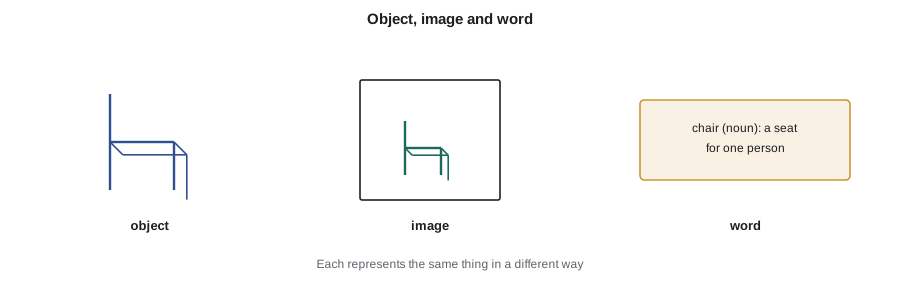
Conceptual artists went further, arguing that the idea is the work and the physical object secondary. Joseph Kosuth's One and Three Chairs of 1965 presented a real chair, a photograph of the chair and a dictionary definition of "chair" side by side, asking how objects, images and words represent things. Photographs and text were central to conceptual art, often used as documents of performances, actions and ideas. Ed Ruscha's books of plain photographs of gas stations and apartment buildings questioned what made a photograph artistic at all.
Feminist art and the critique of media images
From the late 1960s, feminist artists challenged both the art world's exclusion of women and the ways mass media represented women. Judy Chicago's installation The Dinner Party, completed in 1979, honored women from history. The art historian Linda Nochlin's 1971 essay asking why there have been no great women artists argued that institutions, not talent, explained the absence. In 1975, the film theorist Laura Mulvey wrote an influential essay arguing that classical Hollywood cinema was structured around a male gaze that positioned women as objects to be looked at.
In the late 1970s and 1980s, artists of the so-called Pictures Generation turned these critiques into image-making. Cindy Sherman's Untitled Film Stills, a series of black-and-white photographs made from 1977 to 1980, show the artist posing as anonymous female characters reminiscent of 1950s and 1960s films, revealing femininity as a set of constructed roles. Barbara Kruger combined found photographs with bold red-and-white text in the style of advertising to critique power and consumerism. Sherrie Levine rephotographed famous photographs and presented them as her own work, raising questions about authorship and originality.
Appropriation and the law
Pop and Pictures Generation artists borrowed heavily from existing images, raising legal questions about copyright and fair use. These disputes matter to every image maker who samples, quotes, remixes or references other people's work.
The most important recent case is Andy Warhol Foundation for the Visual Arts v. Goldsmith, decided by the US Supreme Court in May 2023. In 1984, Warhol created a series of silkscreens based on Lynn Goldsmith's 1981 photograph of the musician Prince. After Prince died in 2016, the Warhol Foundation licensed one of the images to a magazine for a cover. Goldsmith claimed infringement. The Court held, by seven to two, that the first fair use factor, the purpose and character of the use, did not favor the Foundation for that commercial licensing use, because it shared substantially the same purpose as Goldsmith's photograph, illustrating magazine stories about Prince. New meaning or message alone was not enough to make the use transformative in that context.
For US image makers, Warhol v. Goldsmith means that adding a new style or message to someone else's photograph does not automatically make a commercial use fair. Courts look at the specific use, its purpose, whether it competes with the original's markets and how much is taken. Commentary that targets the original work, parody, criticism and scholarship remain stronger candidates for fair use than commercial uses that serve the same purpose as the source.
Worked problem
Assessing an appropriation risk
A designer wants to create a poster for a commercial music festival by tracing a well-known photographer's recent portrait of a musician and recolouring it in bright Pop Art colors. Using the ideas in this lesson, assess the risk.
Show solution
- Identify the source: a recent photograph is almost certainly protected by copyright.
- Identify the use: a commercial poster promoting an event, which likely shares the purpose of the original portrait, depicting the musician.
- Consider US fair use after Warhol v. Goldsmith: adding new colors or style does not by itself make a commercial use with the same purpose transformative.
- Consider safer alternatives: license the photograph, commission an original photograph, or create an original illustration inspired by Pop Art style without copying the photograph.
Answer: The risk is high: tracing and recolouring a protected photograph for a commercial poster copies its expression for a similar purpose. A Pop Art style can be borrowed freely, but the specific photograph should be licensed, or an original image created.
What image makers take from postwar art
Abstract Expressionism shows the power of scale, gesture and color, and the importance of viewing distance. Pop Art reveals the conventions of mass media and turns repetition, flat color and celebrity into subjects. The rise of art photography established documentary, street and staged photography as major art forms. Minimalism and conceptual art remind you that light, simplicity and ideas can be the work. Feminist artists and the Pictures Generation showed how media images construct identity, influencing film theory's concept of the male gaze. And appropriation cases such as Warhol v. Goldsmith set the legal boundaries within which today's remix culture operates.
Common mistakes
MistakeAssuming Pop Art simply celebrates consumer products
InsteadRecognize its ambiguity: it both enjoys and exposes mass production, celebrity and advertising
MistakeThinking adding a new style always makes copying lawful
InsteadRemember Warhol v. Goldsmith: in the US, new meaning alone did not make a same-purpose commercial use fair
MistakeApplying US fair use rules in Canada
InsteadUse Canadian fair dealing's specific purposes and fairness factors, and consider moral rights
MistakeTreating abstract paintings as random or meaningless
InsteadConsider scale, color, gesture and intended viewing conditions as carriers of meaning
MistakeUsing the term "male gaze" loosely for any image of a woman
InsteadConnect it to Mulvey's argument about how cinema structures looking, and analyze framing, point of view and narrative
Summary and key terms
- Abstract Expressionists such as Pollock and Rothko made large gestural and color field paintings emphasizing process and immersion.
- Pop artists such as Hamilton, Lichtenstein and Warhol used mass-media imagery, repetition and commercial techniques.
- Photography became a major art form through exhibitions, photobooks and institutions in both countries.
- Minimalism and conceptual art made simple forms, light and ideas the substance of art.
- Feminist artists and the Pictures Generation critiqued how media images construct identity.
- Mulvey's 1975 concept of the male gaze shaped how critics analyze cinema and photography.
- Appropriation raises copyright questions, shaped in the US by Warhol v. Goldsmith (2023) and in Canada by fair dealing.
- Abstract Expressionism
- A postwar New York movement of large, gestural or color field abstract painting
- Action painting
- A term for gestural painting that emphasizes the physical act of painting
- Color field painting
- Abstract painting with large areas of flat or soft color intended to immerse the viewer
- Pop Art
- A movement from the late 1950s using the imagery and techniques of mass media and consumer culture
- Benday dots
- Small colored dots used in cheap printing, reproduced by Lichtenstein
- Silkscreen
- A printmaking technique forcing ink through a stencil on fine mesh, used by Warhol
- Conceptual art
- Art in which the idea is the primary work and the object secondary
- Male gaze
- Laura Mulvey's term for cinema's positioning of women as objects of a masculine look
- Appropriation
- Borrowing existing images or objects and recontextualizing them in new work
- Fair dealing
- The Canadian copyright exception for specific purposes, assessed for fairness
Practice problems
Work each problem on paper first, then reveal the answer to check.
What did Hans Namuth's photographs of Pollock contribute?
Show answer
They made Pollock's painting process famous and helped define action painting.
How did Rothko want his paintings viewed?
Show answer
Hung low and seen from close up so viewers are immersed in color.
Name two Pop Art strategies.
Show answer
Examples include enlarging comic images, repetition in grids and silkscreening photographs.
How many cells does a 6 by 3 grid have?
Show answer
18.
What was The Family of Man?
Show answer
A 1955 MoMA photography exhibition of more than 500 photographs from 68 countries.
What did Kosuth's One and Three Chairs compare?
Show answer
A real chair, a photograph of it and a dictionary definition.
What did Cindy Sherman's Untitled Film Stills reveal?
Show answer
That femininity in media is a set of constructed roles.
What did the Supreme Court decide in Warhol v. Goldsmith?
Show answer
The commercial licensing use was not fair use under the first factor because it shared the photograph's purpose.
Which Canadian case set out fairness factors for fair dealing?
Show answer
CCH Canadian v. Law Society of Upper Canada, 2004.
Name a safer alternative to tracing a protected photograph for a commercial project.
Show answer
License the photograph, commission an original or create an original illustration.
Lesson quiz · 5 questions
Score 60% or more to complete this lesson.
Create a free account to save your progress, take quizzes and earn a certificate.