
VIS-130 · Lesson 4 of 12 · 29 min
Baroque light: chiaroscuro, tenebrism, Rembrandt and Vermeer
If the Renaissance gave image makers perspective, the Baroque gave them dramatic light. In the decades around 1600, painters in Italy, Spain and the Netherlands discovered how strong, directional light falling into deep darkness could create drama, focus attention and reveal character. Cinematographers still name lighting styles after these painters: Rembrandt lighting is a standard portrait pattern, and "Caravaggesque" describes hard, single-source light carving figures out of black. This lesson explores chiaroscuro and tenebrism, Caravaggio's revolution, Rembrandt's portraits and the lighting pattern named after him, Dutch window light and Vermeer, and the long debate about whether Vermeer used a camera obscura. It ends by translating these painters' choices into the language of stops, contrast ratios and lighting set-ups.
Chiaroscuro and tenebrism
Chiaroscuro, from the Italian for light-dark, describes the use of strong contrasts between light and shadow to model three-dimensional form. Renaissance painters already used chiaroscuro, but the Baroque pushed it to an extreme. Tenebrism, from the Italian word for darkness, describes painting in which most of the picture is plunged into deep shadow and a few areas are lit by an intense, often unseen light source. The effect is theatrical: figures emerge from blackness as if caught by a spotlight.
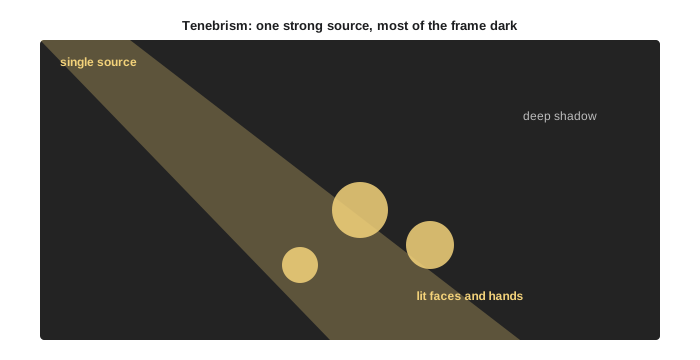
Tenebrist light has several effects that image makers exploit. It isolates the subject from the background, so there are no distractions. It creates strong modeling, making faces and bodies feel sculptural. It suggests a single moment, as if the light has just fallen on the scene. And it creates mood: mystery, revelation, menace or spiritual intensity, depending on context.
Caravaggio's revolution
Michelangelo Merisi da Caravaggio, working mainly in Rome from the 1590s until his death in 1610, transformed European painting. He painted religious stories using ordinary people from the streets as models, with dirty feet, worn clothes and weathered faces, lit by a harsh light from one side against a dark ground. His Calling of Saint Matthew, painted around 1599 to 1600 for a chapel in the church of San Luigi dei Francesi in Rome, shows tax collectors at a table in a dim room. Christ enters at the right and points, and a beam of light from above the doorway falls diagonally across the wall and onto the faces of the men, following the direction of his gesture. The light becomes the visual sign of the calling itself.
Caravaggio's influence spread rapidly. Painters across Europe, known as Caravaggisti, adopted his lighting and realism. Artemisia Gentileschi, one of the most accomplished painters of the seventeenth century and among the first women admitted to the Florentine Academy of the Arts of Drawing, used tenebrist light with great power in scenes of biblical heroines such as Judith. Her work, long overshadowed, is now widely recognized.
Reading Baroque light in stops
Photographers and cinematographers describe contrast in stops, where each stop doubles or halves the amount of light. Baroque paintings can be read in the same terms. The ratio between the brightest highlight and the darkest shadow detail tells you the dynamic range a scene requires.
A painting is a reflective object, so its own contrast range is limited: the whitest lead white paint reflects perhaps 30 to 40 times more light than the darkest black glazes under the same lighting, a range of only about five stops. Baroque painters created the illusion of much greater contrast by placing their brightest values right next to their darkest, and by keeping most of the canvas dark so that the eye adapts.
Worked problem
Translating a tenebrist painting into a lighting ratio
You want to recreate the feel of a tenebrist painting in a portrait. Your key light gives 1,600 lux on the lit side of the face. You want the shadow side about four stops darker and the background about seven stops below the key. What light levels do you need?
Show solution
- Four stops below the key means dividing by \(2^4 = 16\): \(1600 \div 16 = 100\) lux on the shadow side.
- Seven stops below means dividing by \(2^7 = 128\): \(1600 \div 128 = 12.5\) lux on the background.
- Express the key-to-shadow lighting ratio: \(1600 : 100 = 16 : 1\).
- Check practicality: many digital cameras record twelve or more stops, so a seven-stop range fits, with the background falling close to black in a normal exposure for the face.
Answer: Aim for about 100 lux on the shadow side of the face (a 16:1 ratio) and about 12.5 lux on the background. Use a single hard key from one side, minimal fill, and flags to keep light off the background.
Rembrandt and the lighting pattern named after him
Rembrandt van Rijn, working in Amsterdam from the 1630s until his death in 1669, used chiaroscuro differently from Caravaggio: softer, warmer and more psychological. His many self-portraits, painted over four decades, show his face emerging from a warm brown darkness, lit from above and to one side, with the light revealing aging skin, thoughtful eyes and the texture of thick paint. Large group portraits such as the painting commonly called The Night Watch, completed in 1642, use pools of light to pick out key figures within a crowded, dark scene.
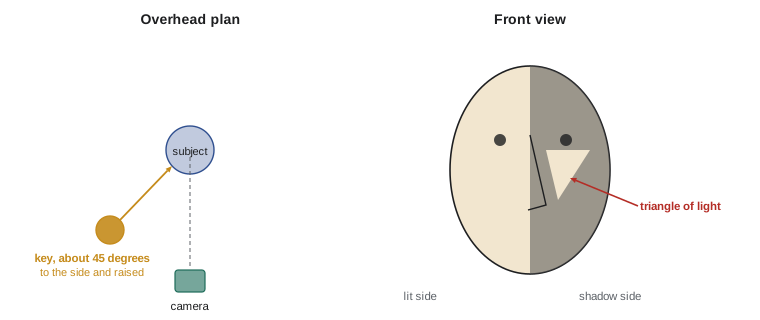
Portrait photographers adopted Rembrandt's name for a specific lighting pattern. In Rembrandt lighting, the key light is placed above and to one side of the subject, at roughly 45 degrees to the side and 45 degrees up. The lit side of the face is fully illuminated, and the nose casts a shadow that meets the shadow of the cheek on the far side, leaving a small, inverted triangle of light on the shadowed cheek beneath the eye.
| Pattern | Key position | Look | Association |
|---|---|---|---|
| Rembrandt | about 45 degrees to the side and above | triangle of light on the shadow cheek | Rembrandt's portraits |
| Loop | slightly to the side and above | small nose shadow looping toward the cheek | everyday flattering portraiture |
| Butterfly or paramount | in front and above | small shadow under the nose | Hollywood glamour portraits |
| Split | 90 degrees to the side | half the face lit, half dark | drama, duality, tenebrism |
| Broad and short | lighting the side of the face nearer or farther from camera | widens or narrows the face | studio portraiture |
Rembrandt lighting is valued because it models the face strongly while still revealing both eyes, giving depth and character without the harshness of split lighting.
Dutch Golden Age light: windows and everyday life
In the Dutch Republic of the seventeenth century, a wealthy merchant class bought paintings for their homes: portraits, landscapes, still lifes and scenes of everyday life, known as genre scenes. Many of these interiors are lit by a single side window, usually on the left. The light falls softly across rooms, figures and objects, creating gentle gradations rather than tenebrist drama.
This north-facing window light, soft, directional and consistent, became the model for studio light in photography. Early portrait studios used large north-facing skylights for the same reason. Today, photographers recreate the effect with large softboxes placed to one side, and cinematographers place big diffused sources outside windows on set.
Vermeer and the camera obscura debate
Johannes Vermeer of Delft, who died in 1675, painted fewer than forty surviving works, mostly quiet interiors with one or two figures lit by a window at the left. Paintings such as the woman reading a letter at an open window, the milkmaid pouring milk, and the girl with a pearl earring are celebrated for their luminous light, precise perspective and tiny dots of bright paint, sometimes called pointillés, that sparkle on bread, metal and fabric.
For centuries, writers have speculated about whether Vermeer used a camera obscura, a darkened box or room in which a lens or pinhole projects an image of the outside world onto a surface. Supporters point to effects that resemble optical phenomena: highlights that look like unfocused circles of light, exaggerated differences in scale between near and far objects, and very accurate perspective. Skeptics note that there is no documentary evidence, such as a record of Vermeer owning a lens, and that skilled painters could produce these effects through observation and convention. The artist David Hockney and the physicist Charles Falco proposed in the early 2000s that many painters used optical aids, a controversial idea known as the Hockney–Falco thesis. In 2013, the documentary Tim's Vermeer followed an inventor who built an optical device to paint a Vermeer-like picture, reviving the debate.
The debate matters to image makers because it raises an enduring question: where does the boundary lie between optical tools and artistic skill? Photographers face the same question with autofocus, computational photography and AI tools. Whatever Vermeer did, his work shows that careful observation of how light behaves on surfaces is the foundation of convincing images.
Baroque composition: diagonals and movement
Baroque compositions often abandoned the stable pyramids of the High Renaissance for dynamic diagonals, twisting figures and moments of peak action. Peter Paul Rubens in Flanders filled large canvases with swirling movement. In Spain, Diego Velázquez's Las Meninas, painted in 1656, created a famously complex composition involving the painter himself at his easel, the young princess and her attendants, and a mirror on the back wall reflecting the king and queen, who seem to stand where the viewer stands. It has fascinated generations of critics because it makes viewers aware of their own position as observers.
Diagonals suggest energy and instability, which is why action scenes in films often use tilted lines, dynamic camera movement and figures moving across the frame diagonally. Velázquez's play with mirrors and viewers also anticipates reflexive cinema, in which films reveal their own making.
Worked problem
Choosing Renaissance calm or Baroque drama
You are lighting and framing two scenes for a short film: a peaceful family breakfast and the moment a character discovers a betrayal. Suggest a lighting and composition approach for each, drawing on Renaissance and Baroque models.
Show solution
- Breakfast: borrow Dutch window light, a large soft source from one side, moderate contrast of about two to three stops between key and shadow.
- Breakfast composition: a stable, balanced arrangement, perhaps a loose pyramid of family members around the table, with a level camera.
- Discovery: borrow tenebrist light, a single hard source, shadow side four or more stops darker, background near black.
- Discovery composition: a diagonal composition, perhaps a slightly low angle, with light falling across the character's face along a diagonal.
Answer: Light the breakfast with soft, low-contrast side window light and a stable, balanced composition, in the spirit of Dutch interiors. Light the discovery with a single hard source in deep darkness and a diagonal composition, in the spirit of Caravaggio, so the shift in visual style signals the emotional shock.
Baroque light in photography and cinema
Film noir of the 1940s and 1950s used low-key, hard light, deep shadows and dramatic angles, partly influenced by German Expressionist cinema, itself indebted to a long tradition of dramatic chiaroscuro. Directors and cinematographers have frequently cited Caravaggio and Rembrandt; many period films light candlelit interiors to resemble Baroque paintings, sometimes with very fast lenses that allow shooting by candlelight alone.
US museums hold major Baroque collections; the Metropolitan Museum of Art and the National Gallery of Art in Washington display paintings by Rembrandt, Vermeer and Caravaggio's followers, and several smaller museums hold important Dutch works.
What image makers take from the Baroque
Baroque painters show that light is a storytelling tool. A single directional source in darkness focuses attention and creates drama. Softer window light makes intimacy and calm. The Rembrandt pattern models a face with character. Contrast can be measured in stops and planned as lighting ratios. Diagonals add energy, and mirrors and gazes can make viewers aware of their own position. And the camera obscura debate reminds you that tools and skill have always worked together.
Common mistakes
MistakeUsing the term chiaroscuro and tenebrism interchangeably
InsteadUse chiaroscuro for light-dark modeling generally and tenebrism for extreme darkness with a few spotlit areas
MistakeAssuming Rembrandt lighting means any dark portrait
InsteadIdentify it by a key about 45 degrees to the side and above, leaving a small triangle of light on the shadow cheek
MistakeStating as fact that Vermeer traced camera obscura images
InsteadPresent the camera obscura theory as a debated hypothesis without documentary proof
MistakeLighting every scene with high contrast because it looks artistic
InsteadMatch contrast and lighting style to the scene's mood, using soft window light for calm and hard light for drama
MistakeThinking paintings could show unlimited contrast
InsteadRemember painted surfaces span only about five stops and painters create the illusion of more by placing extremes side by side
Summary and key terms
- Chiaroscuro models form with light and dark; tenebrism plunges most of the picture into darkness with a few spotlit areas.
- Caravaggio's Calling of Saint Matthew uses a diagonal beam of light as the visual sign of the story's turning point.
- Artemisia Gentileschi and other Caravaggisti spread dramatic tenebrist light across Europe.
- Contrast can be measured in stops; a 16:1 key-to-shadow ratio equals four stops.
- Rembrandt lighting places the key about 45 degrees to the side and above, leaving a triangle of light on the shadow cheek.
- Dutch interiors and Vermeer used soft side-window light, the model for studio light in photography.
- Whether Vermeer used a camera obscura remains debated, raising lasting questions about tools and skill.
- Chiaroscuro
- The use of strong contrasts of light and dark to model form
- Tenebrism
- An extreme form of chiaroscuro in which most of the image is dark and a few areas are dramatically lit
- Caravaggisti
- Painters who adopted Caravaggio's dramatic lighting and realism
- Rembrandt lighting
- A portrait pattern with the key about 45 degrees to the side and above, leaving a triangle of light on the shadow cheek
- Lighting ratio
- The ratio of light on the lit side of a subject to light on the shadow side
- Stop
- A doubling or halving of light
- Genre scene
- A painting of everyday life
- Camera obscura
- A darkened box or room in which a small opening projects an inverted image of the outside world
- Split lighting
- A key at 90 degrees to the side that lights half the face and leaves the other half dark
- Low-key lighting
- Lighting with predominantly dark tones and strong shadows
Practice problems
Work each problem on paper first, then reveal the answer to check.
What is the difference between chiaroscuro and tenebrism?
Show answer
Chiaroscuro is light-dark modeling in general; tenebrism is an extreme version with mostly dark images and dramatic spotlit areas.
How does light carry meaning in Caravaggio's Calling of Saint Matthew?
Show answer
A beam falls diagonally along the direction of Christ's gesture onto the men, visually expressing the calling.
How many stops is a 32:1 lighting ratio?
Show answer
Five stops, because \(2^5 = 32\).
If the key gives 800 lux and you want the shadow three stops darker, what level do you need?
Show answer
\(800 \div 8 = 100\) lux.
Describe the light position for Rembrandt lighting.
Show answer
About 45 degrees to the side of the subject and about 45 degrees above.
What visible feature identifies Rembrandt lighting?
Show answer
A small triangle of light on the shadowed cheek beneath the eye.
Why did early photography studios use north-facing skylights?
Show answer
They gave soft, consistent, directional light, like Dutch window light.
State one argument for and one against Vermeer's use of a camera obscura.
Show answer
For: optical-looking highlights and accurate perspective; against: no documentary evidence and skilled observation could produce the effects.
What compositional feature gives Baroque paintings energy?
Show answer
Dynamic diagonals and twisting figures.
Name a film style influenced by dramatic chiaroscuro.
Show answer
Film noir.
Lesson quiz · 5 questions
Score 60% or more to complete this lesson.
Create a free account to save your progress, take quizzes and earn a certificate.