
VIS-130 · Lesson 5 of 12 · 25 min
Romanticism, Realism and landscape
For most of European history, landscape was a background for religious or historical scenes. Between the late eighteenth and the mid-nineteenth centuries, it became a subject in its own right and a vehicle for feelings about nature, nation, industry and the self. Romantic painters turned storms, mountains and ruins into images of awe and terror; Realists insisted on painting ordinary people and places without idealization. Both movements shaped how photographers and filmmakers frame nature and everyday life: the lone figure before a vast view, the epic western vista, the gritty working-class street. This lesson explores the sublime and the picturesque, J. M. W. Turner and John Constable in Britain, Caspar David Friedrich in Germany, French Realism with Gustave Courbet and Jean-François Millet, and North American landscape traditions, from the Hudson River School to Canadian painters such as Cornelius Krieghoff and the early national landscapes that led to the Group of Seven.
The sublime and the picturesque
Two eighteenth-century ideas framed how artists and audiences thought about landscape. The picturesque, popularized in Britain by writers such as William Gilpin in the 1780s and 1790s, valued scenery that looked like a picture: varied, irregular, with winding paths, ruined buildings, rough textures and a pleasing arrangement of foreground, middle ground and distance. Tourists carried tinted, convex mirrors, known as Claude glasses after the French painter Claude Lorrain, to view scenes reduced and toned like paintings, a curious ancestor of the camera viewfinder and the photo filter.
The sublime, discussed by the philosopher Edmund Burke in 1757, described experiences of overwhelming scale, power or danger, such as storms at sea, towering mountains and avalanches, which produce a mixture of terror and fascination when viewed from safety. Sublime landscapes make humans look small and nature vast and uncontrollable.
| Quality | Typical subjects | Formal features | Modern image equivalent |
|---|---|---|---|
| Beautiful | gentle hills, calm water | smooth forms, harmony, soft light | calm travel and lifestyle imagery |
| Picturesque | ruins, cottages, winding rivers | variety, roughness, layered planes | heritage tourism images, cozy rural scenes |
| Sublime | storms, mountains, waterfalls, ice | vast scale, darkness, tiny figures | epic drone shots, disaster films, extreme adventure photography |
These categories still describe much nature imagery. A tourism advertisement chooses the beautiful or picturesque; an adventure documentary chooses the sublime.
Friedrich and the figure seen from behind
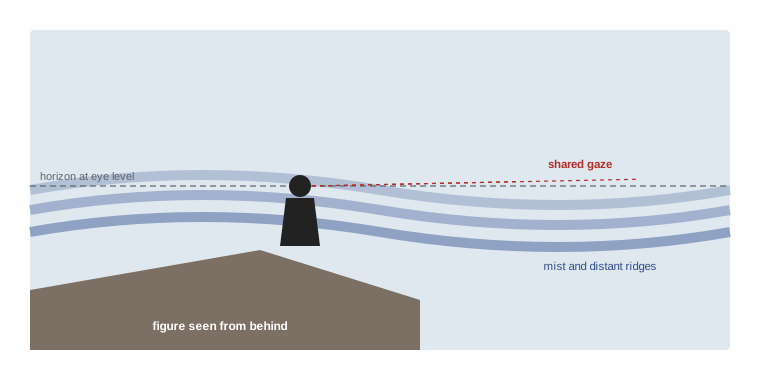
Caspar David Friedrich, working in Dresden in the early nineteenth century, painted quiet, intense landscapes full of spiritual meaning: ruined abbeys in snow, moonrises over the sea, and figures seen from behind gazing out at vast views. This device, often called by the German term Rückenfigur, invites viewers to stand in the figure's place and share their contemplation. Friedrich's painting of a man in a dark coat standing on a rocky summit above a sea of fog, painted around 1817 to 1818, has become one of the most reproduced images of Romanticism.
Friedrich's compositions are often stark and symmetrical, with a horizon placed low and large areas of sky or mist. They feel still rather than dramatic, closer to meditation than to terror. The figure seen from behind is everywhere in modern photography and film: a hiker on a ridge, a character at a window, a traveler at a train window. It works because it lets the audience look with the character rather than at them.
Turner: light, weather and speed
J. M. W. Turner, who lived from 1775 to 1851, began with topographical watercolours and became one of the most radical painters of his age. His later works dissolve ships, steam and landscapes into swirling light, color and atmosphere. In Snow Storm, a painting exhibited in 1842, a steamboat is barely visible within a vortex of wind and snow. In Rain, Steam and Speed, painted around 1844, a train crosses a bridge toward the viewer through rain and mist, a celebration and perhaps a warning about the new speed of industrial life.
Turner's work matters to image makers because it shows that atmosphere can be the subject. Weather, haze, motion blur and the glow of light through moisture can carry an image's emotion. Long exposures of crashing waves, motion-blurred trains, misty mountains at dawn and light shafts through fog all belong to a sensibility Turner helped invent.
Constable: observation and the sky
John Constable, Turner's near contemporary, took a different path. He painted the countryside of Suffolk where he grew up, such as his painting of a hay wain crossing a shallow river near a mill, exhibited in 1821. Constable made hundreds of oil sketches outdoors, especially of clouds, noting the date, time and wind direction on the back. He believed painting should be a science of observation.
His cloud studies are a practical lesson for photographers: skies change minute by minute, and paying attention to cloud forms, wind and light direction transforms landscape images. Constable's commitment to working directly from nature anticipated the outdoor painting of the Impressionists and the habits of landscape photographers who wait for the right light.
Realism: the ordinary as subject
In France around 1850, painters reacted against both academic idealism and Romantic drama. Realism aimed to show contemporary life truthfully, including the lives of workers and peasants, who had rarely been considered worthy of large paintings. Gustave Courbet caused a scandal with A Burial at Ornans, painted in 1849 to 1850, a huge canvas showing an ordinary village funeral at the scale traditionally reserved for history paintings of heroes and saints. His Stone Breakers showed two laborers at backbreaking roadwork.
Jean-François Millet painted peasants at work in the fields, as in The Gleaners, exhibited in 1857, which shows three women bent over to collect the leftover grain after the harvest, set against the abundance of the farm in the distance. Honoré Daumier made biting lithographs and paintings of urban workers, courts and politicians.
Realism's insistence that ordinary people deserve serious attention flows directly into documentary photography, social realist cinema and photojournalism. When a photographer gives a farm worker or factory employee the dignity of a carefully composed, large-format portrait, they are working in the Realist tradition.
Worked problem
Comparing Romantic and Realist approaches to the same subject
You are photographing a commercial fishing crew returning to harbor at dawn. Describe how a Romantic approach and a Realist approach would differ.
Show solution
- Romantic approach: emphasize the sea and sky, perhaps a small boat in a vast seascape with dramatic clouds or mist; use backlight and atmosphere; the people are small and the mood is awe.
- Realist approach: emphasize the workers and their labor, close or medium framing of weathered hands, gear, fish and faces; even, unflattering light; the mood is respect for work.
- Note the composition: Romantic images use low horizons and large skies; Realist images fill the frame with people and tools.
- Note the meaning: the Romantic image speaks of humans against nature; the Realist image speaks of work, community and economic reality.
Answer: A Romantic image would make the boat tiny against a vast, misty sea and sky lit from behind, expressing awe at nature. A Realist image would fill the frame with the crew, their hands, gear and catch in plain light, giving them the dignity of serious attention and showing the reality of their work.
The North American sublime: the Hudson River School
In the United States, a group of landscape painters now called the Hudson River School, active from the 1820s to the 1870s, painted the wilderness of the Hudson River valley, the Catskills and later the American West. Thomas Cole, the group's founder, mixed close observation with moral allegory. Frederic Church painted huge canvases of Niagara Falls, the Andes and icebergs, exhibited as public events that drew crowds. Albert Bierstadt's vast paintings of the Rocky Mountains and Yosemite helped shape popular images of the West and supported arguments for protecting such places.
These paintings were not neutral. They often presented the land as empty, awaiting settlement, while removing or marginalizing the Indigenous peoples who lived there. Many expressed the idea of Manifest Destiny, the belief that American expansion across the continent was inevitable and right. Image makers working with landscapes should remember that the choice of what to include and exclude carries political meaning.
The western landscapes of the Hudson River School and their successors fed directly into photography. Photographers such as Carleton Watkins in Yosemite in the 1860s and William Henry Jackson, who photographed Yellowstone for a government survey in 1871, produced images that helped persuade Congress to protect these lands; Yellowstone became the world's first national park in 1872.
From painting to photograph: the landscape tradition continues
The arrival of photography in 1839 did not end landscape painting, but it added a new medium with its own possibilities. Early landscape photographers borrowed composition directly from painting: foreground interest, a winding path leading the eye, a framed vista. Later photographers in the twentieth century, such as Ansel Adams in the United States, used large-format cameras and precise control of tones to create grand, sublime images of the American West that echo the Hudson River School in ambition, while asserting photography's own aesthetic.
Landscape and nation
Both Romantic and Realist landscapes were bound up with national identity. British painters celebrated the English countryside as an image of national character. German Romantics sought spiritual meaning in northern forests and mountains. In North America, landscape painting became a way to define new nations through their land.
In the United States, landscape remained bound up with national identity into the twentieth century, from regionalist painters of the Midwest in the 1930s to photographers of the national parks. Critics later pointed out that images of untouched wilderness often overlooked Indigenous presence and the forced removals that made many parks possible. Lesson 11 returns to these debates, and to how contemporary Native artists respond to the landscape tradition.
What image makers take from Romanticism and Realism
The sublime offers a vocabulary of scale, weather and tiny figures for images of awe. The picturesque offers layered, varied compositions. Friedrich's figure seen from behind lets audiences share a character's gaze. Turner shows that atmosphere and motion can be the subject; Constable shows the value of patient observation of skies and light. Realism insists that ordinary people and places deserve serious attention, the foundation of documentary practice. And the North American landscape tradition reminds you that framing land is never neutral: what you include, exclude and celebrate carries meaning.
Common mistakes
MistakeUsing sublime and beautiful as interchangeable words
InsteadDistinguish the sublime's awe and fear before vast power from the beautiful's harmony and calm
MistakeAssuming landscape images are politically neutral
InsteadAsk what is included and excluded, including Indigenous presence, industry and land use
MistakeThinking Realism simply means detailed or lifelike painting
InsteadUnderstand Realism as a movement insisting on ordinary contemporary subjects without idealization
MistakeTreating Turner's late works as unfinished or careless
InsteadRecognize that he deliberately made atmosphere, light and motion the subject
MistakeCopying the figure-seen-from-behind shot without purpose
InsteadUse it when you want the audience to share a character's gaze and inner state
Summary and key terms
- The picturesque valued varied, layered scenery; the sublime described awe and terror before vast natural power.
- Friedrich's figures seen from behind invite viewers to share contemplation of vast landscapes.
- Turner made weather, light and speed the subject; Constable made patient study of skies and countryside.
- Realists such as Courbet and Millet gave ordinary workers and village life the scale and seriousness of history painting.
- The Hudson River School painted American wilderness on an epic scale, often expressing ideas of expansion.
- Canadian landscape painting from Krieghoff to the Group of Seven tied land to national identity.
- Landscape images carry political meaning through what they include and exclude.
- Sublime
- An aesthetic of awe and terror before vast scale or power, such as storms and mountains
- Picturesque
- An aesthetic valuing varied, irregular scenery arranged as if in a picture
- Rückenfigur
- A figure seen from behind, inviting the viewer to share their view
- Romanticism
- A late-eighteenth to nineteenth-century movement emphasizing emotion, nature and the individual
- Realism
- A mid-nineteenth-century movement depicting ordinary contemporary life without idealization
- Hudson River School
- A group of American landscape painters active from the 1820s to the 1870s
- Claude glass
- A tinted, convex mirror used by eighteenth-century tourists to view scenery like a painting
- Group of Seven
- Canadian painters who formed a group in 1920 to create a national art from northern landscapes
- Manifest Destiny
- The nineteenth-century belief that US expansion across the continent was inevitable and justified
- Plein air
- Painting outdoors, directly from the subject
Practice problems
Work each problem on paper first, then reveal the answer to check.
Name two features of a sublime landscape.
Show answer
Vast scale and dangerous or overwhelming natural forces, often with tiny human figures.
What was a Claude glass used for?
Show answer
Viewing scenery reduced and tinted like a painting, a kind of early viewfinder or filter.
Why does a figure seen from behind work so well in film?
Show answer
It lets the audience share the character's gaze rather than look at them.
What did Turner make the subject of his late paintings?
Show answer
Atmosphere, light, weather and motion.
What did Constable record on his cloud sketches?
Show answer
The date, time and weather conditions such as wind direction.
Why was A Burial at Ornans controversial?
Show answer
It showed an ordinary village funeral at the huge scale reserved for heroic history painting.
What does The Gleaners show?
Show answer
Three peasant women collecting leftover grain after the harvest, contrasted with distant abundance.
Give one criticism of Hudson River School paintings.
Show answer
They often presented the land as empty, marginalizing Indigenous peoples and supporting expansionist ideas.
What three planes structure a classic landscape?
Show answer
Foreground, middle ground and background.
What links Romantic landscape to modern adventure photography?
Show answer
Both use vast scale, dramatic weather and small figures to create awe.
Lesson quiz · 5 questions
Score 60% or more to complete this lesson.
Create a free account to save your progress, take quizzes and earn a certificate.