
SLS-250 · Lesson 7 of 12 · 19 min
Add-ons and suggestive selling
▶ Video coming soon A video version of this lesson is on the way.
Three days after Aiden sold a washer and dryer to a young couple on October 20, the husband called the store. The delivery crew had arrived, but the couple's old dryer had used a three-prong cord and the new one needed a four-prong cord to match their outlet. The crew did not carry one. Nobody had asked about the outlet at the sale. The installation was rebooked for the following week, and the couple spent another week at the laundromat. "That cord costs 39 dollars," Carl said when Aiden told him. "Asking about it isn't upselling. It's finishing the job."
Add-on selling, also called suggestive selling or attachment selling, means offering products or services that go with the main purchase. Done well, it completes the customer's solution: the mattress protector that keeps the warranty valid, the installation kit that makes the dishwasher work, the felt pads that protect a new hardwood floor. Done badly, it is a series of pushy offers that make the customer feel squeezed. This lesson covers how to choose add-ons, when and how to suggest them, how they affect the store's numbers, and where the ethical and legal lines are.
Completing the solution
The best way to think about add-ons is from the customer's side: what else will they need to use this product well, protect it, install it or enjoy it fully? Many customers only discover what they forgot when the delivery crew arrives or the first spill happens. An associate who asks the right questions at the sale prevents those problems.
| Main purchase | Add-ons that often complete it | Question that uncovers the need |
|---|---|---|
| Mattress | Mattress protector, pillows, adjustable or foundation base, bed frame, sheets in the new size | "Will your current frame and sheets fit the new size?" |
| Sofa or sectional | Fabric care kit, throw pillows, area rug, coffee table, haul-away of the old sofa | "What are you doing with the old one?" |
| Dining set | Table pads, chair glides, extra chairs, a buffet or sideboard | "How many people at your biggest family dinner?" |
| Washer and dryer | Hoses, dryer cord or vent kit, stacking kit, pedestal drawers, haul-away | "Is your dryer outlet three-prong or four-prong?" |
| Refrigerator | Water line kit, extra filter, haul-away, installation | "Does your current fridge have a water line for the ice maker?" |
| Range | Power cord or gas connector, anti-tip bracket installation, haul-away | "Is the range electric or gas, and what's the outlet like?" |
Some of these, such as the anti-tip bracket for a range or the correct dryer cord, are about safety and function, not choice. Associates should always cover them. Others, such as throw pillows or a rug, are genuine options that some customers will want and many will not.
When and how to suggest
Timing matters. Suggesting add-ons before the customer has decided on the main product distracts them and can make the total seem frightening. The usual moment is just after the main decision, when the customer is relieved and thinking about how the product will work at home. A second natural moment is at the counter, when the associate reviews the order and delivery.
How to suggest matters as much. The most effective suggestions connect to something the customer said, explain the benefit briefly and accept a no gracefully. Juniper & Pine teaches a three-part pattern: link, recommend, release.
| Part | What it sounds like |
|---|---|
| Link to what they said | "You mentioned Luis runs hot at night..." |
| Recommend one specific item and why | "...this protector has the same cooling surface as the mattress, so it won't trap heat, and it keeps the warranty valid if there's ever a spill." |
| Release: make no easy | "It's 129 dollars. Would you like to add it, or are you happy with the one you have?" |
One recommendation at a time works better than a list. A customer offered five extras at once usually declines all of them, a reaction researchers who study choice overload have described in many settings. Associates choose the one or two add-ons that matter most for this customer and stop there.
How add-ons affect the numbers
Lesson 1 introduced units per transaction (UPT), average transaction value (ATV) and attachment rate. Add-ons move all three. They also usually carry higher margins than the main product, so they matter to the store's profit and, under margin-based commission plans like Juniper & Pine's, to the associate's pay. That is exactly why they need an ethical frame.
Worked problem
How much do protectors add to a week of mattress sales?
In his first full commission week, Aiden sold 14 mattresses at an average of 1,240 dollars, and 4 of those customers added a 129-dollar protector. Over the following two weeks, using link, recommend and release, 7 of his 16 mattress customers added one. What was the attachment rate in each period, and how much did protectors add to the average mattress transaction in each period?
Show solution
- Attachment rate in the first week.
- \[4 \div 14 \approx 0.29\]
- Attachment rate in the next two weeks.
- \[7 \div 16 \approx 0.44\]
- Protector sales per mattress transaction in the first week.
- \[(4 \times 129) \div 14 = 516 \div 14 \approx 36.86\ \text{dollars}\]
- Protector sales per mattress transaction in the next two weeks.
- \[(7 \times 129) \div 16 = 903 \div 16 \approx 56.44\ \text{dollars}\]
Answer: The attachment rate rose from about 29 in 100 to about 44 in 100, and protectors added about 37 dollars, then about 56 dollars, to each mattress transaction. Aiden's exchange and complaint records stayed clean, which Bev took as a sign that customers wanted the protectors rather than feeling pushed.
The ethical line
The line between helpful suggestion and pressure is not always sharp, but some practices are clearly on the wrong side of it. Associates should not claim an add-on is required when it is not, imply that a warranty will be void without the store's add-on when any suitable product would do, use fear ("you'll regret it when the kids ruin it") to sell protection, add items to an order without the customer's clear agreement, or keep pushing after a clear no.
A good test is the badge rule from lesson 1: would you buy this add-on in their place? If the honest answer is "no, they don't need it", do not suggest it. If it is "yes, but only if they have pets", ask about pets first.
The law on add-ons
Two areas of law matter most. First, the FTC Act's ban on deceptive practices applies to add-on claims: saying that a protector is needed to keep a warranty valid must be true. The federal Magnuson-Moss Warranty Act also generally prevents a warrantor from making warranty coverage depend on using a particular branded product unless it is provided free or the FTC grants a waiver. Second, tying, meaning requiring a customer to buy one product as a condition of buying another, can violate federal antitrust law in some circumstances; in ordinary retail, offering optional bundles is normal, but associates must not tell a customer they cannot buy the mattress without the store's protector. Adding charges a customer did not agree to is also a deceptive practice under South Dakota law and FTC rules.
Bundles and packages
Many stores offer bundles: a mattress set with a base and protector at a package price, or a kitchen appliance package with a discount for buying three. Bundles can be good value and simplify choices. They must still be honest: the package price must actually be lower than buying the items separately at their regular selling price, the customer must be able to buy the main item on its own, and any conditions must be clear. Lesson 9 and SLS-253 return to bundle pricing and margins.
Recording add-on conversations
Because add-ons often come up again, Juniper & Pine asks associates to record declined add-ons too, briefly, in the client book: "declined protector, has one from old bed". This avoids awkward repeat offers on the next visit and helps follow-up. A customer who declined a fabric care kit and then calls about a stain is a natural moment to mention it again, as a solution rather than a sale.
Add-ons by phone and online
Not every sale happens on the floor. Customers who order by phone, through the website or after a virtual consultation need the same complete solution, and they are more likely to forget something because they cannot see the products together. Juniper & Pine's website suggests related items automatically, but associates who follow up on online orders add the human check: "I see you ordered a dishwasher. Do you know whether your old one has a separate shut-off valve, or will the installer need to add one?" These calls prevent failed installations and are usually welcomed.
Measuring add-on selling fairly
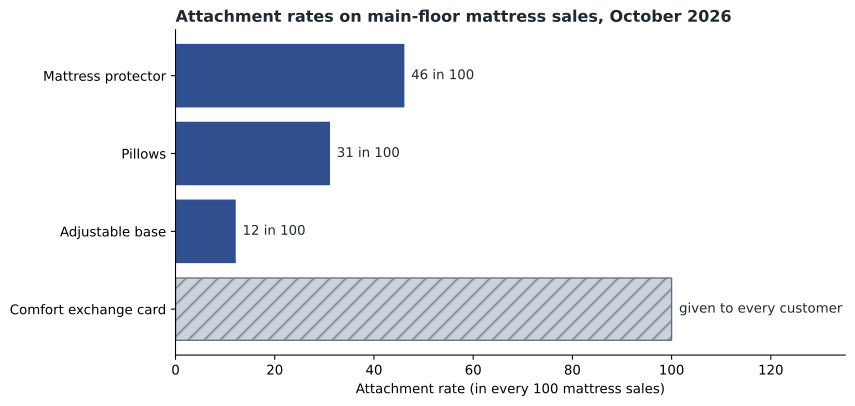
Managers track attachment rates because they reveal both missed opportunities and pressure. A very low rate on mattress protectors may mean associates are not mentioning them; a very high rate combined with complaints or returned protectors may mean they are being pushed. Bev reviews attachment rates alongside returns, complaints and customer comments, never on their own. She also compares rates by product, since some add-ons, such as the anchoring kit for dressers, are given with every sale and should not count as selling at all.
For associates, the healthiest way to think about add-ons is as a checklist of questions that protect the customer, not as a target. When the questions are asked every time, the numbers take care of themselves.
A last check before the counter helps: run through the customer's home in your head. Will the product get in, will it work on the day it arrives, will it be protected, and is anything left to buy before they can use it fully? Any honest answer of "no" points to an add-on worth mentioning.
Add-ons the store gives rather than sells
Some items are best given with the sale rather than sold, because they protect the customer and the store alike. Juniper & Pine includes an anchoring kit with every dresser and bookcase, care instructions with every sofa and a printed copy of the comfort exchange conditions with every mattress. These items have no effect on commission, but they prevent injuries, stains and disputes. Associates mention them at the counter so customers know to use them, which is part of completing the solution even when nothing extra is being bought.
A useful habit is to keep a small card of the add-on questions for each category in your pocket during the first months on the floor. Aiden kept one for mattresses, sofas and laundry, and by the end of his first month he no longer needed to look at it.
Add-on conversations also reveal needs the customer has not mentioned. A question about the old mattress can lead to a conversation about the spare room; a question about the dryer cord can reveal that the washer is also old. Associates note these needs in the client book, as lesson 10 describes, rather than pressing for a second sale on the spot. Many of Carl's follow-up calls begin from a need he first heard about during an add-on question months earlier.
Common mistakes
MistakeAdd-ons are about increasing the sale.
InsteadAdd-ons are first about completing the customer's solution. The sale increases as a result.
MistakeOffer every add-on to every customer.
InsteadChoose the one or two that matter for this customer, based on what they said.
MistakeSuggest add-ons before the main decision.
InsteadWait until the customer has decided on the main product, then suggest at the decision or the counter.
MistakeTell customers a warranty is void without the store's protector.
InsteadOnly state warranty conditions that are true, and never make an optional product sound mandatory.
MistakeA no means try another angle.
InsteadAccept a clear no gracefully, and record it so the customer is not asked again.
Summary and key terms
- Add-ons complete the customer's solution; some, such as the right dryer cord or an anti-tip bracket, are about function and safety.
- Suggest add-ons after the main decision or at the counter, one or two at a time.
- Link to what the customer said, recommend one item and why, and release with an easy way to say no.
- Add-ons raise attachment rate, units per transaction and average transaction value, and usually carry higher margins.
- Never make optional add-ons sound required, use fear, or add items without clear agreement.
- The law prohibits misleading claims about add-ons and restricts tied selling; bundles must be honest and optional.
- Add-on
- A product or service offered to go with the main purchase.
- Suggestive selling
- Recommending related items that complete or improve the customer's purchase.
- Link, recommend, release
- Juniper & Pine's pattern for suggesting an add-on: link to the need, recommend one item, make no easy.
- Tied selling or tying
- Requiring a customer to buy one product as a condition of buying another.
- Bundle
- A group of products sold together at a package price.
Practice problems
Work each problem on paper first, then reveal the answer to check.
Write a link, recommend, release suggestion for felt pads with a new dining set on a hardwood floor.
Show answer
For example: "You mentioned the new hardwood floors. These felt glides go under the chair legs so they won't scratch when the kids push back from the table. They're 19 dollars a set. Want me to add them, or are you set?"
Of 25 sofa sales, 6 included a fabric care kit. What is the attachment rate?
Show answer
6 divided by 25 is 0.24, or 24 in 100.
Why should declined add-ons be recorded?
Show answer
So the customer is not asked again on the next visit, and so follow-up can offer the item later as a solution if a need arises.
Name two add-ons that are about function or safety rather than choice.
Show answer
Any two of: the correct dryer cord or vent kit, a water line kit, a range anti-tip bracket, a gas connector.
Lesson quiz · 5 questions
Score 60% or more to complete this lesson.
Create a free account to save your progress, take quizzes and earn a certificate.