
SLS-250 · Lesson 2 of 12 · 19 min
Approaching and greeting customers
▶ Video coming soon A video version of this lesson is on the way.
On his first Saturday on the main floor, October 24, Aiden counted something Bev had asked him to watch. Between 11 and noon, 31 shopping groups came through the furniture entrance. Eleven were greeted by someone within a minute. Twenty walked the floor on their own for several minutes before anyone spoke to them, and eight of those left without any conversation at all. "You can't sell to someone you never talk to," Bev said when he showed her the tally. "And you can't talk to them well if the first thing you say is 'Can I help you?'"
The approach is the first step of the retail selling process. It sets the tone for everything after it. Done well, it makes the shopper feel welcome and free to browse, while making it easy for them to ask for help when they are ready. Done badly, it feels either like being ignored or like being pounced on, and many shoppers respond to both by leaving. This lesson looks at when and how to approach, what to say, how to read the shopper's signals, and how to handle the common replies.
Why the first minute matters
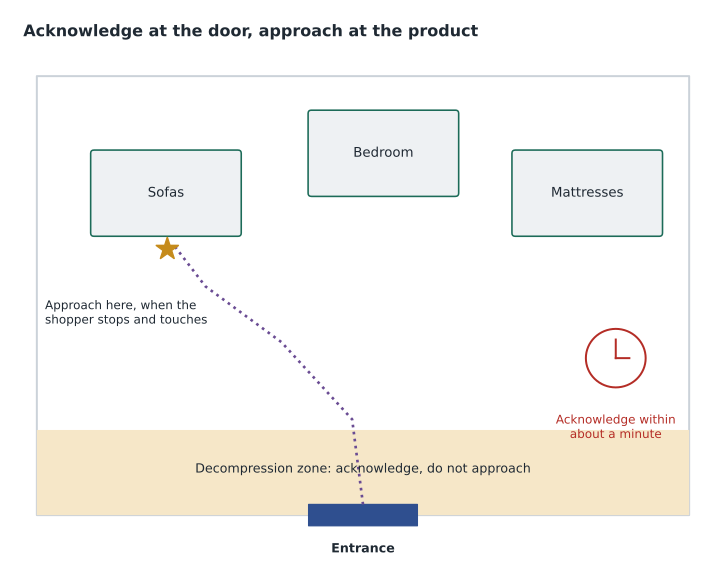
SLS-110 described how shoppers form impressions in seconds and how those impressions color what follows. On a sales floor, the greeting is a large part of that first impression. Research on retail service and Paco Underhill's long-running observations of shoppers point in the same direction: shoppers who interact with a salesperson are more likely to buy than those who do not, and the sheer number of customers who are never approached is often surprising to store managers. Underhill also described the "decompression zone" just inside the entrance, where shoppers are adjusting to the store and tend not to notice signs, displays or people. Approaching someone in the first few steps inside the door usually gets a reflexive "just looking".
Bev's floor rule combines both ideas: acknowledge every shopping group within about a minute of entering, but let them get past the entrance first. A smile, eye contact and a short welcome are enough at that point. The real approach comes a little later, when the shopper shows interest in something.
Acknowledge, then approach
Juniper & Pine teaches two separate moves. The acknowledgment is a brief, friendly signal that the shopper has been seen: "Good morning, welcome in," with a smile, from wherever the associate happens to be. It asks for nothing. The approach is the start of a conversation, and it is timed to the shopper's behavior.
| Signal | What it often means | A good opening |
|---|---|---|
| Stops and touches a product, or sits on a sofa | Interest in that item | A comment about the item they are touching |
| Looks at a price tag, then looks around | Wants information or is checking value | An offer to explain what is included at that price |
| Holds up a phone with a photo or measurements | Has a specific need | "Is that the room you are furnishing?" |
| Returns to the same item twice | Narrowing the choice | A question about what they are comparing |
| Looks around, as if searching for staff | Ready for help now | Walk over promptly and offer help directly |
| Walks briskly with no pauses | Orienting, or not yet interested | Acknowledge and let them browse |
Openings that start conversations
The classic retail opening, "Can I help you?", invites the classic reply, "No thanks, just looking." It is a closed question that shoppers can answer without thinking, and many have learned to answer it defensively. Better openings are specific to what the shopper is doing, sound natural, and invite more than a yes or no.
| Instead of | Try | Why it works |
|---|---|---|
| "Can I help you?" | "That one reclines both ways. Try the side with the button." | Gives useful information and invites the shopper to try |
| "Are you looking for anything in particular?" | "Are you furnishing a new place or replacing something?" | Starts discovery with an easy, open question |
| "Let me know if you need anything." | "The fabric samples for this one are on the wall behind you if you want to see colors." | Shows the associate knows the product and the store |
| "Hi, how are you today?" (and nothing more) | "Hi, welcome in. Is this your first time in our store?" | Leads naturally into a short orientation |
Product-based openings work because they connect to the shopper's current interest, give them something useful and do not demand a decision. They are also honest: the associate is offering help with the product in front of them, not trying to trap them into a conversation. SLS-120 covered open questions and rapport; the approach is where those skills meet the sales floor for the first time.
Reading the shopper
No rule replaces paying attention. Some shoppers want to be left alone for a while and say so clearly; others want help at once. Body language gives clues: a shopper who turns toward the associate, makes eye contact and slows down is open to talking; one who keeps their back turned or moves away is not, yet. SLS-120 warned against reading too much into single gestures, and the same caution applies here. The safest approach is to watch, acknowledge, offer a light opening, and respond to what the shopper actually says.
Couples and families need special attention. Furniture is often bought by two people, and the one who speaks first is not always the one who decides. Good practice is to greet everyone in the group, include both partners in questions, and watch for which items each one returns to. Children should be acknowledged too; a parent whose child is welcomed relaxes.
Handling "just looking"
Even with good openings, many shoppers will say they are just looking. This is a normal response, not a rejection. It usually means "I am not ready to talk yet" or "I do not want to be pressured". The worst responses are to argue, to follow the shopper around, or to disappear completely.
Juniper & Pine teaches a three-part reply: accept, offer one useful thing, and step back. For example: "Of course, take your time. All the sofas with a green tag are in stock for delivery next week. I'll be right over by the recliners if you have any questions." The associate then moves to a nearby task where they can still be seen, and returns if the shopper shows a readiness signal. Carl says about half of his eventual sales start with "just looking".
Worked problem
What is a "just looking" worth?
During Aiden's tally hour, 31 shopping groups entered. Bev estimates from past counts that groups who have a real conversation with an associate buy at about 25 in 100, while groups who never talk to anyone buy at about 4 in 100. Eight groups left without any conversation. If even half of them had been approached well and had a conversation, how many extra sales would the store expect in that hour, at an average sale of 1,150 dollars?
Show solution
- Groups that could have been helped: half of 8.
- \[8 \div 2 = 4\]
- Difference in buying rate between groups who talk to someone and those who do not.
- \[0.25 - 0.04 = 0.21\]
- Expected extra sales from those 4 groups.
- \[4 \times 0.21 = 0.84\]
- Expected extra sales dollars.
- \[0.84 \times 1150 = 966\]
Answer: About 0.84 extra sales, worth roughly 966 dollars, in a single hour. Over a 10-hour Saturday with similar traffic, that could be close to 10,000 dollars of sales that the store was not even attempting.
The example uses rates Bev estimated from her own store's past counts, and the difference is partly because shoppers who are more interested are also more likely to talk to staff. Even so, the pattern is the same in most stores: shoppers who are never approached rarely buy.
When the floor is busy
On a busy Saturday, an associate may be helping one customer when another walks in. Leaving a customer mid-conversation is rude, but so is ignoring the new arrival. The usual solution is a quick acknowledgment: "Welcome in. I'll be with you in just a few minutes, and the mattress area is just past the bedroom sets if you want to start there." Associates can also signal to a colleague, using the store's system for passing customers. At Juniper & Pine, associates take "ups", turns at greeting new arrivals, in a rotating order, with a rule that no customer waits more than about a minute to be acknowledged regardless of whose turn it is.
Rotations matter in commission stores because a customer's first greeter is usually credited with the sale. That creates temptation to rush to every customer or to "steal" customers from colleagues. Juniper & Pine's up system, posted at the sales desk, makes the order visible and the rules clear. Lesson 11 returns to how associates share the floor.
Greeting returning customers
Returning customers should be recognized whenever possible. A greeting like "Mrs. Morin, welcome back. How is the new fridge working out?" shows that the store remembers and cares. Lesson 10 explains how the client book makes this possible. If an associate does not remember a returning customer, it is fine to say "Welcome back. Remind me what you were looking at last time?" Pretending to remember is not.
Greeting customers with different needs
Every shopper should feel welcome, and some need the associate to adjust the approach. A customer using a wheelchair or walker may need wider aisles cleared and products shown at a comfortable height; associates speak to the customer directly, not to a companion. A customer who is deaf or hard of hearing may prefer to face the associate in good light or to write questions down. A customer whose first language is not English may appreciate slower, plain speech, written prices and model numbers, or a colleague who speaks their language. Juniper & Pine keeps a short list at the sales desk of which associates speak which languages and offers a quiet seating area for customers who find a busy floor overwhelming.
None of these adjustments require special scripts. They follow from the same principle as every good greeting: notice the person, offer help that fits them, and let them decide how much help they want. When unsure, the respectful move is to ask: "Is there anything that would make shopping easier for you today?"
Greeting also continues after the first few seconds. Associates who make brief eye contact and say a word to shoppers they pass, even ones another colleague is helping, make the whole floor feel friendly. Shoppers who feel welcome stay longer, look at more products and come back more often.
Phone and online greetings
The first contact is not always on the floor. Many customers call the store or send a question through the website before visiting. The same principles apply: answer promptly, introduce yourself by name, offer something useful straight away ("yes, that sectional is in stock in gray, and I can hold it for you until Saturday") and invite a visit or an appointment. A slow or careless reply to an online enquiry is the digital equivalent of leaving a shopper to wander the floor unacknowledged.
Bev reviews the greeting tally with the team every few weeks. By the second Saturday in November, the share of groups acknowledged within a minute between 11 and noon had risen from 11 of 31 to 27 of 33, and the number who left without any conversation had fallen from 8 to 3.
Common mistakes
MistakeApproach shoppers the moment they walk in.
InsteadAcknowledge them near the entrance, then approach when they stop and show interest past the decompression zone.
Mistake"Can I help you?" is the safest opening.
InsteadIt invites "just looking". A specific, product-based opening starts a real conversation.
Mistake"Just looking" means the shopper does not want help.
InsteadIt usually means they are not ready yet. Accept it, offer one useful thing and stay nearby.
MistakeOnly talk to the person who speaks first.
InsteadGreet and include everyone in the group; the quieter partner may be the decider.
MistakeIgnore new arrivals while helping someone else.
InsteadAcknowledge them briefly, say when you will be free, and point them somewhere useful.
Summary and key terms
- The approach sets the tone for the sale; shoppers who are never approached rarely buy.
- Acknowledge every shopping group within about a minute, but approach after they pass the decompression zone and show interest.
- Readiness signals include touching or sitting on a product, checking a price tag, showing a phone photo and returning to the same item.
- Specific, product-based openings start conversations better than "Can I help you?"
- Handle "just looking" by accepting it, offering one useful thing and staying visible nearby.
- Include everyone in a shopping group, acknowledge new arrivals when busy, and follow the store's rotation fairly.
- Acknowledgment
- A brief, friendly signal that a shopper has been seen, which asks for nothing.
- Approach
- The start of a sales conversation, timed to the shopper's readiness.
- Decompression zone
- The area just inside a store entrance where shoppers are adjusting and tend not to notice signs or people.
- Readiness signal
- A behavior suggesting a shopper is open to help, such as stopping to touch a product.
- Up system
- A rotation that decides which associate greets the next arriving customer.
Practice problems
Work each problem on paper first, then reveal the answer to check.
A shopper sits on a sofa and bounces gently on the cushion. Write a product-based opening.
Show answer
For example: "That one has pocket-coil cushions, so it keeps its shape. Try sinking back into the corner seat."
What three things should an associate do after hearing "just looking"?
Show answer
Accept it, offer one useful piece of information, and step back to somewhere nearby and visible.
Why should associates not approach shoppers in the first few steps inside the door?
Show answer
Shoppers are still adjusting in the decompression zone and tend to reply reflexively with "just looking".
Of 40 groups in an hour, 12 left without a conversation. What fraction is that?
Show answer
12 divided by 40 is 0.3, or 3 in 10.
Lesson quiz · 5 questions
Score 60% or more to complete this lesson.
Create a free account to save your progress, take quizzes and earn a certificate.