
SLS-250 · Lesson 4 of 12 · 19 min
Product knowledge
▶ Video coming soon A video version of this lesson is on the way.
At Thursday floor school on October 22, Bev put two sofas side by side. They looked almost identical: same shape, same gray fabric, same size. One was 1,299 dollars and the other 2,199. She asked the three new associates to explain the difference. Aiden guessed "brand". Another associate guessed "it's on sale". Bev unzipped a cushion on each, tipped both sofas back to show the frames and springs, and read the fabric labels aloud. The cheaper sofa had a frame of engineered wood and plywood, sinuous springs and a single-density foam cushion. The dearer one had a kiln-dried hardwood frame with corner blocks, a higher-density foam core wrapped in a pocket-coil layer and a performance fabric rated for heavy use. "A customer can see the shape and feel the fabric," Bev said. "What they can't see is what makes it last. That part is your job."
Product knowledge is the factual understanding of what a store sells: how products are made, what they do, how they differ, how long they last, how to care for them and what they cost to own. In retail selling, it is what turns a salesperson from a tag-reader into an adviser. This lesson covers what associates need to know, where the knowledge comes from, how to build it quickly, how to use it in conversation and how to stay accurate.
What associates need to know
Product knowledge has several layers. The first is the basic facts: dimensions, materials, colors, features, price, stock and delivery times. The second is construction and quality: why one product costs more than another and what the customer gets for the difference. The third is use and care: how the product behaves over time, what wears out first, how to clean it and what voids the warranty. The fourth is comparison: how the store's products compare with each other and with what competitors sell. The fifth is the cost of ownership: energy use for appliances, replacement cycles for mattresses, cleaning and protection costs.
| Layer | Examples of what to know |
|---|---|
| Basic facts | Width, depth, seat height, fabric options, in-stock colors, price, delivery lead time |
| Construction and quality | Frame material and joinery, spring system, cushion core and density, fabric durability rating |
| Use and care | How cushions soften over time, whether covers are removable or washable, cleaning codes on the fabric label |
| Comparison | How it compares with the next model up and down, and with similar sofas at competitors |
| Cost of ownership | Expected life with normal use, cost of replacement cushions, protection plan options |
Furniture and mattress basics
Every category has a handful of construction facts that explain most of the price differences. For upholstered furniture, these are the frame, the suspension, the cushions and the fabric. Solid or kiln-dried hardwood frames with reinforced corners usually outlast frames of particleboard or soft plywood. Suspension ranges from webbing and sinuous ("S") springs to individually tied coil systems. Cushion cores vary in foam density and in whether they include coils or a fiber wrap; higher-density foam generally keeps its shape longer. Fabric durability is often given as a rub count from a standard abrasion test: Wyzenbeek double rubs in North America and Martindale cycles in Europe. Higher numbers suggest better wear, but the test methods differ and the numbers cannot be compared across methods.
Mattresses are sold in a few main types: innerspring (with connected coils), pocket coil (individually wrapped coils), all-foam, latex and hybrid (coils with a thick foam or latex comfort layer). Firmness is described on each manufacturer's own scale, so "medium firm" is not the same across brands. Associates learn the store's range in terms customers understand: how it feels, how much motion it passes to a partner, how warm it sleeps, how it supports different sleeping positions and how long it is expected to keep its support.
Appliance basics
Appliance customers ask about capacity, size, reliability, energy and water use, noise and features such as ice makers, steam cycles or induction cooking. Two facts deserve special care. First, cut-out and installation requirements, covered in lesson 3, decide whether the appliance can be used at all. Second, energy labels give a standard way to compare running costs.
In the United States, major appliances carry the yellow EnergyGuide label required by the Federal Trade Commission, which shows the model's estimated yearly energy use and an estimated yearly operating cost under standard assumptions, along with a range for similar models. The ENERGY STAR symbol marks the most efficient models in a category. Associates can turn the label's kilowatt-hours into dollars using the customer's own electricity rate.
Worked problem
Which refrigerator costs less to run?
A customer is choosing between two French-door refrigerators of similar size. Fridge A is 1,899 dollars and is rated at 520 kWh a year. Fridge B is 1,749 dollars and is rated at 640 kWh a year. Assume the customer pays 0.17 dollars per kWh and keeps the fridge for 12 years. How much more does Fridge B cost to run, and how does that compare with the price difference?
Show solution
- Difference in yearly energy use.
- \[640 - 520 = 120\ \text{kWh}\]
- Difference in yearly running cost.
- \[120 \times 0.17 = 20.40\ \text{dollars}\]
- Difference over 12 years.
- \[20.40 \times 12 = 244.80\ \text{dollars}\]
- Difference in purchase price.
- \[1899 - 1749 = 150\ \text{dollars}\]
Answer: Fridge B costs about 20 dollars a year, or about 245 dollars over 12 years, more to run. That is more than the 150-dollar price difference, so Fridge A is likely cheaper overall. The result depends on the electricity rate and how long the customer keeps it, so Aiden showed his working rather than just stating the conclusion.
Showing the arithmetic matters. A customer who sees how the number was reached can check it with their own electricity rate, and is more likely to trust the associate's other claims.
Where product knowledge comes from
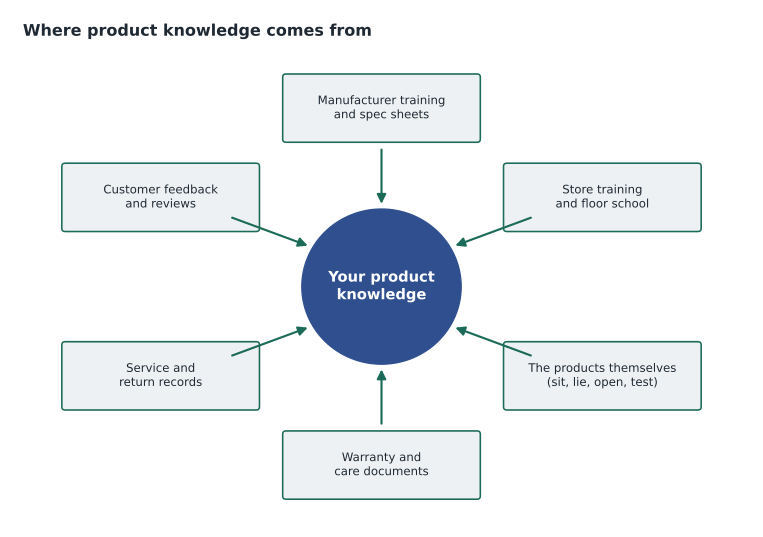
Associates learn products from many sources: manufacturer training and websites, product spec sheets, the store's own training, the labels and tags on the products, warranty documents, service records of common problems, reviews, and above all the products themselves. Juniper & Pine expects new associates to sit on every sofa, lie on every mattress and open every appliance in their area. Carl adds a source that no training covers: what his past customers tell him a year later. "The cushions on that one go flat in a year if you've got teenagers" is knowledge from experience, and it is worth sharing with customers who have teenagers.
Building knowledge quickly
A typical furniture store carries hundreds of products, and ranges change every season. No new associate can learn everything at once. Bev's approach is to learn the floor by "anchors": in each category, learn three products very well, typically an entry model, a mid-range best seller and a premium model. Then learn every other product by how it differs from the nearest anchor. Aiden built a one-page sheet for each category, with the anchors in columns and the construction facts in rows. Within two weeks he could explain the differences on most of the sofa floor.
| Entry anchor | Best-seller anchor | Premium anchor | |
|---|---|---|---|
| Price | About 1,300 dollars | About 1,900 dollars | About 2,800 dollars |
| Frame | Engineered wood and plywood | Kiln-dried hardwood and plywood | Kiln-dried hardwood, corner-blocked |
| Suspension | Sinuous springs | Sinuous springs, closer spacing | Hand-tied coils |
| Seat cushion | Single-density foam | Higher-density foam with fiber wrap | Foam core with pocket-coil layer |
| Fabric | Standard woven | Performance fabric, cleanable | Performance fabric or top-grain leather |
| Typical life with daily use | Several years | Longer | Longest, with reupholstery possible |
Using knowledge in conversation
Product knowledge is only useful when it connects to the customer's needs. A customer with a dog does not need a lecture on frame joinery; they need to know which fabrics resist claws and clean easily. A customer whose last sofa sagged after three years may want to understand the cushion core. Lesson 6 covers how to turn features into benefits for a particular customer. The rule here is simpler: lead with what matters to them, keep the rest ready for questions, and stop talking when the customer has what they need.
Associates should also be ready to say "I don't know, let me find out." Guessing is the fastest way to lose trust, especially when customers can check claims on their phones. Aiden keeps the manufacturer spec sheets for his area on the store tablet and checks them in front of the customer when a question goes beyond what he knows.
Accuracy and the law
Product claims are statements of fact, and the law expects them to be true. SLS-150 covers this in detail. In practice, associates should only repeat claims that come from the manufacturer's documents or the store's training, should not exaggerate durability or performance, and should not describe materials inaccurately, for example calling bonded leather "genuine leather" or a veneer "solid wood".
In the United States, the Federal Trade Commission Act prohibits deceptive claims, and the FTC expects sellers to have a reasonable basis, often called substantiation, for objective claims before they make them. South Dakota's deceptive trade practices law also allows the state attorney general to act against misleading representations about goods.
Knowing the competition
Customers compare, so associates need a working knowledge of what competitors offer: similar products, typical price ranges, delivery and return terms, and warranty differences. The aim is not to criticize competitors but to help customers compare like with like. Juniper & Pine encourages associates to visit other stores and websites on their own time and to share what they learn at floor school. The rule is that competitor information must be current and accurate; an associate who claims "nobody else offers free haul-away" when a competitor does will lose the customer's trust immediately.
Warranties and service
Customers also ask what happens if something goes wrong. Associates should know the manufacturer's warranty for each product category in plain terms: what is covered (for example, the frame for ten years and the cushions for one), what is excluded (wear and tear, stains, misuse), how to make a claim and what the store does to help. They should also know the difference between the manufacturer's warranty, the store's own policies and optional protection plans, which SLS-256 covers in depth. Explaining these accurately and briefly at the sale prevents disappointment later, and it is one of the strongest reasons customers give for buying from a store rather than online.
Keeping knowledge current
Product knowledge goes out of date quickly. Manufacturers change materials, discontinue colors and update warranty terms, and the store adds new ranges every season. Juniper & Pine posts changes at the weekly huddle and in the tablet's product notes, and associates are expected to read them before their first shift of the week. When a customer quotes something from an old brochure or a review written two years ago, the associate should check the current specification rather than assume either version is right.
Finally, knowledge should be shared. When an associate learns something useful, such as which recliner mechanism needs the least wall clearance or which fabric shows pet hair least, telling the team at the next huddle makes everyone better. Carl calls this "paying it forward", and much of what Aiden knew by mid-November he had learned from colleagues rather than from any manual.
Common mistakes
MistakePrice differences are mostly about brand.
InsteadMost of the difference is in construction and materials. Learn the facts that explain it.
MistakeFirmness labels can be compared across mattress brands.
InsteadEach manufacturer uses its own scale. Describe how a mattress feels, not just its label.
MistakeRub counts from different tests can be compared directly.
InsteadWyzenbeek and Martindale use different methods; compare only within one test.
MistakeWhen unsure, give your best guess.
InsteadSay you will check, and check the spec sheet in front of the customer.
MistakeShare every fact you know about a product.
InsteadLead with what matters to this customer and keep the rest ready for questions.
Summary and key terms
- Product knowledge has layers: basic facts, construction and quality, use and care, comparison, and cost of ownership.
- In upholstered furniture, frames, suspension, cushions and fabric explain most price differences; in mattresses, type, feel and support matter most.
- Energy labels let associates compare appliance running costs; show the arithmetic so customers can check it.
- Knowledge comes from manufacturers, store training, the products themselves, service records and customer experience.
- Learn each category by anchors and learn other products by how they differ from the anchors.
- Connect knowledge to the customer's needs, say "I'll check" rather than guess, and keep claims accurate as the law requires.
- Product knowledge
- Factual understanding of what a store sells, how it is made, how it performs and what it costs to own.
- Suspension
- The spring or webbing system that supports the seat of an upholstered piece.
- Rub count
- A measure of fabric abrasion resistance from a standard test, such as Wyzenbeek double rubs or Martindale cycles.
- Anchor product
- A product learned in depth, used as a reference point for learning similar products.
- Energy label
- A label such as EnergyGuide that shows an appliance's estimated yearly energy use and operating cost under standard assumptions.
Practice problems
Work each problem on paper first, then reveal the answer to check.
A customer asks why one sofa costs 900 dollars more than a similar-looking one. Name three things to check.
Show answer
Any three of: frame material and joinery, suspension type, cushion core and density, fabric durability and cleanability.
Two dishwashers use 270 kWh and 310 kWh a year. At 0.17 dollars per kWh, what is the yearly difference in running cost?
Show answer
40 kWh times 0.17 is 6.80 dollars a year.
What should an associate say when asked something they do not know?
Show answer
That they will find out, then check the spec sheet or ask, ideally in front of the customer.
Why is it misleading to call bonded leather "genuine leather"?
Show answer
It describes the material inaccurately; bonded leather is a mix of leather fibers and other materials.
Lesson quiz · 5 questions
Score 60% or more to complete this lesson.
Create a free account to save your progress, take quizzes and earn a certificate.