
SLS-250 · Lesson 12 of 12 · 19 min
Role-play lab: a day on the floor
▶ Video coming soon A video version of this lesson is on the way.
Saturday, November 7, 2026 was the day Bev had circled on Aiden's schedule three weeks earlier. She would shadow him from 10 until 6, staying out of his conversations unless he asked for help, and score him on the store's floor checklist. In September, during the conversation clinic described in SLS-120, he had scored 14 out of 20 in a role-play on a washer and dryer. Today the customers would be real.
This lab follows Aiden's day, then sets out how to run the same exercise yourself, as a role-play with classmates or as a shadowed shift at a workplace. It brings together every step of the course: approach, discovery, product knowledge, demonstration, benefits, add-ons, objections, closing, clienteling and managing a busy floor.
The floor checklist
Juniper & Pine's checklist scores ten skills, each from 0 to 2: 0 means the skill was missing, 1 means it was present but weak, and 2 means it was done well. Bev scores the whole day, not a single conversation, and writes a short comment for each skill.
| Skill | What a score of 2 looks like | Lesson |
|---|---|---|
| 1. Acknowledge and approach | Every group acknowledged within about a minute; product-based openings; graceful "just looking" replies | 2 |
| 2. Discovery | ROOMS covered as needed; budget asked as a range; summary checked with the customer | 3 |
| 3. Product knowledge | Accurate, relevant facts; checks the spec sheet when unsure | 4 |
| 4. Demonstration | Customer in control; time given, especially on mattresses; safe | 5 |
| 5. Benefits | Two or three benefits tied to what the customer said; honest comparisons | 6 |
| 6. Add-ons | One or two relevant add-ons using link, recommend, release; function and safety items always covered | 7 |
| 7. Objections | Listen, acknowledge, clarify, respond, check; honest price comparisons | 8 |
| 8. Close and write-up | Asks clearly; counter checklist followed; order read back; policies explained | 9 |
| 9. Clienteling | Useful, respectful notes; consent for follow-up; next contact planned | 10 |
| 10. Floor awareness | Shares the floor fairly; handles several groups well; uses quiet moments | 11 |
Aiden's day
The day started quietly. Between 10 and 11, Aiden made four follow-up calls from his client book and prepared a quote for a couple coming back at 2 to look at a dining set. Then traffic built. By the end of the day he had acknowledged 38 shopping groups, had real conversations with 26 of them and made 7 sales.
| Time | Customer | What they bought | Items | Sale (dollars, before tax) |
|---|---|---|---|---|
| 11:20 | Retired teacher, bad knee | Lift recliner, delivery | 2 | 1,428 |
| 12:05 | Young couple, first apartment | Queen mattress, protector, frame | 3 | 1,357 |
| 1:15 | Father with two children | Bunk beds, two mattresses, anchoring kit | 4 | 1,646 |
| 2:00 | Couple with appointment | Dining table, six chairs, table pads | 3 | 3,174 |
| 3:30 | Woman with screenshot of online price | Sectional, delivery | 2 | 2,278 |
| 4:40 | Landlord | Two queen mattresses | 1 | 1,198 |
| 5:25 | Couple, back for second visit | King mattress, protector | 2 | 899 |
The landlord's two identical mattresses were rung up as one line with a quantity of two, which the point-of-sale system counts as one item line, so Bev counted it as one item for units per transaction. Different stores count units differently, which is one reason to compare a person's numbers only within the same store's rules.
Worked problem
Aiden's numbers for the day
Using the table, work out Aiden's total sales, his conversion rate on groups acknowledged, his average transaction value and his units per transaction. Of the three mattress sales to people who would sleep on them (not the landlord), two included a protector. What was the protector attachment rate on those sales?
Show solution
- Total sales.
- \[1428 + 1357 + 1646 + 3174 + 2278 + 1198 + 899 = 11\,980\ \text{dollars}\]
- Conversion rate on groups acknowledged.
- \[7 \div 38 \approx 0.18\]
- Average transaction value.
- \[11\,980 \div 7 \approx 1711.43\ \text{dollars}\]
- Units per transaction.
- \[(2 + 3 + 4 + 3 + 2 + 1 + 2) \div 7 = 17 \div 7 \approx 2.43\]
- Protector attachment rate on eligible mattress sales.
- \[2 \div 3 \approx 0.67\]
Answer: Aiden sold 11,980 dollars from 7 transactions: a conversion rate of about 18 in 100 of the groups he acknowledged, an average transaction of about 1,711 dollars and about 2.4 units per transaction. Two of three eligible mattress customers added a protector.
Bev was careful about what the numbers meant. One Saturday is a small sample, the dining set alone was more than a quarter of the day, and the conversion rate counts every group Aiden acknowledged, including people who were clearly only browsing. She used the numbers to start conversations about the skills, not to judge him.
Bev's scores and comments
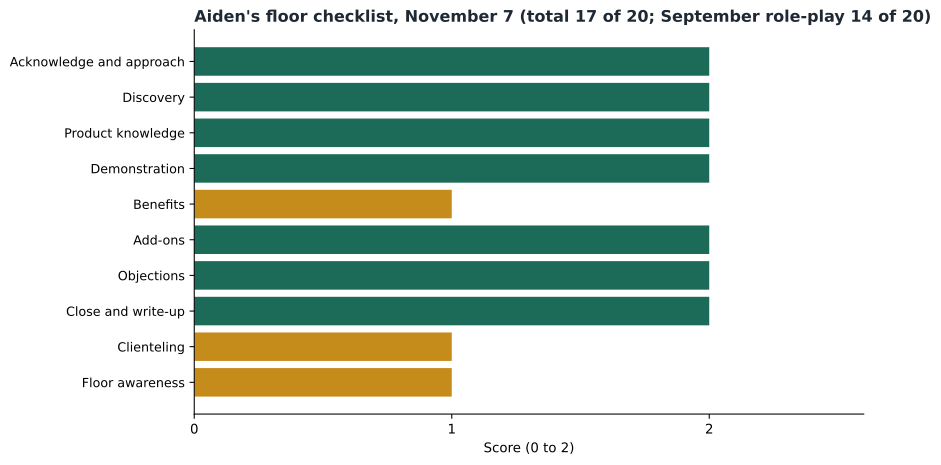
| Skill | Score | Bev's comment |
|---|---|---|
| Acknowledge and approach | 2 | Every group acknowledged quickly; good product openings, especially at the recliners |
| Discovery | 2 | Asked the retired teacher what changed; caught the bad knee before showing anything |
| Product knowledge | 2 | Checked the bunk bed weight limits on the spec sheet in front of the father |
| Demonstration | 2 | Gave the young couple real time on the mattresses; stepped away |
| Benefits | 1 | Still lists features when nervous; with the landlord, talked about comfort when durability and cost mattered |
| Add-ons | 2 | Anchoring kit explained with the bunk beds; protector suggested simply and accepted twice, declined once |
| Objections | 2 | Handled the online price calmly and honestly with a total-cost comparison |
| Close and write-up | 2 | Read back every order; caught a wrong chair count on the dining set |
| Clienteling | 1 | Good notes, but forgot to ask two customers about follow-up consent |
| Floor awareness | 1 | Left the dining couple for six minutes to greet a new group when a colleague was free |
Aiden scored 17 out of 20, up from 14 in September. Bev's summary was short: "Your discovery is now as good as anyone's on the floor. Work on benefits for different kinds of buyers, ask about follow-up every time, and trust your colleagues to take the door." They agreed on three actions for the next month: write benefit statements for landlords and investors for the six best-selling mattresses, add the follow-up consent question to his own counter routine, and hand new arrivals to a free colleague when he is with a deciding customer.
Running the lab yourself
The lab can be run in class as a series of role-plays or at a workplace as a shadowed shift. In class, work in groups of three: one person plays the associate, one plays the customer and one observes and scores using the checklist. Rotate roles so each person plays the associate at least twice. Customers should use scenario cards with details the associate must discover rather than read.
| Card | Customer situation (for the customer only) | What a strong associate will uncover |
|---|---|---|
| A | Your fridge failed yesterday; you need one by the weekend; your kitchen opening is narrow | Urgency, cut-out size, door swing, water line, haul-away |
| B | You are expecting twins and need a sofa that survives spills; your partner is worried about cost | The reason, cleanable fabric, budget range, involving the partner |
| C | You found a lower price online for a dining set; the online set has different chairs | The exact model comparison, total delivered cost, real priorities |
| D | You are a landlord furnishing two rental units; durability and cost matter more than comfort | Durability, cost per year, bulk delivery, no follow-up texts wanted |
| E | You are shopping for your elderly mother who finds it hard to stand up from chairs | Seat height, arm height, lift options, whether she can come in or join a video call |
| F | You want a mattress but are embarrassed to lie down in a store | Comfort, privacy during testing, sleeping position, the comfort exchange |
Observers should note specific behaviors, not general impressions: "asked about the narrow opening before showing models" is useful feedback, "seemed friendly" is not. After each role-play, the associate speaks first about what went well and what they would change, then the observer gives scores and comments, then the customer says how the conversation felt. Keep the feedback for each person to two strengths and one thing to work on.
Reflecting on the course
Retail selling looks simple from outside: a shopper walks in, an associate helps, a sale is made. This course has shown how many decisions sit inside that moment. The best floor salespeople, like Carl, make it look easy because each step has become a habit built on respect for the customer: greet everyone, find out what changed, know the product, let them try it, connect it to their life, complete the solution honestly, answer concerns with facts, write the order carefully and stay in touch in ways that help. Those habits carry into every later course in the retail track: visual merchandising, store operations, retail math, omnichannel selling, high-ticket sales, loyalty and, finally, leading a floor of your own.
Preparing for your own shadowed shift
Before a shadowed shift or a graded role-play, it helps to prepare deliberately. Review the checklist and choose one or two skills to focus on. Refresh product knowledge for your area, especially the anchor products. Check the day's advertised items, stock and delivery calendar. Prepare your tools: measuring tape, swatches, the tablet with spec sheets and the client book. And agree with your coach in advance how they will signal if they need to step in, so customers are never confused about who is helping them.
Being observed changes behavior; most people are more nervous and more formal than usual at first. Coaches like Bev expect this and usually discount the first conversation of the day. The best preparation for being observed is to practice often enough that good habits survive the nerves.
After the lab: making improvement stick
Feedback only helps if it turns into practice. Aiden wrote his three actions on a card and kept it in his badge holder. For the benefits goal, he wrote landlord and investor benefit statements for the six best-selling mattresses and planned to practice them with Carl on two quiet mornings the following week. For follow-up consent, he added the question to his counter routine immediately after the read-back. For floor awareness, he agreed with the other associates to use a hand signal for "please take the door". Bev booked a check-in for the first week of December, before the holiday peak, to see whether all three habits had stuck.
Self-assessment
Before the coach shares scores, the associate should score themselves on the same checklist. Comparing the two is often the most useful part of the feedback conversation. Aiden had scored himself 15 out of 20, lower than Bev's 17. He had marked himself down on discovery and demonstration, where Bev saw strengths, and he had missed his weakness in floor awareness entirely. The gap showed him that his nerves about new skills were not always a good guide to how well he was doing, and that a habit he thought was fine was costing customers time.
The lab is also a model for lifelong practice. Experienced associates like Carl still ask to be shadowed once or twice a year, because even strong habits drift. Each time, the checklist shows a new priority, and each priority, practiced for a month, becomes part of how the associate sells. Bev's own manager still shadows her on the floor each spring, and she says she learns something every time. The goal is never a perfect score, but a clear next step that makes the next customer's visit a little better than the last.
Common mistakes
MistakeJudge a salesperson by one day's numbers.
InsteadOne day is a small sample; use numbers to start conversations about skills.
MistakeFeedback should cover everything that went wrong.
InsteadGive two strengths and one priority to work on, with specific examples.
MistakeRole-play customers should tell the associate everything at once.
InsteadCustomers should reveal details only when the associate asks the right questions.
MistakeUnits per transaction are counted the same way everywhere.
InsteadStores count units differently; compare numbers only within the same rules.
MistakeA high score means there is nothing left to improve.
InsteadEven a strong score points to the next skills to practice.
Summary and key terms
- The floor checklist scores ten skills from approach to floor awareness, each from 0 to 2.
- Aiden's day produced 7 sales worth 11,980 dollars from 38 groups acknowledged, with an average transaction of about 1,711 dollars.
- Numbers from a single day are a starting point for coaching, not a verdict.
- Specific, behavior-based feedback, with two strengths and one priority, helps more than general impressions.
- In class, rotate associate, customer and observer roles and use scenario cards that reward good discovery.
- The habits of the course, built on respect for the customer, carry through the rest of the retail track.
- Floor checklist
- Juniper & Pine's ten-skill scoring sheet for observed selling, each skill scored 0 to 2.
- Shadowed shift
- A working shift observed by a coach who stays out of conversations unless asked.
- Scenario card
- Instructions for a role-play customer describing a situation the associate must discover.
- Behavior-based feedback
- Feedback that names specific actions observed, rather than general impressions.
Practice problems
Work each problem on paper first, then reveal the answer to check.
An associate makes 6 sales totaling 8,400 dollars from 30 groups. What are the conversion rate and average transaction value?
Show answer
6 divided by 30 is 0.20; 8,400 divided by 6 is 1,400 dollars.
Rewrite this feedback to be behavior-based: "You were good with customers."
Show answer
For example: "You asked the couple what changed before showing any sofas, and you summarized their needs before recommending."
Which scenario card tests whether the associate respects a customer's wish not to receive follow-up texts?
Show answer
Card D, the landlord who wants no follow-up texts.
Why did Bev count the landlord's two mattresses as one item?
Show answer
They were rung up as one line with a quantity of two, which the store's system counts as one item line.
Lesson quiz · 5 questions
Score 60% or more to complete this lesson.
Create a free account to save your progress, take quizzes and earn a certificate.