
SLS-250 · Lesson 6 of 12 · 19 min
Features, advantages and benefits
▶ Video coming soon A video version of this lesson is on the way.
At floor school on October 29, Bev played two short recordings she had made, with permission, of associates presenting the same performance-fabric sofa to a mystery shopper. In the first, the associate said: "This one has a performance fabric, a high rub count, removable cushion covers and a kiln-dried frame." In the second, Carl said: "You mentioned the kids eat in front of the TV. This fabric is a performance weave, so if someone spills juice, it beads on the surface and you can blot it off before it soaks in. That's why I'd point you to this one rather than the linen-look sofa you liked first." Both associates were accurate. Only one connected the facts to the customer. The mystery shopper bought from Carl.
The difference is the subject of this lesson. A feature is a fact about a product. An advantage is what the feature does. A benefit is what that means for this particular customer, given what they said in discovery. Turning features into benefits, a method usually called FAB, is one of the oldest ideas in sales training, and it remains useful because it forces the associate to connect product knowledge to the customer's needs.
Features, advantages and benefits defined
| Feature (what it is) | Advantage (what it does) | Benefit (what it means for this customer) | |
|---|---|---|---|
| Sofa | Performance fabric | Repels liquids and resists stains | "The juice spills from movie night wipe off, so it still looks good in five years." |
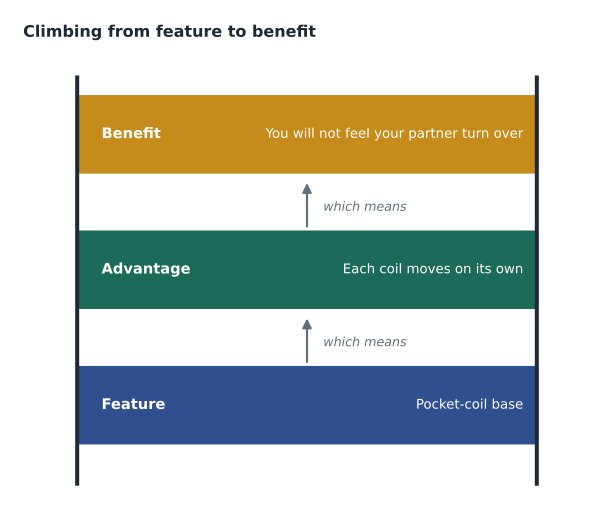
| Mattress | Pocket-coil base | Each coil moves independently | "When Luis turns over at 5 a.m. for his early shift, Hannah won't feel it." |
| Washer | Steam sanitize cycle | Uses heat to remove many germs and allergens | "With your son's allergies, his bedding can be washed hotter without the hot-water bill of a separate cycle." |
The benefit is personal. The same feature can mean different things to different customers: a performance fabric is about children for one family, about a white cat for another and about a rental property for a landlord. That is why benefits cannot be memorized from a product sheet. They come from listening in discovery and connecting what was heard to what the product does.
Bridges: "which means"
A simple way to move from feature to benefit is a bridge phrase: "which means", "so that", "so you can" or "that matters because". Each bridge forces the associate to finish the thought from the customer's side. "This dishwasher has a third rack, which means the cutlery lies flat and comes out cleaner, and that matters because you said you hate washing forks by hand."
Bev's exercise for new associates is to take any feature on the floor and add "which means" three times until they reach something the customer actually cares about. Hidden hinges on a cabinet, which means the doors close flush, which means the kitchen looks cleaner, which means the open-plan room the customer is renovating looks finished. The exercise usually reveals that most features matter only to some customers, and that is the point: pick the features that matter to the person in front of you.
Choosing which benefits to present
Every product has more features than any customer wants to hear about. Presenting all of them buries the important ones and makes the associate sound like a catalog. A useful rule is to present the two or three benefits that connect most directly to the needs the customer named, and to keep the rest available for questions.
The order matters too. People tend to remember the first and last things they hear better than the middle, a pattern psychologists call the serial position effect. Associates can use this by leading with the benefit that addresses the customer's main need and ending with a short summary that repeats it.
Checking reactions
Presenting benefits is not a speech. After each benefit, a short question checks whether it landed: "Would that help with the dog?" "Is that the kind of support you were looking for?" "How does that compare with what you have now?" These questions are sometimes called trial closes, because they test how close the customer is to deciding without asking for the sale. They also reveal concerns early, while there is still time to address them, which lesson 8 develops.
| Benefit statement | Checking question |
|---|---|
| "The seat is a little higher, so getting up is easier on the knees." | "How does that feel when you stand up?" |
| "The freezer drawer slides out fully, so you can see what's at the back." | "Would that help with your bulk shopping?" |
| "The cover zips off and goes in the washer." | "Is washability a big deal with the kids?" |
Comparing options for the customer
Customers often narrow their choice to two or three products and then struggle to choose. A good associate helps by comparing the options against the customer's own priorities, not by declaring a winner. A short comparison, spoken or written on the back of a quote, works well: "Both fit your space. The first has the washable cover you wanted and is 300 dollars less. The second has the deeper seat Luis liked and the better fabric warranty. Which matters more to you?"
Honest comparisons include the weaknesses of each option. Customers trust associates who point out a drawback, such as "the leather will show scratches from the cat more than the fabric would", because it shows the associate is on their side. SLS-120 linked this to trust: candour about limitations makes positive claims more believable.
Talking about value and price
Price is usually discussed after the customer understands what the product will do for them. Presenting price as the last item in a benefit summary, rather than the first, lets the customer judge it against the value. When a customer reacts to price, associates can help them see it in terms that fit their life: cost per year of expected use, the cost of replacing a cheaper product sooner, or the running cost of an appliance.
Worked problem
What does a better sofa cost per day?
The Morenos' neighbors are choosing between two sofas. The entry sofa is 1,299 dollars, and the family expects to replace it after about 4 years of heavy daily use. The best seller is 1,899 dollars, and they expect it to last about 8 years. What does each cost per year and per day of use, assuming it is used every day?
Show solution
- Cost per year for the entry sofa.
- \[1299 \div 4 = 324.75\ \text{dollars}\]
- Cost per year for the best seller.
- \[1899 \div 8 = 237.375 \approx 237.38\ \text{dollars}\]
- Cost per day for each, using 365 days a year.
- \[324.75 \div 365 \approx 0.89 \qquad 237.38 \div 365 \approx 0.65\]
Answer: The entry sofa costs about 325 dollars a year, or 89 cents a day; the best seller costs about 237 dollars a year, or 65 cents a day. If the life estimates are right, the dearer sofa is cheaper per year of use. The answer depends on how long each actually lasts, so Aiden described the estimates as typical for heavy use, not as a promise.
The example shows how value framing works and also its limit. Life estimates are estimates. Stating them as certainties would mislead the customer and could break the rules on performance claims covered in lesson 4. Associates present them as typical experience, based on the store's service records and manufacturer guidance.
Avoiding jargon
The furniture and appliance trades are full of terms customers do not know: sinuous springs, rub counts, coil gauge, convection, inverter compressors, BTUs. Jargon can make an associate sound knowledgeable, but it often leaves customers confused and unwilling to admit it. The rule is to explain any technical term in plain words the first time it is used, or to skip it and describe the benefit directly. "The motor speeds up and slows down instead of switching on and off, so it's quieter and uses less power" is more useful than "it has an inverter compressor".
FAB in an honest frame
FAB is a tool for explaining, not for persuading people to want things they do not need. Its weakness, if used mechanically, is that associates can invent benefits ("this sofa will transform your living room") that are vague or exaggerated. The defense is to keep benefits specific and tied to what the customer said. A benefit the customer did not ask for is usually a guess, and a guess presented as a benefit can feel like pressure.
Benefits for different kinds of buyers
The same product carries different benefits for different buyers, and some common buyer types are worth preparing for. Families with young children care about durability, cleanability and safety. Downsizing retirees often care about comfort, ease of getting up and fitting smaller rooms. Landlords and property managers care about durability, cost per year, easy replacement and quick delivery to several units. First-home buyers often care about style and value, and about pieces that will move with them later. SLS-110 described these as the retail personas Tessa Yellowbird uses in marketing; on the floor they are a reminder to listen for which situation the customer is in before choosing which benefits to present.
| Buyer | Benefit to lead with |
|---|---|
| Family with young children | The removable, washable cover and the edge support that keeps kids from rolling off |
| Downsizing retiree | The medium-firm feel that supports a side sleeper's shoulder and hip, and the lower profile that is easier to get into |
| Landlord | The durable coil base, the 10-year warranty and the cost per year compared with cheaper foam mattresses |
| First-home buyer | The standard height that works with most frames they might buy later, and the comfort exchange if it does not suit |
Preparing benefits by buyer type is not the same as stereotyping. The associate still listens and adapts; the preparation simply means having the right facts ready when the customer reveals their situation.
Summarizing before the decision
At the end of a presentation, a short summary pulls the benefits together and leads naturally to the decision. A good summary names the customer's main needs and how the chosen product meets each one, in the customer's own words where possible, then states the price and asks a checking question. For the Morenos' neighbors, it might be: "So this one seats all five of you for movie night, the fabric wipes clean after the dog, it fits the wall with room for the side table, and it's 1,899 dollars delivered next Thursday. How does that sound?"
The summary also gives the customer a last chance to raise anything the associate has missed. If the answer is "it's great, but I'm still not sure about the color", the associate has learned exactly what is left to resolve, which leads into lesson 8's objection method.
Summaries work best when they are short. Three needs and one price fit easily in a breath; a list of ten features does not, and the customer will remember none of them.
Above all, benefits should be true. A benefit that depends on a claim the associate cannot support, or on a promise the store will not keep, is worse than no benefit at all. Customers forgive an associate who says "I'm not sure that would make a big difference for you"; they do not forgive one whose promised benefit fails to appear.
Common mistakes
MistakeListing features is the same as presenting benefits.
InsteadA benefit says what the feature means for this customer, based on what they told you.
MistakePresent every feature to show product knowledge.
InsteadPresent the two or three benefits that match the customer's needs; keep the rest for questions.
MistakePresent price first so the customer knows where they stand.
InsteadUsually present price after the customer understands the value, unless they ask for it first.
MistakeNever mention a product's weaknesses.
InsteadHonest comparisons that include drawbacks build trust.
MistakeLife estimates can be presented as guarantees.
InsteadPresent them as typical experience, not promises.
Summary and key terms
- A feature is a fact, an advantage is what it does, and a benefit is what it means for this customer.
- Bridges such as "which means" help associates move from feature to benefit.
- Present the few benefits that match the customer's needs, starting with the most important.
- Checking questions after each benefit test whether it landed and reveal concerns early.
- Compare options against the customer's own priorities and include honest drawbacks.
- Frame price as value, such as cost per year, while presenting estimates honestly; explain or avoid jargon.
- Feature
- A fact about a product, such as its material or a function it has.
- Advantage
- What a feature does.
- Benefit
- What a feature means for a particular customer, given their needs.
- Bridge phrase
- Words such as "which means" that link a feature to its benefit.
- Trial close
- A question that checks how close a customer is to deciding without asking for the sale.
- Serial position effect
- The tendency to remember the first and last items in a list better than those in the middle.
Practice problems
Work each problem on paper first, then reveal the answer to check.
Turn this feature into a benefit for a family with a toddler: "rounded corners on the coffee table".
Show answer
For example: "The corners are rounded, which means fewer bumps and bruises when your toddler is running around the living room."
A 999-dollar mattress is expected to last 6 years and a 1,599-dollar one 10 years. Which costs less per year?
Show answer
999 divided by 6 is 166.50 dollars a year; 1,599 divided by 10 is 159.90. The dearer one costs slightly less per year, if the estimates hold.
Write a checking question after the benefit "the drawers close softly, so the kids won't slam them".
Show answer
For example: "Would that make mornings a bit quieter?"
Why can inventing benefits be a problem?
Show answer
Vague or exaggerated benefits can mislead customers and feel like pressure. Benefits should be specific and tied to what the customer said.
Lesson quiz · 5 questions
Score 60% or more to complete this lesson.
Create a free account to save your progress, take quizzes and earn a certificate.