
SLS-212 · Lesson 9 of 12 · 24 min
Building a business case
▶ Video coming soon A video version of this lesson is on the way.
When Carla Bennett read the first draft of Maya Chen's Eastgate Physiotherapy proposal, she asked one question by email: "Mark is going to ask me why we should spend 14,400 dollars when the printers still work. What do I tell him?" Mark Olafson was one of the clinic's two owners, and he was careful with money. Carla needed something she could put in front of him: not a sales pitch, but a short, honest comparison of what the clinic would spend and save under each option. At the Friday presentation lab on November 6, 2026, Farida Haddad called that comparison by its proper name. "She's asking for a business case," Farida said. "And she's telling us who it has to convince."
A business case is a structured argument that a proposed purchase or change is worth making, comparing the costs, benefits and risks of the options, including doing nothing. In large organizations, business cases are formal documents with templates and approval steps. In small ones, a business case may be a single page that an office manager uses to persuade an owner. Either way, the seller's job is the same: to help the customer's champion make the case to the people who decide, using numbers the customer trusts.
This lesson introduces business cases as part of presentations and proposals. SLS-222, Value Selling, Pricing and Business Acumen, goes much further into return on investment, total cost of ownership and the financial measures executives use.
Why customers need a business case
Customers rarely buy simply because a seller's presentation was good. Somebody inside the organization usually has to justify the decision to somebody else: an office manager to an owner, an operations director to a board, a business manager to a superintendent, a public body to taxpayers. Research on B2B buying by Gartner and others has repeatedly found that buying groups struggle to reach agreement and that a large share of purchases stall or end in no decision. A clear business case gives the customer's champion something to carry into the meetings the seller will never attend.
The business case also protects the seller. A deal approved on the strength of a well-founded business case is less likely to be reversed, and a customer who knows what results to expect is more likely to judge the result fairly later.
The parts of a business case
A business case for a sales proposal usually has six parts. The level of detail depends on the size of the decision, but even a one-page case should touch each one.
| Part | What it covers | Eastgate example |
|---|---|---|
| The problem and its cost | What the current situation costs, in money and in other terms | Jams, service calls and a lease costing about 7,500 dollars a year in direct costs |
| The options | At least two options, always including doing nothing or keeping the status quo | Renew the current lease; Ridgeline's proposal; a three-printer version |
| Costs of each option | Up-front and ongoing costs over a stated period | 400 dollars a month for three years |
| Benefits of each option | Savings and gains, separated into hard and soft benefits | Lower direct cost; staff time recovered from jams |
| Risks and assumptions | What could make the numbers wrong | Page volumes; how much jamming falls |
| Recommendation | The option recommended and why | Ridgeline's two-printer agreement |
Hard and soft benefits
Benefits come in two broad kinds. Hard benefits are measurable in money and appear in the accounts: a lower monthly charge, fewer repair invoices, less spent on toner. Soft benefits are real but harder to measure in money: staff time saved, fewer interruptions, a better impression on patients, less stress. Many decision makers give soft benefits little weight unless they are converted into money carefully and honestly.
Staff time is the most common soft benefit in B2B sales, and it is often exaggerated. Saving five minutes a day for each of eleven staff does not mean the clinic saves eleven people's wages; it means staff have a little more time for other work. Business cases are more credible when they convert time to money with conservative rates, say how they did it, and present hard and soft benefits separately so decision makers can weigh them as they choose.
Worked problem
Estimating the cost of jams in staff time
Eastgate's three printers each jam about four times a week. Carla estimates that clearing a jam and reprinting takes about 12 minutes of staff time, and that the clinic's staff cost, including benefits, averages 40 dollars an hour. The clinic operates about 50 weeks a year. What do jams cost in staff time each year?
Show solution
- Jams per week: 3 printers × 4 jams = 12 jams.
- Jams per year: 12 × 50 = 600 jams.
- Minutes per year: 600 × 12 = 7,200 minutes, which is 7,200 ÷ 60 = 120 hours.
- Cost per year: 120 × 40 = 4,800 dollars.
Answer: Jams cost about 4,800 dollars a year in staff time. This is a soft benefit to the extent it is recovered: the clinic does not pay less in wages, but staff spend those 120 hours on other work.
Every number in that calculation came from the customer: the jam frequency from Carla's own count over two weeks, the minutes from timing a few jams, and the staff cost from Carla's estimate. That matters. A business case built on the seller's assumptions is a sales document; one built on the customer's numbers is the customer's own analysis, and it persuades accordingly.
Comparing the options
With costs and benefits estimated, the options can be compared over a stated period. For Eastgate, the natural period was the three-year term of the proposed agreement.
Worked problem
A three-year comparison for Eastgate
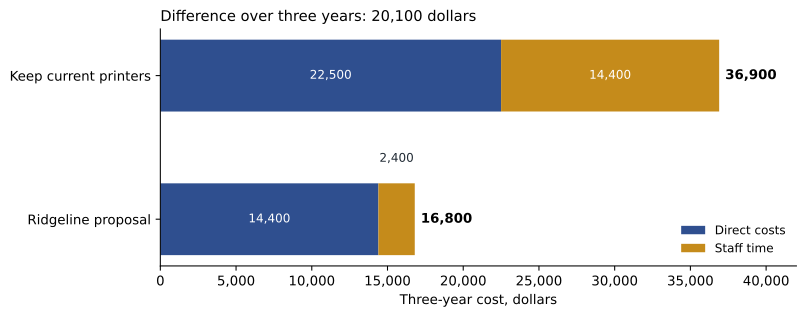
Compare two options over three years. Status quo: direct costs about 7,500 dollars a year and jams costing about 4,800 dollars a year in staff time. Ridgeline proposal: 400 dollars a month, all inclusive, with jams expected to fall to about one a week per printer on two new printers, at the same 12 minutes and 40 dollars an hour.
Show solution
- Status quo, direct costs: 7,500 × 3 = 22,500 dollars.
- Status quo, staff time: 4,800 × 3 = 14,400 dollars. Total: 22,500 + 14,400 = 36,900 dollars.
- Proposal, direct costs: 400 × 36 = 14,400 dollars.
- Proposal, staff time: 2 printers × 1 jam × 50 weeks = 100 jams a year; 100 × 12 = 1,200 minutes = 20 hours; 20 × 40 = 800 dollars a year; 800 × 3 = 2,400 dollars.
- Proposal total: 14,400 + 2,400 = 16,800 dollars.
- Difference: 36,900 − 16,800 = 20,100 dollars over three years, of which hard savings are 22,500 − 14,400 = 8,100 dollars and soft savings are 14,400 − 2,400 = 12,000 dollars.
Answer: Over three years, the proposal saves about 8,100 dollars in direct costs and about 12,000 dollars in staff time, a total of about 20,100 dollars. Presenting the hard and soft savings separately lets the owners decide how much weight to give the staff time.
The hard savings alone make the case: the clinic spends 8,100 dollars less over three years even if no staff time is counted. That is the strongest kind of business case, and it is worth saying plainly. The soft savings are a bonus, not the foundation.
Risks, assumptions and sensitivity
Every business case rests on assumptions, and honest business cases say what they are. For Eastgate, the main assumptions were that page volumes would stay under the 3,000 pages a month included in the agreement, and that new printers would jam about once a week each. If either assumption was wrong, the numbers would change.
A simple way to show how much the result depends on an assumption is a sensitivity check: recalculate the result with the assumption changed and see whether the conclusion still holds.
Worked problem
A sensitivity check on jams
Suppose the new printers jam twice as often as assumed, two times a week each. What are the three-year soft savings, and does the case still hold?
Show solution
- Proposal jams per year: 2 printers × 2 jams × 50 weeks = 200 jams.
- Staff time: 200 × 12 = 2,400 minutes = 40 hours; 40 × 40 = 1,600 dollars a year; over three years, 4,800 dollars.
- Soft savings: 14,400 − 4,800 = 9,600 dollars over three years, down from 12,000.
- Hard savings are unchanged at 8,100 dollars.
Answer: Even if the new printers jam twice as often as assumed, the proposal still saves about 8,100 dollars in direct costs and about 9,600 dollars in staff time over three years. The conclusion holds.
Sensitivity checks build trust because they show the seller is not hiding behind optimistic assumptions. They also prepare the champion for the question every careful decision maker asks: "What if you're wrong?"
A business case that falls short
Sometimes the honest numbers do not quite support the customer's target, and the seller has to decide how to present that. Ridgeline faced this with Prairie Valley. The division spent about 78,000 dollars a year on printing and wanted savings of at least 10 in 100, which meant a contract of no more than 70,200 dollars a year. Ridgeline's first submitted price was 70,800 dollars.
Worked problem
Testing a proposal against the customer's target
Prairie Valley spends about 78,000 dollars a year and wants savings of at least 10 in 100. Ridgeline's first price was 70,800 dollars a year. What saving does that represent, and does it meet the target?
Show solution
- Saving: 78,000 − 70,800 = 7,200 dollars a year.
- As a share of current spending: 7,200 ÷ 78,000 = 0.0923, or about 9.2 in 100.
- Target: 10 in 100, or 7,800 dollars. The proposal falls short by 7,800 − 7,200 = 600 dollars a year.
Answer: The first price saved about 9.2 in 100, just short of the 10 in 100 target. Ridgeline's response said so plainly and showed staff-time and service benefits separately, but the direct-cost gap remained a weakness until the best and final offer.
Farida's advice was never to hide a shortfall. Evaluators would calculate it themselves, and a proposal that claimed to meet the target when it did not would lose credibility on every other claim. The response showed the direct saving honestly, then set out the soft benefits: fewer device models to support, one toner order instead of four, four-hour service in rural schools and reporting by school. As SLS-213 describes, the best and final offer of 66,000 dollars a year later closed the gap: 78,000 − 66,000 = 12,000 dollars, or about 15.4 in 100.
Building the case with the customer
The most effective business cases are built with the customer rather than for them. When the customer's champion helps gather the numbers, checks the assumptions and shapes the presentation, the result becomes their document, and they defend it in meetings the seller does not attend. Maya's approach with Carla was to share a one-page draft with blanks for the numbers only Carla knew, ask her to fill them in, and then check the arithmetic together on a short call.
| Step | What Maya did |
|---|---|
| Agree the question | Confirmed that Mark wanted to know whether replacing working printers was worth the money |
| Agree the options | Status quo (renew the lease), Ridgeline's two-printer proposal and a three-printer version |
| Gather the customer's numbers | Carla counted jams for two weeks and pulled the last year's lease, toner and repair invoices |
| Calculate together | A shared one-page sheet, checked on a fifteen-minute call |
| Agree how to present it | Hard and soft savings shown separately; the sensitivity check included |
| Let the champion own it | Carla put the page in the owners' papers as her own recommendation, with Ridgeline's proposal attached |
In the public sector, business cases carry an extra test: value for money for public funds. A public body must be able to show that its choice was fair and sensible, and its business case may be read by auditors, board members or the public. That makes accuracy and transparency even more important. South Dakota school districts report to elected school boards, and their records are generally open to the public, so a business case for Prairie Valley had to be one the division would be comfortable publishing.
Common mistakes
MistakeLeaving out the do-nothing option.
InsteadAlways compare against the status quo; it is the option the customer will most often choose.
MistakeMixing hard and soft benefits into one total.
InsteadShow hard and soft benefits separately so decision makers can weigh them.
MistakeUsing the seller's assumptions instead of the customer's numbers.
InsteadAsk the customer for their data and build the case with their champion.
MistakeHiding assumptions or ignoring what could go wrong.
InsteadState the main assumptions and show a sensitivity check.
MistakeClaiming a target is met when it is not.
InsteadShow the honest result and explain the other benefits; evaluators will calculate it anyway.
Summary and key terms
- A business case compares the costs, benefits and risks of the options, including doing nothing, so that the customer's champion can justify the decision to others.
- Its parts are the problem and its cost, the options, the costs, the benefits, the risks and assumptions, and a recommendation.
- Hard benefits are measurable in money; soft benefits such as staff time are real but should be converted conservatively and shown separately.
- The best business cases use the customer's own numbers and are built with the customer's champion.
- A sensitivity check recalculates the result with a key assumption changed to show whether the conclusion holds.
- When the numbers fall short of a customer's target, say so plainly and present other benefits honestly.
- Public-sector business cases must also show value for public money.
- Business case
- A structured comparison of the costs, benefits and risks of options, including doing nothing, to justify a decision.
- Status quo
- Keeping the current situation; the do-nothing option in a business case.
- Hard benefit
- A benefit measurable in money that appears in the accounts, such as a lower monthly charge.
- Soft benefit
- A real benefit that is harder to measure in money, such as staff time saved.
- Sensitivity check
- Recalculating a result with a key assumption changed to see whether the conclusion still holds.
- Champion
- A person inside the customer's organization who supports the proposal and argues for it.
Practice problems
Work each problem on paper first, then reveal the answer to check.
Two printers jam three times a week each. Each jam takes 10 minutes and staff cost 36 dollars an hour. Over 50 weeks, what do jams cost?
Show answer
2 × 3 × 50 = 300 jams; 300 × 10 = 3,000 minutes = 50 hours; 50 × 36 = 1,800 dollars a year.
A customer spends 64,000 dollars a year and a proposal costs 57,000. What saving is that, in 100?
Show answer
7,000 ÷ 64,000 = about 10.9 in 100.
Why should hard and soft savings be shown separately?
Show answer
Decision makers weigh them differently; mixing them can make the case look inflated.
Lesson quiz · 5 questions
Score 60% or more to complete this lesson.
Create a free account to save your progress, take quizzes and earn a certificate.