
SLS-212 · Lesson 2 of 12 · 20 min
Structuring a sales presentation
▶ Video coming soon A video version of this lesson is on the way.
At the second session of the Friday presentation lab, on September 25, 2026, Farida Haddad handed out two printed presentations for the same product and asked the group which one they would buy from. Both were for Ridgeline's managed print service. The first had twenty-two slides: company history, a product range, a service map, eight slides of features, pricing and a thank-you slide. The second had nine slides: the customer's problem, what it was costing, a proposed solution in three parts, how it would be installed, evidence from a similar customer, the price and a proposed next step. Every person in the room chose the second. "Same product, same price," Farida said. "The difference is structure."
Structure is the order in which a presentation reveals information, and it shapes what the audience understands and remembers. A well-structured presentation answers the questions a buyer has in roughly the order they have them. A badly structured one answers questions nobody has asked yet and leaves the important ones until the audience has stopped listening.
The questions a buyer brings
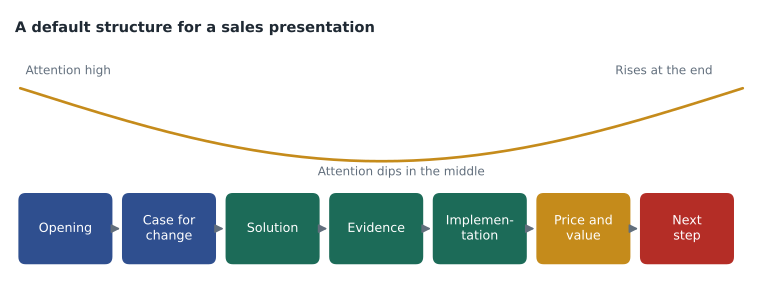
Farida summarized the buyer's questions in the order they tend to arise. A presentation that follows this order feels natural to the listener, because it meets each question just as the listener is ready for it.
| Buyer's question | Part of the presentation that answers it |
|---|---|
| Do you understand our situation? | Opening and bridge statement |
| Why should we change anything? | Case for change: the problem and what it costs |
| What exactly are you proposing? | The solution, in a few clear parts |
| Will it work for us? | Evidence: demonstration, references, data, guarantees |
| How would it happen? | Implementation: steps, timing, people, risks |
| What will it cost, and is it worth it? | Price and value |
| What do we do now? | Next step |
This order is not a rigid template. Some buyers ask about price in the first five minutes, and refusing to answer looks evasive; lesson 10 deals with that. Some committees want the implementation plan before anything else because they have been burned by a failed installation. But as a default, the sequence works because it moves from the customer's world to the seller's solution and back to the customer's decision.
Openings that earn attention
Audiences decide in the first minute or two whether a presenter is worth listening to. Openings that talk about the seller ("Thank you for having us; let me tell you a bit about Ridgeline") spend that minute on the least interesting subject in the room. Openings that talk about the customer earn it.
| Opening type | Example | When it works |
|---|---|---|
| Bridge statement | "When we met, you told us bookings were on a whiteboard and in three calendars..." | Almost always, after discovery |
| A striking fact from the customer's own data | "Your 14 schools use 61 different printer models and order toner from four suppliers." | When discovery produced a surprising number |
| A question | "How many times this term has someone walked to a printer that wasn't working?" | With a group that will answer honestly |
| A short story | A two-sentence account of a similar customer's problem | When a reference case is close to the customer's situation |
| The agenda and purpose | "In 40 minutes we'll show how..., and at the end ask whether a pilot makes sense." | Combined with one of the above, never alone |
Farida's advice was to open with the bridge or the striking fact, then state the purpose and the agenda in one or two sentences, including the decision you will ask for at the end. Saying at the start that you will ask for a decision is not pushy. It tells the audience what they are there to do, and it makes the request at the end feel expected rather than sudden.
The case for change
Before customers will consider a new solution, they must believe that the current situation is worth changing. This is the case for change, and it is where discovery pays off most. A strong case for change uses the customer's own numbers and words, connects the problem to something the decision makers care about, and is honest about the cost of doing nothing.
For the Prairie Valley School District presentation in October, the case for change rested on the audit Ridgeline had carried out with the division's information technology staff. The audit found 61 printer models across 14 schools and the division office, toner bought from four suppliers, and annual print spending of about 78,000 dollars. Teachers and administrative assistants lost time chasing supplies and reporting faults to different service companies. The division had told bidders it wanted savings of at least 10 in 100.
Worked problem
Building a case for change from discovery numbers
Prairie Valley spends about 78,000 dollars a year on printing and wants savings of at least 10 in 100. What is the most it should pay under a new contract, and how would you express the case for change in one sentence?
Show solution
- A saving of 10 in 100 of 78,000 dollars is 78,000 × 0.10 = 7,800 dollars.
- The ceiling for a new contract is therefore 78,000 − 7,800 = 70,200 dollars a year.
- One-sentence case: "Today the division spends about 78,000 dollars a year across 61 printer models and four toner suppliers; a single managed fleet can cut both the number of models and the cost."
Answer: The new contract must cost no more than about 70,200 dollars a year to meet the division's target. The case for change combines cost, complexity and staff time in the division's own terms.
The case for change does not mention Ridgeline at all. It is about the customer's situation. The solution comes next, and the case for change earns the right to present it.
Presenting the solution in a few parts
Most solutions have many features, and the temptation is to show all of them. Research on working memory, starting with George Miller's famous 1956 paper on "the magical number seven" and refined by Nelson Cowan in 2001 to a limit nearer four items, suggests that people can hold only a few new pieces of information in mind at once. Presenters who group their solution into three or four parts, each tied to a problem the customer named, are easier to follow and to remember.
Ridgeline's Prairie Valley solution had dozens of components, but Maya and Farida grouped it into three parts, each answering one of the division's problems.
| Customer problem | Solution part | Detail kept for questions or the written response |
|---|---|---|
| Too many models and suppliers | One standard fleet: 61 models reduced to 44 devices of four types | Device list by school; replacement schedule |
| Staff chasing toner and service | Automatic toner and one service desk | Service levels, response times, escalation contacts |
| No view of costs by school | Monthly reporting by school | Sample report; data security arrangements |
Each part was described in terms of what would change for the division, not in terms of product specifications. "One service desk" meant that a school secretary would make one phone call or send one email for any printer problem, rather than working out which of three companies to call. The specifications were in the written RFP response for anyone who wanted them.
Evidence, implementation and the close of the presentation
After the solution, the audience wants to know whether it will really work for them. Evidence can take several forms: a demonstration (lesson 4), a reference from a similar customer, data from a pilot, a guarantee or service-level commitment, or an independent review. The best evidence is specific and close to the customer's situation. A reference from another school district is worth more to Prairie Valley than a testimonial from a law firm.
The implementation section answers a question that often decides close competitions: "How painful will this be?" Customers who have lived through a badly managed changeover are more worried about the next one than about the price. A clear timeline, named contacts, a plan for training and a realistic view of risks reassure them.
The last part of a presentation should make the next step easy to agree to. Lesson 9 of SLS-213 covers asking for commitment in depth. For presentations, the key is that the next step is specific (a date, a pilot, a review meeting), that it is in the customer's interest, and that it was mentioned in the opening so the request is expected.
Timing and the rule of thirds
Presentations almost always run long, and the part that gets squeezed is the end, where the next step is agreed. Farida taught a simple planning rule: in a meeting of any length, plan to finish the prepared material at about two-thirds of the time, leaving the last third for questions, discussion and agreeing the next step.
Worked problem
Planning time for a 45-minute meeting
Maya has 45 minutes with Keystone. Using Farida's rule of thirds, how long should the prepared material run, and how might it be divided?
Show solution
- Two-thirds of 45 minutes is 45 × 2 ÷ 3 = 30 minutes of prepared material.
- One-third, 15 minutes, is left for questions, discussion and the next step.
- A possible split of the 30 minutes: bridge and purpose 3; case for change 4; solution 5; demonstration 10; implementation 4; price 4.
- Check: 3 + 4 + 5 + 10 + 4 + 4 = 30 minutes.
Answer: Plan 30 minutes of material and keep 15 minutes free. Most of the prepared time goes to the demonstration, because that is the strongest evidence for this customer.
Questions do not wait politely for the end, so in practice the free third is spread through the meeting. The point of the rule is that the presenter has room to answer questions without rushing the ending.
Signposting
Listeners cannot flip back a page the way readers can. Presenters help them by signposting: telling the audience where they are in the structure. Simple phrases do this well: "So that's the problem. Let me show you how we'd fix it, in three parts." "That's the second part. The third is reporting." "Before we talk about price, let me show you how the changeover would work." Signposts feel repetitive to the presenter, who knows the structure, but they are a relief to the audience.
Short summaries at transitions serve the same purpose. After the case for change, a one-sentence summary ("So the cost today is about 78,000 dollars a year, spread over four suppliers") gives late arrivals and distracted listeners a way back in.
Structures for different situations
The default structure suits most solution presentations, but other situations call for variations.
| Situation | Structure that works | Why |
|---|---|---|
| A senior executive with ten minutes | Recommendation first, then the two or three reasons, then the ask | Executives want the conclusion before the reasoning |
| A committee that must score you against criteria | Follow their criteria in their order | It makes scoring easy and shows you read their documents |
| A follow-up after a previous meeting | What changed since last time, then the updated proposal | The audience already knows the background |
| A technical audience | Problem, then a deep demonstration, then architecture and questions | Technical buyers want to see it work |
| A customer comparing two options | Options side by side against their criteria, then a recommendation | It respects their need to compare |
The committee situation matters most for public-sector sales. When Prairie Valley invited the three shortlisted suppliers to present on October 27, its invitation listed the topics to cover and the time for each. Ridgeline's presentation followed that list exactly, in the order given, even where Farida would normally have ordered things differently. "When the customer gives you the structure," she said, "you use it. They are going to score you against it."
Common mistakes
MistakeSpending the first few minutes on your own company.
InsteadOpen with the customer: a bridge statement or a striking fact from their own data.
MistakeListing every feature of the solution.
InsteadGroup the solution into three or four parts, each linked to a problem the customer named.
MistakeRunning out of time before the next step.
InsteadPlan to finish prepared material at about two-thirds of the time.
MistakeLeaving the audience to work out where you are.
InsteadSignpost transitions and summarize briefly at each one.
MistakeIgnoring a structure the customer has given you.
InsteadWhen a committee specifies the topics and order, follow them exactly.
Summary and key terms
- A good structure answers the buyer's questions in the order they arise: do you understand us, why change, what are you proposing, will it work, how would it happen, what will it cost and what now.
- Open with the customer, not your company, and state the purpose and the decision you will ask for.
- The case for change uses the customer's own numbers and does not mention the seller.
- Present the solution in three or four parts, each tied to a problem the customer named, because working memory is limited.
- Evidence should be specific and close to the customer's situation, and the implementation plan answers the question of how painful the change will be.
- Plan to finish prepared material at about two-thirds of the time.
- Signpost transitions.
- When a committee specifies a structure, follow it.
- Case for change
- The part of a presentation that shows why the current situation is worth changing, using the customer's own data.
- Signposting
- Telling the audience where they are in the structure of a presentation.
- Rule of thirds
- Farida's planning rule: finish prepared material at about two-thirds of the meeting time.
- Evidence
- Anything that shows the solution will work for this customer: demonstrations, references, data, guarantees.
- Implementation plan
- The steps, timing, people and risks involved in putting the solution in place.
- Working memory
- The limited mental space for holding new information, often put at about four items.
Practice problems
Work each problem on paper first, then reveal the answer to check.
A customer spends 52,000 dollars a year and wants a saving of 15 in 100. What is the most a new contract should cost?
Show answer
52,000 × 0.85 = 44,200 dollars a year.
You have a 60-minute meeting. Using the rule of thirds, how long should prepared material run?
Show answer
About 40 minutes, leaving about 20 for questions and the next step.
A senior executive gives you ten minutes. How should you structure them?
Show answer
Recommendation first, then the two or three main reasons, then the specific request.
Lesson quiz · 5 questions
Score 60% or more to complete this lesson.
Create a free account to save your progress, take quizzes and earn a certificate.