
SLS-212 · Lesson 3 of 12 · 18 min
Tailoring to the audience
▶ Video coming soon A video version of this lesson is on the way.
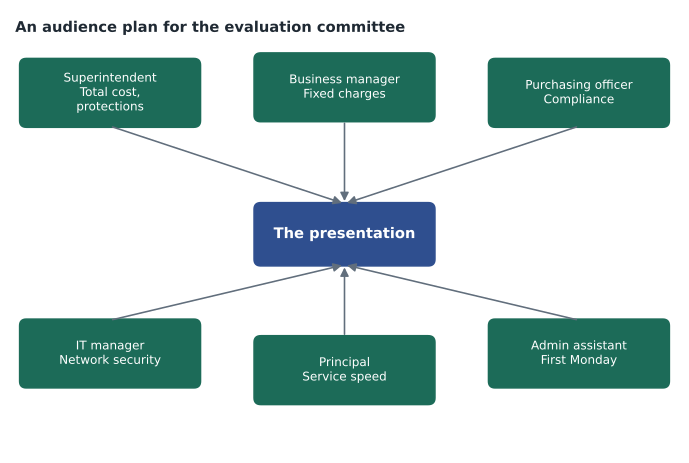
Two weeks after Prairie Valley shortlisted Ridgeline, Farida Haddad pinned a sheet of chart paper to the wall of the presentation lab. Across the top she wrote the names of the six people on the division's evaluation committee, as listed in the invitation to present: the superintendent of business administration, the business manager, the purchasing officer, the information technology manager, a principal who sat on the technology committee, and an administrative assistant from one of the high schools. Down the side she wrote: "What does this person need to hear?" Then she handed Maya a marker. "The presentation is for the committee," she said. "But the committee is six people, and each of them is listening for something different."
Tailoring means adapting a presentation's content, emphasis, language and evidence to the particular people who will hear it. It goes beyond putting the customer's logo on the first slide. It starts from what each person in the audience is responsible for, what they worry about, and what they would need to believe to support the decision.
Mapping the audience
SLS-110 introduced the buying center: the group of people who influence an organizational purchase, often described as users, influencers, gatekeepers, buyers and deciders. SLS-211 shows how to map stakeholders during discovery. For a presentation, that map turns into an audience plan: for each person who will attend or receive the material, what they care about, what they already know, what they might object to, and what part of the presentation is mainly for them.
| Committee member | Role in the decision | Main concern | What they need to hear |
|---|---|---|---|
| Superintendent of business administration | Final decider, recommends to the board | Value for public money; risk to the division | Total cost against the 10-in-100 savings target; contract protections |
| Business manager | Owns the budget | Predictable costs; no surprises | Fixed monthly charges; how price increases are capped |
| Purchasing officer | Runs the process; checks compliance | A fair, defensible process | Clear answers that map to the RFP's requirements |
| IT manager | Influencer; retiring in the spring | Network security; workload for his staff | How devices connect; who handles faults; handover to his successor |
| Principal on the technology committee | Champion; represents schools | Teachers' time; reliability | One service desk; how fast a broken printer is fixed |
| High-school administrative assistant | User | Daily hassle | Automatic toner; what changes on her first Monday |
The plan showed something the team had nearly missed. The administrative assistant was the only member of the committee who used the printers every day, and she would be asked by the others what she thought. Her question would not be about price or network security. It would be: "What happens the first time it jams?" Maya added a slide showing exactly that: one call, one ticket, a technician on site within four business hours, and a loaner device if the fix took longer than a day.
Adapting content and emphasis
Tailoring rarely means building a different presentation for each person. It means making sure the shared presentation contains what each person needs, giving the most time to what matters most to the decider, and deciding who should hear which details.
| Audience type | Emphasize | Keep brief or move to an appendix |
|---|---|---|
| Senior decision makers | Outcomes, cost, risk, strategic fit | Technical detail; feature lists |
| Finance | Total cost, payment terms, predictability, savings | How the product works |
| Technical staff | How it works, security, integration, support | High-level benefits they consider marketing |
| End users | What changes in their day; ease of use; training | Contract terms |
| Procurement | Compliance with requirements; clarity; fairness | Persuasive language without substance |
When a meeting mixes these audiences, a common approach is to present to the decider and finance at the level of outcomes, and to plan specific moments for the others: a two-minute section on network security addressed to the IT manager by name, a short demonstration of the service request for the administrative assistant. Addressing a section to a person ("Mr. Fehr, this part is mainly for you") tells them their concern was heard and tells everyone else they can relax for two minutes.
Language and level of detail
Every industry has its own vocabulary, and sellers pick up their company's quickly. Within a month at Ridgeline, Maya was saying "MFD" for multifunction device, "click charges" for per-page fees and "MPS" for managed print services. None of those terms meant anything to the principal or the administrative assistant. Farida's rule was to use the customer's words, not the seller's, and to explain any term the customer had not used first.
| Seller's term | Customer-friendly version |
|---|---|
| MFD | Printer-copier, or the printer that also scans |
| Click charge | Cost per printed page |
| MPS | Managed printing: we look after the printers, toner and repairs for a fixed monthly price |
| SLA | Our service promise: how fast we respond and fix faults |
| Fleet rationalization | Fewer, more standard printers |
| Uptime | The share of time the printers are working |
The level of detail should match what the audience needs to decide, not what the seller knows. A useful test is to ask, for each detail, "Would this change anyone's mind or answer anyone's question?" If not, it can go in the written proposal or wait for a question.
Tailoring evidence
Evidence persuades most when the audience can see themselves in it. A reference from a customer of similar size, in the same sector and the same region, with the same problem, is far stronger than a general claim. For Prairie Valley, Ridgeline asked another South Dakota school district it had served for four years whether its business manager would take a call from the committee. For Keystone, it used a regional manufacturer of grain bins. For Eastgate Physiotherapy, a small clinic with three printers, it used Northfield Family Clinic, which had signed with Ridgeline in early October, but only after asking Janet Morrow, Northfield's office manager, whether she was willing to be contacted. Customers who are used as references without being asked rarely agree to be used again.
Evidence should also match the audience's standard of proof. Finance staff tend to trust numbers they can check. Technical staff trust demonstrations and documentation. Users trust other users. Senior decision makers often trust peers in similar roles and the seller's willingness to accept contractual commitments, such as service levels with credits if they are missed.
Cultural and individual differences
Audiences differ in more than role. Some organizations expect formality and a printed agenda; others prefer an informal conversation. Some people want a lot of data and time to think; others want a clear recommendation. SLS-120 discussed social styles as a rough guide to individual preferences, with the warning that personality typing has limited evidence and that people should be treated as individuals rather than types. The same caution applies here: the best guide to how a person wants to be presented to is what they have said and done in earlier conversations.
Cultural differences also matter, especially with Indigenous-owned businesses, newcomer-owned businesses and organizations whose meeting practices differ from the seller's. A respectful approach is to ask in advance about format, time, who will attend and any protocols for the meeting, and to follow the host's lead. Sellers should never assume a person's preferences from their background.
Accessibility
Tailoring includes making sure everyone in the audience can take part. That means readable slides with enough contrast and large text, not relying on color alone to show meaning, describing charts aloud, providing materials in advance when asked, captioning or a transcript for online sessions, and choosing an accessible room. Documents sent before or after a meeting should be readable by screen readers. Public bodies such as school districts have obligations under the Americans with Disabilities Act, and many customers now ask suppliers to follow the WCAG guidelines for digital documents.
Asking the host in advance whether anyone attending needs an accommodation is simple and respectful. Prairie Valley's purchasing officer told Ridgeline that one committee member was hard of hearing and preferred speakers to face the room, not the screen. Farida rehearsed the team to turn toward the committee before speaking, a habit that improved the presentation for everyone.
Worked problem
Allocating presentation time to audience priorities
Prairie Valley gave each shortlisted supplier 60 minutes on October 27: 40 minutes to present and 20 for committee questions. The evaluation criteria were price 40 points, technical solution 25, service and support 15, implementation 10 and references 10. If Ridgeline allocated its 40 minutes in proportion to the points, how many minutes would each area get?
Show solution
- Total points: 40 + 25 + 15 + 10 + 10 = 100.
- Price: 40 × 40 ÷ 100 = 16 minutes. Technical solution: 40 × 25 ÷ 100 = 10 minutes.
- Service and support: 40 × 15 ÷ 100 = 6 minutes. Implementation: 40 × 10 ÷ 100 = 4 minutes. References: 4 minutes.
- Check: 16 + 10 + 6 + 4 + 4 = 40 minutes.
- Adjust for the audience: price is fully set out in the written response and needs little explanation, so move 8 minutes from price to service and implementation, which worried the users.
Answer: Proportional time is a useful starting point (16, 10, 6, 4 and 4 minutes), but the final plan should reflect what this committee most needs to hear in person. Ridgeline spent about 8 minutes on price and gave the extra time to service and implementation.
Checking the tailoring
Before the Prairie Valley presentation, Farida ran a rehearsal in which each member of the Ridgeline team played one committee member and listened only for that person's concerns. After the run-through, each "committee member" said what they had heard that answered their concern and what was missing. The administrative assistant's part was still thin, so Maya added a thirty-second walk-through of the first Monday after installation. The IT manager's part was too long, so the network detail moved to an appendix with an offer of a separate technical call.
This kind of rehearsal is one of the most useful habits in presentation work. It costs an hour and often catches the one missing point that would have cost the deal.
Tailoring when you cannot meet everyone
Often the people who decide will not all be in the room. At Prairie Valley, the board that would approve the contract on November 17 would never hear Ridgeline present; it would read a short report from the superintendent. At Eastgate Physiotherapy, the two owners would read the proposal at their monthly meeting without the seller present. Tailoring for absent decision makers means giving the person who does attend what they need to retell the story. A short written summary in the absent person's terms, a single chart they can show, and a clear statement of the decision being asked for all help the champion carry the message into rooms the seller cannot enter.
A practical step is simply to ask. "Who else will need to be comfortable with this, and what will they want to know?" is a question most champions are glad to answer. The answer often adds a stakeholder the seller had not met, such as a board treasurer or a department head, and shows which part of the presentation should become a one-page summary.
Tailoring can go too far. A presentation split into six separate pitches, one for each person, loses its single message. The aim is one clear story, the key message from the presentation plan, told so that each person hears the part that answers their own question. If the audience plan shows that two stakeholders want contradictory things, such as the lowest possible price and the highest level of service, that conflict is better raised openly with the champion before the meeting than discovered in front of the committee.
Common mistakes
MistakePresenting the same way to everyone in the room.
InsteadMap the audience and make sure each person hears what they need, addressed to them where useful.
MistakeUsing the seller's jargon.
InsteadUse the customer's words and explain any term they have not used.
MistakeUsing references without permission.
InsteadAsk customers before using them as references, and pick references close to the audience's situation.
MistakeAssuming preferences from a person's background.
InsteadAsk about format and needs in advance, and follow the host's lead.
MistakeLeaving accessibility to chance.
InsteadAsk about accommodations, design readable materials and describe visuals aloud.
Summary and key terms
- Tailoring adapts content, emphasis, language and evidence to the particular people in the audience.
- Start with an audience plan: for each person, their role, main concern and what they need to hear.
- Senior decision makers want outcomes, cost and risk; finance wants predictable total cost; technical staff want how it works; users want what changes in their day; procurement wants compliance and clarity.
- Replace jargon with the customer's words, and include only details that answer a question or could change a mind.
- Evidence persuades most when it is close to the audience's situation, and references should always be asked first.
- Ask about format, accommodations and protocols in advance.
- A rehearsal in which team members each listen for one stakeholder's concerns is a quick way to find gaps.
- Tailoring
- Adapting a presentation's content, emphasis, language and evidence to the people who will hear it.
- Audience plan
- A list of the people who will hear or read a presentation, with each person's role, concern and needs.
- Buying center
- The group of people who influence an organizational purchase.
- Reference customer
- An existing customer who has agreed to tell prospects about their experience.
- Appendix
- Supporting detail kept out of the main presentation but available to those who want it.
- Accessibility
- Designing materials and meetings so everyone in the audience can take part fully.
Practice problems
Work each problem on paper first, then reveal the answer to check.
List two things a finance manager is likely to listen for in a managed print presentation.
Show answer
For example, the total cost compared with today and whether monthly charges are fixed or can rise without warning.
An evaluation gives 30 of 100 points to service. How many minutes of a 50-minute presentation is that in proportion?
Show answer
50 × 30 ÷ 100 = 15 minutes.
Rewrite "Our SLA guarantees 98 percent uptime" for a school secretary.
Show answer
For example: "We promise the printers will be working at least 98 days in every 100, and if one breaks we'll have someone there within four business hours."
Lesson quiz · 5 questions
Score 60% or more to complete this lesson.
Create a free account to save your progress, take quizzes and earn a certificate.