
SLS-212 · Lesson 7 of 12 · 19 min
Writing a sales proposal
▶ Video coming soon A video version of this lesson is on the way.
Eastgate Physiotherapy was a clinic with eleven staff, three printers and a printer lease that ended on January 31, 2027. Carla Bennett, the office manager, could approve spending up to 5,000 dollars on her own. Anything larger went to the clinic's two owners, the physiotherapists Jenna Fraser and Mark Olafson, who met on the first Wednesday of each month and wanted any papers a week in advance. Maya Chen would never be in the room when they decided. "So the proposal is the salesperson," Farida Haddad said at the Friday lab on November 6, 2026, when Maya brought her first draft. "It has to do everything you would do if you were there, and it has to do it for two people who have never met you."
A sales proposal is a written document that sets out a customer's situation, the seller's recommended solution, the price and terms, and the next steps, in a form the customer can review, share and approve. Proposals range from a two-page letter for a small sale to a formal document of fifty pages or more for a large one. This lesson covers the structure of a proposal, how to write each section, and how to make a proposal easy to read and approve. Lesson 8 covers formal responses to requests for proposals, which follow the customer's structure instead.
What a proposal is for
A proposal does three jobs. It persuades: it makes the case that the recommended solution is the right choice. It informs: it gives the people who decide, who may not have attended any meeting, everything they need to understand the decision. And it records: it states exactly what is being offered, at what price and on what terms, so that both sides can refer to it later. A proposal that persuades but does not record creates disputes; one that records but does not persuade loses deals.
Proposals are often the bridge between a sales conversation and a contract. In many small and mid-sized B2B sales, the customer signs the proposal itself, or a short order form attached to it, and that signature creates the contract. SLS-213 lesson 11 explains how a verbal yes becomes a signed contract. That means everything in a proposal should be accurate and approved, because it may become binding.
The structure of a proposal
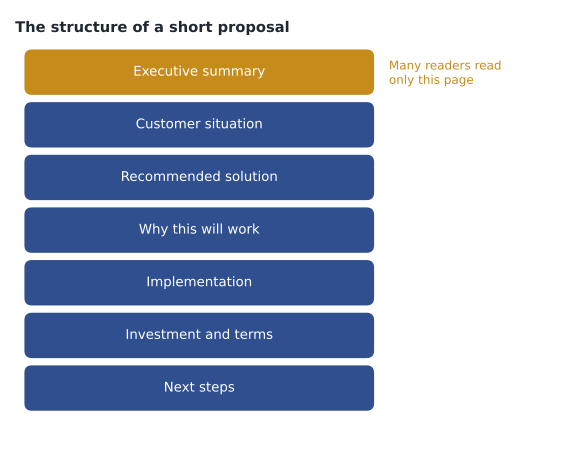
Most effective proposals follow the same logic as the presentation structure in lesson 2, adapted for a reader rather than a listener. Farida's standard structure for a proposal under ten pages had seven parts.
| Section | What it contains | Typical length |
|---|---|---|
| Executive summary | The customer's situation, the recommendation, the main benefits, the price and the next step | One page or less |
| The customer's situation | What discovery found, in the customer's terms, including the cost of the problem | Half a page to a page |
| Recommended solution | What is proposed, in a few parts, each tied to a need | One to two pages |
| Why this will work | Evidence: references, results, service commitments, the team | Half a page |
| Implementation | Steps, dates, responsibilities, training | Half a page |
| Investment and terms | Price, what is included, payment terms, contract length, key terms | Half a page to a page |
| Next steps | What the customer needs to do to proceed, and by when | A few lines |
The executive summary
The executive summary is the most important page of any proposal, because it is the page everyone reads and the only page some people read. A senior decision maker given a ten-page proposal will often read the first page, look at the price, and decide whether to read further. An executive summary should therefore be able to stand alone: someone who reads nothing else should understand the problem, the recommendation, why it is good, what it costs and what to do next.
An executive summary is not an introduction to the seller or a list of contents. It is the whole proposal in miniature. Maya's first draft began: "Ridgeline Workplace Solutions is pleased to present this proposal for managed print services. Founded in 2004, Ridgeline serves more than 600 organizations across the region." Farida crossed it out. The second draft began with the clinic.
Worked problem
Writing an executive summary
Write a five-sentence executive summary for Eastgate Physiotherapy using these facts: three aging printers jam about four times a week each; jams and service calls cost about 4,800 dollars a year in staff time; the clinic spends about 7,500 dollars a year on its lease, toner and repairs; Ridgeline proposes two new printers on a three-year managed print agreement at 400 dollars a month, all inclusive; the current lease ends January 31, 2027.
Show solution
- Situation: "Eastgate's three printers jam about four times a week each, and the time staff spend clearing jams and calling for service costs the clinic about 4,800 dollars a year."
- Recommendation: "We recommend replacing them with two new printers on a three-year managed print agreement, starting when your current lease ends on January 31, 2027."
- Benefits: "Toner and repairs are included, a technician responds within four business hours, and your spending on printing falls from about 7,500 to 4,800 dollars a year."
- Price: "The agreement costs 400 dollars a month, or 14,400 dollars over three years, with no up-front cost."
- Next step: "If the owners approve the proposal at their meeting on December 2, we will install the printers on Saturday, January 30, so the change happens without disrupting patients."
Answer: Five sentences cover the situation and its cost, the recommendation, the benefits, the price and the next step. An owner who reads only this paragraph can decide.
Check the arithmetic in that summary before it goes out. Three years at 400 dollars a month is 400 × 36 = 14,400 dollars. A year at 400 dollars a month is 4,800 dollars, compared with about 7,500 today, a saving of about 2,700 dollars a year in direct costs before any staff time is counted. Lesson 9 shows how to present that kind of comparison as a business case.
Writing the customer's situation
The situation section shows that the seller understands the customer, and it gives decision makers who were not in the discovery conversations the facts they need. It should be written in the customer's language, use the customer's numbers, and be checked with the customer before the proposal is sent. Maya sent Carla a short summary of the situation section by email and asked whether anything was wrong. Carla corrected one fact: the clinic had eleven staff, not twelve, because a part-time receptionist had left. A small correction, but one that showed the owners the proposal was based on their real clinic.
The recommended solution
The solution section describes what is proposed in enough detail to be clear and in a form the customer can follow. As in a presentation, it helps to group the solution into a few parts, each linked to a need from the situation section. It should describe what will change for the customer, not only what the products are. Technical specifications belong in an appendix or a product sheet.
Many proposals offer options: two or three versions of the solution at different levels of scope or price. Options can help customers choose, and lesson 10 discusses how to present them. But options also make a proposal longer and a decision harder, so they should be used only when there is a genuine choice to make. For Eastgate, Maya offered one recommendation and mentioned in one sentence that a three-printer version was available if the clinic preferred a printer in each treatment area.
Evidence, implementation and terms
The evidence section answers the reader's question, "Why should we believe this?" For a small clinic, the best evidence was a reference from a similar customer and a clear service commitment. With Janet Morrow's permission, Maya named Northfield Family Clinic as a reference and included Ridgeline's standard service promise: response within four business hours and a loaner device if a repair took longer than one business day.
The implementation section reassures readers that the change will be manageable. It should give dates, say who does what, and say how disruption will be kept low. For Eastgate, installation on a Saturday when the clinic was closed, a fifteen-minute training session for staff on the Monday morning, and removal of the old printers by the leasing company were the key points.
The investment and terms section must be precise. It should state the price, what it includes and excludes, how and when payment is due, the contract length, and any key terms, such as price increases, termination rights and what happens at the end of the term. Carla had told Maya that the clinic once paid a large fee to leave a five-year lease early, so termination mattered to her. Maya worked with Leah Marchand, Ridgeline's contracts manager, to describe the agreement's early termination terms in plain language in the proposal, with the full terms in an attached agreement.
| Term | How Maya described it |
|---|---|
| Price | 400 dollars a month for three years, billed monthly |
| Included | Two printers, toner, parts, labor and service visits, and up to 3,000 pages a month in total across both printers |
| Extra pages | Pages above 3,000 a month billed at the rate in the agreement |
| Taxes | Prices exclude sales tax, which is added to each invoice where it applies |
| Price changes | Fixed for the three-year term |
| Early termination | Allowed after the first year with 90 days' notice and a fee set out in the agreement |
| End of term | The clinic can renew, upgrade or return the printers |
Writing so it is easy to read
Proposals are read by busy people who skim. Writing that is easy to skim gets read; writing that is dense does not. Plain language guidelines, such as those used by the governments of Canada and the United States, recommend short sentences, active voice, common words, headings that say what each section contains, and lists or tables for information that is naturally a list.
| Harder to read | Easier to read |
|---|---|
| "It is anticipated that the implementation of the proposed solution will be effected over a two-day period." | "We will install the printers over one weekend." |
| "Ridgeline will endeavor to respond to service requests within a timeframe of four business hours." | "A technician will respond within four business hours." |
| Heading: "Section 4" | Heading: "How the changeover will work" |
| A paragraph listing six included items | A short table or list of the six items |
Length should fit the decision. Farida's rule was that a proposal should be as short as it can be while still giving the decision makers everything they need. For Eastgate, that was four pages plus the agreement. For Prairie Valley's RFP, it was more than forty pages, because the RFP required it.
Proposal templates and AI drafting
Most sales teams use proposal templates, and many now use proposal software or AI tools to draft sections. Templates save time and keep terms consistent. AI drafting can produce a reasonable first draft quickly. Both carry the same risk: a proposal that reads as generic, or that contains statements that are not true for this customer. Common errors include another customer's name left in from a previous proposal, standard claims that do not apply, and terms that legal has since changed.
Ridgeline's rule was that every proposal was checked by the seller against the discovery notes before it went out, and that any change to standard terms was approved by Leah. AI tools could be used only through Ridgeline's approved account, and customer information that was not already in Ridgeline's systems was not pasted into them. Maya read her Eastgate draft aloud before sending it, which caught two sentences that sounded like the template rather than like the clinic.
Sending and following up
How a proposal is sent matters too. Maya sent the Eastgate proposal to Carla on November 12 as a PDF with a short covering email, two weeks before the owners' deadline for papers on November 25, so that Carla had time to read it, ask questions and prepare her own recommendation to the owners. She offered a fifteen-minute call to walk Carla through it, and asked whether Carla would like a one-page summary to put in front of the owners. Carla accepted both. Sellers who send a proposal and wait are often surprised by the silence that follows; sellers who agree a review conversation in advance learn what the customer thinks.
Common mistakes
MistakeStarting the proposal with the seller's company history.
InsteadStart with an executive summary that covers the customer's situation, recommendation, benefits, price and next step.
MistakeWriting a situation section without checking it with the customer.
InsteadSend the customer a summary and ask what is wrong before sending the proposal.
MistakeLeaving key terms vague.
InsteadState price, inclusions, exclusions, taxes, length, price changes and termination precisely, with legal approval for any changes.
MistakeUsing dense, passive language.
InsteadWrite short sentences in active voice, with headings that say what each section contains.
MistakeSending a template or AI draft without checking it.
InsteadCheck every proposal against the discovery notes and remove anything that is not true for this customer.
Summary and key terms
- A sales proposal persuades, informs and records: it makes the case, gives absent decision makers what they need, and states exactly what is offered.
- Because proposals often become contracts, everything in them must be accurate and approved.
- A standard short proposal has an executive summary, the customer's situation, the recommended solution, evidence, implementation, investment and terms, and next steps.
- The executive summary must stand alone.
- The situation section uses the customer's language and should be checked with them.
- Group the solution into parts tied to needs, and use options only when there is a real choice.
- State terms precisely, including taxes and termination.
- Write in plain language, keep the proposal as short as the decision allows, and check templates and AI drafts against discovery.
- Send the proposal early and agree a review conversation.
- Sales proposal
- A written document setting out the customer's situation, the recommended solution, the price and terms, and next steps.
- Executive summary
- The first page of a proposal, which states the whole case in miniature and must stand alone.
- Options
- Two or three versions of a solution at different levels of scope or price, offered so the customer can choose.
- Investment and terms
- The proposal section that states the price, inclusions, payment, contract length and key terms.
- Plain language
- Writing that uses short sentences, active voice, common words and clear headings.
- Covering email
- A short message sent with a proposal that explains it and proposes a review conversation.
Practice problems
Work each problem on paper first, then reveal the answer to check.
A managed print agreement costs 350 dollars a month for four years. What is the total?
Show answer
350 × 48 = 16,800 dollars.
Rewrite in plain language: "Remediation of identified deficiencies will be undertaken within one business day."
Show answer
For example: "We will fix any problem we find within one business day."
Why should a seller check the situation section with the customer before sending the proposal?
Show answer
To catch mistakes and changes, and to show absent decision makers the proposal is based on their real situation.
Lesson quiz · 5 questions
Score 60% or more to complete this lesson.
Create a free account to save your progress, take quizzes and earn a certificate.