
ROOF-330 · Lesson 9 of 12 · 27 min
Estimating materials and labor
▶ Video coming soon A video version of this lesson is on the way.
With the Linden takeoff checked, Glen handed Rory a blank estimate sheet and a printed price list from the supplier. "The takeoff tells you how much roof there is," he said. "The estimate tells you what it costs us to build it, and what we charge for it. Those are different numbers, and the difference between them is how this company pays its people in February, when nobody's roofing." The prices in this lesson are samples for teaching, not real prices; real prices change month to month and differ between suppliers and regions.
This lesson covers turning a takeoff into material quantities and costs, estimating labor from production rates, adding equipment, disposal and other direct costs, and then adding overhead and profit to reach a price.
The parts of an estimate
Every estimate, from a shingle roof to a warehouse, is built from the same parts:
| Part | What it includes |
|---|---|
| Materials | Everything that stays on the roof, plus consumables: membranes, shingles, insulation, fasteners, adhesives, flashings, metal, sealants |
| Labor | The hours of every worker on the job, priced at what each hour costs the company, including payroll costs |
| Equipment and direct costs | Cranes, hoists, bins and disposal, safety equipment rental, permits, testing, travel |
| Overhead | The company's costs of being in business that are not tied to one job: office, estimating, trucks, insurance, the yard |
| Profit | What the company earns for its risk and work, and what it reinvests |
| Taxes and allowances | Sales taxes as the contract requires; allowances or unit prices for unknowns such as deck repair |
Materials, labor and equipment together are the direct cost of the job. Overhead and profit are added on top to make the price.
Materials
Material quantities come from the takeoff, adjusted for waste and for the units the materials are sold in. Shingles are sold in bundles, commonly three bundles to a square for laminated shingles; underlayment and eave protection in rolls of a stated coverage; drip edge in lengths; nails in boxes or coils. Every quantity is rounded up to whole units, and the unit count is what goes on the order.
Worked problem
Materials for 15 Linden Street
From the takeoff: 14.1 squares including waste; 76 ft of eaves; 143.3 ft of eaves and rakes; 38 ft of ridge. Ridgecap installs one course of ice barrier 3 ft wide along both eaves. Work out the order and the material cost using these sample prices: shingles 36 dollars a bundle; starter strip 48 dollars a bundle covering 105 ft; ridge cap 62 dollars a bundle covering 33 ft; ice barrier 95 dollars a roll covering 65 ft of eave; synthetic underlayment 130 dollars a roll covering about 900 ft² after laps; drip edge 11 dollars per 10 ft length; one box of coil nails, 80 dollars.
Show solution
- Shingles: 14.1 × 3 = 42.3, so 43 bundles × 36 = 1,548 dollars.
- Starter: 143.3 ÷ 105 = 1.4, so 2 bundles × 48 = 96 dollars.
- Ridge cap: 38 ÷ 33 = 1.2, so 2 bundles × 62 = 124 dollars.
- Ice barrier: 76 ÷ 65 = 1.2, so 2 rolls × 95 = 190 dollars.
- Underlayment: roof area 1,279 ft² less ice barrier 76 × 3 = 228 ft² leaves 1,051 ft²; 1,051 ÷ 900 = 1.2, so 2 rolls × 130 = 260 dollars.
- Drip edge: 143.3 ÷ 10 = 14.3, so 15 lengths × 11 = 165 dollars.
- Nails: 1 box = 80 dollars.
- Material total = 1,548 + 96 + 124 + 190 + 260 + 165 + 80 = 2,463 dollars.
Answer: 2,463 dollars of material on these sample prices. A real estimate would add vents, pipe flashings, step flashing at the dormer if there is one, and sealant, which Glen left out to keep the exercise short.
Labor
Labor is the hardest part of an estimate to get right, and the part that most often loses money. It is estimated from production rates: how many labor-hours a unit of work takes, such as hours per square to tear off and re-shingle, hours per square meter to install insulation, or hours per meter to flash a parapet. Good contractors build their production rates from their own job records, comparing estimated and actual hours on every job, and adjust them for conditions: height, slope, access, weather, the number of layers to remove, how cut up the roof is, and the crew's experience.
The labor cost of an hour is more than the wage. It includes the employer's share of payroll costs, such as Social Security and Medicare, unemployment insurance, workers' compensation premiums and any benefits, plus training, small tools and other costs that go with each hour worked. Contractors use a burdened rate for each trade or a blended rate for the crew.
Worked problem
Labor for 15 Linden Street
Ridgecap's records for tearing off one layer and re-shingling two-story 8 in 12 houses on Linden Street average about 2.6 labor-hours per square, plus 8 hours per job for setup, protection of the garden and clean-up. The sample blended burdened rate for Crew 5 is 55 dollars an hour. What is the labor estimate?
Show solution
- Roof hours = 14.1 × 2.6 = 36.7 hours.
- Total = 36.7 + 8 = 44.7 hours.
- Labor cost = 44.7 × 55 = 2,459 dollars.
Answer: About 45 labor-hours: a crew of four for about a day and a half, which Wes would book as two days to allow for weather and the dumpster swap. Labor costs 2,459 dollars on these sample figures.
Equipment and other direct costs
Equipment and other direct costs are listed item by item: disposal bins and tipping fees, crane or hoist time, rented guardrails or safety equipment, permits, testing such as an asbestos sample, delivery charges, parking and travel. On a shingle job these are small; on a large commercial job, as lesson 12 shows, cranes and disposal can be a large part of the cost. For Linden, Glen allowed one bin at 500 dollars.
Overhead and profit
Overhead is what it costs to run the company, spread over its work. Ridgecap works out its overhead each year by dividing the year's expected overhead costs by the year's expected direct costs, and adds that fraction to every estimate. Profit is added on top, as a fraction of cost plus overhead. Both fractions depend on the company, the market and the job: a small residential job with a lot of office time may carry more overhead per dollar than a large commercial job, and a risky job deserves more profit than a simple one.
Worked problem
From cost to price at Linden
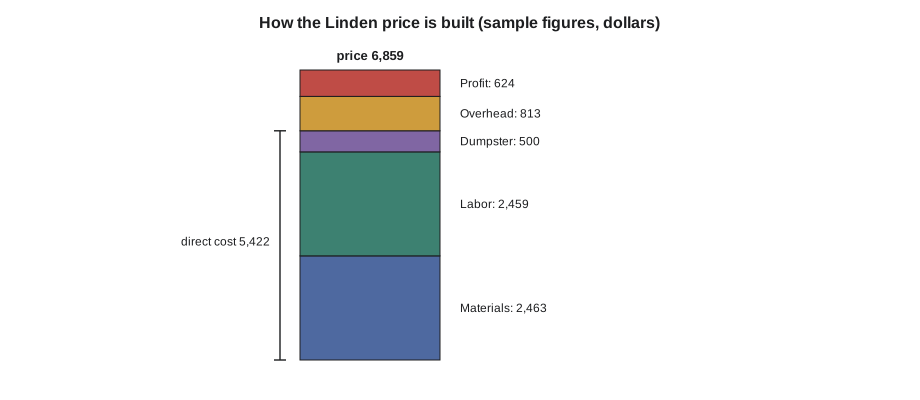
Add the bin to the material and labor costs to get the direct cost. Then add overhead at 15 in 100 of direct cost, and profit at 10 in 100 of cost plus overhead. What is the price?
Show solution
- Direct cost = 2,463 + 2,459 + 500 = 5,422 dollars.
- Overhead = 5,422 × 0.15 = 813 dollars; cost plus overhead = 6,235 dollars.
- Profit = 6,235 × 0.10 = 624 dollars.
- Price = 6,235 + 624 = 6,859 dollars.
Answer: About 6,860 dollars, which works out to about 485 dollars a square. Glen would round the quote to 6,850 dollars and list what it includes and excludes, such as replacing rotted sheathing, which is priced per sheet.
Markup and margin
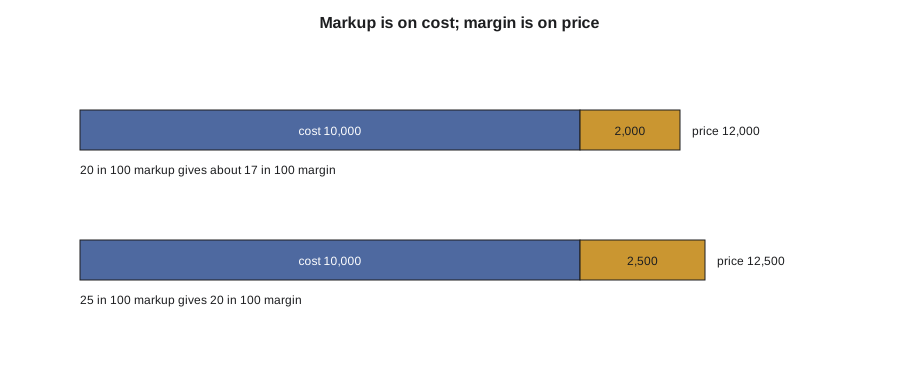
Two words cause more confusion in estimating than any others. Markup is what is added to cost, as a fraction of cost. Margin is what is left of the price after cost, as a fraction of the price. The same job has a larger markup than margin. A contractor who confuses them, and thinks a 20 in 100 markup gives a 20 in 100 margin, will earn less than planned on every job.
Worked problem
Markup is not margin
A job costs 10,000 dollars. The contractor adds a markup of 20 in 100. What is the price, and what is the margin? What markup would give a margin of 20 in 100?
Show solution
- Price = 10,000 × 1.20 = 12,000 dollars.
- Margin = (12,000 − 10,000) ÷ 12,000 = 0.167, about 17 in 100.
- For a margin of 20 in 100, the price must be 10,000 ÷ 0.80 = 12,500 dollars, a markup of 2,500 ÷ 10,000 = 25 in 100.
Answer: A 20 in 100 markup gives only about 17 in 100 margin. To earn a 20 in 100 margin, the markup must be 25 in 100.
Checking an estimate
Before a price goes out, it is checked. Glen checks every estimate three ways. First, the arithmetic and the takeoff, by a second person. Second, the cost per unit against similar recent jobs: if the Linden price comes out at 600 dollars a square and the last four Linden houses were between 560 and 640, it is probably right; if it comes out at 400, something is missing. Third, the scope: does the price cover everything the drawings, the specification or the customer's request call for, and does the proposal say clearly what is excluded? Most money lost in estimating is lost through things that were never priced.
Unit prices, allowances and contingencies
Some work cannot be measured before the job starts. Rotted deck, wet insulation beyond what the survey found, and extra layers hidden under the roof are the usual examples on re-roofs. There are three ways to handle them, and a proposal should say which it uses. A unit price quotes a rate per unit, such as per sheet of sheathing or per square meter of steel deck, and the owner pays for the quantity actually found, measured and agreed on site. An allowance carries a fixed sum in the price for an item whose extent or choice is not yet known, with the final cost adjusted up or down when it is. A contingency is a sum the contractor adds to cover its own risk, usually without telling the owner what it covers; contingencies make prices less competitive and less transparent, so most roofers prefer unit prices for unknowns.
Worked problem
Unit price for rotted sheathing
Glen's Linden quote includes replacing rotted roof sheathing at a unit price of 70 dollars per sheet installed (sample figure). If the crew finds and replaces 6 sheets, measured and photographed with the owner's agreement, what is the extra?
Show solution
- Extra = 6 × 70 = 420 dollars.
Answer: The owner knows the rate in advance and pays only for what is found. Without a unit price, the same six sheets become an argument at the door.
Pricing extra work
Once a job is under way, extra work is priced by change order, using the same parts as the estimate: materials, labor at the burdened rate, equipment, and overhead and profit, usually at rates set out in the contract. Extra work done on a time-and-material basis needs daily records signed by the owner's representative: who worked, how many hours, what materials were used. A change order is agreed in writing before the work is done whenever possible; when it cannot be, because water is coming in or the crew cannot continue without it, the work is recorded and photographed and the change order follows as soon as possible.
Learning from every job
An estimate is only as good as the production rates and prices behind it, and those come from finished jobs. After each job, Ridgecap's office compares the estimate with the actual costs: hours by task, materials used against materials ordered, equipment days, and any extras. The differences adjust the production rates for the next estimate. A crew that consistently installs insulation faster than estimated, or a roof type that always uses more waste than allowed, shows up in this comparison. Glen calls it "the most valuable hour of the job", and it is the reason Dana's daily reports in lesson 11 record hours by task, not just in total.
Common mistakes
MistakeOrdering by area instead of in whole units.
InsteadConvert quantities to bundles, rolls and lengths, and round up.
MistakePricing labor at the wage.
InsteadUse a burdened rate that includes payroll costs and other costs of each hour.
MistakeUsing someone else's production rates.
InsteadBuild rates from your own job records and adjust for conditions.
MistakeConfusing markup and margin.
InsteadMarkup is on cost; margin is on price; a 25 in 100 markup gives a 20 in 100 margin.
MistakeSending a price without checking scope and exclusions.
InsteadCheck against similar jobs and list what is and is not included.
Summary and key terms
- An estimate is materials, labor and equipment (direct cost), plus overhead and profit, plus taxes and allowances.
- Materials come from the takeoff with waste, converted to whole selling units.
- Labor comes from production rates in hours per unit, from the company's own records, at a burdened rate.
- Equipment and direct costs are listed item by item; on large jobs they can be large.
- Overhead is added on direct cost; profit is added on cost plus overhead.
- Markup is a fraction of cost and margin a fraction of price; check every estimate against similar jobs and its scope.
- Direct cost
- The cost of materials, labor and equipment for a job.
- Production rate
- The labor-hours needed for a unit of work, such as hours per square.
- Burdened rate
- The full cost of an hour of labor, including payroll costs, not just the wage.
- Overhead
- The costs of running the company that are not tied to one job.
- Markup
- The amount added to cost, as a fraction of cost.
- Margin
- The part of the price left after cost, as a fraction of price.
- Exclusion
- Work a proposal states is not included in the price.
Practice problems
Work each problem on paper first, then reveal the answer to check.
A roof needs 18.4 squares of laminated shingles. How many bundles?
Show answer
18.4 × 3 = 55.2, so 56 bundles.
A job takes 60 labor-hours at a burdened rate of 60 dollars. What is the labor cost?
Show answer
3,600 dollars.
Direct cost is 20,000 dollars, overhead 12 in 100 and profit 8 in 100. What is the price?
Show answer
20,000 × 1.12 = 22,400; × 1.08 = 24,192 dollars.
What markup gives a 25 in 100 margin?
Show answer
Price = cost ÷ 0.75, so the markup is 1 ÷ 3, about 33 in 100.
Name three costs included in a burdened labor rate besides the wage.
Show answer
Social Security and Medicare, unemployment insurance, workers' compensation, benefits, training, small tools.
Lesson quiz · 5 questions
Score 60% or more to complete this lesson.
Create a free account to save your progress, take quizzes and earn a certificate.