
ROOF-330 · Lesson 3 of 12 · 22 min
Maintenance programs
▶ Video coming soon A video version of this lesson is on the way.
Nadine Szabo has run Ridgecap's service department since 2015. When she started, the company had eleven maintenance contracts; by the fall of 2026 it had sixty-four, from small plazas to the Eastport warehouse and the Scioto Commons green roof. At the October 26 session she put a chart on the screen showing two lines: the age at which Ridgecap's maintained roofs had been replaced, and the age of roofs on comparable buildings it had replaced for owners who never called until they leaked. "The maintained roofs lasted years longer," she said. "Not because we're magicians. Because somebody cleaned the drains, put the stone back, and fixed the small things while they were still small."
A roof maintenance program is a planned set of inspections and small repairs, done on a schedule and recorded, so that a roof reaches the end of its expected life, or beyond it, without the damage that unplanned leaks cause. This lesson covers what goes into a program, who does what, how often, how it is recorded, and how it pays for itself.
What a program includes
A typical commercial maintenance program has five parts:
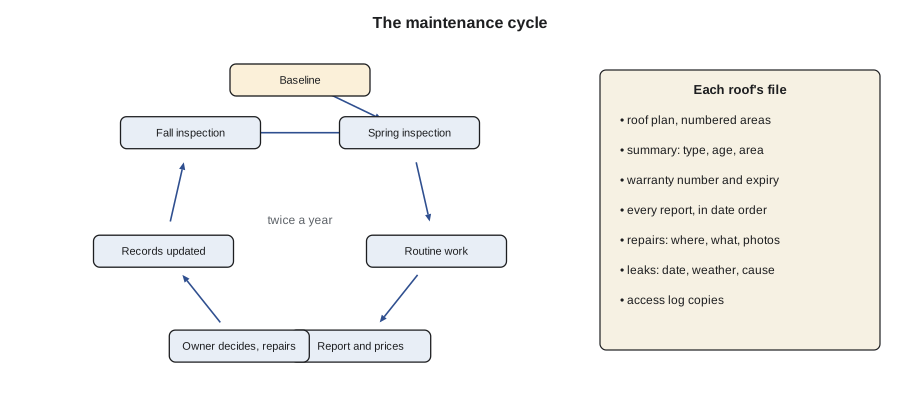
- A baseline: a first full inspection, a roof plan with numbered areas and details, and a record of the roof's type, age, warranty, past repairs and known problems.
- Scheduled inspections: usually two a year, in spring to find winter damage and in fall to prepare for winter, plus inspections after severe storms.
- Routine work: cleaning drains, gutters and scuppers, removing debris, resetting ballast and pavers, resealing minor details, topping up pitch pans, fixing small punctures and open laps.
- Reporting: a report after every visit, with photos, priorities and prices for work beyond the routine items.
- Records: a file for each roof that holds every report, repair, leak, warranty letter and photo, so that the next inspector starts with the history.
Some programs also include a budget forecast: an estimate of the roof's remaining life and the year a replacement should be planned. Owners of large buildings budget years ahead, and a forecast from the roofer who inspects the roof twice a year is worth more to them than one from somebody who has never been up there.
Who does what
Maintenance is shared, and the program should say who does each part. The owner's staff are often responsible for keeping drains clear between visits, controlling roof access, and calling in leaks quickly. The roofing contractor inspects, does the routine work and the repairs, and reports. Other trades that work on the roof, especially mechanical contractors servicing rooftop units, need to be told where to walk, to put panels and screws back, and to report damage. Many owners keep a roof access log at the hatch: everyone who goes up signs in, with the date, company and reason. When a new puncture turns up next to a rooftop unit, the log shows who was there.
| Task | Typical frequency | Usually done by |
|---|---|---|
| Full inspection and report | Spring and fall | Roofing contractor |
| Inspection after a severe storm | After high wind, hail or heavy snow | Roofing contractor, called by the owner |
| Clean drains, scuppers, gutters | At every inspection; more often under trees | Contractor or owner's staff |
| Reset ballast and pavers | At every inspection; after storms | Roofing contractor |
| Check sealants, pitch pans, counterflashing | Every inspection; reseal as needed | Roofing contractor |
| Recoat reflective coatings | As the coating maker specifies, often every 10 years or so | Roofing contractor |
| Roof access log | Every visit by anyone | Owner |
The membrane maker's warranty usually lists the owner's maintenance duties. Most require the owner to keep drains clear, prevent damage by other trades, report leaks promptly, and use a contractor approved by the maker for repairs. A warranty claim can be refused if the records show the roof was neglected, or if there are no records at all. Lesson 10 covers warranties in detail.
Routine work done well
Routine work is simple, but it is where a program earns its money. Drains are the first job: strainers are lifted, debris is bagged and removed from the roof, the drain line is checked for flow, and the strainer and clamping ring are put back and tightened. Debris is never pushed down the drain. Ballast is raked back over bare membrane, especially at corners and edges where the wind scours it, and the scoured areas are recorded so the owner can see the pattern. Loose walkway pads are reset or replaced. Small punctures and open seams are repaired with the maker's materials, not with a tube of sealant from the truck.
Sealant is maintenance, not a repair. Where a detail depends on sealant, such as the top of a surface-mounted counterflashing, a pitch pan or a pipe collar, it is checked at every visit and replaced when it cracks or lets go. ROOF-320 lesson 10 explained why sealants fail; a maintenance program is where they are kept working.
Worked problem
Planning a year of inspections
Nadine plans her year in hours. Her sixty-four contract buildings each get two inspections a year. An inspection takes an average of 3.5 hours on site for a two-person team, and each report takes another hour in the office. How many team-hours of inspection and reporting does the program need each year?
Show solution
- Inspections a year = 64 × 2 = 128.
- Site time = 128 × 3.5 = 448 team-hours.
- Reports = 128 × 1 = 128 hours.
- Total = 448 + 128 = 576 hours.
Answer: About 576 hours a year before any repairs, storm calls or leak calls. Spring and fall each hold about 288 hours, so Nadine books two inspection teams for about five weeks each season.
Records that work
A maintenance record is only useful if the next person can find what they need. For each roof, Nadine's file holds the roof plan with numbered areas and details, a summary sheet (type, age, area, warranty number and expiry, maker and contacts), and every report in date order. Each repair is recorded with its location number, the date, what was done and with what materials, and photos before and after. Leaks are recorded with the date, the weather, where they appeared inside and what was found. Over a few years, the records show patterns: the same drain clogging every fall, the same corner losing ballast, the same rooftop unit technician leaving screws behind. Patterns are what turn repairs into permanent fixes.
Does maintenance pay?
Owners pay for maintenance because it costs less than the damage it prevents. A leak that runs for a month into a dressing room or a warehouse can cost more in ceilings, stock and lost use than a year of maintenance. Maintenance also extends the life of the roof. Comparing the cost per year of the roof's life with and without maintenance shows why.
Worked problem
Cost per year of service
A roof costs 180,000 dollars to replace (sample figure). Without maintenance, an owner expects it to last 20 years. With a maintenance program costing 1,500 dollars a year (sample figure), it is expected to last 25 years. Compare the cost per year of service.
Show solution
- Without maintenance: 180,000 ÷ 20 = 9,000 dollars per year.
- With maintenance: total cost = 180,000 + 25 × 1,500 = 180,000 + 37,500 = 217,500 dollars.
- Per year: 217,500 ÷ 25 = 8,700 dollars per year.
Answer: The maintained roof costs about 300 dollars a year less over its life, before counting any leak damage avoided. The comparison is simplified: it ignores interest and inflation, and the extra life is an estimate. But the direction is clear, and it is usually stronger once leak damage is counted.
The numbers in that example are samples, not prices. What matters is the method: when an owner asks whether maintenance is worth it, compare the cost per year of service, and add the cost of the leaks that a program prevents.
Starting a program on an existing roof
When a building with an existing roof joins a program, the first visit is a baseline inspection: a full inspection to the standard of lesson 1, a roof plan, cores or a moisture survey if the roof's condition is in doubt, and a frank report. Some roofs are not worth maintaining. A roof with large wet areas, failed seams throughout and no remaining life needs replacing, not maintenance, and the baseline report should say so. Lesson 4 covers that decision.
Storms, snow and emergency calls
A maintenance program also covers the calls nobody plans for. After a severe windstorm, Nadine's team checks the contract buildings in order of risk: large ballasted and mechanically attached roofs first, then roofs with known weak edges, then the rest. The first visit is a safety and damage check: loose edge metal, displaced ballast, torn membrane, debris from trees or neighboring buildings, and anything that could blow off and hurt someone. Temporary repairs are made the same day where possible, and photographed, because the owner's insurer will want to see the damage before and after.
Heavy snow brings different calls. Most roofs are designed for the snow loads in the building code for their location, but drifts behind parapets, beside higher roofs and around rooftop units can load small areas far more than the average. Owners sometimes ask roofers to clear snow. Snow removal from a roof is roofing work with all its hazards: falls at hidden edges and skylights under the snow, and damage to the membrane from shovels. Ridgecap's rule is plastic shovels only, a layer of snow left on the membrane, no snow thrown onto anything below without a guarded drop zone, and fall protection set up before anyone steps onto the roof.
Leak calls are the most common emergency. The service technician's first job is to stop the damage inside: buckets, tarps over stock and equipment, and a temporary seal on the roof if the source can be found safely. The permanent repair waits for a dry day and, as ROOF-320 showed, for a proper investigation. Every call goes into the roof's file with its date, weather, location and what was found.
| Event | First actions | Records |
|---|---|---|
| Windstorm | Check edges, ballast, membrane and debris; temporary repairs; protect the public below | Photos before and after; list of damage for the insurer |
| Heavy snow | Check drifts at parapets and units; clear only with plastic shovels and fall protection | Depths and locations of drifts; areas cleared |
| Hail | Look for bruised membrane, dented metal and fractured shingles; test suspect areas | Photos with scale; hail size if known |
| Leak call | Protect the interior; temporary seal if safe; plan an investigation | Date, weather, inside location, cause when found |
Pricing a maintenance program
Maintenance contracts are usually priced as a fixed annual fee for the scheduled inspections, reports and a set list of routine tasks, with repairs beyond that list priced separately and approved by the owner before the work is done. The fee is built like any estimate: hours for the inspections and reports, travel, equipment such as ladders and fall protection, a small allowance for consumables, overhead and profit. Nadine's contracts also set a response time for leak calls, such as within four hours during business hours and the next morning otherwise, and a rate for emergency calls. The contract should say clearly what is included, because an owner who thinks every repair is covered by the fee and a contractor who thinks none are will soon disagree.
Training the owner's staff
A program works best when the owner's own staff know what to watch for between visits. Nadine gives each contract building's maintenance staff a one-page sheet: keep drains and scuppers clear, especially in fall; keep the roof access locked and the log signed; call Ridgecap the same day for any leak, with the location and the weather; never let anyone cut into the roof or set equipment on it without calling first; and stay back from the edges and skylights. She walks the roof with them once a year, so they know where the drains, the soft spots and the problem details are. Staff who know the roof catch problems weeks before the next inspection would.
Common mistakes
MistakePushing debris down the drain to clear it.
InsteadBag debris and take it off the roof; check the drain flows.
MistakeTreating new sealant as a permanent repair.
InsteadUse the maker's repair materials; check and renew sealants at every visit.
MistakeKeeping reports in e-mails and phone photos.
InsteadKeep one file per roof with the plan, summary, reports, repairs and leaks.
MistakeLetting other trades walk the roof without rules.
InsteadUse an access log and tell service technicians where to walk and what to put back.
MistakeMaintaining a roof that has no life left.
InsteadSay so in the baseline report and recommend replacement.
Summary and key terms
- A maintenance program is planned inspections, routine work, reports and records, often with a budget forecast.
- Inspections are usually spring and fall, plus after severe storms.
- Routine work: drains, debris, ballast, walkway pads, sealants and small repairs with the maker's materials.
- The program says who does what; an access log tracks who goes on the roof.
- Warranties usually require maintenance and records; neglect can void a claim.
- Maintenance pays through longer roof life and avoided leak damage; compare cost per year of service.
- Maintenance program
- A planned schedule of inspections, routine work and records for a roof.
- Baseline inspection
- The first full inspection that starts a roof's file and program.
- Roof access log
- A sign-in record of everyone who goes on a roof.
- Budget forecast
- An estimate of remaining life and when replacement should be planned.
- Routine work
- Small, repeated tasks such as cleaning drains and resetting ballast.
- Cost per year of service
- Total cost of a roof and its upkeep divided by the years it lasts.
Practice problems
Work each problem on paper first, then reveal the answer to check.
A program covers 40 roofs, inspected twice a year at 3 hours each plus 1 hour reporting. How many hours?
Show answer
80 × 4 = 320 hours.
A 150,000 dollar roof lasts 18 years without maintenance or 24 years with 1,200 dollars a year. Compare cost per year.
Show answer
8,333 versus (150,000 + 28,800) ÷ 24 = 7,450 dollars a year.
When are routine inspections usually done?
Show answer
Spring and fall, and after severe storms.
What should happen to debris found in a drain?
Show answer
Bag it and remove it from the roof; never push it down the drain.
Why keep a roof access log?
Show answer
To know who was on the roof when new damage appears.
Lesson quiz · 5 questions
Score 60% or more to complete this lesson.
Create a free account to save your progress, take quizzes and earn a certificate.