
ROOF-330 · Lesson 5 of 12 · 25 min
Recover and tear-off decisions
▶ Video coming soon A video version of this lesson is on the way.
Before Ahmed's survey came back, Glen had sketched two scopes for Parkdale on the whiteboard. The first was a recover: leave the old EPDM and insulation in place, remove the ballast, add a cover board, and adhere a new membrane over the top. The second was a tear-off: remove everything down to the steel deck and build a new roof from scratch. "A recover looks like the cheap option," he said at the November 2 session, "and sometimes it is. But you can only recover a roof that's dry, sound, and allowed to be recovered. Parkdale failed the first test the moment Ahmed's cores came up wet."
This lesson covers what a recover is, when the codes and the makers allow one, the hidden costs and risks on both sides, and how the decision is made on a real roof.
Recover, replacement and tear-off
A recover (also called an overlay or re-cover) installs a new roof covering over the existing one, without removing it. On steep roofs it usually means a second layer of shingles over the first; on low-slope roofs it means a new membrane, usually over a new cover board or insulation, laid over the old roof. A replacement or tear-off removes the existing covering, and usually the insulation, down to the deck, so the deck can be inspected and repaired and a complete new roof built. A partial tear-off removes the wet or damaged areas and recovers the rest.
A recover saves the cost and mess of tearing off, keeps the building closed during the work, and keeps metric tons of old roofing out of landfill. A tear-off costs more, but it lets the crew see and repair the deck, remove wet materials, add insulation to current energy levels, correct drainage, and start with a system the maker will warranty without conditions.
What the codes say
The Ohio Building Code, based on the 2021 International Building Code, and the Residential Code of Ohio, based on the IRC, both have a reroofing section (IBC Section 1512, IRC Section R908). In their own words, they define a roof replacement as removing all existing layers of roof covering down to the deck, and a roof recover as installing a new covering over an existing one. They do not allow a recover where the existing roof or roof covering is water-soaked or has deteriorated so that it is not an adequate base, where the existing covering is slate, clay, cement or asbestos-cement tile, or where the roof already has two or more applications of any type of roof covering. They allow certain overlays as exceptions, such as complete new roof systems like standing-seam metal panels that do not rely on the existing roof, and coatings over some existing roofs. Columbus requires a permit for roof replacement, as ROOF-130 noted.
Whatever the code allows, the membrane maker has the last word on the warranty. Most makers allow recovers over existing roofs only if the existing roof is dry, one layer, firmly attached, and covered with a separation or cover board, and only with their approval of the specific roof, often after an inspection and cores.
Is the roof a candidate?
Before a recover is considered, the existing roof has to pass a set of tests. Ridgecap's checklist asks:
- Is the insulation dry? A moisture survey and cores answer this; wet areas must be removed.
- How many coverings are there? Cores show the layers; a roof with two coverings already is not a candidate under the US codes, and is a poor one anywhere.
- Is the existing roof firmly attached, and can the new system be attached to resist wind uplift through it? Mechanically attached recovers need fasteners that reach and hold in the deck.
- Can the structure carry the added weight, and is the deck sound?
- Will there be enough flashing height at walls, curbs and doors after the new layers are added?
- Will drainage still work, and can the old system's problems, such as ponding, be fixed in a recover?
- Does the maker approve the recover for a warranty?
Worked problem
What a recover adds
A recover at Parkdale would have removed the ballast and added a 1/2 in gypsum cover board, an adhered 60 mil TPO membrane and its bonding adhesive over the old EPDM. Typical weights are about 2.0 lb/ft² for the board, 0.3 lb/ft² for the membrane and 0.1 lb/ft² for adhesive. What weight does the recover add, and how does that compare with the ballast removed, at 10.5 lb/ft²?
Show solution
- Added = 2.0 + 0.3 + 0.1 = 2.4 lb/ft².
- Removed = 10.5 lb/ft² of ballast.
- Net change = 2.4 − 10.5 = −8.1 lb/ft²: the roof gets lighter.
Answer: On a ballasted roof, a recover that removes the stone makes the roof lighter. On a roof without ballast, the same recover adds weight, and on an older building near the limit of its structure, that weight has to be checked by an engineer.
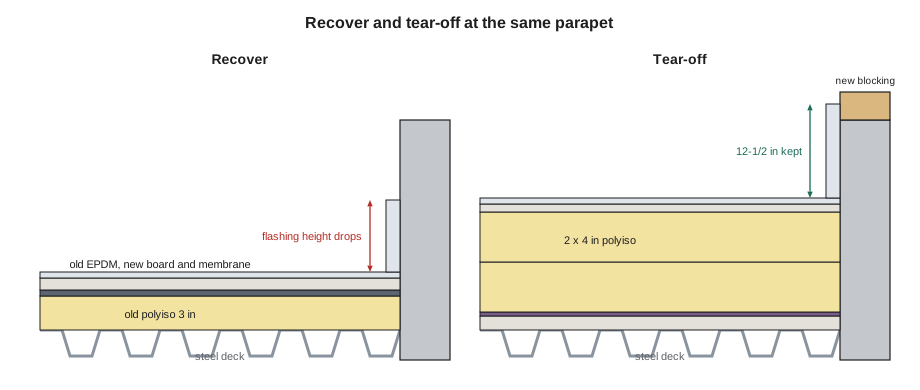
Flashing height is the test that recovers most often fail on low-slope roofs. Every layer added raises the roof surface and lowers the flashing height left at walls, curbs, doors and drains. ROOF-320 lesson 4 showed how a curb can end up too short after a re-roof; in a recover, the same thing happens everywhere at once.
Hidden costs on both sides
Recovers have hidden costs. Wet areas found during the work have to be cut out, and nobody knows how many until the work starts. Curbs may need raising and rooftop units lifting. Drains need extension rings or new drain bodies. The old roof's problems, such as poor slope or a sagging deck, stay. If the existing roof traps moisture, a recover can seal it in. And at the next replacement, there will be two roofs to tear off.
Tear-offs have hidden costs too. The deck under an old roof is often in worse condition than anyone expected, and deck repairs are usually priced as unit prices or allowances because their extent cannot be known in advance. The building is open to the weather during the work, so each day's tear-off must be closed in by the end of the day with a temporary or finished roof. Old roofing must be hauled and disposed of, and older materials may need testing for asbestos before they are disturbed, as at Ferncliff, where Anjali had a sample tested before the crew cut into the 1984 roof. Tear-off also brings code requirements that a recover might avoid, such as energy-code insulation levels.
Worked problem
Moving the ballast
Whichever scope Parkdale got, its ballast had to come off: 10.5 lb/ft² over 15,000 ft². How many tons of stone is that, and how many truckloads at 20 tons each?
Show solution
- Weight = 15,000 × 10.5 = 157,500 lb = 78.75 tons.
- Truckloads = 78.75 ÷ 20 = 3.9, so 4 loads.
Answer: About 70 metric tons in four truckloads. The stone is lifted off by crane in bags or bins, which is a large part of the cost of any work on a ballasted roof. Clean stone can be reused on a new ballasted roof or sent to an aggregate recycler; Glen priced recycling for Parkdale, because the new system would be adhered.
The Parkdale decision
Ahmed's cores settled the main question: about a fifth of the insulation was wet, so a full recover was out. Glen looked hard at a partial tear-off: remove the wet fifth, recover the rest. He decided against it for four reasons, which went into his report to Hugo. The 1997 polyiso was only 3 in thick in total, far below what a new roof would need under the energy rules, so most of the roof would be getting new insulation anyway. The membrane was at the end of its life. Every core showed no vapor retarder over a steel deck under a building with damp dressing rooms below. And with the new insulation, the roof surface would rise about 5 in, so the parapets needed raising whichever way the work was done. A full tear-off would cost more than a partial one, but not much more, and it would leave Parkdale with one new, complete, warrantable roof.
On a steep-slope house the decision is usually simpler. An existing single layer of dry, flat-lying asphalt shingles may be overlaid where the code and the shingle maker allow it, but most roofers in Columbus tear off anyway, because a tear-off lets them inspect and repair the sheathing, install eave protection and new flashings properly, and give a full warranty.
Running a tear-off
A tear-off on an occupied building is planned around one rule: the building must be watertight at the end of every day. The crew tears off only as much as it can rebuild, or at least close in with a temporary roof, before the end of the day or before rain. On low-slope roofs, each day's new roof is sealed to the old one at its edge with a temporary tie-in, sometimes called a night seal, which is cut away the next morning when work continues. The weather forecast is checked before tearing off, and again at midday; the crew stops tearing off early enough to close in if rain is coming.
Debris has to come off the roof safely. Old roofing goes down an enclosed chute into a bin, or is bagged and lowered by hoist or crane; it is never thrown off the roof. OSHA requires an enclosed chute for material dropped more than 20 ft to a point outside the building's walls, and the bin location needs protection for the public. Dust and odor reach the building through its air intakes, so the owner's maintenance staff are asked to shut off or filter the intakes near the work, as Crew 2 did at Ferncliff.
Worked problem
How much can the crew tear off in a day?
Parkdale's estimate allowed 0.011 labor-hours per square foot to remove the ballast and tear off, and 0.026 hours per square foot to build the new roof up to a watertight membrane. With 64 crew-hours a day, how many square feet can Dana's crew tear off and close in each day, and how many days does the field take?
Show solution
- Hours per square foot torn off and closed in = 0.011 + 0.026 = 0.037.
- Area per day = 64 ÷ 0.037 = 1,730 ft².
- Days for the field = 15,000 ÷ 1,730 = 8.7 days.
Answer: About 1,730 ft² a day, so the field takes about nine days, leaving the rest of the twelve working days for the parapets, details and coping. Dana would tear off in strips about 1,730 ft² at a time, starting at the low side near the drains.
Steep-slope recovers
On a house, a recover means a second layer of shingles nailed through the first. It is quicker and cheaper, but the new shingles telegraph the bumps of the old ones, nails must be longer to reach the deck, flashings and drip edge are hard to replace properly, the sheathing cannot be inspected, and ice and water protection cannot be installed at the eaves where it belongs, under the first layer. Many shingle makers reduce or limit their warranty on a recover, and a roof with two layers must be fully torn off next time, at a higher cost. Ridgecap quotes tear-offs on houses as a rule and explains why when an owner asks for an overlay.
Protecting the inside
Tear-offs drop debris, dust and sometimes water into the building below, especially through steel decks with open flutes and old roofs with holes. Before tearing off over occupied space, the crew walks the inside with the owner's staff to see what is below: offices, stock, equipment, dressing rooms. Sensitive areas are covered with plastic or emptied, and the owner is told the schedule so staff can plan around noise and smell. On steel decks, the crew watches for fasteners and debris falling through and stops to protect anything below that could be damaged. At Parkdale, the dressing rooms would be emptied and covered section by section as the tear-off moved over them.
Common mistakes
MistakePricing a recover without a moisture survey or cores.
InsteadFind out whether the roof is dry, how many layers it has and how it is attached first.
MistakeForgetting flashing heights when layers are added.
InsteadMeasure walls, curbs, doors and drains, and price raising them.
MistakeAssuming the deck under a tear-off is sound.
InsteadCarry unit prices or an allowance for deck repairs.
MistakeDisturbing old roofing without knowing what it contains.
InsteadTest older materials for asbestos before tearing off.
MistakeLeaving a tear-off open overnight.
InsteadClose in every day's work by the end of the day.
Summary and key terms
- A recover installs a new covering over the old; a tear-off removes everything to the deck; a partial tear-off does both.
- The Ohio codes forbid recovers over wet or deteriorated roofs, over slate or tile, and over two or more existing coverings.
- Makers usually approve recovers only over dry, single, well-attached roofs, often after cores.
- Check dryness, layers, attachment, structure, flashing height, drainage and maker approval before recovering.
- Both choices have hidden costs: wet areas and raised details in recovers; deck repairs, weather and disposal in tear-offs.
- At Parkdale, wet insulation, thin old insulation, no vapor retarder and the parapet height led to a full tear-off.
- Recover
- A new roof covering installed over an existing one without removing it.
- Tear-off
- Removal of the existing roof down to the deck before a new roof is built.
- Partial tear-off
- Removing the wet or damaged areas and recovering the rest.
- Separation board
- A board laid over an old roof before a recover, to separate and support the new membrane.
- Allowance
- An amount carried in a price for work whose extent is unknown, such as deck repairs.
- Unit price
- A price per unit of work, such as per square meter of deck replaced, used when quantities are unknown.
Practice problems
Work each problem on paper first, then reveal the answer to check.
A recover adds 2.5 lb/ft² over 10,000 ft². What weight is added?
Show answer
25,000 lb, 12.5 tons.
Ballast of 10 lb/ft² covers 20,000 ft². How many 20 ton loads?
Show answer
100 tons ÷ 20 = 5 loads.
A wall flashing is 9 in above the roof and a recover adds 4-1/2 in. Is enough height left?
Show answer
4-1/2 in is left, below the usual 8 in minimum: raise the flashing or tear off.
Name three things a tear-off allows that a recover does not.
Show answer
Deck inspection and repair, removal of all wet materials, new insulation to current levels, corrected drainage.
What must be done before disturbing old roofing on an older building?
Show answer
Test for asbestos.
Lesson quiz · 5 questions
Score 60% or more to complete this lesson.
Create a free account to save your progress, take quizzes and earn a certificate.