
ROOF-310 · Lesson 2 of 12 · 23 min
Insulation boards and their properties
▶ Video coming soon A video version of this lesson is on the way.
At the second study night, on Tuesday, October 27, the training-room table was covered with offcuts. Rory had brought a corner of polyiso from the Redhill Freight job, where Crew 3 was laying two layers of 3 in board under the new TPO. Keisha had a scrap of white expanded polystyrene from a residential job, and Glen had pulled samples from the warehouse: a pink board of extruded polystyrene, a heavy gray slab of mineral wool, a piece of glass-mat gypsum and a brittle square of old wood fiberboard from the Carrick Street test cut. "Every one of these is a roof insulation or a cover board," Glen said. "Your job tonight is to tell me which one you'd want under your membrane, and why the answer is always 'it depends'."
This lesson covers the boards used in low-slope roofs: polyisocyanurate, expanded and extruded polystyrene, mineral wool and other boards, and the cover boards laid over them. It explains how they are rated, how temperature and age change their thermal value, how they handle moisture, fire and foot traffic, and how designers combine them. The figures given are typical; a real design uses the values in the maker's current data sheet and the system listing.
What the label tells you
Every insulation board used on a roof is made to a material standard, and the standard number, type and grade are printed on the board or the bundle label. The main standards are:
| Material | Standard | What the type or grade tells you |
|---|---|---|
| Polyisocyanurate (polyiso) | ASTM C1289 | Type (facer), class and compressive grade |
| Expanded polystyrene (EPS) | ASTM C578 | Type by density and strength |
| Extruded polystyrene (XPS) | ASTM C578 | Type by strength |
| Mineral wool board | ASTM C726 | Type and density |
| Glass-mat gypsum cover board | ASTM C1177 | Thickness |
| Wood fiberboard | ASTM C208 | Type and thickness |
The long-term thermal resistance (LTTR) of polyiso is measured by ASTM C1303 or CAN/ULC-S770, which age the foam in the laboratory to predict its average value over 15 years. Since 2014, the industry has published polyiso at R-5.7 per inch for permeable-faced boards, down from the earlier R-6.0, because of a change in the test method, not the product.
The label also shows the board size, thickness, facer, maker, production date and plant, and the listings it carries: fire tests, the wind-uplift systems it appears in, and the FM Approvals listing. Rory's Redhill label showed the type, a compressive strength grade, a 2026 production date and the board's aged thermal resistance for its thickness. Glen made everyone find the same items on their samples. Keisha's EPS scrap had no label at all. "Then it doesn't go on a roof," Glen said.
Polyisocyanurate
Polyiso is a closed-cell foam made between two facers, which may be glass-reinforced paper, coated glass mat or foil. It is the most common roof insulation in Ohio because it gives the highest thermal resistance per unit of thickness of the common boards, is compatible with most membranes and adhesives, and performs well in fire tests in approved assemblies. Its weaknesses:
- It absorbs water if its facer is damaged or its edges are exposed, and wet polyiso loses much of its value and can delaminate. It is never used above the membrane, so it does not suit protected membrane roofs (lesson 7).
- Its thermal value drops at low mean temperatures, because the blowing gas in the cells conducts more heat when it is cold (see below).
- Its facers can crush or blister under heavy foot traffic and torch heat, which is one reason a cover board goes over it.
Polyiso is sold in compressive grades. ASTM C1289 Grade 2 boards are 20 psi and Grade 3 boards 25 psi; high-density polyiso cover boards (Class 4) are much harder, typically 80 to 120 psi. Thicker polyiso has a slightly higher thermal value per inch than thin board, because the facers and surface layers age differently from the core.
Expanded and extruded polystyrene
EPS is made by expanding polystyrene beads in a mold; the beads fuse into a board with tiny gaps between them. It is cheap, light and available in many densities and in thick blocks that are easy to cut into tapered shapes. Its thermal value is lower than polyiso's, it is not damaged by short-term wetting, and its thermal value actually improves slightly as it gets colder. It softens at high temperatures, so it cannot be torched or mopped with hot asphalt, and some solvents in adhesives and primers dissolve it. EPS roof systems usually have a cover board or a separator sheet and use approved adhesives or mechanical attachment.
XPS is made by extruding molten polystyrene through a die into a continuous board with a smooth skin. It is stronger than EPS, resists water absorption very well and keeps its value when wet better than any other common board, which is why it is the board used above the membrane in protected membrane roofs and plaza decks. Like EPS, it is damaged by heat and some solvents.
Mineral wool and other boards
Mineral wool (stone wool) roof board is made of fibers spun from molten rock and bonded into rigid boards. It is non-combustible, resists high temperatures, absorbs sound and does not change its value with temperature. It is heavy, more expensive per unit of thermal resistance and less resistant to foot traffic unless it is a dual-density board with a hard top layer. It is used where fire performance matters, where noise matters (over gymnasiums, for example), and as the top layer over polyiso in hybrid systems.
Other boards appear on older roofs and in special cases: wood fiberboard (like the Carrick Street sample, which had soaked up water and crumbled), perlite board, cellular glass for very high loads and cold storage, and composite boards that bond polyiso to a cover board. Fiberboard and perlite are now used mostly as thin cover boards or recover boards over existing roofs.
Typical properties side by side
The table below gives typical values for comparison only. Design uses the product data for the specific board and thickness.
| Board | Typical R per inch | Water | Heat | Main uses |
|---|---|---|---|---|
| Polyiso | about 5.7 (LTTR) | Keep dry | Good with cover board | Most low-slope roofs |
| EPS | 3.6 to 4.2 | Tolerates short wetting | No torch or hot asphalt | Tapered fill, single-ply |
| XPS | about 5.0 | Best of the foams | No torch or hot asphalt | Protected membrane roofs |
| Mineral wool | 3.8 to 4.2 | Drains and dries | Non-combustible | Fire, sound, hybrid top layer |
| Glass-mat gypsum | about 0.45 for 1/2 in | Moderate | Non-combustible | Cover board, thermal barrier |
| High-density polyiso | about 2.5 for 1/2 in | Keep dry | Approved systems only | Light cover board |
Worked problem
Thickness for the same thermal resistance
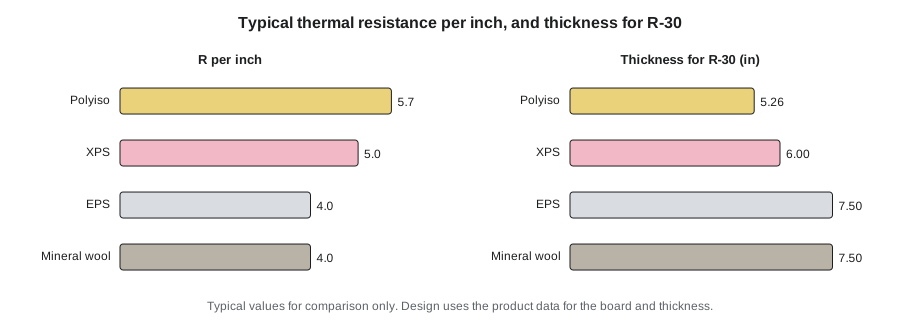
A designer needs R-30 of insulation. Using typical values of R-5.7 per inch for polyiso, R-5.0 for XPS and R-4.0 for EPS, how thick would each be?
Show solution
- Polyiso: 30 ÷ 5.7 = 5.26 in.
- XPS: 30 ÷ 5.0 = 6.00 in.
- EPS: 30 ÷ 4.0 = 7.50 in.
Answer: The EPS roof would be about 2-1/4 in thicker than the polyiso roof. On a re-roof with low curbs and parapets, that difference can decide the choice.
Temperature changes the numbers
A board's thermal resistance is measured at a standard mean temperature, 75 °F, the average of the warm and cold faces in the test. On a real roof in a Columbus January, the insulation's mean temperature is far lower. Polystyrene and mineral wool do slightly better when cold. Polyiso does worse below a mean of about 50 °F, because the blowing agent in its cells begins to condense and conducts more heat. Testing by researchers and by NRCA has found cold-weather values below the published aged values, and NRCA has long advised designers to use a lower design value for polyiso than the label shows, and lower again for cold climates and cold storage.
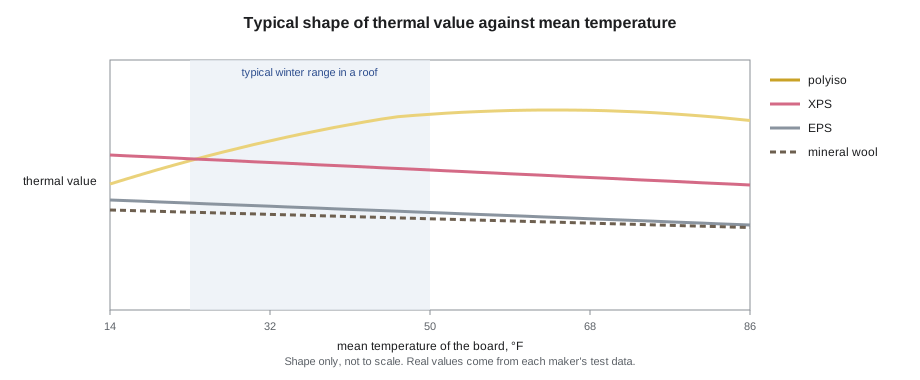
Designers handle this in three ways. They use a conservative design value rather than the label value. They add a layer of a material that does not lose value in the cold, such as mineral wool or polystyrene, on the cold side, so the polyiso below stays warmer. Or they simply add thickness. On the Northgate design (lesson 12), Martin used a lower design value for the polyiso than its label.
Worked problem
What a cold winter does to a polyiso roof
Two 3 in layers of polyiso are rated R-34.2 at the standard test temperature. Suppose a product loses about 12 in 100 of its value at the mean temperature it reaches on a cold January night. What is its value that night, and how much more heat flows?
Show solution
- Loss = 0.12 × 34.2 = 4.1, so the value is 34.2 − 4.1 = R-30.1.
- Heat flow is proportional to 1 ÷ R: 34.2 ÷ 30.1 = 1.136.
Answer: About 14 in 100 more heat flows on that night than the label suggests. The figure of 12 in 100 is for illustration; the real loss depends on the product and how cold the board gets.
Strength, foot traffic and dimensional stability
Insulation is crushed by point loads: boot heels, ladder feet, loaded carts, rooftop equipment on legs, and hail. Compressive strength is measured at a small deformation, so a board rated at a certain strength will already have dented at that load. Areas with regular traffic, such as paths to rooftop units, get walkway pads, and the whole roof usually gets a cover board. Equipment never sits directly on insulation; it goes on curbs or supports carried to the structure.
Boards also move. Polyiso can shrink slightly after manufacture and with heat; EPS shrinks if it is fresh from the mold. Boards are laid tight but not forced, and staggered layers hide any small gaps that open over time. Boards that are bowed, crushed or have damaged facers are set aside.
Fire and the thermal barrier
Foam plastic insulation burns, and building codes control how it is used. On a steel deck, foam insulation must be part of an assembly that has passed a fire test, or it must be separated from the interior by an approved thermal barrier, often a layer of gypsum board fastened to the deck before the foam goes on. The roof covering itself must have an exterior fire classification for the building. These requirements come from the code and the tested assembly listings; roofers follow the roof type on the drawings, and never substitute a board or leave out a thermal barrier without the designer's written approval.
Fire matters during installation too. Torch-applied membranes are never torched directly over polystyrene or polyiso; a fire-resistant cover board or base sheet comes first, and torching follows the hot-work rules in ROOF-210.
Cover boards
A cover board is a thin, hard board laid over the insulation. It spreads point loads, protects the foam from heat and foot traffic, gives adhered membranes a smooth, solid surface and improves hail and wind performance. The common types are glass-mat gypsum, 1/2 in or 1/4 in, which is non-combustible and very hard; high-density polyiso, which is much lighter and adds some thermal value; wood fiberboard and perlite, used mainly on bituminous roofs and recovers; and cement board for special cases. Gypsum cover boards under self-adhered or adhesive membranes are usually primed. The cover board is part of the wind-uplift and fire listing, so the type and thickness on the roof type must be followed.
Storing and handling boards
Insulation damaged before it reaches the roof is the most avoidable failure. Ridgecap's handling rules:
- Keep bundles raised off the ground or roof on pallets, covered with breathable tarps (not the plastic factory wrap alone, which traps condensation).
- Weight down bundles on the roof against wind, and never stack more than the deck or structure can carry; spread loads over beams, not mid-span.
- Bring up only what can be installed and covered that day.
- Reject boards with wet, torn or crushed facers, or that feel heavy for their size.
- Cut with a knife or saw that leaves a square edge, and fit boards tight to curbs, drains and edges.
"Polyiso is a sponge with a raincoat," Glen said at the end of the evening, holding up the corner of Rory's Redhill board with its facer peeled back. "Look after the raincoat."
Common mistakes
MistakeUsing the fresh or label thermal value of polyiso for a cold-climate design.
InsteadUse the aged value and a conservative design value, or add a cold-side layer.
MistakeTorching or hot-mopping directly over polystyrene.
InsteadUse an approved cover board or base sheet and follow the system's application method.
MistakeLeaving bundles on the roof in factory plastic in the rain.
InsteadRaise and cover them with breathable tarps, and bring up only a day's supply.
MistakeSubstituting a different board or leaving out a cover board or thermal barrier.
InsteadFollow the roof type; changes need the designer's written approval.
MistakeSetting rooftop equipment directly on insulation.
InsteadSupport equipment on curbs or supports carried to the structure.
Summary and key terms
- Every roof board is made to a material standard printed on its label, along with type, grade and listings.
- Polyiso gives the highest common thermal value per unit thickness but must be kept dry and loses value in the cold.
- EPS is economical and easy to taper; XPS resists water best and is used above the membrane.
- Mineral wool is non-combustible, heavy and stable with temperature.
- Design uses aged, conservative thermal values; temperature and age change the numbers.
- Cover boards protect the insulation, spread loads and are part of the wind and fire listing.
- Polyisocyanurate
- A closed-cell foam insulation board made between facers; the most common low-slope roof insulation.
- Expanded polystyrene
- An insulation board made of fused polystyrene beads.
- Extruded polystyrene
- A dense, water-resistant polystyrene board with a smooth skin.
- Mineral wool board
- A rigid, non-combustible board made of stone fibers.
- Long-term thermal resistance
- The thermal value of foam insulation averaged over 15 years of aging, measured by an accelerated test.
- Mean temperature
- The average of the warm-side and cold-side temperatures of a layer.
- Compressive strength
- The load per unit area a board carries at a small set deformation.
- Thermal barrier
- A layer, often gypsum board, that protects foam insulation from an interior fire.
Practice problems
Work each problem on paper first, then reveal the answer to check.
Which common board has the highest thermal value per inch?
Show answer
Polyiso.
Why is XPS, not polyiso, used above the membrane?
Show answer
XPS resists water absorption and keeps its value when wet.
How thick must EPS be for R-20 at R-4.0 per inch?
Show answer
20 ÷ 4.0 = 5 in.
What happens to polyiso's thermal value when the board is very cold?
Show answer
It drops below its rated value.
Name two jobs a cover board does.
Show answer
Spreads point loads and protects the insulation; also gives the membrane a solid surface.
Lesson quiz · 5 questions
Score 60% or more to complete this lesson.
Create a free account to save your progress, take quizzes and earn a certificate.