
ROOF-230 · Lesson 11 of 12 · 25 min
Repairs to premium roofs
▶ Video coming soon A video version of this lesson is on the way.
On Thursday, October 8, with the north transept valleys finished, Bram turned Crew 6 to the rest of the nave at St. Brendan's. The July survey had marked every damaged slate on a set of photographs: 63 broken or cracked, 41 slipped out of their courses where the nails had failed, and 22 soft or flaking. Most of the slipped slates were in patches where someone in the 1950s or 1960s had made repairs with steel nails, now rusted through; the original 1903 slates around them still hung on their copper nails. Bram and Callum worked from hook ladders hung over the ridge, and Rory worked the ground: sorting salvaged slate, punching holes, cutting copper bibs and sending them up in a bucket.
Most premium roofing work is repair. A slate, tile or copper roof that has lasted a century usually needs repairs every few decades, not replacement, and the skill is in fixing what has failed without damaging what has not. This lesson covers the principles of premium roof repair, finding the real cause, the decision to repair or replace, and the methods for slate, tile, metal and wood.
Principles
- Find the real cause. A stain on a ceiling is rarely under the leak; water runs along rafters, deck boards and underlayment before it drips. Trace it from inside if possible, then check the roof above and uphill.
- Do no harm getting there. Never walk on slate or tile; work from ladders, hook ladders, brackets or scaffolding, and protect the roof below the work.
- Match like with like: the same material, size, color, thickness and method, so the repair performs and looks like the roof.
- Use permanent methods. Roofing cement, caulk and face-nailed patches are not repairs; they trap water, stain the roof and make the next repair harder.
- Keep it minimal on heritage roofs. Replace only what has failed, and keep the original material wherever it is sound.
- Document it: photographs before and after, a marked-up plan, the number and source of replacement pieces, and the methods used.
Repair or replace?
Owners are often told that an old slate or tile roof is finished when it only needs repair. The decision rests on what has failed:
- If the slates or tiles themselves are sound (they ring, have no widespread flaking, and absorb little water) and only individual pieces are broken, the roof should be repaired.
- If the slates are sound but the nails have failed widely (nail sickness), the roof can be stripped and relaid: slates removed, sorted, re-holed where needed, and hung again on new copper nails over new underlayment, with salvaged slate making up the shortfall.
- If the material itself is failing across the roof, with many soft, flaking or delaminating pieces, replacement makes sense. A common rule of thumb among slaters is that when more than about one piece in five is failing, repairs become a losing battle; below that, repair is usually right.
- Flashings and valleys often fail long before the covering, as at St. Brendan's. Replacing them in a sound roof is a repair, not a reason to replace the roof.
Worked problem
Repair or replace at St. Brendan's?
The nave has about 12,400 slates. The survey found 63 broken, 41 slipped and 22 soft or flaking. What share of the slates has failed, and what share is the slate itself failing (broken pieces not counted, since breakage is mostly from damage)?
Show solution
- Failed = 63 + 41 + 22 = 126.
- Share = 126 ÷ 12,400 = 0.0102, about 1 in 100.
- Slate itself failing (soft or flaking) = 22 ÷ 12,400 = 0.0018, about 2 in 1,000.
Answer: About 1 slate in 100 needed attention, and fewer than 2 in 1,000 were failing as stone. The roof is sound; it needs valleys and repairs, not replacement. Bram put those numbers in the report for the parish council, which had heard from another contractor in 2024 that the roof "needed replacing".
Slate repairs
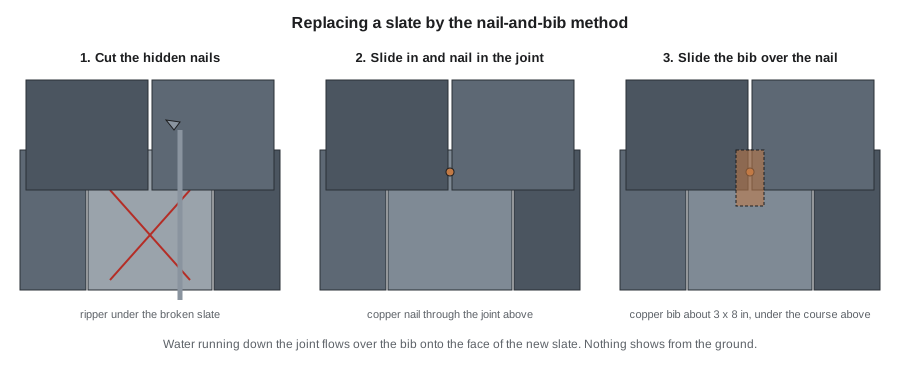
Removing a broken slate: the slate ripper's blade is slid up under the slate, hooked around one hidden nail, and struck down with a hammer on its handle to cut or pull the nail. Then the other. The broken pieces slide out. Care is needed not to crack the slates above and beside it, which are pushed up slightly by the blade.
Fastening the new slate: the slate cannot be nailed through its holes, because they are hidden under the course above. Three methods are used:
- Nail and bib: the new slate is slid into place and a single copper nail is driven through the vertical joint between the two slates of the course above it, into the deck, low enough to catch the new slate at its head area. A copper bib, a strip of copper about 3 by 8 in, is slid up under the course above over the nail head and bent very slightly so it holds by friction. Water running down the joint flows onto the bib and out over the new slate. This is the standard repair on heritage roofs because nothing shows.
- Slate hooks: a stainless steel or copper hook is nailed to the deck in the joint of the course below, and the new slate is slid down onto it so the hook holds its tail. Quick and reversible, but the small hook shows at the bottom of the slate, which heritage staff may not accept on a visible slope.
- Copper strap (tingle): a copper strip is nailed in the joint and its exposed end bent up over the tail of the new slate. Also visible; used on less visible areas or where the specification allows.
Face-nailing a slate and covering the nail with roofing cement is the most common bad repair: the cement dries out, the nail rusts, and water enters at the hole. St. Brendan's had a few of them, dark blobs on the nave from the 1960s, and each one was removed and the slate replaced.
Worked problem
Copper bibs from a sheet
Bibs are cut 3 in by 8 in from a 36 in by 96 in sheet of 16 oz copper. How many bibs does one sheet give? Are two sheets enough for the field repairs, which need one bib for each of the 126 slates, plus spares?
Show solution
- Across the width: 36 ÷ 3 = 12.
- Along the length: 96 ÷ 8 = 12.
- Bibs per sheet = 12 × 12 = 144.
- One sheet gives 144, which covers 126 with 18 spare; two sheets are more than enough.
Answer: One sheet. Rory cut them on Theo's shear the evening before, deburred the edges, and put them in a bucket by the dozen.
Rehanging slipped slates: where the slate itself was sound, it went back in its own place, fastened by nail and bib. Where a patch of slates had all slipped from rusted steel nails, Bram removed the whole patch down to the deck, checked the felt, and relaid the slates on copper nails through their own holes, finishing the last course of the patch by nail and bib.
Worked problem
How long will the field repairs take?
Working from hook ladders, Bram and Callum each average about 6 slate repairs an hour, including moving the ladders. How long will 126 repairs take the two of them?
Show solution
- Rate for both = 2 × 6 = 12 repairs per hour.
- Time = 126 ÷ 12 = 10.5 hours.
Answer: About ten and a half working hours: all of Thursday and Friday morning, which left Friday afternoon for the snow guards over the south porch (lesson 10). The rate depends heavily on access; repairs from scaffolding go faster than from hook ladders high on a steep nave.
Tile repairs
The Basile repair (lesson 4) showed the main methods for tile:
- Remove the broken tile by lifting the tiles that lap over it, freeing or cutting its fastener, and sliding it out.
- Patch any damage to the underlayment below, slipping new membrane up under the existing layer so it laps with the flow.
- Set the replacement tile, salvaged or new, of the same profile, size and color, and fasten it with a wire tie, a tile hook, a nail where it can be reached, or an approved adhesive, as the tile manual shows for repairs.
- Reset the lapping tiles without forcing them, and check that each sits in its interlocks.
On interlocking tile, several tiles may need to be lifted to free one. Clay tile breaks easily when lifted, so spare tiles must be on hand before starting. Mortar at hips and ridges is repaired only as an infill; loose hip tiles are refastened mechanically.
Metal repairs
- Scratches: the maker's touch-up paint, applied with a fine brush only to the scratch.
- Small holes in steel: the maker's patch method, often a lapped patch of the same metal bedded in sealant and fastened with sealed rivets; on copper, a soldered patch.
- Damaged standing seam panels: snap-lock panels can sometimes be unsnapped and replaced individually; mechanically seamed panels must be unseamed with a special tool, which is slow, and replacement may mean working from the nearest rake. The new panel must match the profile, color and coil, which is easier if the owner was left spare panels.
- Loose or leaking exposed fasteners: replace with the next size up, with new washers, rather than overdriving the old ones.
- Seams that have opened: re-seam with hand tools or the electric seamer, and find out why they opened (wind, movement, poor original seaming).
On every metal repair, keep incompatible metals apart and remove all filings.
Wood repairs
On Friday afternoon, October 2, with the carriage house finished, Callum replaced eight split cedar shingles on the bay window roof of Iris's house. He used the standard method:
- Split the damaged shingle into narrow pieces with a chisel and pull them out.
- Cut the two hidden nails with a hacksaw blade or a shingle ripper slid up under the course above.
- Trim a new shingle to fit with the right gap at each side, and slide it up until its butt is about 1/2 in below the butts of its course.
- Drive two nails just below the butts of the course above, angled slightly up, then tap the new shingle up into line with a block. The nails slide up under the course above and are hidden, with the shingle holding against them.
Shakes are repaired the same way, with felt interlayment patched if it was damaged. Split pieces are replaced rather than nailed together, and moss is brushed off rather than scraped.
Records
At the end of Friday, Rory sat in the truck and wrote up the St. Brendan's field repairs for the file: a copy of the survey photographs with each repair marked and numbered, the number replaced and rehung, the source of the replacement slates (salvaged stock from the 1890s school, sorted by Rory over two weeks), the methods used (nail and bib throughout), and the cement patches removed. Bram checked it and added one line: "No slates walked on." The record would go to the parish and, with the valley report, to the heritage staff.
Finding leaks with water
When the source of a leak is not obvious, the surest way to find it is a controlled water test, as Callum did on the Basile roof. The method is slow and patient:
- Have one person inside, in the attic or below the stain, with a light, and one on the roof with a garden hose, never a pressure nozzle, which can drive water where rain never would.
- Start low, below the suspected area, and wet one small section at a time for 10 to 15 minutes, working upward. Wetting the whole roof at once only shows that the roof leaks.
- Wet the flashings, valleys and penetrations separately from the field.
- Stop as soon as water appears inside, and note which section was being wetted.
- Do it on a dry day, after the roof and the building have dried out from the last rain.
Typical leak sources differ by covering:
| Covering | Common leak sources |
|---|---|
| Standing seam | headwall and sidewall trims, penetration boots, ridge closures, seams damaged by foot traffic |
| Metal shingles | damaged panels, trims at walls and valleys, loose fasteners in exposed noses |
| Tile | broken tiles, aged underlayment, valleys, hips and dish or antenna mounts |
| Slate | valleys and flashings, slipped slates from failed nails, old face-nailed repairs |
| Wood | split pieces, worn or rotted courses on shaded slopes, flashings at walls and chimneys |
On most premium roofs, the covering itself is rarely the first thing to fail. The flashings and the fasteners are.
Common mistakes
MistakeRepairing at the stain instead of finding the source.
InsteadTrace the water from inside and check uphill of the stain before opening the roof.
MistakeFace-nailing a slate and covering the nail with cement.
InsteadUse nail and bib, slate hooks or straps as the specification allows.
MistakeCondemning a roof because of slipped slates.
InsteadCheck the slate and nails; if the slate is sound, rehang it or strip and relay.
MistakeForcing interlocking tiles to remove one.
InsteadLift the lapping tiles carefully and have spares on hand.
MistakeLeaving repairs undocumented.
InsteadPhotograph, mark and record every repair and the materials used.
Summary and key terms
- Premium roof repair finds the real cause, does no harm getting there, matches like with like and uses permanent methods.
- Repair is right when the material is sound; strip and relay when nails have failed; replace when the material itself is failing widely.
- Slates are removed with a ripper and fastened by nail and bib, slate hooks or copper straps, never by face-nailing with cement.
- Tile repairs lift the lapping tiles, patch the underlayment, and fasten replacements with wire, hooks, nails or approved adhesive.
- Metal repairs use the maker's touch-up and patch methods, matching profiles and compatible metals.
- Wood shingles are replaced by cutting the hidden nails and nailing the new piece just below the course above.
- Nail and bib
- A slate repair in which a copper nail through the joint above is covered by a copper bib.
- Slate hook
- A metal hook nailed to the deck that holds a replacement slate at its tail.
- Tingle
- A copper strap nailed in a joint and bent up to hold a replacement slate.
- Strip and relay
- Removing slates or tiles, renewing nails and underlayment, and relaying the same pieces.
- Nail sickness
- Failure of a roof because its fasteners have corroded, while the covering is sound.
- Like-for-like
- Replacement with the same material, size, color and method as the original.
Practice problems
Work each problem on paper first, then reveal the answer to check.
A roof has 8,000 slates and 240 have failed. What share is that?
Show answer
240 ÷ 8,000 = 0.03, 3 in 100.
Why is face-nailing with cement not a repair?
Show answer
The cement dries out, the nail rusts and water enters at the hole.
How many 3 by 8 in bibs come from a 24 by 48 in sheet?
Show answer
(24 ÷ 3) × (48 ÷ 8) = 8 × 6 = 48.
At 5 repairs an hour each, how long do two slaters take for 90 repairs?
Show answer
90 ÷ 10 = 9 hours.
Which slate repair leaves nothing visible?
Show answer
Nail and bib.
Lesson quiz · 5 questions
Score 60% or more to complete this lesson.
Create a free account to save your progress, take quizzes and earn a certificate.