
ROB-460 · Lesson 8 of 12 · 28 min
Space robotics
Space is the most remote field environment of all. Robots there face vacuum, extreme temperatures, radiation, abrasive dust, launch loads, limited power and communication delays measured in seconds to tens of minutes, and in almost all cases they can never be repaired. Yet space robots have been among the most successful field robots: manipulators that assemble and maintain space stations, rovers that have driven tens of kilometers on Mars, and landers that sample other worlds. Canada has a distinctive role through the Canadarm family. This lesson covers orbital manipulators, planetary rovers, the physics of communication delay, power and radiation, autonomy on other worlds, and the current status of major programs as of October 2026.
Manipulators in orbit: the Canadarm family
The original Canadarm, the Shuttle Remote Manipulator System built by Spar Aerospace for the Canadian government and NASA, first flew in 1981 and served on the Space Shuttle for 30 years, deploying and retrieving satellites and supporting the Hubble Space Telescope servicing missions. Canadarm2, built by MDA (now MDA Space) and installed on the International Space Station in 2001, is a 17 m arm that can move end over end between grapple fixtures on the station, and it was used to assemble much of the station and to capture visiting cargo spacecraft. Dextre, the Special Purpose Dexterous Manipulator added in 2008, is a two-armed robot that performs maintenance tasks such as replacing station components, reducing the need for spacewalks. Much of their operation is now done by ground controllers rather than astronauts.
Canadarm3 was designed as a smart robotic system for NASA's Lunar Gateway, a small station planned to orbit the Moon, with greater autonomy than its predecessors because the Gateway would often be uncrewed. On 24 March 2026 NASA announced that it was pausing the Gateway to focus on operations on the lunar surface. Because MDA Space's contract is with the Canadian Space Agency, work continued, and in August 2026 the Government of Canada said it intends to redirect its Canadarm3 investment toward lunar surface activity, with a critical design milestone expected in early 2027. In the same period, the Canadian Space Agency's 2026 to 2027 departmental plan canceled a planned Canadian lunar rover mission. These decisions illustrate how space robotics depends on international programs and budgets as well as engineering; students should check the current status, which may have changed since this lesson was written.
| System | Years | Platform | Main roles |
|---|---|---|---|
| Canadarm (SRMS) | 1981 to 2011 | Space Shuttle | Satellite deployment and retrieval, Hubble servicing support |
| Canadarm2 (SSRMS) | 2001 to present | International Space Station | Station assembly, capture of visiting vehicles, moving astronauts and equipment |
| Dextre (SPDM) | 2008 to present | International Space Station | Dexterous maintenance, replacing components |
| Canadarm3 | In development | Planned for Gateway; redirected toward lunar surface use in 2026 | Autonomous maintenance and support (design evolving) |
Orbital manipulators face special dynamics problems. In free fall there is no fixed base: when an arm moves, the station or spacecraft it is attached to moves in reaction, conserving momentum. Arms on large stations barely disturb them, but on small servicing spacecraft the coupling is strong and must be included in control. Capturing a free-flying object requires matching its motion, and contact forces can push the target away. Commercial satellite servicing has begun: Northrop Grumman's Mission Extension Vehicle docked with an Intelsat communications satellite in 2020 to extend its life, the first such commercial docking with a satellite not designed for it.
Planetary rovers
NASA's Sojourner, the first Mars rover, drove about 100 m around its lander in 1997. Spirit and Opportunity landed in 2004 with a planned 90-sol mission; Spirit operated until 2010 after becoming embedded in soft soil, and Opportunity drove more than 45 km before a global dust storm ended its mission in 2018. Curiosity, a car-sized rover powered by a radioisotope generator, landed in 2012 and is still exploring Gale crater. Perseverance landed in Jezero crater in February 2021, collecting rock and soil samples in sealed tubes for possible return to Earth, and carried the Ingenuity helicopter, which made 72 flights, far beyond its planned five, before rotor damage ended its mission in January 2024. China's Zhurong rover operated on Mars from 2021, and Chinese and other rovers have operated on the Moon, including on its far side.
The return of Perseverance's samples has proved difficult. A 2023 independent review estimated the original Mars Sample Return architecture could cost up to US$11 billion with samples not returning until 2040, and NASA studied cheaper options, with a decision on the architecture expected in 2026 amid proposals to cut the program. As with Gateway, students should check the current status.
Rover design reflects every topic in lessons 1 to 3. Mobility uses rocker-bogie suspensions and wheels sized for Mars regolith; Curiosity's aluminum wheels suffered unexpected punctures from sharp rocks, which led to changes in route planning and in Perseverance's wheel design. Localization uses visual odometry, inertial sensors and matching to orbital images, because there is no GNSS. Thermal design keeps electronics and batteries warm through nights that fall to about minus 80 degrees or colder on Mars and about minus 170 degrees during the two-week lunar night.
Communication delay and autonomy
Radio signals travel at the speed of light, but distances in space are so large that delays are significant. The Moon is about 384,000 km away, giving a one-way delay of about 1.3 s. Mars varies between about 55 million and 400 million km from Earth, so the one-way delay ranges from about 3 to 22 minutes. Communication is also intermittent: rovers can talk to Earth only when an antenna or relay orbiter is in view, and around solar conjunction, when Mars is behind the Sun, missions stop sending commands for about two weeks.
# One-way and round-trip light time to space destinations
c = 299_792_458.0
targets_km = {"Low Earth orbit (400 km, overhead)": 400,
              "Geostationary orbit": 35_786,
              "Moon (mean)": 384_400,
              "Mars (closest, about)": 54.6e6,
              "Mars (farthest, about)": 401e6,
              "Jupiter (mean, about)": 778e6}
for name, km in targets_km.items():
    t = km * 1000 / c
    unit, val = ("ms", t * 1000) if t < 1 else ("s", t) if t < 120 else ("min", t / 60)
print(f"{name:36s} one-way {val:8.2f} {unit} round trip {2*val:8.2f} {unit}")Low Earth orbit (400 km, overhead) one-way 1.33 ms round trip 2.67 ms Geostationary orbit one-way 119.37 ms round trip 238.74 ms Moon (mean) one-way 1.28 s round trip 2.56 s Mars (closest, about) one-way 3.04 min round trip 6.07 min Mars (farthest, about) one-way 22.29 min round trip 44.59 min Jupiter (mean, about) one-way 43.25 min round trip 86.50 min
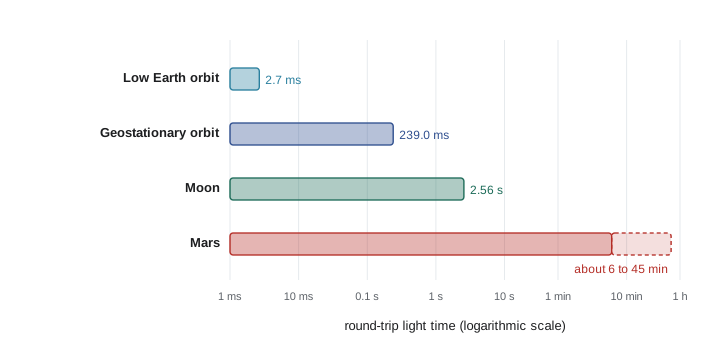
At lunar distances, direct teleoperation is possible but awkward: ROB-430 lesson 6 showed that delays above a few hundred milliseconds degrade operator performance, and 2.6 s round trips force move-and-wait strategies or predictive displays. At Mars distances, teleoperation is impossible. Mars rovers are commanded once per sol with a plan built by ground teams, which the rover executes autonomously and reports back. Over the years onboard autonomy has grown: AutoNav lets rovers plan their own paths across terrain they have imaged, Perseverance's improved autonomous navigation lets it drive while thinking rather than stopping to compute, and AEGIS software lets rovers choose rock targets for their instruments without waiting for ground commands. Ingenuity flew entirely autonomously using a downward camera and inertial sensors, because no human could react in time.
Worked problem
How far can a rover drive in one sol?
A Mars rover receives its plan in the morning. It can drive at 4 cm/s with autonomous navigation, but spends 30 percent of driving time stopped to image and assess terrain, and it has a three-hour driving window each sol. What distance can it cover, and how does that compare with a teleoperated approach at a 30-minute round-trip delay, assuming one 5 m move per round trip?
Show solution
- Driving time: 3 h = 10,800 s, of which 70 percent moving: 7,560 s.
- Autonomous distance: \( 7560 \times 0.04 \approx 302 \) m.
- Teleoperation: \( 10800 / 1800 = 6 \) round trips, so about \( 6 \times 5 = 30 \) m.
Answer: About 300 m autonomously versus about 30 m with move-and-wait teleoperation, a tenfold gain; this is why autonomy, not faster motors, increased rover driving distances.
Power in space
Solar power is the default for spacecraft and many rovers. Sunlight at Earth's distance carries about 1,361 W/m²; at Mars' mean distance it is about 590 W/m², and atmospheric dust reduces it further at the surface. Dust settling on panels lowers output over time; Spirit and Opportunity benefited from occasional wind gusts that cleaned their panels, and the InSight lander's mission ended in 2022 when dust reduced its power too far. On the Moon, sunlight is strong but the lunar night lasts about 14 Earth days, so a solar-powered robot must either hibernate, store enormous amounts of energy, or carry another source. Radioisotope power systems convert heat from the decay of plutonium-238 into electricity; Curiosity and Perseverance each carry a multi-mission radioisotope thermoelectric generator that produced about 110 W at launch and declines slowly over the years, and its waste heat keeps the rover warm.
# Sizing a solar array and battery for a small Mars rover (illustrative assumptions)
import math
flux_toa = 590.0          # W/m^2 at Mars mean distance, top of atmosphere
tau = 0.6                 # atmospheric optical depth (clear-ish season); dust storms can exceed 4
cell_eff, dust_factor = 0.28, 0.85    # cell efficiency and panel dust loss
daylight_h, sol_h = 12.0, 24.66
surface_peak = flux_toa * math.exp(-tau)            # crude Beer-Lambert estimate at noon
avg_daylight = surface_peak * 2 / math.pi            # average over a sinusoidal day
energy_per_m2_wh = avg_daylight * daylight_h * cell_eff * dust_factor
loads = {"driving (2 h at 60 W)": 120, "instruments and computer (8 h at 25 W)": 200,
         "night survival heaters (12.7 h at 15 W)": 190, "communication (1 h at 40 W)": 40}
need = sum(loads.values())
area = need / energy_per_m2_wh
battery_wh = loads["night survival heaters (12.7 h at 15 W)"] / 0.8        # 80 % depth of discharge
print(f"noon surface flux {surface_peak:.0f} W/m^2, energy per m^2 of panel per sol {energy_per_m2_wh:.0f} Wh")
print(f"daily need {need} Wh  ->  panel area {area:.2f} m^2, battery at least {battery_wh:.0f} Wh")
for t in (1.0, 2.0, 4.0):
    e = flux_toa * math.exp(-t) * 2 / math.pi * daylight_h * cell_eff * dust_factor
print(f"optical depth {t:.1f}: {e:4.0f} Wh per m^2 -> supports {e * area / need:4.0%} of loads")noon surface flux 324 W/m^2, energy per m^2 of panel per sol 589 Wh daily need 550 Wh -> panel area 0.93 m^2, battery at least 238 Wh optical depth 1.0: 395 Wh per m^2 -> supports 67% of loads optical depth 2.0: 145 Wh per m^2 -> supports 25% of loads optical depth 4.0: 20 Wh per m^2 -> supports 3% of loads
The calculation shows why dust storms are so dangerous for solar-powered rovers: when optical depth rises above about 4, as it did during the 2018 storm that ended Opportunity's mission, a rover sized for normal conditions receives only a small fraction of the energy it needs, and its heaters cannot keep the batteries warm. The crude model counts only direct sunlight; light scattered by the dust keeps real values somewhat higher, but the trend is the same. Real power analyses use measured flux models, panel temperatures, seasonal sun angles and degradation, but the structure of the calculation is the same.
Radiation, thermal and dust
Outside Earth's magnetic field and atmosphere, electronics face galactic cosmic rays, solar particle events and, in some orbits, trapped radiation belts. As lesson 5 explained for nuclear sites, radiation causes cumulative total-dose damage and sudden single-event effects such as bit flips and latch-ups. Spacecraft computers have traditionally used radiation-hardened processors such as the RAD750 used in Curiosity and Perseverance, which are reliable but far slower than consumer chips. Ingenuity showed another approach: it used a commercial smartphone processor, accepting the risk for a technology demonstration and relying on resets and redundancy. Many missions now combine a hardened supervisor with faster commercial processors for vision and autonomy, protected by error-correcting memory, watchdogs and software that can recover from upsets.
Thermal design keeps every component within its limits through sunlight, shadow and night, using insulation, heaters, radiators, heat pipes and radioisotope heater units. Lunar dust is a further hazard: the fine, sharp, electrostatically charged regolith clings to surfaces, abrades seals and joints, and degraded Apollo equipment and spacesuits within days. Mechanisms for the Moon use dust seals, bellows, and designs that keep sliding contacts away from dust, and dust mitigation is an active research area for long-duration lunar surface robots.
| Hazard | Effect on robots | Typical countermeasures |
|---|---|---|
| Vacuum | Outgassing, cold welding of metal contacts, no convective cooling | Space-qualified materials and lubricants, radiators |
| Temperature extremes | Battery and electronics failure, thermal stress | Insulation, heaters, radioisotope heater units, thermal modeling |
| Radiation | Total-dose degradation, single-event upsets and latch-ups | Hardened parts, shielding, error correction, watchdogs, redundancy |
| Dust | Abrasion, seal failure, coated optics and panels | Dust seals, protected mechanisms, cleaning, panel tilt |
| Communication delay and gaps | No real-time control, long waits for decisions | Onboard autonomy, safe modes, daily planning cycles |
| No repair | Single faults can end the mission | Redundancy, fault protection, extensive testing, conservative operations |
The lunar economy and future robots
The Moon has become a focus for both government and commercial robots. NASA's Commercial Lunar Payload Services program buys delivery of instruments by commercial landers; Intuitive Machines' Odysseus landed near the lunar south pole region in February 2024 but tipped onto its side, and Firefly Aerospace's Blue Ghost landed upright and operated successfully in March 2025. Artemis II carried four astronauts, including Canadian Jeremy Hansen, around the Moon in April 2026. Plans for a lunar surface base envision rovers, construction robots, regolith excavators and maintenance robots, operating partly autonomously and partly under control from Earth or from crew on the surface, with delays short enough for supervised autonomy. These robots will combine almost every theme of this course: terramechanics in regolith, localization without GNSS, solar power with long nights, radiation and dust, multi-robot coordination and delay-tolerant communication.
Common mistakes
MistakePlanning to teleoperate a Mars rover in real time.
InsteadOne-way delays of 3 to 22 minutes make real-time control impossible; plan daily command cycles and onboard autonomy.
MistakeSizing a Martian solar array for clear-sky conditions only.
InsteadInclude dust on panels and dust storms with high optical depth, and plan survival modes.
MistakeIgnoring reaction motion when a manipulator moves on a small spacecraft.
InsteadInclude free-floating base dynamics and momentum conservation in control design.
MistakeUsing fast commercial processors without upset protection.
InsteadAdd error correction, watchdogs, hardened supervisors and software recovery, or use radiation-hardened parts.
MistakeTreating program plans as fixed facts.
InsteadSpace programs change with budgets and policy; check current status of missions such as Gateway and Mars Sample Return.
Summary and key terms
- The Canadarm family has supported the Shuttle and ISS since 1981, with Canadarm3 redirected toward lunar surface use after NASA paused Gateway in March 2026.
- Orbital manipulators must handle free-floating base dynamics and capture of moving objects; commercial satellite servicing began in 2020.
- Mars rovers from Sojourner to Perseverance show the value of robust design, conservative operations and growing autonomy.
- One-way light time is about 1.3 s to the Moon and 3 to 22 min to Mars, ruling out teleoperation at Mars.
- Solar power is limited by distance, dust and night; radioisotope generators provide steady power and heat.
- Radiation, temperature extremes, vacuum and dust drive hardware choices and fault protection.
- Commercial landers and lunar surface plans are creating new demand for autonomous and supervised space robots.
- Canadarm2
- The 17 m robotic arm on the International Space Station, installed in 2001.
- Dextre
- The two-armed dexterous maintenance robot on the International Space Station.
- Free-floating base
- A spacecraft that moves in reaction to its manipulator's motion because no external fixed base exists.
- Sol
- A Martian solar day, about 24 hours 40 minutes.
- Light time
- The time for a radio signal to travel between two points at the speed of light.
- Solar conjunction
- A period when a planet is nearly behind the Sun, interrupting communication.
- Optical depth
- A measure of how much the atmosphere attenuates sunlight, which rises during dust storms.
- Radioisotope thermoelectric generator
- A power source that converts heat from radioactive decay into electricity.
- Radiation-hardened processor
- A processor designed to tolerate total dose and single-event effects in space.
- Regolith
- The loose layer of dust and broken rock covering the Moon and other bodies.
Practice problems
Work each problem on paper first, then reveal the answer to check.
What is the round-trip light time to the Moon?
Show answer
About 2.6 s.
Why can Canadarm2 move around the ISS?
Show answer
It can walk end over end between grapple fixtures, using either end as its base.
What happened to the Lunar Gateway in March 2026, and how did Canada respond?
Show answer
NASA paused Gateway to focus on the lunar surface; Canada continued Canadarm3 work and in August 2026 said it would redirect the investment toward lunar surface use.
A rover moves 5 cm/s for 2 h of a sol. How far does it travel?
Show answer
\( 0.05 \times 7200 = 360 \) m.
Why did autonomy rather than faster motors increase rover driving distances?
Show answer
Driving was limited by time spent waiting for ground commands and assessing terrain; autonomous navigation allows continuous driving within each sol.
Roughly what solar flux reaches Mars' distance from the Sun?
Show answer
About 590 W/m², less than half of Earth's 1,361 W/m².
Why are dust storms a threat to solar-powered rovers?
Show answer
High optical depth cuts surface sunlight drastically, so the rover cannot generate enough energy for heaters and operations.
What is the trade-off between radiation-hardened and commercial processors?
Show answer
Hardened processors are reliable but slow and expensive; commercial ones are fast but more vulnerable to upsets and dose.
Name two properties of lunar dust that make it hazardous to mechanisms.
Show answer
It is fine and sharp, abrading seals and joints, and electrostatically charged, so it clings to surfaces.
Why must a capture maneuver with a free-flying satellite be carefully controlled?
Show answer
Contact forces can push the target away and disturb the servicer, because neither has a fixed base.
Lesson quiz · 5 questions
Score 60% or more to complete this lesson.
Create a free account to save your progress, take quizzes and earn a certificate.