
ROB-460 · Lesson 2 of 12 · 30 min
Locomotion and terramechanics for rough terrain
A field robot is only useful if it can get to the work. Mobility on soft soil, snow, mud, rock and slopes is governed by terramechanics, the study of how vehicles and terrain interact, and by the geometry of stability. This lesson introduces the classical Bekker approach to sinkage and resistance, the Mohr-Coulomb model of soil strength that limits traction, the static stability of vehicles on slopes, and the trade-offs between wheels, tracks and legs. The models are simplified and the soil values are illustrative; real designs use measured soil parameters and testing on representative ground. ROB-340 lesson 1 covered mobile robot platforms and odometry on firm floors; here the ground itself becomes part of the problem.
Ground pressure: the first check
The simplest measure of how a vehicle will behave on soft ground is its nominal ground pressure, the weight divided by the contact area. A person standing exerts about 15 to 20 kPa; a loaded agricultural tractor on standard tires often exceeds 100 kPa; tracked vehicles designed for snow or bogs may exert 10 to 30 kPa. Low pressure means less sinkage and less soil compaction, which matters to farmers because compacted soil reduces crop yields for years. Ground pressure is a crude measure, because pressure is not uniform under a tire or track and soils respond nonlinearly, but it is the right first check when choosing a platform.
| Platform | Typical nominal ground pressure | Notes |
|---|---|---|
| Person walking | about 15 to 25 kPa (peaks higher under the heel) | Useful reference point |
| Small wheeled field robot, 150 kg on four narrow tires | about 60 to 120 kPa | Narrow tires sink in wet soil |
| Same robot on wide low-pressure tires | about 30 to 50 kPa | Wider tires trade width for flotation |
| Tracked utility robot | about 10 to 30 kPa | Good on snow, mud and peat |
| Legged robot, 30 to 50 kg | High peak pressure under each foot | Small feet sink in soft ground but can step over obstacles |
Worked problem
Nominal ground pressure of tires and tracks
A 200 kg robot can be fitted with four tires, each with a contact patch of 0.10 m by 0.08 m, or two tracks, each 0.15 m wide with 0.70 m in contact with the ground. Compare nominal ground pressures. Take g = 9.81 m/s².
Show solution
- Weight: \( W = 200 \times 9.81 = 1962 \) N.
- Tires: contact area \( 4 \times 0.10 \times 0.08 = 0.032 \) m², so \( p = 1962 / 0.032 \approx 61 \) kPa.
- Tracks: contact area \( 2 \times 0.15 \times 0.70 = 0.21 \) m², so \( p = 1962 / 0.21 \approx 9.3 \) kPa.
Answer: About 61 kPa on tires and about 9 kPa on tracks, a factor of more than six; the tracked version will sink far less in soft ground.
The Bekker pressure-sinkage relation
In the 1950s and 1960s M. G. Bekker, working on military and later lunar vehicles, proposed an empirical relation between the pressure \( p \) under a plate and its sinkage \( z \) into soil:
Here \( b \) is the smaller dimension of the contact patch (the width of a wheel), \( k_c \) and \( k_\phi \) are cohesive and frictional moduli of deformation, and \( n \) is an exponent, often between about 0.5 and 1.3. The parameters are found by pressing plates of different widths into the soil with a bevameter and fitting the curves. Bekker's work fed directly into the design of the Lunar Roving Vehicle driven on the Moon by Apollo astronauts in 1971 and 1972.
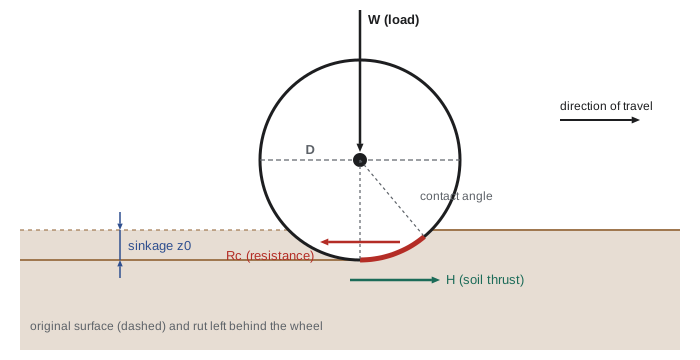
For a rigid wheel of diameter \( D \) and width \( b \) carrying a vertical load \( W \), integrating the pressure around the contact arc gives an approximate sinkage
and a compaction resistance, the horizontal force needed to keep pushing the wheel through the rut it is making,
These formulas show the main design levers. Sinkage falls as wheel diameter and width increase, and the resistance falls rapidly with sinkage because of the power \( n + 1 \). They also explain why soft-soil vehicles often have large, wide wheels and why lowering tire pressure helps: a flexible tire flattens and behaves like a wider, longer contact patch.
# Bekker sinkage and compaction resistance of a rigid wheel (illustrative dry sand values)
import numpy as np
n, kc, kphi = 1.1, 0.99e3, 1528.43e3     # n, kc [N/m^(n+1)], kphi [N/m^(n+2)]
def sinkage(W, b, D):
    return (3 * W / ((3 - n) * (kc + b * kphi) * np.sqrt(D))) ** (2 / (2 * n + 1))
def resistance(W, b, D):
    z = sinkage(W, b, D)
    return b * (kc / b + kphi) * z ** (n + 1) / (n + 1), z
W = 500.0   # load per wheel in N (about 51 kg)
for b, D in [(0.10, 0.40), (0.20, 0.40), (0.20, 0.80), (0.30, 0.80)]:
    R, z = resistance(W, b, D)
print(f"width {b:.2f} m diameter {D:.2f} m sinkage {z*1000:5.1f} mm resistance {R:5.1f} N R/W {R/W:.3f}")width 0.10 m diameter 0.40 m sinkage 49.3 mm resistance 132.0 N R/W 0.264 width 0.20 m diameter 0.40 m sinkage 32.1 mm resistance 106.4 N R/W 0.213 width 0.20 m diameter 0.80 m sinkage 25.8 mm resistance 67.5 N R/W 0.135 width 0.30 m diameter 0.80 m sinkage 20.1 mm resistance 59.5 N R/W 0.119
Doubling the width cuts the rolling resistance coefficient by about a fifth in this example, from 0.264 to 0.213, and doubling the diameter as well brings it down to 0.135, about half the original value. The model is less accurate for small wheels, for high slip and for soils that are layered or saturated, but it remains a standard first estimate and a way to compare designs.
Soil strength and traction
Sinkage creates resistance; traction comes from the soil's shear strength. Terramechanics uses the Mohr-Coulomb model, in which the maximum shear stress the soil can carry is
where \( c \) is cohesion, \( \sigma \) the normal stress and \( \phi \) the internal friction angle. Integrating over a contact area \( A \) under total load \( W \) gives the maximum gross thrust \( H_{max} = A c + W \tan \phi \). The drawbar pull, the net force available to climb, tow or push, is thrust minus resistance: \( DP = H - R \). Dry sand has almost no cohesion, so thrust depends on weight and friction angle; clay has cohesion, so a larger contact area helps even when the vehicle is light. Thrust only develops with slip, the difference between wheel surface speed and vehicle speed, usually expressed as \( i = 1 - v/(r\omega) \). Janosi and Hanamoto's relation models the build-up of shear stress with shear displacement; in practice many rovers operate at 10 to 30 percent slip on loose ground and become stuck when slip approaches 100 percent.
Worked problem
Can the robot climb out of the field?
A 400 kg four-wheel-drive robot works on a loam with cohesion c = 5 kPa and friction angle 30 degrees. The total contact area is 0.12 m² and total rolling resistance on level ground is 0.08 W. Estimate the maximum drawbar pull and the steepest slope it could climb if thrust and resistance were unchanged on the slope.
Show solution
- Weight: \( W = 400 \times 9.81 = 3924 \) N.
- Maximum thrust: \( H = 0.12 \times 5000 + 3924 \tan 30^\circ = 600 + 2266 = 2866 \) N.
- Resistance: \( R = 0.08 \times 3924 = 314 \) N, so \( DP = 2866 - 314 = 2552 \) N.
- On a slope the downhill component \( W \sin\theta \) must not exceed DP: \( \sin\theta = 2552/3924 = 0.65 \), so \( \theta \approx 40^\circ \) as a theoretical traction limit.
Answer: About 2.6 kN of drawbar pull, giving a theoretical traction limit near 40 degrees. In practice reduced normal load on the slope, slip and stability limits would cut this considerably, so the robot should be restricted to much gentler slopes.
Static stability on slopes
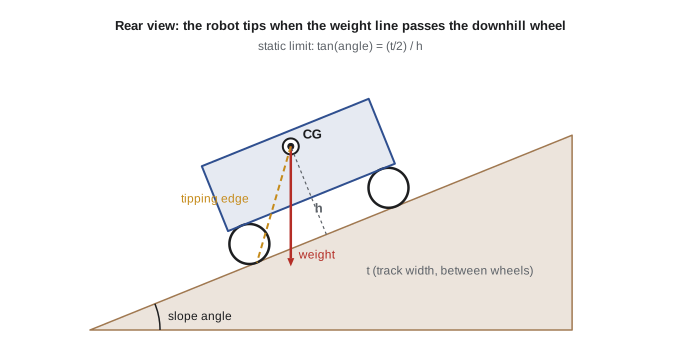
Even with enough traction, a robot can tip over. For a rigid vehicle standing still on a slope, the static stability limit is reached when the line of action of the weight through the center of mass passes outside the support polygon formed by the wheel or foot contacts. For a vehicle with track width \( t \) and center of mass at height \( h \) above the ground, centered between the wheels, the lateral tip-over angle is
The longitudinal limit uses the horizontal distance from the center of mass to the front or rear axle instead of half the track. Dynamic effects such as turning, bumps and payload sway reduce the usable angle, so designers apply a margin, and many vehicles monitor roll and pitch with an inertial measurement unit and stop or reverse when a threshold is approached. Stability measures such as the force-angle stability margin of Papadopoulos and Rey extend the idea to moving robots and manipulators carrying loads.
# Static tip-over angles and a stability margin check
import numpy as np
def tip_angles(track, wheelbase, h, x_cg_from_rear):
    lateral = np.degrees(np.arctan((track / 2) / h))
    downhill_front = np.degrees(np.arctan((wheelbase - x_cg_from_rear) / h))   # nose down
    downhill_rear = np.degrees(np.arctan(x_cg_from_rear / h))                  # nose up
    return lateral, downhill_front, downhill_rear
designs = {"low and wide": (0.90, 1.10, 0.35, 0.55),
           "tall sensor mast": (0.90, 1.10, 0.70, 0.55),
           "rear-heavy payload": (0.90, 1.10, 0.45, 0.35)}
margin = 0.5   # allow only half the static angle in operation (illustrative policy)
for name, (t, L, h, x) in designs.items():
    lat, fwd, back = tip_angles(t, L, h, x)
    print(f"{name:18s} lateral {lat:4.1f}  nose-down {fwd:4.1f}  nose-up {back:4.1f}  "
f"operating limit {margin*min(lat, fwd, back):4.1f} deg")low and wide lateral 52.1 nose-down 57.5 nose-up 57.5 operating limit 26.1 deg tall sensor mast lateral 32.7 nose-down 38.2 nose-up 38.2 operating limit 16.4 deg rear-heavy payload lateral 45.0 nose-down 59.0 nose-up 37.9 operating limit 18.9 deg
Raising the center of mass by mounting a tall sensor mast cuts the lateral limit by about 20 degrees, and moving payload rearward makes nose-up tipping on a climb the critical case. Field robots that need tall sensors often fold them down for slopes, or carry batteries low in the chassis to compensate.
Wheels, tracks, legs and hybrids
Wheels are efficient, mechanically simple and fast on firm ground, and most field robots use them. Skid-steer wheeled platforms are robust but scrub their tires when turning, which wastes energy and damages turf and crops; Ackermann steering and independently steered wheels avoid this at the cost of complexity. Rocker-bogie suspensions, used on NASA's Mars rovers since Sojourner, keep all six wheels in contact over obstacles without springs, so a rover can climb rocks roughly the size of its wheel diameter while keeping the body level.
Tracks spread load over a long contact length, giving low ground pressure and good traction in snow, mud and sand, and they cross gaps and ditches well. They are heavier and less efficient than wheels on hard ground, they wear and can be thrown off, and skid steering a track causes high turning resistance and ground damage. Rubber tracks are now common on agricultural and utility robots.
Legs choose their footholds, so they can step over obstacles, climb stairs and cross terrain that would stop a wheel. Quadruped robots such as Boston Dynamics' Spot and ANYbotics' ANYmal are used commercially for inspection at industrial plants, offshore platforms and mines. Legs are more complex and less energy efficient over distance, they need sophisticated control, and their small feet can sink in soft ground. Hybrid designs add wheels to legs, combining efficient rolling with the ability to step, and some planetary concepts use wheel-walking, in which wheels and suspension joints are moved in sequence to inch through soft soil where ordinary driving would dig in.
| Locomotion | Strengths | Weaknesses | Typical field uses |
|---|---|---|---|
| Wheels (skid-steer) | Simple, robust, efficient on firm ground | Scrubbing in turns, sinkage in soft soil | Inspection, security, light agriculture |
| Wheels (steered, rocker-bogie) | Efficient turning, good obstacle climbing at low speed | More actuators and complexity | Planetary rovers, row-crop robots |
| Tracks | Low ground pressure, traction on snow and mud | Heavier, lower efficiency, ground damage when turning | Utility, forestry, snow, peat, defense and rescue |
| Legs | Step over obstacles, stairs, very rough terrain | Complex control, energy use, sinkage of small feet | Industrial inspection, search and rescue |
| Wheel-legs and other hybrids | Combine rolling efficiency with stepping | Mechanical and control complexity | Research platforms, planetary concepts |
Terrain assessment closes the loop between perception and mobility. Robots estimate traversability from geometry (slope, step height, roughness from lidar or stereo), from appearance (classifying grass, sand, gravel and water with learned models) and from proprioception (motor current, wheel slip and vibration while driving). Learned traversability models trained on the robot's own driving experience have become common, but they must be validated for the seasons and soils the robot will meet. When a rover detects high slip, it can stop, reverse and choose another route, as the Mars rovers do after Spirit became permanently embedded in soft soil in 2009.
Common mistakes
MistakeChoosing a platform from its speed and payload on a test track.
InsteadCheck ground pressure, sinkage and traction on the actual soils and seasons, including wet and frozen conditions.
MistakeTreating Bekker parameters from a textbook table as exact for a site.
InsteadUse them for comparison only; measure the site soil or test on representative ground before committing to a design.
MistakeAssuming that enough traction means a slope is safe.
InsteadAlso check static stability with a margin for dynamics, payload and turning, and monitor roll and pitch in operation.
MistakeMounting heavy sensors high on the robot for a better view without recalculating stability.
InsteadRecompute tip-over angles, lower heavy components, or fold masts on slopes.
MistakeIgnoring slip because the wheels are turning.
InsteadMonitor slip from wheel speed against measured motion; rising slip is an early sign of becoming stuck.
Summary and key terms
- Nominal ground pressure is a first check on soft-ground mobility and soil compaction.
- Bekker's pressure-sinkage relation predicts sinkage and compaction resistance from soil parameters and wheel size.
- Larger, wider wheels and flexible tires reduce sinkage and resistance; tracks reduce ground pressure further.
- The Mohr-Coulomb model limits gross thrust to the contact area times cohesion plus weight times the tangent of the friction angle.
- Drawbar pull is thrust minus resistance and develops only with slip.
- Static tip-over angles depend on track or wheelbase and center-of-mass height, and need a margin in operation.
- Wheels, tracks, legs and hybrids each suit different terrain, and traversability is estimated from geometry, appearance and proprioception.
- Terramechanics
- The study of the mechanical interaction between vehicles and terrain.
- Nominal ground pressure
- Vehicle weight divided by contact area.
- Bekker equation
- An empirical relation between plate pressure and sinkage, using moduli k_c and k_phi and exponent n.
- Bevameter
- An instrument that presses and shears plates in soil to measure terramechanics parameters.
- Compaction resistance
- The horizontal force needed to keep a wheel moving through the rut it is creating.
- Mohr-Coulomb model
- A soil strength model in which shear strength equals cohesion plus normal stress times the tangent of the friction angle.
- Drawbar pull
- Net horizontal force available at the vehicle after subtracting resistance from thrust.
- Slip ratio
- The relative difference between wheel surface speed and vehicle speed.
- Rocker-bogie
- A passive linkage suspension that keeps six wheels in contact over rough terrain.
- Traversability
- An estimate of whether and how easily a robot can cross a region of terrain.
Practice problems
Work each problem on paper first, then reveal the answer to check.
A 120 kg robot has four tires each with a 0.12 m by 0.06 m contact patch. Find nominal ground pressure.
Show answer
\( 120 \times 9.81 / (4 \times 0.0072) \approx 40.9 \) kPa.
According to the Bekker wheel model, how does sinkage change if wheel diameter increases?
Show answer
It decreases, because sinkage varies with an inverse power of the square root of D.
Why does compaction resistance fall steeply as sinkage falls?
Show answer
Resistance is proportional to sinkage raised to the power n + 1.
Dry sand has c close to 0 and friction angle 32 degrees. What is the maximum thrust for a 3,000 N vehicle?
Show answer
\( 3000 \tan 32^\circ \approx 1875 \) N.
Why can a light vehicle generate useful traction on clay but not on dry sand?
Show answer
Clay has cohesion, so thrust includes area times cohesion, independent of weight.
A robot has track width 0.8 m and center-of-mass height 0.5 m. Find the lateral tip-over angle.
Show answer
\( \arctan(0.4/0.5) \approx 38.7^\circ \).
Give two ways to make a robot more stable on slopes without widening it.
Show answer
Lower heavy components such as batteries; fold or lower tall masts; limit speed and turning on slopes.
What is a rocker-bogie suspension good at?
Show answer
Keeping all wheels in contact and the body level while climbing obstacles at low speed, without springs.
Name two signals a robot can use to detect that it is becoming stuck.
Show answer
High wheel slip from comparing wheel speed with visual or GNSS motion; rising motor current; vibration patterns.
When would you choose a legged robot over a tracked one for plant inspection?
Show answer
When the route includes stairs, steps, narrow walkways and obstacles that tracks cannot cross.
Lesson quiz · 5 questions
Score 60% or more to complete this lesson.
Create a free account to save your progress, take quizzes and earn a certificate.