
RCDD-115 · Lesson 9 of 12 · 20 min
Maintenance holes, handholes and vaults
▶ Video coming soon A video version of this lesson is on the way.
Daniel's first duct bank drawing shows a clean line from Harbourview's entrance room to the college building, 420 m long with three sweeps. Roz traces it with her finger and stops at the street. 'Where do you pull from?' she asks. 'And where do you splice? And where does the next building connect when the college buys the lot to the south?' Daniel has drawn a pipe. What the campus needs is a system, and every system of ducts needs places where people can get at the cables.
Underground structures are the access points of a conduit system. They divide long duct runs into sections short enough to pull cable through, provide space for splices and slack, allow branches to other buildings and give technicians a way to reach the cables for repairs. They range from small handholes a technician works into from the surface to large maintenance holes, still widely called manholes, that a person climbs into, to vaults big enough to hold equipment. This lesson covers how to choose, size, place and equip them, and the safety rules for working in them.
Types of structures
A handhole is a small underground box with a removable lid, too small for a person to enter. Technicians work from the surface, reaching in to pull cable, store slack or install a small splice closure. Handholes are made of precast concrete, polymer concrete or composite materials and come in sizes from about 12 by 24 in to 4 by 6 ft in plan. They are cheaper and quicker to install than maintenance holes and suit smaller cable counts, branch points and areas with light traffic.
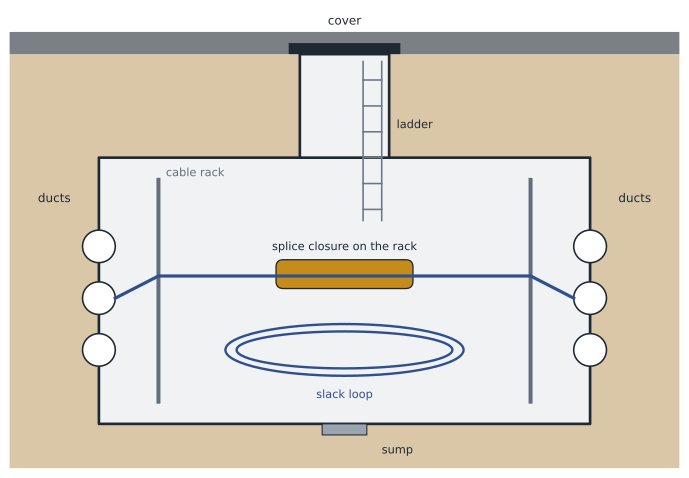
A maintenance hole is a larger structure, usually precast concrete, that a person can enter through a round opening in the top called the throat or chimney, closed by a cast iron or composite cover. Inside there is room to stand, rack cables along the walls and work on splice closures. Maintenance holes are used on main routes with large cable counts, under roads, at major splice points and where future growth is expected. A vault is a larger enclosure still, sometimes with equipment such as amplifiers, cabinets or utility transformers, and is designed case by case.
Where structures go
Structures are placed wherever the system needs access. The main reasons are pulling, splicing, branching and changes of direction.
| Reason | What decides the location |
|---|---|
| Pulling | The tension calculation: sections must be short enough, with few enough bends, that cable can be pulled within its rating |
| Splicing | Where cable lengths end, where outside plant cable meets indoor cable and where future branches will be spliced |
| Branching | Where a lateral to another building or future building leaves the main route |
| Direction | Where the route turns more than the allowed bends per section |
| Crossings | On each side of a road, rail line or waterway, so that the crossing can be pulled as one section |
Section lengths are set by pulling tension, bends and the maximum length of cable on a reel. Many owners also set a maximum length between structures, often a few hundred meters for fiber routes, so that a damaged section can be replaced without pulling a very long cable. In cities, structures are often placed at street intersections, because routes change direction there and because branch connections to buildings come off at corners.
Worked problem
Placing structures on the Harbourview route
The 420 m route runs 150 m across the parking lot, turns 90 degrees, runs 110 m along the edge of the lot to the street, turns 90 degrees again to cross the street by a 40 m bore, then runs 120 m to the college building with one more 45 degree sweep. The owner allows at most 180 degrees of bends per section. The college may buy the lot to the south. Where should Daniel place structures?
Show solution
- At the first 90 degree turn: a structure here lets the lot-crossing section be pulled straight and gives a branch point toward the south lot.
- At the street edge, before the bore: a structure on each side of the street lets the crossing be pulled as one short section.
- Beyond the street, the remaining 120 m with one 45 degree sweep is one section.
- Count: one structure at the first turn and one on each side of the street, three in total.
Answer: Three structures: a maintenance hole at the first turn, sized for a future branch to the south lot, and a handhole or maintenance hole on each side of the street crossing.
Sizing structures
A structure must be large enough for the ducts entering it, the cables racked inside it, any splice closures and slack loops, and the people who will work in it. Ducts must enter at heights and positions that let cables be racked without sharp bends; a structure with ducts entering at the same height in opposite end walls lets cables pass straight through. Splice closures for large fiber cables can be 2 ft or more long and need space on the racks. Slack loops, which let a closure be lifted out and taken to a splicing truck, often need 30 to 60 ft of cable on each side of the closure, coiled on racks or in figure-eight storage brackets.
Bend radius applies inside structures too. A cable entering through one wall and leaving through another must turn without going below its installed bend radius. This often decides the minimum width and length of a maintenance hole for large cables. When in doubt, choose the larger structure; a structure that is too small is almost impossible to enlarge without digging it out and replacing it.
Worked problem
Slack and splice planning
At the street-side structure, the campus cable will be spliced to a short future lateral. The owner wants a 15 m slack loop on each side of the closure, and the closure takes 0.8 m on the rack. How much cable must be stored in the structure for this cable, and how many splice trays are needed if the closure uses 24-fiber trays and all 144 fibers pass through it, with 48 fibers spliced to the lateral and the rest uncut?
Show solution
- Slack: 2 × 15 = 30 m of cable, plus the closure itself.
- Fibers spliced: 48. Uncut fibers pass through the closure in loose tubes and do not need trays.
- Trays: 48 ÷ 24 = 2 trays, with spare tray positions for future splices.
Answer: About 30 m of slack cable stored on the racks, and two splice trays for the 48 spliced fibers, in a closure with room for more.
Load ratings and covers
Covers and lids must carry whatever will drive or stand on them. A handhole in a lawn needs a light-duty lid; one in a parking lot or under a road needs a lid and box rated for vehicle loads, including occasional heavy trucks. Ratings are given by the manufacturer according to recognized test standards, often the tier ratings of ANSI/SCTE 77 for underground enclosures, or the road authority's own requirements. Maintenance hole covers in roads are usually cast iron rated for highway loads. Covers should be marked with the owner's name or the word identifying the system, such as communications, so that other utilities do not open them by mistake.
Security matters too. Fiber in a maintenance hole can be cut by vandals or tapped by intruders. Locking covers, tamper-resistant bolts and alarms that report when a cover is opened are common on critical routes.
Inside the structure
Cables in a maintenance hole are supported on racks bolted to the walls, with hooks or arms at intervals so that cables are lifted off the floor and kept in order. Each cable should be tagged at each structure with its owner, its identifier and its fiber or pair count, so that a technician opening the structure years later knows what is there. Splice closures are mounted on the racks, never left on the floor where water collects. Pulling irons cast into the walls opposite each duct entrance give an anchor point for pulling equipment.
Metal racks, cable armor and metallic strength members in the structure are bonded together and, where the owner's standard requires, connected to a ground rod or ground ring. RCDD-113 covered the reasons: a lightning strike or power fault on a nearby line can induce voltages on long metallic paths. All-dielectric cables avoid this, which is one reason they are common on campus routes.
Keeping water and gas out
Every underground structure gets wet. Groundwater seeps through joints, rain enters through covers and ducts carry water downhill from higher structures. Structures should have a sump or a drain in the floor, ducts should slope gently toward structures so that water drains out rather than standing in the ducts, and every duct entrance should be sealed. Empty ducts get removable plugs; occupied ducts get seals that fit around the cables. Seals also keep out rodents, which chew cable jackets, and gases, which can travel through ducts from a leaking gas line into a structure or, worse, into a building.
In cold climates, water in ducts can freeze and crush cables, especially near the surface. Ducts should be deep enough or well enough drained that standing water does not freeze around cables. At Harbourview, with frost penetrating well over a meter in some winters, Daniel specifies sealed duct entrances in both buildings, a slope toward the maintenance holes, and sumps in each structure.
Working safely in maintenance holes
A maintenance hole is a confined space: large enough to enter, with limited ways in and out and not designed for people to stay in. Confined spaces can hold too little oxygen, toxic gases such as hydrogen sulfide or carbon monoxide, or flammable gases such as methane or leaked natural gas. People have died entering maintenance holes to rescue a co-worker who collapsed.
In the United States, OSHA's confined space standards, the general industry permit-required confined space rule in 29 CFR 1910.146 and the construction confined space rule in 29 CFR 1926 Subpart AA, require a hazard evaluation, atmospheric testing, ventilation, an attendant outside and rescue procedures where the space is permit-required. Telecommunications work also has its own OSHA rules in 29 CFR 1910.268, which address work in maintenance holes. The ICT designer does not manage entry, but the specification should require the contractor to follow the applicable regulations, and the design should not create structures that are harder to enter safely than they need to be.
Good design helps. Large enough openings, ladders or ladder rungs, room to stand, and racks that let technicians work without climbing over cables all make entry and rescue easier. Locating structures out of traffic lanes, where possible, keeps workers safer and reduces road closures.
Documentation
Every structure should appear on the record drawings with a unique identifier, location coordinates, size, depth, duct entrances and the cables in each duct. Many owners also keep a 'butterfly' drawing for each maintenance hole, showing each wall laid out flat with duct positions and their contents. When a cable is added or a duct is used, the drawing is updated. Without it, the next designer must open the structure to find out what is inside, which costs money and creates safety risks.
Choosing between a handhole and a maintenance hole
The choice comes down to what will happen inside the structure over its life. If the structure will only be used to pull cable through and to store a little slack, a handhole is cheaper and faster to install. If large splice closures will be mounted, many cables racked or future laterals spliced, a maintenance hole gives people room to work properly. On the Harbourview route, Daniel uses a maintenance hole at the first turn, where a branch to the south lot is likely, and large traffic-rated handholes on each side of the street, where the work will be pulling only.
Common mistakes
MistakePlacing structures only where the route turns.
InsteadAlso place them where pulling tension, splicing, branching and crossings require access.
MistakeLeaving splice closures on the floor.
InsteadMount closures on racks above the floor, where water collects.
MistakeLeaving ducts unsealed.
InsteadPlug empty ducts and seal occupied ones to keep out water, gas and rodents.
MistakeChoosing a light-duty lid for a parking lot.
InsteadChoose enclosures rated for the loads they will carry, including vehicles.
Summary and key terms
- Handholes are small, surface-worked boxes; maintenance holes are larger, person-entry structures; vaults are larger still.
- Structures are placed for pulling, splicing, branching, direction changes and crossings.
- Size structures for ducts, cable racking, splice closures, slack loops and bend radius, with room to grow.
- Covers must carry expected loads and be marked and secured; cables must be racked, tagged and bonded as required.
- Seal ducts, provide drainage and treat maintenance holes as confined spaces under the applicable safety regulations.
- Handhole
- A small underground enclosure worked from the surface.
- Maintenance hole
- A person-entry underground structure for cable access, often called a manhole.
- Vault
- A large underground enclosure that may house equipment.
- Slack loop
- Extra cable stored at a structure so a splice closure can be lifted out or repairs made.
- Pulling iron
- An anchor cast into a structure wall for attaching pulling equipment.
- Confined space
- An enclosed space, not designed for occupancy, with limited entry and exit and possible atmospheric hazards.
Practice problems
Work each problem on paper first, then reveal the answer to check.
Give two reasons to place a structure where there is no change of direction.
Show answer
Pulling tension, a splice point, a future branch or a road crossing.
A closure needs 20 m of slack on each side. How much cable is stored?
Show answer
40 m.
Why seal empty ducts?
Show answer
To keep out water, gas and rodents.
Lesson quiz · 5 questions
Score 60% or more to complete this lesson.
Create a free account to save your progress, take quizzes and earn a certificate.