
RCDD-115 · Lesson 8 of 12 · 20 min
Aerial plant and joint use
▶ Video coming soon A video version of this lesson is on the way.
The city's engineering department sends a letter about the street crossing permit: approval will take at least ten weeks, and may take longer if the road reconstruction planned for next summer changes the design. Elena calls Roz the same afternoon. 'If the permit is late, can we put the campus cable on the poles along the street, at least for a year?' Roz puts the aerial option back on the table and asks Daniel to work it up properly. 'Aerial plant looks simple from the ground,' she tells him. 'It is a wire on some poles. In practice you are a guest on somebody else's structure, in somebody else's rules, with the weather trying to pull you down.'
Aerial plant is outside plant cable supported on poles or other overhead structures. It is cheaper and faster to build than underground plant, especially where poles already exist, and it is easy to reach for repairs. It is also exposed to wind, ice, falling trees, vehicles hitting poles and accidental contact with power lines. This lesson covers how aerial cables are supported, how space on a pole is shared, how sag and loading are estimated, and what it takes to get permission to attach to someone else's pole.
How aerial cable is supported
Three methods are common. In lashed construction, a steel support wire called a strand or messenger is installed first and tensioned between poles, and the cable is wrapped to it with a thin lashing wire applied by a lashing machine that travels along the strand. Lashed construction can carry several cables on one strand and is the traditional method for telephone and cable television plant. In self-supporting figure-eight cable, the messenger is built into the cable, with the jacket forming a figure eight in cross-section; it installs in one pass but carries only that cable. All-dielectric self-supporting cable, called ADSS, has no metal at all, carrying its own weight with strong aramid yarns, and is often used near power lines because it does not conduct.
Hardware attaches the strand or cable to each pole: bolts through the pole, suspension clamps that hold the strand at intermediate poles, and dead-end fittings where the strand ends or turns. At corners and ends, the pull of the strand must be balanced by guy wires anchored in the ground, or the pole will lean. Metallic strands are bonded to the pole's grounding system according to the pole owner's standard. ADSS cable needs its own hardware designed for the cable's diameter and span length.
Space on the pole
A utility pole is shared by several users, and its height is divided into spaces with rules for each. The electric utility's conductors occupy the top, in the supply space. Below them is a safety zone with no attachments, which separates electrical conductors from the communications workers who climb or use bucket trucks below. Below the safety zone is the communications space, where telephone, cable television and fiber attachments go, each at a set separation from the others. At the bottom, the cable must clear the ground, roads, driveways and walkways by minimum distances.
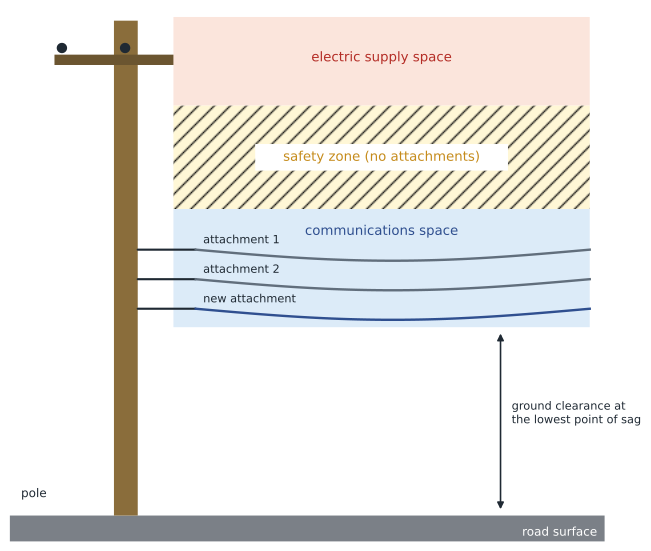
The distances between zones and the clearances above ground come from the National Electrical Safety Code, which most states adopt for utility work, and from the pole owner's own construction standards, which may be stricter. The values depend on the voltage of the supply conductors, the type of surface beneath the span and the loading conditions, so a designer must look them up for each situation rather than rely on a single number.
Sag
A cable or strand between two poles hangs in a curve. The vertical distance from the straight line between the attachment points to the lowest point of the curve is the sag. Sag depends on the weight of the cable and strand, the span length and the tension. More tension means less sag but more force on the poles, the guys and the strand. Too little tension and the cable droops into the clearance zone above the road. For spans where the sag is small compared with the span, a simple parabolic approximation gives a good estimate.
Here s is the sag in feet, w is the weight per foot of everything the strand carries in pounds per foot, L is the span length in feet and T is the horizontal tension in pounds. The formula shows that doubling the span length multiplies the sag by four, which is why long spans need much more tension or a higher attachment.
Worked problem
Sag of a street span
A span along the street is 150 ft long. The strand, cable and lashing together weigh 1.0 lb per foot, and the strand is tensioned to 1,350 lb. What is the sag?
Show solution
- Span squared: 150² = 22,500.
- Sag: 1.0 × 22,500 ÷ (8 × 1,350) = 22,500 ÷ 10,800 ≈ 2.1 ft.
Answer: About 2.1 ft. If the attachment is at 18 ft and the road clearance required is 15.5 ft, the low point at about 15.9 ft is acceptable, but only just, and ice will add weight and sag.
The example values for attachment height and clearance are illustrations only; the real values come from the code and the pole owner. What the calculation shows is the method: find the low point of the span under the worst expected conditions and compare it with the required clearance.
Ice and wind
Codes divide regions into loading districts or zones based on expected ice thickness, wind pressure and temperature. In a heavy loading area, which includes much of northern Ontario and northern Minnesota, the design must assume a layer of radial ice around the cable and strand at the same time as a strong wind, at a low temperature. Ice can add several times the bare weight of a small cable, increasing both sag and tension. Wind pushes the cable sideways, adding load on the poles. The strand is chosen so that its rated strength, reduced by a safety factor, exceeds the tension under these combined loads.
Worked problem
The effect of ice
In the same 150 ft span, ice adds 1.7 lb per foot to the 1.0 lb per foot bare weight. If the tension rose in proportion to weight, the sag would stay the same. Suppose instead that the tension rises only to 2,000 lb. What is the sag with ice?
Show solution
- Loaded weight: 1.0 + 1.7 = 2.7 lb/ft.
- Sag: 2.7 × 22,500 ÷ (8 × 2,000) = 60,750 ÷ 16,000 ≈ 3.8 ft.
Answer: About 3.8 ft, almost double the bare sag. The low point would drop to about 14.2 ft in the illustration, below the 15.5 ft clearance, so the design would need a higher attachment, a shorter span or more tension.
Professional sag and tension calculations use the strand maker's data and account for elastic stretch and temperature, which change how tension responds to load. Pole owners usually require these calculations, done with specialized software, as part of an attachment application. The parabolic estimate is for checking whether a design is plausible before that work begins.
Joint use and pole attachments
Most poles are owned by an electric utility or a telephone company, and other users rent space on them under pole attachment agreements. An attacher must apply for each pole, pay a fee, have the owner's engineers check that the pole can carry the added load and clearances, and pay for any make-ready work: moving existing attachments to make room, replacing poles that are too short or too weak, or adding guys. Make-ready is often the slowest and most expensive part of an aerial project.
In the United States, pole attachments by cable and telecommunications companies are regulated by the FCC under federal law, except in states that have certified that they regulate attachments themselves; about two dozen states and the District of Columbia have done so, and the FCC was reviewing those certifications in 2026. A private owner such as the college would usually work through a carrier or apply to the pole owner directly, and must follow the owner's construction standard. Which rules apply in a given state should be confirmed for each project.
| Step | Who does it | Typical content |
|---|---|---|
| Survey existing poles | Attacher or consultant | Pole heights, classes, existing attachments, spans, clearances |
| Pole loading analysis | Attacher's engineer, reviewed by owner | Whether each pole can carry the new load under the code loading |
| Attachment application | Attacher | Pole list, drawings, loading results, fees |
| Make-ready engineering and work | Owner and existing attachers | Moving attachments, replacing poles, adding guys |
| Construction and inspection | Attacher's contractor, owner inspects | Strand, cable, hardware, bonding, tags |
Risks and protection
Aerial plant fails in predictable ways. Ice storms bring down trees and break strands. Vehicles hit poles, especially at curves and intersections. Wind causes ice-coated cables to gallop, swinging in large waves that can strike other attachments. Squirrels and birds chew or peck jackets. Fires and accidents near power conductors can damage the communications space. The designer reduces these risks by choosing routes away from heavy tree cover where possible, keeping slack loops at intervals so that a broken span can be repaired without a new cable, using armored or rodent-resistant jackets where needed, and labeling every attachment with the owner's tag.
For a campus link, the biggest risk is often simply that the network depends on a structure the owner does not control. A pole replaced by the utility after an accident may be reset without the college's cable for days. This is why Elena prefers the underground route and why Roz recommends that, if aerial is used at all, it be treated as temporary and replaced by the duct bank when the street permit is issued.
The Harbourview aerial option
Daniel's survey finds eleven poles along the street between the two properties, owned by the local electric utility, with one existing telephone attachment and one cable television attachment. Four poles have no room for another attachment at the required separation, and one is too short for the road crossing span. The utility's estimate for make-ready is eight to fourteen weeks, about the same as the street crossing permit. Roz shows Elena the result: aerial would not be faster after all. The college decides to wait for the permit and to use a temporary wireless bridge between the buildings, for basic network service only, if the duct bank is late.
Building and maintaining aerial plant
Aerial construction follows a set sequence. Crews install hardware on each pole, place and tension the strand, pull the cable up onto the strand with temporary rollers, lash it in place, form slack loops at intervals, install guys and anchors at corners and ends, bond metallic parts, and tag the cable at every pole with the owner's identification. The work is done from bucket trucks or by climbing, close to energized conductors, so crews must be qualified for work in the communications space and must keep the approach distances to power lines set by the occupational safety rules where the work is done.
Once built, aerial plant needs regular attention. Owners patrol routes after storms, trim trees that grow toward the cable, replace damaged guards and tags, and respond when the pole owner replaces a pole, which requires every attacher to transfer its cable to the new pole. A transfer that is delayed leaves the cable hanging from an old pole that may be cut down. Pole attachment agreements usually set time limits for transfers, and the owner should know who will do them.
Common mistakes
MistakeUsing one clearance value everywhere.
InsteadClearances depend on voltage, surface type and loading; look them up for each span.
MistakeIgnoring ice in sag calculations.
InsteadDesign for the loading district's ice, wind and temperature, not for a bare cable on a calm day.
MistakeAssuming an attachment can be added to any pole.
InsteadThe owner must approve each pole, and make-ready may be needed.
MistakeRunning metallic strand without bonding.
InsteadBond strands to the pole owner's grounding system according to its standard.
Summary and key terms
- Aerial cable is lashed to a strand, built as figure-eight cable or installed as all-dielectric self-supporting cable.
- Poles are divided into supply space, a safety zone and communications space, with ground clearances below.
- Sag is roughly w L² ÷ 8T; doubling the span multiplies sag by four, and ice can nearly double it.
- Loading districts set ice, wind and temperature assumptions for design.
- Attaching to poles requires the owner's approval, a loading analysis and often make-ready work, under rules set by regulators and the owner.
- Strand
- A steel messenger wire that supports lashed aerial cable.
- ADSS
- All-dielectric self-supporting cable, which supports itself and contains no metal.
- Communications space
- The zone on a pole where communications cables are attached, below the safety zone.
- Sag
- The vertical drop of a span below the straight line between its supports.
- Make-ready
- Work to prepare poles for a new attachment, such as moving existing attachments or replacing poles.
- Pole attachment agreement
- A contract under which an owner rents pole space to an attacher.
Practice problems
Work each problem on paper first, then reveal the answer to check.
If the span doubles and nothing else changes, what happens to sag?
Show answer
It becomes four times as large.
Why might ADSS cable be preferred near power lines?
Show answer
It contains no metal and does not conduct.
Name two kinds of make-ready work.
Show answer
Moving existing attachments, replacing a pole, adding guys.
Lesson quiz · 5 questions
Score 60% or more to complete this lesson.
Create a free account to save your progress, take quizzes and earn a certificate.