
RAC-120 · Lesson 3 of 12 · 22 min
Personal safety: pressure, cold, asphyxiation and decomposition
Dana tells every apprentice the same story in their first week of refrigerant work. Early in her career, a technician from another company was recovering refrigerant from a large unit in a basement plant room. A hose fitting gave way, liquid refrigerant sprayed across the floor and the room filled with a cold fog. The technician did the right thing: he got out immediately, closed the door behind him and called for help. A second worker, coming down the stairs to see what the noise was, nearly walked straight into a room where the air near the floor was mostly refrigerant. "Nobody was hurt that day," Dana says. "But I think about that second worker every time I go down basement stairs into a mechanical room."
Refrigerants are often described as safe, and most of the ones a technician handles are in safety group A1: lower toxicity and non-flammable. But "lower toxicity" is not the same as harmless. Refrigerant work involves high pressures, liquids that boil far below freezing, vapors heavier than air that can displace oxygen, chemical effects on the heart at high concentrations, toxic products when refrigerants meet flames, and, with the newer refrigerants, flammability. This lesson covers each hazard, the protective equipment and practices that control it, and first aid.
Pressure
A refrigerant cylinder or system is a vessel full of liquid and vapor at saturation pressure. At room temperature, R-410A sits at about 200 psig, and on a hot roof the high side of a running system can exceed 435 psig. That stored energy is released suddenly if a hose bursts, a fitting is loosened under pressure, a sight glass cracks or a cylinder fails.
The most serious cylinder hazard is hydrostatic pressure. While a cylinder holds both liquid and vapor, its pressure is simply the saturation pressure at its temperature. But liquid expands as it warms. If a cylinder is overfilled so that the liquid fills it completely, any further warming has nowhere to go: the liquid pushes on the walls with enormous force, and the pressure climbs far faster than the saturation pressure. A cylinder that is liquid-full can rupture violently from a modest temperature rise, for example in a hot van or in the sun. This is why cylinders are never filled beyond their safe limit, which Lesson 4 explains, and why no cylinder is ever heated with a flame or a heat source that is not designed for the purpose.
Practical pressure safety comes down to a few habits:
- Use hoses, manifolds and recovery equipment rated for the refrigerant and its pressures, and inspect hoses for cracks, kinks and worn gaskets.
- Never loosen a fitting, remove a valve core or cut a line on a system under pressure unless the procedure and the tools are designed for it.
- Keep cylinders out of direct sun and away from heat; never heat a cylinder with a torch.
- Use a pressure-reducing regulator and a relief device whenever you use nitrogen, and never pressurize a system above its rated test pressure.
- Never use oxygen or compressed air to pressure test or purge a system. Oxygen mixed with compressor oil under pressure can explode, and air brings moisture and, with flammable refrigerants, a combustible mixture.
Cold: frostbite and eye injury
Liquid refrigerant released to the atmosphere boils instantly at its atmospheric boiling point: about −41 °F for R-22, −61 °F for R-410A and −15 °F for R-134a. As it boils it draws heat from whatever it touches. A spray of liquid on skin freezes tissue in seconds, causing frostbite that looks and behaves much like a burn. In the eye it can cause severe and lasting damage.
This is why safety glasses with side shields, or goggles when liquid release is likely, are worn whenever hoses are connected or disconnected, and why gloves are worn when handling hoses, valves and cylinders. Gloves for refrigerant work should resist cold and the refrigerant and oil; check the SDS and the glove manufacturer's guidance. Thin gloves that soak through are worse than none, because they hold liquid against the skin. A small hiss of vapor from a hose fitting is normal; a jet of liquid is not, and you should never place your hand or face in front of a fitting being opened.
Asphyxiation
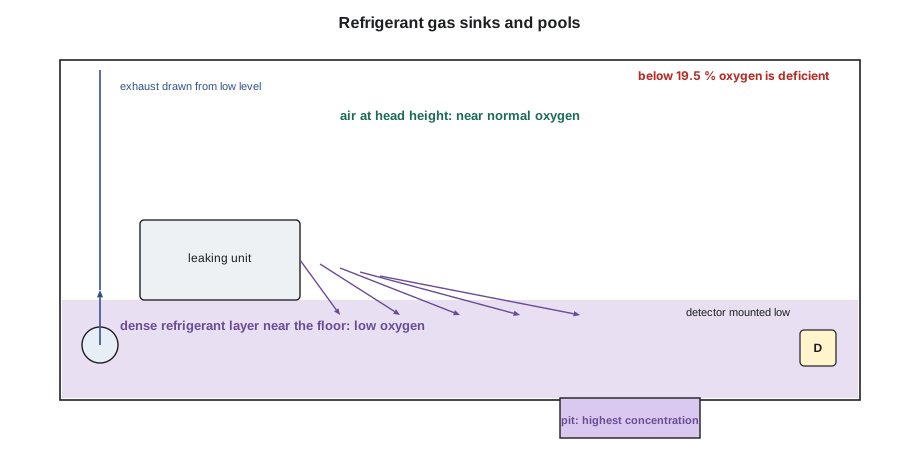
Most refrigerant vapors are three to four times heavier than air; ammonia is the main exception. A large leak in an enclosed space does not mix evenly with the room air. It sinks and spreads along the floor, collecting in basements, pits, trenches, crawl spaces, the bottoms of walk-in boxes and low corners of machinery rooms. There it displaces the air, and with it the oxygen. A person entering such a space can lose consciousness within a few breaths, with little or no warning: most A1 refrigerants have only a faint smell or none, and the body does not sense a lack of oxygen, only a buildup of carbon dioxide.
Normal air contains about 20.9 percent oxygen. Workplace safety rules in Canada and the United States treat an atmosphere with less than 19.5 percent oxygen as oxygen deficient, and lower levels quickly impair judgment and coordination, then cause collapse. Because refrigerant pools rather than mixing, the concentration near the floor of a room can be many times the average for the room as a whole.
Worked problem
How much oxygen does a leak displace?
The brewery's condensing unit for the walk-in cooler sits in a small mechanical room 10 ft by 10 ft with an 8 ft ceiling. If its whole charge of 10 lb of R-448A escaped and mixed evenly with the room air, what would the average concentration and oxygen level be?
Show solution
- \[V_{\text{room}} = 10 \times 10 \times 8 = 800\ \text{ft}^3\]
- \[n = \frac{4536\ \text{g}}{86.3\ \text{g/mol}} \approx 52.6\ \text{mol}, \quad V_{\text{gas}} \approx 52.6 \times 0.851\ \text{ft}^3/\text{mol} \approx 44.7\ \text{ft}^3\]
- \[x = \frac{44.7}{800} \approx 5.6\ \%, \qquad \text{O}_2 \approx 20.9\ \% \times (1 - 0.056) \approx 19.7\ \%\]
Answer: Mixed evenly, the room would be just above the oxygen-deficiency line, but at about 56,000 to 58,000 parts per million of refrigerant, far above workplace exposure limits of about 1,000 parts per million for common refrigerants. And it would not mix evenly: the layer near the floor could be several times richer. Leave the room, ventilate it from low level and confirm with a detector before going back in.
The calculation uses the ideal gas law: one mole of any gas at room temperature and atmospheric pressure occupies about 0.851 ft³. The program below repeats it for several rooms and refrigerants. It is a rough estimate, useful for showing why small rooms and large charges are dangerous, not a substitute for a detector.
# Average refrigerant concentration and oxygen level if a full charge mixes into a room
MOLAR_VOLUME = 0.851    # ft3 per mol at about 68 F and 1 atm
G_PER_LB = 453.6
molar_mass = {"R-22": 86.5, "R-134a": 102.0, "R-410A": 72.6, "R-448A": 86.3, "R-32": 52.0}
cases = [  # (place, refrigerant, charge lb, length ft, width ft, height ft)
    ("brewery mechanical room", "R-448A", 10.0, 10, 10, 8),
    ("clinic rooftop unit in a penthouse", "R-410A", 15.0, 13, 10, 9),
    ("glycol chiller closet", "R-134a", 7.0, 6.5, 5, 8),
    ("seniors' residence plant room", "R-134a", 210.0, 26, 20, 11.5),
]
for place, ref, lb, l, w, h in cases:
    room = l * w * h
    gas = lb * G_PER_LB / molar_mass[ref] * MOLAR_VOLUME
    x = gas / room
    o2 = 20.9 * (1 - x)
    flag = "OXYGEN DEFICIENT" if o2 < 19.5 else "above 19.5 % on average"
print(f"{place:36s} {ref:7s} {x * 1e6:9.0f} ppm O2 {o2:5.1f} % {flag}")brewery mechanical room R-448A 55912 ppm O2 19.7 % above 19.5 % on average clinic rooftop unit in a penthouse R-410A 68167 ppm O2 19.5 % OXYGEN DEFICIENT glycol chiller closet R-134a 101889 ppm O2 18.8 % OXYGEN DEFICIENT seniors' residence plant room R-134a 132899 ppm O2 18.1 % OXYGEN DEFICIENT
The seniors' residence plant room shows why larger systems have machinery rooms with refrigerant detectors, alarms and mechanical ventilation. Even averaged over a large room, a full release of a chiller charge makes the air dangerous to breathe.
The mechanical refrigeration safety standard, ASHRAE 15, adopted through the mechanical codes, sets limits on how much refrigerant may be used in occupied spaces and requires machinery rooms, detection, alarms and ventilation for larger systems. OSHA's permit-required confined space standard governs spaces such as pits and tanks, which require hazard evaluation, atmospheric testing and an entry permit procedure.
When a refrigerant alarm sounds or a large leak is suspected, the rule is simple: leave, keep others out, ventilate if it can be done from outside the space, and re-enter only after the atmosphere has been tested and is safe, or with self-contained breathing apparatus and the training to use it. Never enter a space to rescue a collapsed person without proper breathing protection; untrained rescuers are a large share of the people who die in oxygen-deficient spaces.
Effects on the heart and nervous system
At high concentrations, many halocarbon refrigerants act on the body directly. Breathing them can cause dizziness, confusion and loss of coordination, much like an anesthetic, and at higher levels they can sensitize the heart to adrenaline, the body's own stress hormone, triggering an irregular heartbeat that can be fatal. This effect, called cardiac sensitization, is part of how refrigerant toxicity is assessed, and it is one reason the SDS for many refrigerants advises that adrenaline-like drugs should not be given to a person overexposed to the refrigerant, except on a doctor's direction.
Never deliberately inhale refrigerant, and never use the smell of a release to identify a refrigerant. Workplace exposure limits for common refrigerants are typically about 1,000 parts per million averaged over a working day; these are set by refrigerant manufacturers, standards bodies or regulators and are given in section 8 of the SDS.
Decomposition in flames and on hot surfaces
Halocarbon refrigerants that are stable in a system break down when they pass through a flame or touch a very hot surface, such as a torch flame, a gas furnace burner, an electric heating element or the glowing filament of an old-style leak detector. The products include hydrogen fluoride and, from refrigerants containing chlorine, hydrogen chloride; under some conditions, carbonyl fluoride and phosgene can also form. These are highly toxic and corrosive gases: they burn the eyes, nose, throat and lungs, and hydrogen fluoride can cause deep chemical burns. A sharp, acrid smell near a flame in a space with a refrigerant leak is a sign of decomposition, and the space should be left and ventilated.
Decomposition is the reason two firm rules exist. First, never braze or solder on a line or component that contains refrigerant. Recover the refrigerant first, then flow dry nitrogen through the piping while brazing to protect the inside of the tube and carry away any traces. Second, leak search with a flame or heated detector in a space where a large leak has occurred can create the very gases you are trying to avoid; use electronic detectors designed for the purpose and ventilate first.
Flammable refrigerants
A2L and A3 refrigerants add fire and explosion hazards. A flammable refrigerant can burn when it is mixed with air between its lower and upper flammability limits and meets an ignition source with enough energy. A2L refrigerants need a stronger ignition source than A3 refrigerants and burn more slowly, but in an enclosed space with an open flame or an arcing electrical contact they can still ignite.
- Before work, check the area with a leak detector rated for the refrigerant, and keep ignition sources such as open flames, smoking and non-rated electrical tools out of the work area.
- Use recovery machines, vacuum pumps and other tools that are rated for the refrigerant's flammability class, and bond and ground equipment as the manufacturer directs.
- Ventilate the work area, especially indoors, and work so that any release is diluted quickly.
- Recover the refrigerant and purge the circuit with nitrogen before any brazing or cutting on an A2L or A3 system.
- Use cylinders and connections designed for flammable refrigerants: red band, left-hand threads for A2L, and the correct adapters.
RAC programs cover flammable refrigerant installation and service procedures in detail, and equipment manufacturers publish specific instructions for their A2L and A3 products. The purpose here is to recognize that flammability changes how every handling task is set up.
Protective equipment and first aid
| Hazard | Protection | First aid |
|---|---|---|
| Liquid spray, frostbite | Safety glasses with side shields or goggles; cold-resistant gloves; long sleeves | Warm the area gently with lukewarm water, not hot; do not rub; get medical attention for blistering or numbness |
| Refrigerant in the eye | Goggles when liquid release is possible | Flush with clean water for at least fifteen minutes, holding the eyelids open; get medical attention |
| High concentration, low oxygen | Detection, ventilation, never entering pooled vapor; breathing apparatus where required | Move the person to fresh air only if it is safe for the rescuer; call emergency services; give CPR if trained and needed |
| Decomposition products | No flames near leaks; recover before brazing; ventilate | Leave the area; move to fresh air; get medical attention for any breathing difficulty or burns |
| Flammable refrigerant | Rated tools, ignition control, ventilation | Treat burns as burns; evacuate if a fire starts |
Northfield's vans each carry an eyewash bottle, a first-aid kit, a refrigerant leak detector and a portable oxygen monitor for work in basements and small rooms. Dana's rule is that the monitor goes in before the technician does whenever a room smells odd, an alarm has sounded, or a large leak is known.
Common mistakes
MistakeTreating A1 refrigerants as harmless.
InsteadThey can displace oxygen, sensitize the heart and decompose into toxic gases.
MistakeWalking into a basement room after a large leak to find the leak.
InsteadLeave, ventilate from low level, and test the atmosphere before entering.
MistakeBrazing on a line that still holds refrigerant.
InsteadRecover first and flow nitrogen while brazing.
MistakePressure testing with oxygen or compressed air.
InsteadUse dry nitrogen through a regulator with a relief device.
MistakeHeating a cylinder with a torch to speed up charging or recovery.
InsteadNever heat cylinders with a flame; liquid expansion can rupture them.
Summary and key terms
- Refrigerant systems and cylinders store energy as pressure; a liquid-full cylinder can rupture from a small temperature rise.
- Liquid refrigerant boils far below freezing and causes frostbite and eye injury; wear glasses or goggles and gloves.
- Most refrigerant vapors are heavier than air, pool in low spaces and can create oxygen-deficient atmospheres below 19.5 percent.
- High concentrations can cause anesthetic effects and cardiac sensitization.
- Flames and hot surfaces decompose halocarbons into hydrogen fluoride and other toxic gases; recover before brazing.
- A2L and A3 refrigerants require rated tools, ignition control and ventilation.
- Machinery rooms need detection, alarms and ventilation; never enter a hazardous atmosphere without testing or breathing protection.
- Hydrostatic pressure
- The very high pressure that develops when a liquid-full container is warmed.
- Asphyxiation
- Loss of consciousness or death from lack of oxygen.
- Oxygen deficient
- An atmosphere with less than 19.5 percent oxygen.
- Cardiac sensitization
- An effect of high refrigerant concentrations that makes the heart prone to dangerous irregular rhythms.
- Decomposition products
- Toxic gases such as hydrogen fluoride formed when refrigerants pass through flames or hot surfaces.
- Lower flammability limit
- The lowest concentration of a gas in air that can burn.
- Machinery room
- A dedicated room for refrigerating machinery, with detection, alarms and ventilation as required by code.
Practice problems
Work each problem on paper first, then reveal the answer to check.
Why do detectors for most refrigerants mount low on the wall?
Show answer
Most refrigerant vapors are heavier than air and collect near the floor.
What is the oxygen level below which an atmosphere is considered oxygen deficient?
Show answer
19.5 percent.
Name two toxic products of refrigerant decomposition.
Show answer
Hydrogen fluoride and hydrogen chloride; also carbonyl fluoride or phosgene.
What should you do if refrigerant liquid sprays into a co-worker's eye?
Show answer
Flush with clean water for at least fifteen minutes and get medical attention.
Why must a cylinder never be filled until it is completely liquid-full?
Show answer
Warming a liquid-full cylinder creates hydrostatic pressure that can rupture it.
Lesson quiz · 5 questions
Score 60% or more to complete this lesson.
Create a free account to save your progress, take quizzes and earn a certificate.