
RAC-120 · Lesson 8 of 12 · 21 min
Recovery methods: vapor, liquid and push-pull
The grocery store closed in the spring, and in October Northfield got the job of decommissioning its old refrigeration rack before the building was sold. The rack held about 100 lb of R-22 in a large receiver and what felt like miles, as Theo put it, of copper running to the empty display cases. On a residential split system Theo would simply have recovered vapor from both service ports and waited. Here Dana planned the job like a move: liquid first, by push-pull from the receiver, then vapor from every section, then a check that the rack stayed at the required level. "Vapor recovery alone would take us a day and a half," she said. "Push-pull will move most of the charge before lunch."
This lesson covers the three ways to get refrigerant out of a system: vapor recovery, liquid recovery and the push-pull method. It explains when each is used, how to set it up, how to finish a job properly, and how to speed things up safely.
Where the refrigerant is
A system that is off and at a steady temperature contains refrigerant as liquid in its coldest places and its receiver or accumulator, and as vapor everywhere else, all at the saturation pressure of the coldest liquid. Most of the mass is in the liquid. A residential split system may hold a few pounds, most of it as liquid in the condenser coil and liquid line. A large rack with a receiver may hold tens or hundreds of pounds, most of it in the receiver. Some refrigerant is also dissolved in the compressor oil and comes out slowly as the pressure falls.
Moving refrigerant as vapor is slow because vapor has a low density: the machine must compress and condense every pound. Moving it as liquid is fast because liquid is hundreds of times denser. The best recovery plans move as much as possible as liquid, then finish with vapor.
Vapor recovery
Vapor recovery is the basic method and works on any system. The recovery machine's inlet is connected to the system, preferably to both the high side and the low side, and its outlet to the vapor valve of the recovery cylinder. As the machine draws vapor, the liquid in the system boils to replace it, which cools the system, lowers its pressure and slows the process. Connecting to both sides avoids trapping refrigerant on one side of a closed metering device, solenoid valve or check valve.
Vapor recovery is the only method for small systems with little liquid, and it is always the last stage of any recovery, because only vapor recovery can pull a system down to the required vacuum. Its weakness is speed on large charges, and in cold weather, when the system's low temperature means low pressure and a small mass of vapor per stroke of the machine's compressor.
Liquid recovery
In liquid recovery, the machine draws liquid from a point where it collects, such as the liquid line service valve, the king valve on a receiver or a liquid drain on a chiller, and pumps it into the cylinder. The recovery machine must be rated for liquid, or the liquid must be throttled through the machine's inlet valve so that the compressor receives it in a form it can handle; the machine's instructions say which. Liquid can also be transferred directly into a recovery cylinder by pressure difference alone, when the system is warmer than the cylinder, but this is slow and stops as the pressures equalize.
Liquid recovery moves the bulk of the charge quickly. When the liquid runs out, which shows as the machine's sight glass or the hose changing from liquid to vapor, the technician switches to vapor recovery to finish.
Push-pull
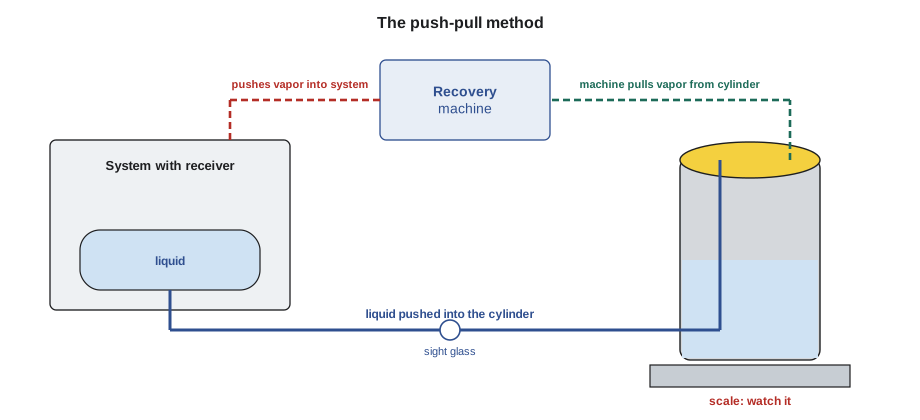
Push-pull uses the recovery machine to move liquid without passing it through the compressor. A hose connects the system's liquid outlet, usually the receiver king valve or liquid line valve, to the recovery cylinder's liquid valve. The machine's inlet is connected to the cylinder's vapor valve, and its outlet to the system's vapor side. When the machine runs, it pulls vapor from the top of the cylinder, lowering the cylinder's pressure, and pushes that vapor into the system, raising its pressure. The pressure difference drives liquid from the system into the cylinder.
Push-pull is very fast on systems with a large amount of liquid that can be reached in one place, such as systems with receivers, supermarket racks and many chillers. It is not suitable for small systems, for systems where the liquid cannot be isolated in one place, or for many heat pumps with reversing valves and accumulators, where liquid is spread around the system. A sight glass in the liquid hose shows when liquid stops flowing; at that point the push-pull hoses are removed and the job is finished by vapor recovery.
Push-pull has one particular hazard: the float switch may not protect the cylinder. Liquid enters through the liquid valve as fast as the system can push it, and if the cylinder is not watched on a scale it can be overfilled in minutes. The scale is the main control, and the job must be stopped before the cylinder reaches its limit.
Worked problem
Planning the grocery rack recovery
The rack holds 100 lb of R-22. Northfield's recovery cylinders have a water capacity of 47.7 lb, so each may hold 38.2 lb under the company's fill rule. How many cylinders are needed, and how should the job be organized?
Show solution
- \[\frac{100\ \text{lb}}{38.2\ \text{lb per cylinder}} = 2.6 \Rightarrow 3\ \text{cylinders}\]
Answer: Dana brings four dedicated R-22 recovery cylinders, evacuated and weighed, because the true charge of an old rack is rarely exactly what the records say. Push-pull from the receiver fills the first two cylinders, watched on the scale; the third takes the rest of the liquid and the vapor; the fourth is a spare.
# Plan a large recovery: cylinders needed and an estimate of the time for each stage
import math
charge_lb = 100.0
wc_lb = 47.7
per_cylinder = 0.8 * wc_lb                 # field fill rule
cylinders = math.ceil(charge_lb / per_cylinder)
liquid_share = 0.85                        # share of charge expected to move as liquid
push_pull_rate = 6.6                       # lb per minute, effective, illustrative
vapor_rate = 0.77                          # lb per minute, effective, illustrative
liquid_lb = charge_lb * liquid_share
vapor_lb = charge_lb - liquid_lb
t_liquid = liquid_lb / push_pull_rate
t_vapor = vapor_lb / vapor_rate
print(f"Cylinders needed: {cylinders} (plus one spare), {per_cylinder:.1f} lb each")
print(f"Push-pull: {liquid_lb:.1f} lb in about {t_liquid:.0f} min")
print(f"Vapor recovery: {vapor_lb:.1f} lb in about {t_vapor:.0f} min")
print(f"Vapor recovery of the whole charge would take about {charge_lb / vapor_rate / 60:.1f} h")Cylinders needed: 3 (plus one spare), 38.2 lb each Push-pull: 85.0 lb in about 13 min Vapor recovery: 15.0 lb in about 19 min Vapor recovery of the whole charge would take about 2.2 h
Even with illustrative rates, the comparison is clear: push-pull plus a vapor finish takes about an hour, while vapor recovery alone would take most of a working day.
Choosing the method
| Method | Best for | Limits |
|---|---|---|
| Vapor | Small systems; the final stage of every job | Slow on large charges and in cold weather |
| Liquid | Systems with an accessible liquid line or drain | Machine must be rated for liquid or throttled; finish with vapor |
| Push-pull | Large liquid charges in one place: receivers, racks, many chillers | Not for small systems, heat pumps or spread-out liquid; scale is essential |
| System-dependent | Small appliances | Cannot reach a deep vacuum; depends on the system's condition |
Speeding up recovery safely
Recovery is a contest between the pressure in the system and the pressure in the cylinder. Anything that raises the first or lowers the second speeds the job.
- Keep the recovery cylinder cool. Shade it, and in hot weather set it in a container of cool water or ice water. A cooler cylinder has a lower pressure and condenses refrigerant more readily.
- Warm the system, where it is safe to do so. Run the evaporator fan or the chilled-water pump so that the room or the water supplies heat to boil the liquid. On a cold rooftop in winter, recovery from a condenser full of cold liquid is slow; waiting for the afternoon sun can help.
- Use large, short hoses and remove valve cores, as described in Lesson 7.
- Recover from both the high and low sides, and open any valves that might trap refrigerant, such as solenoid valves, by energizing them or using their manual stems.
- Never heat a recovery cylinder, never use an open flame on any part of the system, and never bypass a high-pressure cutout to keep a machine running.
Finishing the job
Recovery is not finished when the gauge first reaches the required level. Refrigerant dissolved in the compressor oil and liquid trapped in cold corners keep boiling off. The usual practice is to reach the required level, isolate the system from the recovery machine, and wait several minutes while watching the gauge. If the pressure rises, more refrigerant is still in the system: recover again, and repeat until the pressure holds. A large or cold system can take several rounds. The required levels themselves, which differ by type and size of equipment, are covered in Lesson 9.
When the system holds at the required level, close the hose-end valves, run the recovery machine's purge or self-clear mode into the cylinder, close the cylinder valves, and then disconnect. Weigh the cylinder and record the amount recovered. Tag the cylinder with the refrigerant type, the amount and the source. If the system is being opened for repair rather than scrapped, it may be left at a slight positive pressure of nitrogen to keep air and moisture out until the work begins, or evacuated and opened immediately, depending on the job and the rules.
Non-condensables in the recovery cylinder
Air that gets into a recovery cylinder, from unpurged hoses, a leaking system that has drawn in air, or a cylinder that was not evacuated, does not condense at normal pressures. It collects at the top of the cylinder and adds its own pressure to the refrigerant's, which raises the cylinder pressure and makes recovery slower and the cylinder hotter. To check, let the cylinder stand until its temperature is steady, measure the temperature and pressure, and compare the pressure with the saturation pressure from a P-T chart for that refrigerant. A pressure noticeably higher than the chart value means non-condensables are present.
Venting air from the top of a recovery cylinder also releases refrigerant mixed with the air, so the preferred practice is to prevent air from getting in at all, and to send a cylinder with non-condensables to the reclaimer, labeled with what is known. Some recovery machines and reclaimers have equipment to separate air from refrigerant without significant loss.
Worked problem
Checking a recovery cylinder for air
A recovery cylinder of R-22 has stood in the shop overnight at 70 °F. Its gauge reads 152 psig. The P-T chart shows R-22 at that temperature at about 121 psig. What does this show?
Show solution
- The measured pressure is about 31 psi above the saturation pressure for R-22 at the cylinder temperature.
- Liquid R-22 alone cannot produce that pressure at 70 °F, so another gas is adding pressure: non-condensables, most likely air.
Answer: The cylinder contains non-condensables. Theo labels it accordingly for the reclaimer and checks which job it came from, so the hose purging step can be reviewed.
Common mistakes
MistakeRecovering a large charge by vapor alone.
InsteadMove liquid first by liquid recovery or push-pull, then finish with vapor.
MistakeRelying on the float switch during push-pull.
InsteadWatch the scale; liquid can overfill a cylinder quickly.
MistakeStopping as soon as the gauge first reaches the required level.
InsteadIsolate, wait, and recover again if the pressure rises.
MistakeConnecting to only one side of a system with a closed metering device.
InsteadRecover from both high and low sides.
MistakeVenting a recovery cylinder to get rid of air.
InsteadPrevent air entry; send cylinders with non-condensables to the reclaimer.
Summary and key terms
- Most refrigerant in an idle system is liquid; moving it as liquid is far faster than as vapor.
- Vapor recovery works on any system and is always the final stage; connect to both sides.
- Liquid recovery moves liquid through a rated machine or by pressure difference.
- Push-pull pushes vapor into the system and pulls liquid into the cylinder; it suits large liquid charges and needs a scale.
- Cool the cylinder, warm the system safely, use large hoses, and never heat cylinders or bypass safety controls.
- Finish by holding at the required level, purging the machine, weighing and tagging the cylinder.
- Pressure above the P-T value in a recovery cylinder means non-condensables.
- Vapor recovery
- Removing refrigerant from a system as vapor through the recovery machine.
- Liquid recovery
- Removing liquid refrigerant directly from a system.
- Push-pull
- A method that uses vapor from the cylinder to push liquid out of the system into the cylinder.
- King valve
- The service valve at a receiver outlet, used to reach liquid.
- Non-condensables
- Gases such as air that do not condense at normal system pressures.
- Sight glass
- A window in a line or hose showing whether liquid or vapor is flowing.
- Pump-down
- Using the system's compressor to move refrigerant into the condenser or receiver for storage within the system.
Practice problems
Work each problem on paper first, then reveal the answer to check.
Why is vapor recovery always the last stage?
Show answer
Only vapor recovery can pull a system down to the required vacuum.
Why is the scale more important than the float switch during push-pull?
Show answer
Liquid enters quickly through the liquid valve, and the cylinder can be overfilled before a float switch acts reliably.
A system rises from the required vacuum to a positive pressure after the machine is isolated. What does it mean?
Show answer
Refrigerant is still boiling out of oil or trapped liquid; recover again.
How many recovery cylinders, each holding 38.2 lb, are needed for a 132 lb charge?
Show answer
Four: 60 ÷ 17.3 = 3.5, rounded up.
Lesson quiz · 5 questions
Score 60% or more to complete this lesson.
Create a free account to save your progress, take quizzes and earn a certificate.