
PWR-340 · Lesson 9 of 12 · 24 min
Hazard analysis and management of change
▶ Video coming soon A video version of this lesson is on the way.
Two changes were waiting for Cantwell's November operations meeting. Lorne Fitzwilliam had proposed raising the deaerator's low-level alarm by 1.5 ft after feed pump 2 cavitated on October 27 (PWR-210), and Pilar Quenneville had proposed a set of alarm changes after her October review of the alarm system (PWR-240). Both had been written up on the plant's management of change form, and both were waiting for a hazard review before the meeting would approve them.
Grazyna decided to use Lorne's proposal as Okonkwo's worked example. "A hazard study for a change this small is a few hours with three people and a P&ID," she said. "But it is the same method a refinery uses for a whole unit, and the questions are the same. What is it for? What could go wrong? What stops it going wrong? Is that enough? And have we just made something else worse?"
This lesson describes the main methods of hazard identification and analysis, from checklists and what-if studies to HAZOP, failure modes and effects analysis, fault trees and layer of protection analysis, and shows how risk is judged against criteria. It then explains management of change: what counts as a change, how one is reviewed, approved and closed out, and why temporary and organizational changes need it as much as new equipment. It works a HAZOP node on the deaerator, a LOPA calculation and a risk ranking.
Hazards and risk
A hazard is something with the potential to cause harm: stored energy, a toxic or flammable material, a hot surface, a large rotating machine. Risk combines how likely a harmful event is with how severe its consequences would be. Hazard analysis has two jobs: to identify what could go wrong, and to assess whether the safeguards against it are adequate. The methods differ in how they search for problems and how much they quantify.
Methods of hazard identification
- Checklists compare a design or operation with a list of known requirements and good practices. They are quick and catch familiar problems but find nothing that is not on the list.
- What-if analysis is a structured brainstorm by an experienced team, asking questions such as "what if the feedwater control valve fails open?" and recording causes, consequences, safeguards and recommendations. It is flexible and suits small systems and changes, but its thoroughness depends on the team.
- Hazard and operability study (HAZOP) applies guidewords systematically to each part of a process to generate deviations from the design intent. It is the most thorough of the common methods and the standard for new processes and major changes.
- Failure modes and effects analysis (FMEA) takes each component in turn, lists the ways it can fail and traces the effect of each failure. It suits equipment and control systems.
- Fault tree analysis works backward from an undesired top event, such as "boiler low water with burner firing," through AND and OR gates to the combinations of basic failures that could cause it, and can be quantified to give the event's frequency.
- Bow-tie analysis draws the threats leading to a central event on the left with their preventive barriers, and the consequences on the right with their mitigating barriers. It is a clear way to show which barriers matter and who owns them.
HAZOP
A HAZOP divides a process into nodes, such as a vessel, a line or a control loop, each with a stated design intent. For each node the team applies guidewords to parameters to produce deviations:
| Guideword | Meaning | Example deviations |
|---|---|---|
| No or none | Complete negation of the intent | No flow, no level |
| More | Quantitative increase | More pressure, more temperature, more flow |
| Less | Quantitative decrease | Less level, less flow |
| Reverse | Opposite of the intent | Reverse flow through a pump |
| As well as | Something in addition | Contamination, a second phase |
| Part of | Only some of the intent achieved | Wrong concentration of treatment chemical |
| Other than | Something else entirely | Wrong material, startup or shutdown conditions |
For each meaningful deviation, the team records its causes, its consequences if nothing intervened, the safeguards already in place, and any recommendations. A typical HAZOP is led by a trained facilitator with a scribe, and includes the process designer or engineer, an experienced operator, a maintenance or instrument person and others as needed. The operator's knowledge of what really happens in the plant is often what finds the most important problems.
Worked problem
A HAZOP node on the deaerator
Node: deaerator storage tank level. Design intent: hold enough deaerated water to supply the feed pumps at full boiler load, with makeup and condensate return controlling the level. Deviation: less level.
Show solution
- Causes: makeup water valve fails closed or its controller fails; softener outage or city water interruption; condensate return loss from a customer; feed demand rises suddenly on a cold morning; level transmitter reads high.
- Consequences: feed pump suction pressure falls and the pumps cavitate (as on October 27); with continued loss, the pumps lose prime, feedwater flow to the boilers stops, drum levels fall, and the boilers trip on low water or, if a cutout failed, are damaged by overheating.
- Safeguards: low-level alarm on the DCS; operator response; boiler low-water cutouts and auxiliary low-water cutouts; feed pump low suction pressure alarm.
- Recommendation: raise the low-level alarm by 1.5 ft to give operators more time before cavitation; add a low-low level trip of the feed pumps independent of the DCS, to protect the pumps; review the response procedure.
Answer: The team's discussion found a second problem the proposal had not addressed: the alarm and the level controller used the same transmitter, so a transmitter reading high would defeat both. That became a further recommendation, a second, independent level transmitter for the alarm and trip. A small change, examined properly, had found a common-cause weakness.
Layer of protection analysis
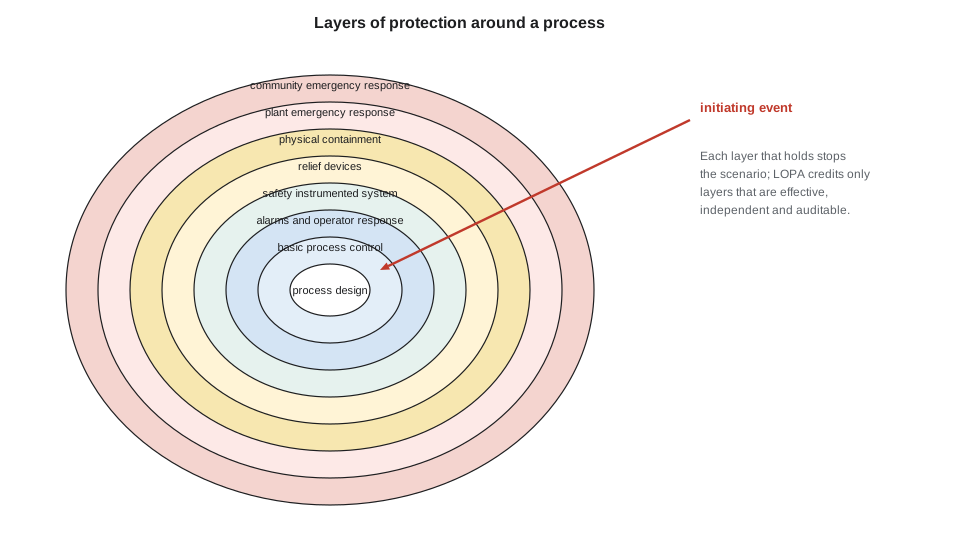
HAZOP shows what safeguards exist; it does not by itself say whether they are enough. Layer of protection analysis (LOPA) answers that semi-quantitatively for each serious scenario. It starts from an initiating event with an estimated frequency per year, then multiplies by the probability of failure on demand (PFD) of each independent protection layer (IPL), giving the mitigated event frequency, which is compared with the organization's tolerable frequency for that consequence.
To count as an IPL, a safeguard must be effective in preventing the consequence on its own, independent of the initiating event and of the other IPLs, and auditable, so that its performance can be checked. Typical PFD values used in LOPA are about 0.1 for an operator responding to an alarm with enough time, 0.1 for a basic control system function, and 0.01 to 0.001 for a safety instrumented function of safety integrity level 2 or 3. A relief valve in clean service is often credited at about 0.01.
Worked problem
LOPA for feed pump loss
Scenario: loss of deaerator level leading to feed pump damage and loss of feedwater to the boilers. Initiating event: makeup control failure, estimated at 0.1 per year. Proposed IPLs: operator response to the raised low-level alarm (PFD 0.1) and the new independent low-low level trip (PFD 0.01). The plant's tolerable frequency for this consequence is 1 × 10⁻⁴ per year. Is the risk tolerable with and without the trip?
Show solution
- Without the trip, only the alarm and operator:
- \[f = 0.1 \times 0.1 = 1 \times 10^{-2} \text{ per year}\]
- With the independent trip:
- \[f = 0.1 \times 0.1 \times 0.01 = 1 \times 10^{-4} \text{ per year}\]
- Compare with the target of 1 × 10⁻⁴ per year.
Answer: The alarm alone leaves the frequency a hundred times too high. With the independent trip, the frequency meets the target. Note that the alarm counts only because the second, independent transmitter was added: an alarm on the same transmitter as the controller would not be independent of a transmitter failure, which is one of the initiating events.
Judging risk
Many organizations use a risk matrix to rank the scenarios a study finds, with severity on one axis and likelihood on the other, and with each cell assigned to a category such as low, medium, high and very high. Each category carries an expected response: accept, reduce as far as reasonably practicable, or act before continuing. A matrix is quick and consistent but coarse, and it should be calibrated with the organization's own definitions. The principle behind it is often expressed as reducing risk as low as reasonably practicable (ALARP): beyond a certain point, the cost and effort of further reduction is grossly out of proportion to the benefit, but up to that point, risk must keep being reduced.
Worked problem
Ranking a scenario
On Cantwell's 5 × 5 matrix, likelihood is scored 1 to 5 and severity 1 to 5, and the product is used to rank. Scores of 15 and above are high, 8 to 14 medium-high, 4 to 7 medium and 1 to 3 low. Before the change, loss of deaerator level was scored likelihood 3 (has happened in the industry, near miss here) and severity 4 (serious equipment damage, plant-wide outage in winter). After the change, with the independent trip, likelihood is rescored 1. Rank both.
Show solution
- Before:
- \[3 \times 4 = 12 \quad \text{(medium-high)}\]
- After:
- \[1 \times 4 = 4 \quad \text{(medium)}\]
Answer: The change moves the scenario from medium-high to medium. The severity does not change, because a loss of feedwater would still be just as bad; the safeguards change only its likelihood. That distinction, between reducing likelihood and reducing consequence, is worth stating in every review.
Management of change
Many major accidents have followed a change that seemed small: a substituted material, a bypassed trip, a new procedure, a reorganized shift, a temporary hose. Management of change (MOC) is the discipline of reviewing changes before they are made, so that their hazards are understood and controlled and the plant's documents, training and procedures keep up with the plant.
A change is anything other than a replacement in kind, which is a replacement that satisfies the design specification, such as an identical part from the same specification. Changes include:
- Equipment and materials: new or modified equipment, different materials, different set points, changed relief devices or control logic.
- Process conditions: new operating limits, different chemicals, changed treatment programs.
- Procedures: new or revised operating, maintenance or emergency procedures.
- Software and control systems: changes to DCS logic, alarm settings or tuning, like Wendeline Achterberg's retuning of the hot water supply temperature loop on October 2 (PWR-240), which went through MOC.
- Temporary changes: jumpers, bypasses, temporary hoses, temporary supports and repairs, which must have a time limit and be removed or made permanent through MOC.
- Organizational changes: changes to staffing, shift patterns, roles and responsibilities, or the loss of experienced people, which can remove a safeguard as surely as removing a trip.
A typical MOC process has these steps: a written request describing the change and its reason; a hazard review suited to its size, from a checklist to a full HAZOP; technical review against codes and the design basis; approval by named authorities; implementation with updated drawings, procedures and training; a pre-startup safety review confirming it was done as approved; and closure once all documents are updated. Many plants also review completed MOCs to check that the change worked as intended.
For pressure equipment, MOC overlaps with the jurisdiction's rules. Changing a relief valve setting, adding a nozzle to a vessel or re-rating a boiler is an alteration that needs an R certificate holder and an inspector's approval under Ohio's rules and the NBIC, as well as the plant's own MOC. The MOC form at Cantwell has a question near the top: "Does this change affect a boiler or pressure vessel, a relief device or a safety shutdown?" A yes sends it to Grazyna and, where needed, to Ottoline and the state.
The deaerator change
The hazard review of Lorne's proposal took an evening, with Grazyna as facilitator, Lorne as proposer, Pilar as the operations representative and Okonkwo as scribe. It produced three recommendations: raise the low-level alarm as proposed; add an independent transmitter for the alarm and a new low-low level trip of the feed pumps; and revise the response procedure and train each shift on it. The MOC now goes to the November operations meeting with the review attached. If it is approved, the work will be planned for the new year, the pre-startup safety review will be done before the trip is put in service, and the P&ID, the alarm list and the procedure will be updated before the MOC is closed.
"That is what a good MOC looks like," Grazyna said. "It started as a simple set point change and it ended by finding a common-cause failure we had lived with for years. Nobody did anything wrong. We just looked carefully."
Common mistakes
MistakeTreating a set point or tuning change as too small for MOC.
InsteadChanges to alarms, trips, set points and control logic are changes; review them.
MistakeCounting two safeguards on the same transmitter as two independent layers.
InsteadIPLs must be independent of each other and of the initiating event.
MistakeLetting a temporary bypass stay in place indefinitely.
InsteadTemporary changes need a time limit and removal or a permanent MOC.
MistakeIgnoring organizational changes.
InsteadStaffing and role changes can remove safeguards; review them under MOC.
MistakeClosing an MOC before drawings, procedures and training are updated.
InsteadClose only when all documents match the plant.
MistakeTreating a risk matrix score as precise.
InsteadIt is a coarse ranking; use it to prioritize, and quantify where it matters.
Summary and key terms
- Hazard analysis identifies what can go wrong and judges whether safeguards are adequate; methods include checklists, what-if, HAZOP, FMEA, fault trees and bow-ties.
- HAZOP applies guidewords to parameters at each node to find deviations, then records causes, consequences, safeguards and recommendations.
- LOPA multiplies an initiating event frequency by the PFDs of independent protection layers and compares the result with a tolerable frequency.
- Risk matrices rank scenarios; ALARP requires reducing risk until further reduction is grossly disproportionate.
- MOC reviews every change other than replacement in kind, including procedures, software, temporary and organizational changes, through request, review, approval, implementation, PSSR and closure.
- Changes to pressure equipment also need the jurisdiction's approvals.
- Hazard
- Something with the potential to cause harm.
- Risk
- The combination of the likelihood and severity of a harmful event.
- HAZOP
- A hazard and operability study using guidewords to find deviations from design intent.
- Guideword
- A word such as more, less or reverse used in HAZOP to generate deviations.
- Independent protection layer
- A safeguard that is effective, independent and auditable, credited in LOPA.
- Probability of failure on demand
- The chance that a protective function will fail to act when needed.
- Replacement in kind
- A replacement that satisfies the design specification, not requiring MOC.
- ALARP
- As low as reasonably practicable, the principle that risk must be reduced until further reduction is grossly disproportionate.
- Common-cause failure
- A single failure that defeats more than one safeguard at once.
Practice problems
Work each problem on paper first, then reveal the answer to check.
An initiating event at 0.2 per year is protected by an alarm (PFD 0.1) and a relief valve (PFD 0.01). Mitigated frequency?
Show answer
2 × 10⁻⁴ per year.
Which HAZOP guideword would produce the deviation reverse flow?
Show answer
Reverse.
Is replacing a pump seal with an identical seal of the same specification a change under MOC?
Show answer
No; it is a replacement in kind.
Why must a temporary change have a time limit?
Show answer
So it is removed or made permanent through MOC rather than becoming permanent unreviewed.
Lesson quiz · 5 questions
Score 60% or more to complete this lesson.
Create a free account to save your progress, take quizzes and earn a certificate.