
PWR-340 · Lesson 3 of 12 · 23 min
Materials for high temperature and pressure
▶ Video coming soon A video version of this lesson is on the way.
Cantwell is a saturated-steam plant, and almost everything under pressure in it is carbon steel. Grazyna wanted Okonkwo to see why that would not be good enough in a hotter plant, so for this session she used Keswold's outage report, which Okonkwo had seen being written during his visits (PWR-320), and a box of tube samples she had kept from her years at the paper mill. "Every one of these failed because somebody, years earlier, picked a material, or a temperature, or a water chemistry that did not match," she said. "Materials are where the code's numbers meet the plant's reality."
The box held a carbon steel tube with a thick-lipped rupture from short-term overheating, a superheater tube with the fine longitudinal cracks and swelling of long-term creep, a tube section with a ragged window blown out of it by hydrogen damage, and a cracked weld joining a ferritic tube to a stainless one. Each would come up in the session.
This lesson explains how pressure equipment materials are specified and grouped, why carbon steel is replaced by alloy steels and stainless steels as temperature rises, and how high temperature changes the way metal fails. It covers creep and the Larson-Miller parameter, the main damage mechanisms of boiler and plant materials, brittle fracture and impact testing, dissimilar metal welds and bolting, and the materials of a plant like Cantwell. Values marked typical are teaching values; design values come from Section II for the material, temperature and edition.
How materials are specified
Every material in a code pressure part is identified by a specification and a grade: SA-516 Grade 70 for drum plate, SA-106 Grade B for seamless pipe, SA-178 Grade A for electric resistance welded tubes, SA-192 for seamless carbon steel boiler tubes, SA-213 T22 for chromium-molybdenum superheater tubes. The specification sets the chemical composition, the mechanical properties, the heat treatment, the tests and the marking. The material arrives with a material test report from the mill, listing the heat number, the chemistry and the test results, and the manufacturer must trace each pressure part back to its report.
For welding, materials are grouped by P-number so that a procedure qualified on one material in a group covers others in the same group (lesson 4). Carbon steels are P-No. 1, carbon-molybdenum steels P-No. 3, 1¼ chromium-½ molybdenum steels P-No. 4, 2¼ chromium-1 molybdenum steels P-No. 5A, austenitic stainless steels P-No. 8, and the creep strength enhanced ferritic steels such as Grade 91 have a group of their own, P-No. 15E.
| Material family | Typical specifications | Typical use | Typical upper range |
|---|---|---|---|
| Carbon steel | SA-516 70, SA-106 B, SA-192, SA-178 | Drums, headers, economizers, waterwalls, steam piping | about 800 °F for long-term service |
| Carbon-molybdenum | SA-209 T1 | Older superheaters and piping | about 875 °F; prone to graphitization |
| Chromium-molybdenum | SA-213 T11, T22; SA-335 P11, P22 | Superheaters, reheaters, headers, main steam piping | about 1,050 to 1,075 °F |
| Creep strength enhanced ferritic | SA-213 T91, SA-335 P91, Grade 92 | Modern superheater headers and main steam piping | about 1,110 to 1,150 °F |
| Austenitic stainless | SA-213 TP304H, TP347H | Hottest superheater and reheater tubes | about 1,200 to 1,300 °F |
Strength and temperature
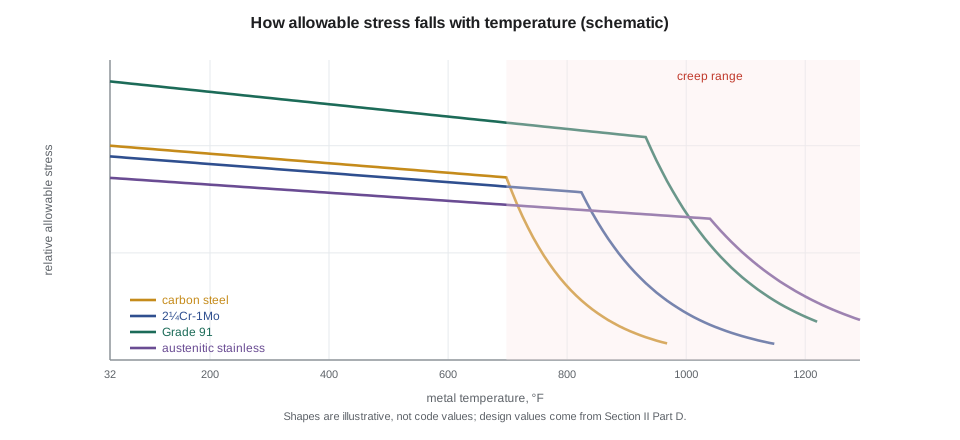
Below about 650 °F, the strength of steel changes slowly with temperature, and the allowable stress is set by the tensile and yield strength as lesson 1 described. Above that, steel begins to creep: it stretches slowly under a steady load, and the stretch continues for as long as the load and temperature last. The allowable stress at those temperatures is set by creep and rupture data, so that the part will not stretch too far or rupture within a long service life, and it falls steeply with temperature. For carbon steel the allowable stress at 930 °F is a fraction of its value at room temperature.
Alloying raises the temperature at which creep becomes important. Molybdenum strengthens steel at high temperature; chromium adds resistance to oxidation and to hydrogen attack; together they give the chromium-molybdenum steels that dominate superheaters and steam piping. Grade 91, a 9 chromium-1 molybdenum steel with small additions of vanadium and niobium, gets its creep strength from a carefully controlled microstructure created by normalizing and tempering. It allowed thinner, lighter headers and pipes in modern plants, but its strength depends on getting the heat treatment right, during manufacture and after every weld. A Grade 91 component that has been overheated or wrongly tempered can lose much of its creep strength while looking and testing normally at room temperature. Austenitic stainless steels keep their strength to higher temperatures still and resist oxidation, but they expand more, conduct heat less well and are susceptible to chloride stress corrosion cracking.
Creep and creep life
A material under creep passes through three stages. Primary creep is a short period in which the creep rate falls. Secondary creep is a long period at a nearly steady, slow rate. Tertiary creep is the final stage: voids form along the grain boundaries, join into cracks, the rate accelerates and the part ruptures. A creep failure in a superheater tube is typically thick-lipped, with the tube swollen around the rupture and many small longitudinal cracks in the oxide and metal nearby.
Creep life depends very strongly on temperature. Engineers compare combinations of time and temperature with the Larson-Miller parameter, a long-established empirical relation:
where T is the absolute metal temperature in degrees Rankine, t is the time to rupture in hours, and C is a constant, commonly taken as about 20 for steels. For a given stress, the parameter is roughly constant, so a higher temperature trades directly against a shorter life.
Worked problem
What 20 degrees does to a superheater tube
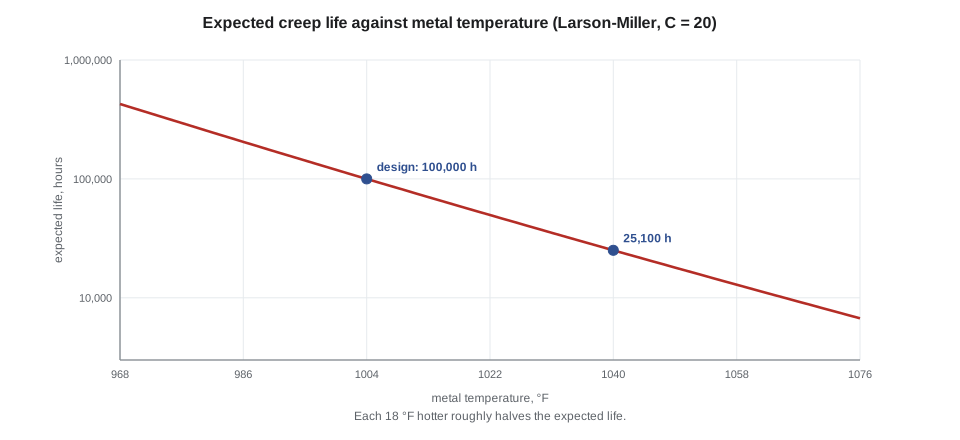
A superheater outlet tube is expected to last 100,000 h at a metal temperature of 1,004 °F under its design stress. Using the Larson-Miller parameter with C = 20, estimate its life if it runs 36 °F hotter at the same stress, for example because of internal oxide scale.
Show solution
- Parameter at the design condition, T = 1,004 + 459.67 = 1,463.67 °R:
- \[LMP = 1{,}463.67 \times (20 + \log_{10} 100{,}000) = 1{,}463.67 \times 25 = 36{,}592\]
- At 1,499.67 °R, solve for t:
- \[\log_{10} t = \frac{36{,}592}{1{,}499.67} - 20 = 24.400 - 20 = 4.400\]
- \[t = 10^{4.400} \approx 25{,}100 \text{ h}\]
Answer: Thirty-six degrees Fahrenheit cut the expected life to about a quarter, roughly three years of continuous service instead of eleven. Eighteen degrees alone would halve it, to about 49,700 h. That is why steam-side oxide, which insulates the tube and raises its metal temperature, and flame or gas temperature changes that overheat a few tubes, are watched so closely in high-temperature boilers.
Creep damage is assessed in service by measuring tube diameter for swelling, measuring wall and internal oxide thickness by ultrasonic testing, taking replicas of the surface microstructure on headers and piping to look for creep voids, and, where needed, removing a tube sample for testing. Plants with high-temperature equipment keep a record of time at temperature, because creep life is used up whether or not anyone is looking.
Other ways metals fail at temperature
- Short-term overheating occurs when a tube loses cooling, for example from low water or a blockage, and its temperature rises far above design within minutes or hours. The tube bulges and fails with a thin-edged, fish-mouth rupture. It is a failure of operation, not of material.
- Graphitization is the breakdown of the carbide in carbon and carbon-molybdenum steels into graphite nodules after long service above about 800 °F. If the graphite forms in a line, often along the heat-affected zone of a weld, the steel can crack there with little warning. It is one reason older carbon-molybdenum piping has been replaced in many plants.
- Spheroidization is a gradual change in the carbide shape in carbon steel at high temperature, which reduces strength somewhat. It is a sign of long time at temperature.
- Hydrogen damage in boilers occurs when concentrated acid or caustic under deposits corrodes the tube's inside surface. Hydrogen produced by the corrosion diffuses into the steel, reacts with carbon to form methane at the grain boundaries, and cracks the steel internally. The tube fails with a thick-edged, window-shaped piece blown out, often with little wall loss. Its cause is water chemistry and deposits, as PWR-220 explained.
- High temperature hydrogen attack is the related refinery problem in which hot, high-pressure hydrogen gas attacks carbon and low-alloy steel the same way. In 2010 a heat exchanger at the Tesoro refinery in Anacortes, Washington, ruptured from this attack, killing seven workers. The US Chemical Safety and Hazard Investigation Board (CSB) found that the carbon steel exchanger had been operating in conditions where industry guidance showed it was vulnerable, and recommended that operators use inherently safer materials rather than rely on inspection for a damage mechanism that is hard to detect.
- Temper embrittlement reduces the toughness of some low-alloy steels after long exposure in a temperature band, so that they can crack in a brittle way when cold, for example during startup or a hydrostatic test.
- Fatigue and thermal fatigue crack parts that are repeatedly loaded and unloaded, or heated and cooled. Plants that cycle, starting and stopping daily, use up fatigue life that base-load plants do not; this is one reason owners and insurers of cycling high-pressure boilers increasingly ask for an engineering review of the design and a lifetime monitoring program.
Brittle fracture and toughness
Steel that is tough at normal temperatures can become brittle when cold. Below its transition temperature, a crack can run through a plate at high speed with little energy, at stresses well below the yield strength. Brittle fracture caused the failure of welded ships in the 1940s and of storage tanks and pressure vessels since, often during a cold hydrostatic test or a cold start.
Codes deal with it through impact testing, most often the Charpy V-notch test, in which a notched bar is broken by a swinging hammer and the energy absorbed is measured. Vessels that may see low temperatures must show adequate toughness at their minimum design metal temperature (MDMT), which is stamped on the nameplate, or be built of materials and thicknesses the code exempts. For an operator, the practical rules are to keep hydrostatic tests above the minimum test temperature, to warm thick-walled equipment before pressurizing it in winter, and never to pressurize a vessel colder than its MDMT.
Dissimilar metal welds
Where a ferritic superheater tube joins a stainless steel one, the two metals expand differently. Austenitic stainless steel expands about 40 in 100 more than chromium-molybdenum steel, so every heating and cooling cycle strains the weld, and carbon migrates across the joint at temperature, weakening the ferritic side. Dissimilar metal welds are a known weak point in high-temperature boilers, and they are usually made with nickel-based filler metal, placed in lower-stress locations, and inspected on a schedule.
Worked problem
Expansion mismatch at a dissimilar weld
A 2¼ chromium-1 molybdenum tube (typical mean expansion coefficient 7.2 × 10⁻⁶ per °F) is welded to a type 304H stainless tube (typical 10.0 × 10⁻⁶ per °F). Find the difference in free expansion per foot of tube when both heat from 68 °F to 1,004 °F, and the stress if that mismatch were fully restrained (E ≈ 24.7 × 10⁶ psi at temperature, typical).
Show solution
- Strain mismatch:
- \[\Delta \varepsilon = (10.0 - 7.2) \times 10^{-6} \times (1{,}004 - 68) = 0.00262\]
- Per foot of length:
- \[0.00262 \times 12 = 0.031 \text{ in}\]
- Stress if fully restrained:
- \[\sigma = E \, \Delta\varepsilon = 24.7 \times 10^{6} \times 0.00262 \approx 64{,}700 \text{ psi}\]
Answer: In a real joint the mismatch is shared between the two tubes and the weld over a short length, so the stress is lower than this upper bound, but it is still large and it reverses with every start and stop. That is why dissimilar welds crack by thermal fatigue and creep, and why designers place them away from bends and supports.
Bolting, castings and the small parts
The materials of small parts matter as much as those of drums. Flange bolting in steam service is commonly SA-193 Grade B7 alloy steel studs with SA-194 Grade 2H nuts, chosen for strength at temperature; ordinary hardware-store bolts have no place in a pressure joint. Valve bodies are often cast steel such as SA-216 WCB, and the code limits where cast iron may be used, because it is brittle. Gaskets, packing and valve trim have their own temperature and pressure limits. A replacement part that looks the same but is made of a different material can fail where the original would not, which is why the code and the jurisdiction require replacement parts to be of the specified material, and why material traceability is part of every repair.
Cantwell's materials
Cantwell's boilers make saturated steam at about 366 °F, well below the creep range of carbon steel. Their drums are SA-516 Grade 70, their tubes SA-178, and the steam headers SA-106 Grade B, and none of them needs alloy steel. Grazyna listed the material problems that do matter in a plant like Cantwell: corrosion and oxygen pitting during layup and in condensate lines; caustic and acid attack under deposits; erosion near sootblowers and at bends; thermal fatigue at the feedwater inlets and at the economizer, if one is added; brittle fracture during cold hydrostatic tests; and the wrong material substituted during a repair.
"The material problems in a saturated plant are mostly chemistry and care," she told Okonkwo. "In a plant like Keswold, they are temperature and time as well. The engineer's license expects you to know both, because sooner or later you will work somewhere hotter."
Common mistakes
MistakeAssuming a tube rated for 100,000 h at one temperature will last 90,000 h if run a little hotter.
InsteadCreep life falls steeply with temperature; 36 °F can cut it to about a quarter.
MistakeTreating Grade 91 like an ordinary low-alloy steel during repairs.
InsteadIts creep strength depends on correct heat treatment after every weld; follow the qualified procedure exactly.
MistakeCalling a thick-lipped superheater tube rupture short-term overheating.
InsteadThick lips and swelling suggest long-term creep; thin, fish-mouth edges suggest short-term overheating.
MistakeHydrostatically testing a thick vessel with very cold water.
InsteadKeep the test above the minimum test temperature to avoid brittle fracture.
MistakeSubstituting a fitting or bolt of unknown material because it fits.
InsteadEvery pressure part must be of the specified, traceable material.
MistakeThinking hydrogen damage is a material defect.
InsteadIt is caused by water chemistry and deposits; the steel was sound.
Summary and key terms
- Pressure part materials are identified by specification and grade, traced to mill test reports, and grouped by P-number for welding.
- Carbon steel suits saturated boilers; chromium-molybdenum, Grade 91 and stainless steels serve progressively hotter parts.
- Above the creep range, allowable stress falls steeply and creep life depends strongly on temperature, as the Larson-Miller parameter shows.
- Graphitization, spheroidization, hydrogen damage, high temperature hydrogen attack, temper embrittlement and fatigue are the main long-term damage mechanisms.
- Brittle fracture is controlled by impact-tested materials, the MDMT and warm hydrostatic tests.
- Dissimilar metal welds and small parts such as bolting and castings need the right materials and inspection.
- Material test report
- The mill's certificate of the chemistry and test results for a heat of material.
- Creep
- Slow, continuing deformation of a material under steady load at high temperature.
- Larson-Miller parameter
- An empirical combination of absolute temperature and time used to compare creep lives.
- Graphitization
- Breakdown of carbide into graphite in carbon and carbon-molybdenum steels after long high-temperature service.
- Hydrogen damage
- Internal cracking of boiler tube steel by hydrogen from corrosion under deposits.
- Minimum design metal temperature
- The lowest metal temperature at which a vessel may be pressurized, stamped on its nameplate.
- Charpy impact test
- A test of toughness in which a notched bar is broken by a swinging hammer.
- Dissimilar metal weld
- A weld joining two different alloys, such as ferritic and austenitic steels.
- Replica
- A plastic film impression of a polished metal surface used to examine its microstructure in place.
Practice problems
Work each problem on paper first, then reveal the answer to check.
A tube good for 100,000 h at 1,040 °F is run at 1,067 °F. Estimate its life (C = 20).
Show answer
About 36,100 h.
Which steel family is usually chosen for superheater tubes between about 930 and 1,070 °F?
Show answer
Chromium-molybdenum steel such as T22.
A superheater tube shows a swollen, thick-lipped rupture with many small cracks nearby. Likely cause?
Show answer
Long-term creep.
What does MDMT on a nameplate tell an operator?
Show answer
The lowest metal temperature at which the vessel may be pressurized.
Lesson quiz · 5 questions
Score 60% or more to complete this lesson.
Create a free account to save your progress, take quizzes and earn a certificate.