
PWR-340 · Lesson 6 of 12 · 23 min
Piping codes and pressure piping
▶ Video coming soon A video version of this lesson is on the way.
Most of the pressure equipment at Cantwell is not boilers or vessels but pipe: the steam headers in the boiler house, the feedwater and blowdown lines, the fuel gas train, the condensate returns, and miles of steam and hot water distribution mains in the tunnels and vaults under downtown streets. Fenella's crew spends more of its time on piping than on anything else, and most of the plant's leaks, water hammer events and support problems are in the pipe.
For this session Grazyna unrolled the piping and instrument diagram for the boiler 2 steam outlet and blowdown connections on the control room table. "Draw me the code boundaries," she said to Okonkwo. "Show me where Section I stops and B31.1 starts, where B31.1 stops and the customer's building code starts, and what changes at each line. Then we will talk about why the pipe is as thick as it is, and what keeps it from tearing itself off its supports."
This lesson covers the piping codes and their scopes, the boundary between boiler external piping and other power piping, pipe sizes and schedules, the pressure design of pipe, flanges, fittings, valves and gaskets, thermal expansion and the flexibility, supports and anchors that manage it, water hammer, and the testing and inspection of piping. It works examples on pipe wall thickness and thermal expansion. As in lesson 2, the thickness relation is a teaching form; B31.1 and B31.3 publish their own formulas.
The piping codes
Piping in a boiler plant is built to one of the ASME B31 books, chosen by service and location:
- B31.1, Power Piping, covers piping in electric generating stations, industrial and institutional plants, and central and district heating plants: steam, feedwater, blowdown, fuel, air and similar services. Cantwell's plant piping is B31.1.
- B31.3, Process Piping, covers piping in refineries, chemical, pharmaceutical, food and similar plants. It classifies fluids by hazard and sets stricter rules for toxic and high-pressure services.
- B31.5 covers refrigeration piping, B31.9 building services piping inside buildings at moderate pressures and temperatures, and B31.8 gas transmission and distribution piping.
Ohio's boiler rules cover boilers and the piping the boiler code treats as part of them; other plant piping is built to the B31 code that the owner's specification, the state's mechanical code or the insurer requires. Fuel gas piping on the burner side of the meter falls under the fuel gas code the state and city adopt and the burner standards rather than B31.1. Steam and hot water distribution piping in a district energy system, such as Cantwell's mains to its customers, is designed to B31.1 or to standards the owner and the jurisdiction accept for it.
Boiler external piping
The boundary between the boiler code and the piping code is drawn by Section I. Boiler proper piping is part of the boiler itself. Boiler external piping (BEP) runs from the boiler's connections to and including the required valves: for a steam outlet, the stop valve or valves; for feedwater, the stop and check valves; for blowdown, the blowoff valves; and similarly for drains, vents and water column connections. BEP is administered under Section I, which means it is inspected by the Authorized Inspector and recorded on a data report, but it is designed and built to B31.1's technical rules. Beyond the BEP valves, the piping is non-boiler external piping, built and administered under B31.1 alone.
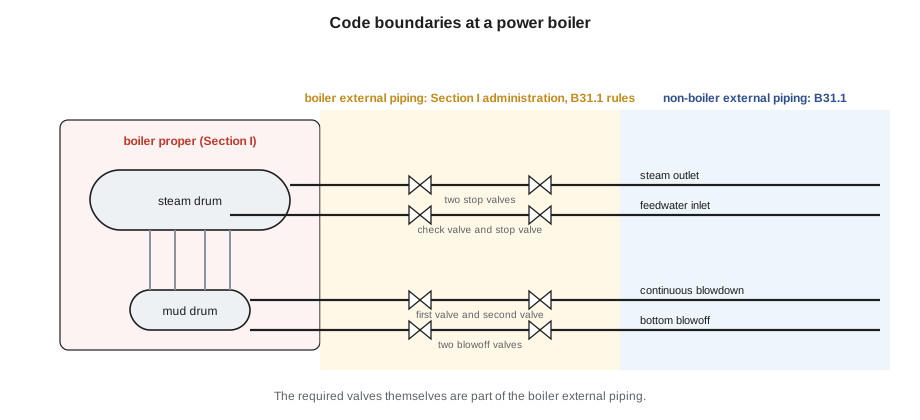
The distinction matters in a repair. Replacing the section of boiler 2's continuous blowdown line between the drum and the second valve (lesson 4) is a repair to BEP, so it falls under the boiler rules and needs the inspector's acceptance. Replacing the line beyond the second valve to the flash tank is a repair to non-boiler piping, still under B31.1 and the jurisdiction's piping rules but with different paperwork.
Pipe sizes and schedules
Pipe is identified by nominal pipe size (NPS) and schedule. For NPS 14 and above, the nominal size is the outside diameter in inches; below that, the outside diameter is a fixed value that is close to, but not equal to, the nominal size: NPS 6 pipe, for example, has an outside diameter of 6.625 in. The schedule number fixes the wall thickness for each size: Schedule 40, Schedule 80 and so on, with older designations such as standard (STD), extra strong (XS) and double extra strong (XXS). Because the outside diameter stays the same for each size, a thicker schedule has a smaller bore. Metric designations (DN) correspond to the NPS sizes.
Common boiler plant pipe is SA-106 Grade B seamless carbon steel or SA-53 Grade B, which may be seamless or welded. Seamless pipe may be thinner than its nominal wall by up to 12.5 in 100 under its specification, so the minimum, not the nominal, wall must meet the design. Threaded pipe loses the depth of its threads, and grooved pipe the depth of its grooves, which the design must also allow for.
Pressure design of pipe
Pipe under internal pressure is a thin cylinder, and its pressure thickness follows the same hoop stress idea as lesson 2, usually written with the outside diameter because that is fixed for each size. The teaching form is:
where c covers corrosion, erosion and thread or groove depth, and the division by 0.875 allows for the 12.5 in 100 mill tolerance. B31.1's own formula adds a temperature-dependent coefficient and other refinements; the allowable stress comes from its own tables, which for most materials match Section II.
Worked problem
Wall thickness of the steam header
Cantwell's boiler house steam header is NPS 6 (6.625 in OD) SA-106 Grade B seamless pipe, Schedule 40 (nominal wall 0.280 in). Using the MAWP of 200 psi, a typical allowable stress of 17,100 psi, E = 1.0 for seamless pipe and a 1/16 in corrosion allowance, find the minimum nominal wall the teaching form needs, and the hoop stress in the Schedule 40 wall at the MAWP.
Show solution
- Pressure thickness:
- \[t = \frac{200 \times 6.625}{2 \times 17{,}100 \times 1.0} = \frac{1{,}325}{34{,}200} = 0.039 \text{ in}\]
- Add the allowance and the mill tolerance:
- \[t_{nominal} \geq \frac{0.039 + 0.0625}{0.875} = \frac{0.101}{0.875} = 0.116 \text{ in}\]
- Hoop stress in Schedule 40 at the MAWP:
- \[\sigma = \frac{200 \times 6.625}{2 \times 0.280} = 2{,}370 \text{ psi}\]
Answer: Pressure needs about 0.12 in of nominal wall; Schedule 40 supplies 0.280 in (0.245 in at its minimum). At this pressure, the wall is set less by pressure than by the need to carry weight between supports, resist the bending stresses of thermal expansion and water hammer, and give margin for erosion and corrosion over decades. In high-pressure plants the balance changes and pressure governs.
Flanges, fittings, valves and gaskets
Flanges, valves and fittings are not designed piece by piece. They are made to standards that give their dimensions and pressure-temperature ratings. ASME B16.5 covers steel pipe flanges and flanged fittings in classes such as 150, 300, 600 and 900; each class has a rated working pressure that falls as temperature rises and depends on the material group. A Class 150 flange is not rated for 150 psi at all temperatures; its rating at Cantwell's steam temperature is lower than its rating at room temperature, and the designer reads the rating from the standard for the material and temperature. Butt-welding fittings follow B16.9, socket-welding and threaded fittings B16.11, and valves B16.34.
Gaskets must suit the fluid, pressure, temperature and flange faces. Spiral wound gaskets, made of metal strip wound with graphite or other filler, are common in steam service on raised-face flanges. Ring-type joints are used at high pressures. A gasket is a one-use part: once compressed and heated, it will not seal properly again. Bolting must be of the specified material and tightened in a cross pattern to the specified torque or tension, in stages, so that the flange faces close evenly. Most flange leaks come from uneven tightening, the wrong gasket or damaged faces, not from the pipe.
Valves are chosen for their job: gate valves for isolation, fully open or fully shut; globe valves for throttling; check valves to prevent backflow; ball and butterfly valves for quick operation; and special blowoff valves for boiler blowdown, which must be of a type the boiler code allows. A gate valve used to throttle will have its seat and wedge cut away by the high-velocity flow. Stop valves on boiler outlets that can be isolated from another boiler in service must be arranged as the code requires, usually two valves with a drain between them, so that a boiler being worked on cannot be pressurized by its neighbors.
Thermal expansion and flexibility
Pipe grows when heated. A steel steam line warming from cold to operating temperature lengthens by about 0.8 in per 100 ft for every 100 °F of temperature rise, and a long line grows by many centimeters. If the growth is not allowed for, it bends the pipe, overloads its supports and equipment nozzles, and pulls joints apart.
Worked problem
Growth of a distribution main
A 200 ft run of steam main in a tunnel heats from 68 °F to the steam temperature of 366 °F. Taking α = 6.67 × 10⁻⁶ per °F (typical for carbon steel over this range), how much does it grow?
Show solution
- \[\Delta L = 6.67 \times 10^{-6} \times (200 \times 12) \times (366 - 68) = 4.77 \text{ in}\]
Answer: Nearly 5 in of movement must be taken up by an expansion loop, offsets, bends or an expansion joint between anchors. The loop in Cantwell's tunnel that Fenella showed Tamar in October (PWR-210) does exactly this job.
Designers manage expansion in several ways:
- Flexibility: routing the pipe with bends, offsets and loops so that it can bend elastically as it grows. B31.1 requires a flexibility analysis to show that the expansion stresses and the loads on equipment nozzles are within limits.
- Anchors, which fix the pipe at chosen points so that expansion goes where the designer intends, and guides, which keep the pipe moving along its axis.
- Expansion joints, bellows or slip types, which absorb movement in a short length but must be properly anchored and guided, because pressure acting on a bellows produces a large pressure thrust that tries to push the pipe apart.
- Cold spring: cutting a line short and pulling it into place cold, so that the hot stress is reduced. It must be documented, because it changes the cold and hot positions.
Supports carry the weight of the pipe, its contents and insulation. Rigid supports hold a line where it does not move vertically. Spring hangers carry a line that moves vertically as it heats; variable spring hangers change their load slightly as they move, and constant support hangers keep the load almost constant over their travel. Each spring hanger has a scale showing its cold and hot positions, and a set of travel stops used only during erection and hydrostatic testing. A hanger left locked, bottomed out or topped out is no longer supporting the line as designed. Walking down the hangers hot and cold, and recording their positions, is a simple check that finds many piping problems early.
Water hammer and drainage
PWR-230 explained the causes of water hammer in steam lines: condensate picked up by fast-moving steam and slammed into a fitting, steam collapsing into cold condensate, and sudden valve closures in water lines. Its effect on the piping code is direct: a water hammer pressure surge can exceed the pipe's design pressure many times over, and the impact loads on elbows and supports are not in the normal design. The defenses are design and operation together: lines sloped in the direction of flow with drip legs and traps at low points and before risers; warm-up valves and drains used during startup; slow opening of steam valves; and in water lines, slow-closing valves and surge protection.
Grazyna had one rule above all for steam mains. "Never open a steam valve into a cold line that has not been drained. The pipe does not care that you are in a hurry."
Testing and inspecting piping
New or repaired piping is pressure tested before use. B31.1 normally requires a hydrostatic test at 1.5 times the design pressure, held long enough to examine every joint. Where water cannot be used, a pneumatic test at a lower multiple may be allowed with special precautions, because the energy stored in compressed gas makes a failure far more violent. For Cantwell's steam header, designed for 200 psi, a hydrostatic test would be at 300 psi.
In service, piping is inspected for wall thinning by ultrasonic thickness readings at selected points, for external corrosion under insulation where water can get in, for support and hanger condition, for leaks and for signs of water hammer. Hot tapping, welding a connection onto a line in service, needs a qualified procedure, a review of the line's wall thickness and the fluid, and acceptance by the owner's engineer and, where the rules require, the inspector. Lesson 7 describes how inspection programs decide where and how often to look.
Common mistakes
MistakeTreating NPS as the outside diameter for all pipe sizes.
InsteadBelow NPS 14, the outside diameter is a fixed value that differs from the nominal size.
MistakeUsing nominal wall thickness to check seamless pipe.
InsteadAllow for the mill tolerance; the minimum wall must meet the design.
MistakeAssuming a flange class is its pressure rating at all temperatures.
InsteadRatings fall with temperature and depend on material; read the standard.
MistakeReusing a spiral wound gasket.
InsteadGaskets are single-use; fit a new one of the right type.
MistakeLeaving spring hanger travel stops in after a hydrostatic test.
InsteadRemove them before startup, or the hanger cannot follow the line.
MistakeThrottling with a gate valve.
InsteadUse a globe or control valve; gate valves are for full open or full shut.
Summary and key terms
- B31.1 covers power and district heating plant piping; B31.3 process plants; B31.5, B31.9 and B31.8 other services.
- Boiler external piping, up to and including the required valves, is administered by Section I and built to B31.1.
- Pipe is identified by NPS and schedule; the outside diameter is fixed for each size, and seamless pipe has a 12.5 in 100 mill tolerance.
- Pressure thickness follows the hoop stress relation; at low pressures, weight, expansion stress and corrosion often govern.
- Flanges, fittings and valves are made to standards with pressure-temperature ratings; gaskets and bolting must be correct and tightened evenly.
- Thermal expansion is managed by flexibility, anchors, guides, expansion joints and supports, including spring hangers.
- Piping is pressure tested at 1.5 times design pressure, drained and warmed carefully, and inspected for thinning and support condition.
- Boiler external piping
- Piping from a power boiler to and including its required valves, administered under Section I.
- Nominal pipe size
- The standard size designation of a pipe, fixing its outside diameter.
- Schedule
- A number fixing a pipe's wall thickness for its size.
- Pressure-temperature rating
- The working pressure allowed for a flange, valve or fitting at each temperature.
- Spiral wound gasket
- A gasket of metal strip wound with a soft filler, common in steam service.
- Flexibility analysis
- A calculation of the stresses and loads produced by thermal expansion in a piping system.
- Anchor
- A support that fixes a pipe at a point so expansion is directed elsewhere.
- Constant support hanger
- A spring hanger that keeps its load nearly constant over its travel.
- Pressure thrust
- The force produced by pressure acting on the effective area of an expansion joint.
Practice problems
Work each problem on paper first, then reveal the answer to check.
NPS 4 pipe has an OD of 4.500 in. Find its pressure thickness at 150 psi with S = 17,100 psi, E = 1 (teaching form).
Show answer
150 × 4.5 ÷ 34,200 = 0.020 in.
A 130 ft line heats from 60 °F to 390 °F (α = 6.67 × 10⁻⁶ per °F). Growth?
Show answer
About 3.4 in.
A line is designed for 230 psi. What is its B31.1 hydrostatic test pressure?
Show answer
345 psi.
Which valve type is right for throttling flow?
Show answer
A globe valve.
Lesson quiz · 5 questions
Score 60% or more to complete this lesson.
Create a free account to save your progress, take quizzes and earn a certificate.