
PSYC-104 · Lesson 9 of 12 · 18 min
Consciousness, sleep and dreams
▶ Video coming soon A video version of this lesson is on the way.
In week nine, the class's sleep data from the first day comes back. Navarro has kept track of the anonymous reports the students have posted each morning since, and she shows the results: the average student in the section slept just under 6 hours and 40 minutes on weeknights and more than 8 hours on weekends. 'That pattern has a name,' she says. 'Researchers call it social jet lag. Many of you are flying from New York to Los Angeles every weekend and back every Monday, without leaving town.' Ruth, who works evening shifts, says her schedule is worse. This week is about consciousness, and sleep is its most familiar change of state.
What is consciousness?
Consciousness is our awareness of ourselves and our environment. It includes sensations, thoughts, feelings and the sense of being a self who has them. William James described it as a continuous stream, always changing yet felt as one. For decades, behaviorists considered consciousness too private to study scientifically, but it returned to psychology with the cognitive revolution, and today researchers use brain imaging, sleep recordings and careful experiments to study it.
Much mental activity happens outside awareness. Psychologists describe a dual-processing mind with two tracks. One is slow, deliberate and conscious, used for solving a new problem or following directions in an unfamiliar city. The other is fast, automatic and largely unconscious, used for reading familiar words, recognizing faces and driving a familiar route. A person can drive home and arrive with little memory of the trip, because the automatic track handled it while the conscious track was busy elsewhere. Lesson 12 returns to this distinction in thinking and decision making.
Consciousness varies in level. Navarro describes a range of states, from alert wakefulness through daydreaming, drowsiness and sleep to the altered states produced by meditation, hypnosis and drugs, and finally the reduced consciousness of anesthesia and coma. This lesson focuses on sleep, the state everyone enters every day.
Biological rhythms
The body runs on a circadian rhythm, a roughly 24-hour cycle of body temperature, alertness, hormone release and sleepiness. The rhythm is controlled by the suprachiasmatic nucleus, a small cluster of neurons in the hypothalamus. Light reaching the eyes signals to the suprachiasmatic nucleus, which adjusts the rhythm to the day. In the evening, as light fades, it signals the pineal gland to release melatonin, a hormone that promotes sleepiness. Bright light in the evening, including light from screens, can delay melatonin release and push sleep later.
People differ in their timing. Some are morning types, who wake easily and do their best work early; others are evening types. Adolescents and young adults tend to shift later, with their rhythms often peaking in the evening, which is one reason early classes and early school start times are hard for many students. With age, most people shift back toward mornings. Jet lag and shift work disrupt the rhythm by putting sleep at the wrong time for the internal clock, and long-term night shift work is associated with sleep problems and other health risks.
The stages of sleep
In 1953, Eugene Aserinsky and Nathaniel Kleitman at the University of Chicago noticed that sleepers' eyes periodically darted back and forth beneath their eyelids. When woken during these periods of rapid eye movement, or REM sleep, people usually reported vivid dreams. Researchers now study sleep by recording brain waves with EEG, eye movements and muscle tension through the night.
Sleep is divided into REM sleep and three stages of non-REM sleep. As a person drifts off, the alert beta waves of waking give way to the slower alpha waves of relaxation and then to stage N1, a light sleep that lasts a few minutes, during which people may feel they are falling or see fleeting images. Stage N2 is a deeper sleep marked by bursts of rapid brain wave activity called sleep spindles; adults spend about half the night in it. Stage N3 is deep, slow-wave sleep dominated by large, slow delta waves; it is hard to wake someone from it, and it is the stage in which growth hormone is released.
After N3, the sleeper climbs back through N2 and enters REM sleep. During REM, the brain is highly active, heart rate and breathing become irregular, and the eyes move rapidly, but the large muscles of the body are paralyzed, which keeps people from acting out their dreams. Because the brain is so active while the body is still, REM is sometimes called paradoxical sleep.
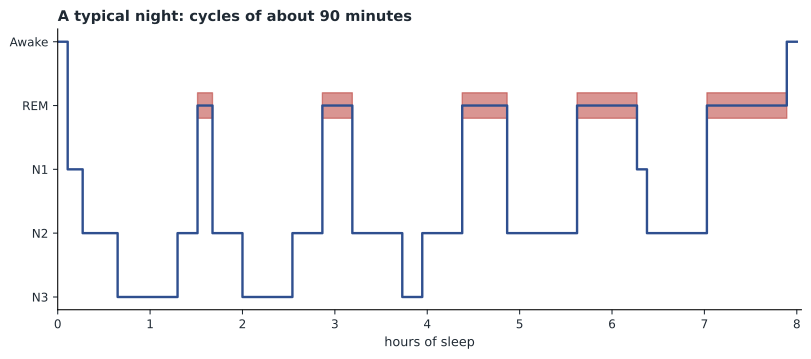
A full cycle through the stages takes about 90 minutes, so a typical night includes four to six cycles. Their content changes: deep N3 sleep is concentrated in the first half of the night, while REM periods get longer toward morning, the last ones lasting up to an hour. Someone who cuts sleep short by waking early therefore loses mostly REM sleep, and someone who stays up late loses some of both.
Why we sleep
Every mammal and bird studied sleeps, which suggests that sleep serves important functions. Several have been proposed, and they are not mutually exclusive. Sleep may have protected ancestors by keeping them still and hidden at night, when they could not see well. It helps the brain recover: during sleep, the space between brain cells appears to widen, allowing fluid to clear away waste products that build up during waking. Sleep supports memory, as lesson 11 describes: during deep sleep, the brain replays and strengthens new memories, and people who sleep after learning remember more than people who stay awake for the same period. Sleep also supports growth, immune function and the regulation of appetite.
The American Academy of Sleep Medicine and the Sleep Research Society recommend that adults sleep 7 or more hours a night on a regular basis, and that teenagers sleep 8 to 10 hours. Many people get less. Sleep deprivation impairs attention, reaction time and judgment, and it makes people more irritable and more likely to feel low. Drowsy driving contributes to many crashes; after about 18 hours awake, performance on driving tests can resemble that of a person with a blood alcohol level near the legal limit. Chronic short sleep is linked to weight gain, high blood pressure and a weakened immune response. Because these are mostly correlational findings, some of the association may run the other way, but experiments in which people are kept short of sleep show many of the same effects.
Navarro tells the story of Randy Gardner, a high school student in San Diego who stayed awake for 264 hours, about 11 days, in 1964 as a science project. By the end he had trouble concentrating, speaking and remembering, and he had brief hallucinations. He then slept for about 14 hours and recovered. Researchers do not repeat such experiments today, and sleep researchers point out that most of the harm from sleep loss comes not from rare extreme cases but from the everyday shortfall many people live with for years.
Sleep disorders
Insomnia is persistent difficulty falling or staying asleep. Occasional sleepless nights are normal; insomnia is diagnosed when problems persist for months and affect daytime functioning. Sleeping pills can help in the short term, but they can reduce deep sleep and lead to tolerance. The recommended first treatment for chronic insomnia is cognitive behavioral therapy for insomnia, which uses techniques such as keeping a regular wake time, getting out of bed when unable to sleep and changing worries about sleep, and its benefits tend to last after treatment ends.
Obstructive sleep apnea is a disorder in which the airway repeatedly collapses during sleep, stopping breathing for seconds at a time until the sleeper briefly wakes, often without knowing it, sometimes hundreds of times a night. It is most common in people who are overweight and in older men, and it causes loud snoring, daytime sleepiness and higher risk of heart disease. It is often treated with a machine that keeps the airway open with gentle air pressure. Narcolepsy is a rarer disorder in which people experience overwhelming sleepiness and may suddenly fall into REM sleep, sometimes with a sudden loss of muscle tone triggered by strong emotion.
Some disorders happen in deep sleep. Sleepwalking and night terrors, in which a person sits up screaming in apparent terror but has no memory of it in the morning, usually occur during N3 sleep early in the night, are most common in children and tend to run in families. Because they occur outside REM, they are not acted-out dreams.
Dreams
Most dreams occur during REM sleep, though people also report thought-like dreaming in non-REM stages. Typical REM dreams are emotional, visual and story-like, and their content is often ordinary: everyday places, familiar people, worries and recent events. Negative emotions are common. Most dreams are forgotten within minutes of waking unless the sleeper wakes during or right after them.
Several theories try to explain why we dream. Freud proposed that dreams disguise unconscious wishes, but this view has little scientific support and is hard to falsify. The activation-synthesis theory, proposed by J. Allan Hobson and Robert McCarley in 1977, holds that dreams are the brain's attempt to make sense of random neural activity from the brainstem during REM. Information-processing theories suggest that dreams reflect the brain sorting and consolidating the day's experiences, which fits evidence that REM sleep supports some kinds of learning. Cognitive theories describe dreaming as a form of thinking that draws on the dreamer's concerns and knowledge. Many researchers now combine elements of several views.
When people are deprived of REM sleep, they show REM rebound: on the next nights, they enter REM sooner and spend more time in it. The same happens after some medications that suppress REM are stopped. This suggests that REM sleep meets a real need, even if what that need is remains debated.
Hypnosis and psychoactive drugs
Hypnosis is a social interaction in which one person suggests changes in another's perceptions, feelings, thoughts or behavior. People vary widely in how responsive they are. Hypnosis can help relieve pain and is used as part of some treatments, but it does not uncover accurate hidden memories; hypnotized people are more confident in their recollections without being more accurate, and suggestions during hypnosis can create false memories. Researchers debate whether hypnosis is a special altered state or an intense form of focused attention and social role-playing.
Psychoactive drugs are chemicals that change perception, mood and consciousness by acting at synapses, as lesson 4 described. Depressants, such as alcohol, benzodiazepines and opioids, slow nervous system activity; alcohol impairs judgment and memory formation, and combining depressants can dangerously suppress breathing. Stimulants, such as caffeine, nicotine, cocaine and amphetamines, increase arousal and activity, often by increasing dopamine and norepinephrine. Hallucinogens, such as LSD and psilocybin, distort perception; some are now being studied in carefully controlled clinical trials. Cannabis has mixed effects, including relaxation, altered perception and impaired short-term memory and coordination. In the United States, cannabis remains illegal under federal law, while many states have legalized it for medical or adult use. Repeated use of many drugs produces tolerance, needing more to get the same effect, and dependence, in which stopping causes withdrawal.
Common mistakes
MistakeEveryone needs exactly 8 hours of sleep.
InsteadNeeds vary; guidelines for adults recommend about 7 to 9 hours, and teenagers need more.
MistakeThe brain shuts off during sleep.
InsteadThe brain is active throughout sleep, especially during REM.
MistakeSleepwalkers are acting out their dreams.
InsteadSleepwalking happens in deep non-REM sleep, not during REM dreaming.
MistakeHypnosis can recover accurate buried memories.
InsteadHypnosis increases confidence, not accuracy, and can create false memories.
Summary and key terms
- Consciousness is awareness of oneself and the environment; much processing happens automatically outside awareness.
- The circadian rhythm is regulated by the suprachiasmatic nucleus, light and melatonin.
- Sleep cycles about every 90 minutes through N1, N2, N3 and REM; deep sleep comes early and REM late.
- Sleep supports memory, waste clearance, growth and immune function; deprivation impairs attention and judgment.
- Insomnia is best treated first with cognitive behavioral therapy; sleep apnea and narcolepsy are other major disorders.
- Dream theories include activation-synthesis and information processing; REM rebound suggests REM meets a need.
- Hypnosis increases suggestibility; depressants, stimulants and hallucinogens alter consciousness by acting at synapses.
- Circadian rhythm
- A roughly 24-hour biological cycle of alertness, temperature and hormones.
- Melatonin
- A hormone released by the pineal gland that promotes sleepiness.
- REM sleep
- A stage of sleep with rapid eye movements, vivid dreams and paralyzed large muscles.
- Sleep apnea
- A disorder in which breathing repeatedly stops during sleep.
- Activation-synthesis theory
- The view that dreams are the brain's interpretation of random neural activity during REM.
- Tolerance
- The need for larger doses of a drug to produce the same effect.
Practice problems
Work each problem on paper first, then reveal the answer to check.
About how long is a sleep cycle, and how many occur in a typical night?
Show answer
About 90 minutes; four to six cycles.
Why does waking early cut REM sleep more than deep sleep?
Show answer
Deep N3 sleep is concentrated early in the night, while REM periods are longest toward morning.
What is the recommended first treatment for chronic insomnia?
Show answer
Cognitive behavioral therapy for insomnia.
Name the three main classes of psychoactive drugs with an example of each.
Show answer
Depressants such as alcohol; stimulants such as caffeine; hallucinogens such as LSD.
Habits for better sleep
Navarro ends the sleep section with practical advice, drawn from research on sleep hygiene and on cognitive behavioral therapy for insomnia. Keeping a consistent wake time, including on weekends, is the most powerful single habit, because it anchors the circadian rhythm; it also reduces the social jet lag the class's data showed. Morning daylight helps set the clock, and dimming lights and screens in the hour before bed helps melatonin rise. Caffeine can affect sleep for many hours after it is consumed, so an afternoon coffee may still be active at bedtime. Alcohol can make people fall asleep faster but fragments sleep later in the night and suppresses REM. Regular exercise improves sleep, though vigorous exercise right before bed can delay it for some people.
For students, the evidence on all-night studying is clear. Because sleep consolidates memory, a student who sleeps after studying will usually remember more than one who stays up to study for the same number of extra hours. Ruth asks about shift workers like her. Navarro suggests keeping her sleep window as consistent as her schedule allows, darkening her bedroom fully during daytime sleep and protecting a short nap before evening shifts, while noting that some people adapt to shift work much better than others.
Lesson quiz · 5 questions
Score 60% or more to complete this lesson.
Create a free account to save your progress, take quizzes and earn a certificate.