
PSYC-104 · Lesson 7 of 12 · 18 min
Sensation: how the senses gather information
▶ Video coming soon A video version of this lesson is on the way.
At the start of week seven, Navarro turns off the lecture hall lights and asks the class to raise a hand when they first see the dot she projects on the screen. She starts with a dot so faint it is invisible and slowly brightens it. Hands go up over several seconds, not all at once, and a few students raise and lower their hands as they change their minds. 'You have just run a classic experiment in psychophysics,' she says. 'And you have already discovered two of its main findings: detection is not all-or-none, and people differ.'
Sensation is the process by which sense organs and the nervous system receive energy from the environment and represent it as neural signals. Perception, the subject of lesson 8, is the process of organizing and interpreting those signals to recognize meaningful objects and events. In practice the two blend together, but the distinction is useful. This lesson follows information from the outside world to the brain; the next asks what the brain makes of it.
From energy to neural signals
Each sense has receptors, specialized cells that respond to a particular kind of energy: light for vision, pressure waves in air for hearing, chemicals for taste and smell, and pressure, temperature and tissue damage for the skin senses. The conversion of one form of energy into the electrical signals neurons use is called transduction. After transduction, signals travel along nerves to the brain, where most of them pass through the thalamus on the way to the relevant area of the cortex.
Our senses detect only a small part of the energy around us. Human eyes respond to a narrow band of electromagnetic radiation, wavelengths from about 400 to 700 nanometers, which we call visible light. Bees see ultraviolet light, snakes sense infrared heat, and dogs hear pitches far above the human range. Each species' senses are tuned to the information most useful for its way of life.
Thresholds
Psychophysics, founded by Gustav Fechner in the 1800s, studies the relationship between the physical properties of stimuli and our experience of them. The absolute threshold is the minimum intensity of a stimulus that a person can detect half the time. The classroom demonstration showed why it is defined that way: near the threshold, detection is a matter of probability, not a sharp line.
Signal detection theory, developed in the 1950s, adds that detection depends on more than the stimulus. A radiologist looking for a small tumor on a scan, a lifeguard scanning the water and a student listening for their name in a noisy cafeteria are all trying to separate a signal from background noise, and each also brings expectations, motivation and fatigue. If missing a signal is costly, people say 'yes' more readily, catching more real signals but also producing more false alarms. The theory describes four outcomes: hits, misses, false alarms and correct rejections.
| Signal present | Signal absent | |
|---|---|---|
| Person says yes | Hit | False alarm |
| Person says no | Miss | Correct rejection |
Stimuli below the absolute threshold are called subliminal. Laboratory studies show that brief, masked images or words can slightly and briefly influence judgments, a process called priming. But claims that hidden messages in advertisements, films or music can make people buy products or change their behavior have not held up; the most famous claim, about a cinema flashing 'eat popcorn' in the 1950s, was later admitted to have been invented.
The difference threshold and Weber's law
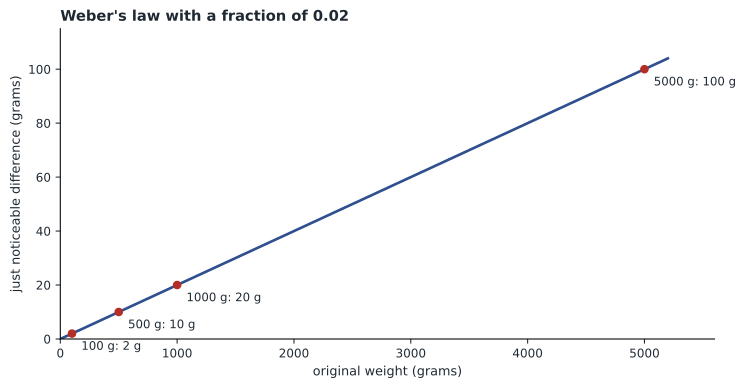
The difference threshold, or just noticeable difference, is the smallest change in a stimulus that a person can detect half the time. In the 1830s, Ernst Weber found that the difference threshold is not a fixed amount but a constant proportion of the original stimulus. This is Weber's law. For lifted weights, people need a change of about one-fiftieth to notice a difference; for the brightness of light, a change of roughly one-sixtieth to one-tenth, depending on conditions; for the pitch of a tone, a much smaller fraction.
In the equation, I is the original intensity, delta I is the just noticeable difference and k is Weber's fraction, a constant for each sense. Owen sees the practical side: a price increase from 1 to 2 dollars is noticed by everyone, while the same one-dollar increase on a 500-dollar phone goes almost unnoticed. Marcus calculates the just noticeable difference for several weights using a Weber fraction of 0.02.
k = 0.02   # Weber fraction for lifted weights (about one-fiftieth)
for grams in [100, 500, 1000, 5000]:
print(f"original weight {grams:5} g -> noticeable change about {k * grams:5.0f} g")original weight 100 g -> noticeable change about 2 g original weight 500 g -> noticeable change about 10 g original weight 1000 g -> noticeable change about 20 g original weight 5000 g -> noticeable change about 100 g
Sensory adaptation
Sensory adaptation is a reduced sensitivity to a constant stimulus. Within minutes of entering a room with a strong smell, people stop noticing it; the watch on a wrist or the chair underneath is felt only when attention turns to it. Adaptation lets the nervous system focus on change, which usually carries the most important information. Even vision adapts. The eyes make tiny, constant movements; when researchers use special equipment to hold an image perfectly still on the retina, it fades from view within seconds.
Vision
Light enters the eye through the cornea, a clear protective layer that begins to bend the light, then passes through the pupil, an opening whose size is controlled by the colored muscle of the iris. The lens changes shape to focus the image on the retina, the light-sensitive layer at the back of the eye. Because of the optics, the image on the retina is upside down and reversed, and the brain interprets it correctly.
The retina contains two kinds of photoreceptors. Rods, about 120 million per eye, detect dim light and are responsible for black-and-white and peripheral vision. Cones, about 6 million per eye, are concentrated in the fovea, the central point of sharpest vision, and detect fine detail and color in good light. This is why it is hard to see color at night, and why astronomers look slightly to the side of a faint star: its light then falls on the rod-rich periphery. The photoreceptors pass signals through other retinal cells to ganglion cells, whose axons gather to form the optic nerve. Where the optic nerve leaves the eye there are no receptors, creating a blind spot that we do not notice because the brain fills in the gap and the two eyes cover for each other.
Two theories of color vision, once seen as rivals, are now known to describe different stages. The trichromatic theory, developed by Thomas Young and Hermann von Helmholtz, holds that the retina has three kinds of cones, most sensitive to short, medium and long wavelengths, roughly blue, green and red; all colors we see come from combinations of their responses. People who lack one type of cone have a color vision deficiency, most often difficulty telling red from green, which affects about 1 in 12 men and 1 in 200 women of northern European ancestry. The opponent-process theory, proposed by Ewald Hering, holds that later in the visual system, neurons respond in opposing pairs: red versus green, blue versus yellow and black versus white. It explains afterimages: stare at a red square for half a minute, look at a white wall and a green square appears.
Information from the two eyes is split and recombined on the way to the brain. At the optic chiasm, fibers from the half of each retina nearer the nose cross to the other side, so the left half of the visual field, seen by both eyes, is processed in the right hemisphere and the right half in the left, the arrangement that made the split-brain experiments in lesson 5 possible. From there, signals pass through the thalamus to the primary visual cortex in the occipital lobe.
In the visual cortex, cells respond to specific features. In work that earned the 1981 Nobel Prize, David Hubel and Torsten Wiesel found that individual neurons in a cat's visual cortex fire in response to lines and edges at particular angles. These feature detectors pass information to areas that respond to more complex patterns. One region of the temporal lobe responds strongly to faces; damage there can cause face blindness, a difficulty recognizing even familiar people by their faces.
Hearing
Sound is a wave of changing air pressure. The frequency of the wave, measured in hertz, determines pitch: humans hear from about 20 to 20,000 hertz when young, with the upper limit falling with age. The amplitude determines loudness, measured in decibels, a logarithmic scale on which every increase of 10 decibels means ten times the sound intensity. Normal conversation is around 60 decibels; a busy street around 80; a rock concert can exceed 110.
Sound waves enter the outer ear and make the eardrum vibrate. Three tiny bones in the middle ear, the hammer, anvil and stirrup, amplify the vibrations and pass them to the cochlea, a fluid-filled, snail-shaped tube in the inner ear. Waves in the fluid bend thousands of hair cells lining the cochlea's basilar membrane, and this bending triggers signals in the auditory nerve. Place theory explains how we hear high pitches: different frequencies cause the greatest vibration at different places along the membrane. Frequency theory explains low pitches: neurons fire at the same rate as the sound wave. For middle frequencies, groups of neurons take turns firing, combining both principles.
Hair cells can be damaged by loud noise and do not regrow in humans, so noise-induced hearing loss is permanent. A useful rule of thumb is that if you must raise your voice to be heard by someone an arm's length away, the sound is loud enough to damage hearing with long exposure. Cochlear implants can restore some hearing for people with damaged hair cells by stimulating the auditory nerve directly with electrodes.
Touch, pain and the body senses
The skin contains receptors for pressure, warmth, cold and pain. Pain is not simply a measure of tissue damage. In 1965, Ronald Melzack , a Canadian psychologist, and Patrick Wall proposed the gate-control theory: signals from small nerve fibers that carry pain can be blocked by a 'gate' in the spinal cord, which is closed by activity in larger fibers, such as those activated by rubbing an injury, and by messages from the brain. Expectations, attention, emotion and culture all influence how much pain people feel, which is one reason placebos are effective for pain. Some people who lose a limb experience phantom limb pain, showing that pain is constructed by the brain.
Two further senses are easy to overlook. Kinesthesia is the sense of the position and movement of body parts, provided by receptors in muscles, tendons and joints; it allows Owen to touch his nose with his eyes closed. The vestibular sense, based in the semicircular canals and other structures of the inner ear, monitors head position and movement and maintains balance. Motion sickness is thought to arise when vestibular signals conflict with what the eyes report, as when reading in a moving car.
Taste and smell
Taste and smell are chemical senses. Taste buds on the tongue and in the mouth contain receptors for five basic tastes: sweet, sour, salty, bitter and umami, a savory taste associated with glutamate and found in foods such as broth, cheese and tomatoes. The popular 'tongue map', showing each taste in a different zone, is a myth; all regions of the tongue respond to all five tastes. Much of what we call flavor is actually smell: food tastes bland with a blocked nose.
Smell begins when molecules in the air reach receptor cells high in the nasal cavity. Humans have about 350 types of smell receptor, which work in combination to distinguish a very large number of odors. Smell is the only sense whose signals do not pass first through the thalamus; they go directly to areas near the amygdala and hippocampus, which may help explain why odors can trigger vivid emotional memories.
The senses also interact. Sensory interaction is the principle that one sense can influence another. In the McGurk effect, people watching a video of a person saying 'ga' while hearing the sound 'ba' often report hearing 'da', because sight and sound are combined. Food looks, smells and even sounds affect how it tastes; crisps taste fresher when the crunch is louder.
Common mistakes
MistakeWe detect a stimulus as soon as it exists.
InsteadDetection near threshold is probabilistic and depends on expectations, motivation and fatigue as well as intensity.
MistakeHidden subliminal ads can control what people buy.
InsteadSubliminal priming has small, brief effects in the lab; claims of strong persuasion have not held up.
MistakeDifferent parts of the tongue detect different tastes.
InsteadThe tongue map is a myth; all regions respond to all five basic tastes.
MistakePain is a direct measure of tissue damage.
InsteadPain is constructed by the brain and influenced by attention, expectation and emotion.
Summary and key terms
- Sensation turns physical energy into neural signals through transduction by receptors.
- The absolute threshold is detected half the time; signal detection theory adds expectations and motivation.
- Weber's law: the just noticeable difference is a constant proportion of the original stimulus.
- Sensory adaptation reduces sensitivity to constant stimuli so the senses can focus on change.
- Rods handle dim light; cones handle detail and color; trichromatic and opponent-process theories describe different stages of color vision.
- Pitch is coded by place and frequency along the cochlea; noise damage to hair cells is permanent.
- Gate-control theory explains how the brain influences pain; taste and smell are chemical senses, and senses interact.
- Transduction
- The conversion of physical energy into neural signals.
- Absolute threshold
- The minimum stimulus intensity detected half the time.
- Weber's law
- The principle that the just noticeable difference is a constant proportion of the original stimulus.
- Sensory adaptation
- Reduced sensitivity to an unchanging stimulus.
- Fovea
- The central point of the retina, packed with cones and giving the sharpest vision.
- Gate-control theory
- The theory that a neural gate in the spinal cord can block or allow pain signals.
Practice problems
Work each problem on paper first, then reveal the answer to check.
Using a Weber fraction of 0.02, what change would be noticed on a 2,000-gram weight?
Show answer
About 40 grams.
Why is color hard to see in dim light?
Show answer
In dim light, vision relies mainly on rods, which do not distinguish color.
Name the four outcomes in signal detection theory.
Show answer
Hit, miss, false alarm and correct rejection.
Why does food taste bland when you have a cold?
Show answer
Much of flavor comes from smell, and a blocked nose reduces smell.
Lesson quiz · 5 questions
Score 60% or more to complete this lesson.
Create a free account to save your progress, take quizzes and earn a certificate.