
PSYC-104 · Lesson 4 of 12 · 20 min
Neurons and neurotransmission
▶ Video coming soon A video version of this lesson is on the way.
Navarro begins the fourth week by asking the class to wiggle the fingers of their right hands. 'In the time it took you to do that,' she says, 'millions of cells in your brain and spinal cord sent signals to one another, and a chain of them carried a command to the muscles of your hand. Every thought, feeling and memory you will study in this course depends on those signals.' Marcus asks whether the brain works like a computer. 'In some ways,' Navarro says. 'But the parts are alive, wet, chemical and constantly rebuilding themselves. Today we look at the parts.'
The nervous system is made of two main kinds of cells. Neurons are cells specialized to receive, integrate and transmit information. The human brain contains roughly 86 billion of them. Glial cells, or glia, support neurons: they supply nutrients, insulate axons, clean up debris and help regulate the chemical environment. Glia were once thought to be mere packing material, but research now shows they also influence how neurons signal and how connections form.
The parts of a neuron
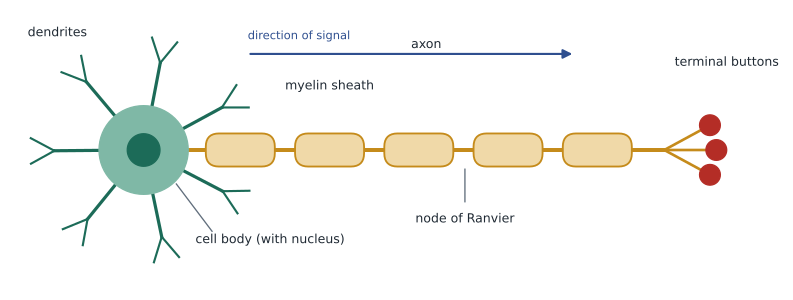
Neurons come in many shapes, but most share the same basic parts. Dendrites are branching extensions that receive messages from other neurons. The cell body, or soma, contains the nucleus and the machinery that keeps the cell alive, and it combines the incoming signals. The axon is a single long fiber that carries the neuron's own message away from the cell body, sometimes over a distance of a meter, as in neurons that run from the spinal cord to the toes. At the end of the axon, branches finish in terminal buttons, which release chemical messengers to other cells.
Many axons are wrapped in a myelin sheath, a fatty insulating layer formed by glial cells. The sheath is interrupted at regular gaps called nodes of Ranvier, and the signal jumps from node to node, traveling much faster than it could along a bare axon. Myelin keeps developing into early adulthood, especially in the frontal lobes, which is one reason judgment and planning continue to mature through the teenage years. In multiple sclerosis, the immune system damages myelin, slowing and disrupting signals and causing problems with movement, vision and sensation.
Neurons are often grouped by what they do. Sensory neurons carry information from the body's tissues and sense organs inward to the spinal cord and brain. Motor neurons carry commands outward to muscles and glands. Interneurons, which make up the vast majority of neurons in the brain and spinal cord, connect neurons to one another and do most of the processing in between.
The action potential
A neuron's message is electrical within the cell and chemical between cells. At rest, the inside of a neuron is negatively charged relative to the outside, at about minus 70 millivolts. This resting potential exists because the cell membrane keeps more positively charged sodium ions outside and more potassium ions and negatively charged molecules inside, maintained by pumps that use energy.
When a neuron receives enough stimulation from other neurons, the charge inside rises toward a threshold of about minus 55 millivolts. If it reaches threshold, channels in the membrane open and sodium ions rush in, making the inside briefly positive, peaking at about plus 30 to plus 40 millivolts. Potassium channels then open, potassium flows out, and the charge falls back, briefly overshooting below the resting level before returning. This rapid reversal and recovery is the action potential, and it travels down the axon like a wave, each section triggering the next.
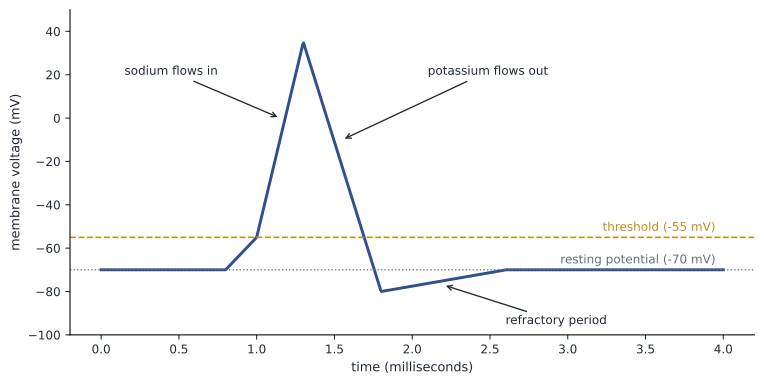
Two features of the action potential surprise students. First, it follows the all-or-none principle: if threshold is reached, the action potential fires at full strength; if it is not, nothing happens. A neuron cannot fire a 'small' action potential. How, then, does the nervous system signal intensity, such as the difference between a light touch and a hard slap? By firing more often, and by recruiting more neurons. Second, after firing, a neuron has a brief refractory period, about a millisecond or two, during which it cannot fire again. This limits a neuron to a few hundred action potentials per second at most and ensures the signal moves in one direction.
Speeds vary. Signals in thin, unmyelinated fibers travel at about 1 or 2 meters per second, while those in thick, myelinated fibers reach about 100 meters per second. That is fast for a living cell but millions of times slower than electricity in a wire, which is why reaction times, measured since Helmholtz, are in the range of a few hundred milliseconds.
Synapses: the gaps between neurons
Neurons do not touch. The junction between the terminal button of one neuron and the dendrite or cell body of another is the synapse, and the tiny gap is the synaptic cleft, only about 20 nanometers wide. When an action potential reaches the terminal buttons, it causes small sacs called vesicles to release neurotransmitters, chemical messengers that cross the cleft and bind to receptor sites on the receiving neuron, much as a key fits a lock.
The effect of a neurotransmitter depends on the receptor. Some binding is excitatory, nudging the receiving neuron closer to threshold; some is inhibitory, pushing it further away. Each neuron may receive input from thousands of others, and whether it fires depends on the sum of all the excitatory and inhibitory messages arriving at once. In this sense, every neuron is a tiny decision-maker.
After binding, neurotransmitters detach and must be cleared from the cleft. Some are broken down by enzymes. Many are taken back into the sending neuron through reuptake, to be recycled. Reuptake matters for medicine: a class of antidepressants called selective serotonin reuptake inhibitors, or SSRIs, partially blocks the reuptake of serotonin, leaving more of it active in synapses.
The discovery that synapses are chemical came from an experiment by Otto Loewi in 1921, which he said came to him in a dream. He stimulated the vagus nerve of a frog's heart, slowing it, and then transferred the fluid around that heart to a second heart. The second heart slowed too, showing that a chemical released by the nerve carried the message. The chemical was later identified as acetylcholine.
Major neurotransmitters
Scientists have identified more than a hundred substances that act as neurotransmitters or related messengers. A handful come up again and again in psychology. Navarro warns the class that each has many roles, and that popular descriptions, such as calling dopamine the 'pleasure chemical', are oversimplified.
| Neurotransmitter | Some main roles | Links to health and drugs |
|---|---|---|
| Glutamate | The main excitatory transmitter; learning and memory | Excess can overexcite and damage neurons, as after a stroke |
| GABA | The main inhibitory transmitter; calms neural activity | Alcohol and anti-anxiety drugs called benzodiazepines enhance its effects |
| Acetylcholine | Muscle movement; attention, learning and memory | Neurons that produce it are lost in Alzheimer's disease |
| Dopamine | Movement; motivation, reward learning and prediction | Lost in Parkinson's disease; involved in addiction and psychosis |
| Serotonin | Mood, sleep, appetite and impulse control | Many antidepressants act on serotonin systems |
| Norepinephrine | Alertness and arousal; the stress response | Involved in some forms of depression and anxiety |
| Endorphins | Reduce pain; involved in pleasure | Opioid drugs mimic them by binding to the same receptors |
Dopamine is a good example of why simple labels mislead. Dopamine neurons do fire when an animal receives an unexpected reward, but research has shown that they respond most strongly to the difference between what was expected and what happened, a reward prediction error. A reward that is fully expected produces little dopamine response; one that is better than expected produces a burst; and one that fails to arrive when expected produces a dip. Lesson 10 shows how this signal supports learning, and Owen notes that it helps explain why unpredictable rewards, like an occasional great video in a feed, are so compelling.
How drugs act at the synapse
Because neurons communicate chemically, drugs can change how they communicate. An agonist is a molecule that increases a neurotransmitter's action, for example by mimicking it at the receptor, increasing its release or blocking its reuptake. An antagonist decreases a neurotransmitter's action, usually by blocking receptors without activating them.
Morphine and heroin are agonists at endorphin receptors, which is why they relieve pain powerfully and why the brain, flooded with an artificial signal, may reduce its own production, contributing to dependence. Naloxone, the medication used to reverse opioid overdoses, is an antagonist that binds to the same receptors more strongly than the opioid and pushes it off. Caffeine works by blocking receptors for adenosine, a chemical that builds up during waking hours and promotes sleepiness, which is why coffee seems to restore energy. Curare, used on poison darts, blocks acetylcholine receptors at muscles, causing paralysis. Ruth recognizes many of these mechanisms from the product monographs she used to read at the pharmacy.
From single neurons to networks
Marcus's question about computers returns at the end of the class. Navarro explains that no single neuron knows anything. Information is carried by patterns of activity across networks of neurons, and learning changes those networks. In 1949, Donald Hebb proposed that when one neuron repeatedly helps to fire another, the connection between them strengthens. His idea is often summarized as 'neurons that fire together wire together'. Decades later, researchers found a mechanism that fits it: long-term potentiation, in which repeated stimulation of a synapse makes it respond more strongly for hours, days or longer. Lesson 11 returns to long-term potentiation as a basis for memory.
The artificial neural networks Marcus studies in computing were loosely inspired by these ideas. They contain simple units that add up weighted inputs and pass on a signal if the total is large enough, and learning adjusts the weights. But Navarro stresses the differences. A real neuron is a living cell with thousands of synapses, many kinds of neurotransmitters and receptors, timing that matters to the millisecond and chemistry that changes with sleep, hormones and experience. Real brains also run on about 20 watts, roughly the power of a dim light bulb, while large artificial networks need data centers. The comparison is useful as a metaphor, she says, as long as nobody forgets that it is one.
Ruth asks whether adults can grow new neurons. For most of the twentieth century the answer was thought to be no. Research since the 1990s has shown that new neurons are born in some regions of the adult brain in many mammals, especially in the hippocampus, which is important for memory. How much this happens in adult humans is still debated, because studies of human brain tissue have reached different conclusions. What is not debated is that adult brains keep forming and pruning synapses throughout life, which is the subject of plasticity in lesson 5.
Worked problem
Predicting a drug's effect
A new medication blocks the reuptake of norepinephrine and dopamine. What would you predict it does at the synapse and in behavior, and what kind of drug is it?
Show solution
- Blocking reuptake leaves more norepinephrine and dopamine in the synaptic cleft for longer.
- More norepinephrine would be expected to raise alertness and arousal.
- More dopamine would be expected to affect motivation and attention.
- Because it increases neurotransmitter action, it is an agonist in its overall effect.
- This is the general mechanism of some medications used for attention problems and of some antidepressants, which shows that predictions from synaptic action must still be tested in people.
Answer: It increases the action of norepinephrine and dopamine by blocking reuptake, so it acts as an agonist and would be expected to increase alertness and motivation.
The endocrine system
The nervous system has a slower partner. The endocrine system is a set of glands that release hormones into the bloodstream, which carries them throughout the body. Some molecules, such as norepinephrine, act both as neurotransmitters and as hormones. Hormonal messages take seconds to minutes to arrive, rather than milliseconds, but their effects can last much longer.
The pituitary gland, at the base of the brain and controlled by the hypothalamus, is sometimes called the master gland because its hormones regulate other glands. The adrenal glands, above the kidneys, release epinephrine and norepinephrine during stress, raising heart rate, blood pressure and blood sugar, and they release cortisol, which helps the body manage longer-term stress. The thyroid regulates metabolism, and the sex glands produce hormones that shape development and influence sexual behavior. The brain controls the glands, and the hormones in turn influence the brain, a feedback loop that lesson 5 places in the wider nervous system.
Common mistakes
MistakeA strong stimulus makes a bigger action potential.
InsteadAction potentials are all-or-none; intensity is signaled by firing rate and the number of neurons firing.
MistakeNeurons physically touch each other to pass messages.
InsteadNeurons are separated by synaptic clefts; neurotransmitters carry the message across.
MistakeDopamine is simply the pleasure chemical.
InsteadDopamine is involved in movement, motivation and learning from the difference between expected and actual reward.
MistakeGlial cells are just packing material.
InsteadGlia insulate axons, supply nutrients, clear debris and influence signaling and synapse formation.
Summary and key terms
- Neurons receive, integrate and transmit information; glia support and influence them.
- Dendrites receive messages, the cell body combines them and the axon carries the neuron's own message.
- Myelin speeds conduction; signals jump between nodes of Ranvier.
- An action potential is an all-or-none reversal of charge, from about minus 70 to about plus 35 millivolts.
- Neurotransmitters cross the synapse and bind to receptors, with excitatory or inhibitory effects.
- Reuptake and enzymes clear neurotransmitters; many drugs act by changing release, binding or reuptake.
- Agonists increase and antagonists decrease a neurotransmitter's action; hormones carry slower messages.
- Neuron
- A nerve cell specialized to receive, integrate and transmit information.
- Action potential
- A brief, all-or-none electrical impulse that travels down an axon.
- Synapse
- The junction where a neuron passes a message to another cell.
- Neurotransmitter
- A chemical messenger released by a neuron that crosses the synapse.
- Reuptake
- The reabsorption of a neurotransmitter by the neuron that released it.
- Agonist
- A molecule that increases the action of a neurotransmitter.
Practice problems
Work each problem on paper first, then reveal the answer to check.
Trace a signal from one neuron to the next in five steps.
Show answer
Dendrites receive input; the cell body sums it; an action potential travels down the axon; vesicles release neurotransmitter; it binds to receptors on the next neuron.
How does the nervous system signal a stronger stimulus if action potentials are all-or-none?
Show answer
By a higher firing rate and by more neurons firing.
What does an SSRI do at the synapse?
Show answer
It partially blocks the reuptake of serotonin, leaving more of it active in the synaptic cleft.
Is naloxone an agonist or an antagonist, and why does that help in an overdose?
Show answer
An antagonist: it blocks opioid receptors and displaces opioids, reversing their effects on breathing.
Lesson quiz · 5 questions
Score 60% or more to complete this lesson.
Create a free account to save your progress, take quizzes and earn a certificate.