
PSYC-104 · Lesson 12 of 12 · 19 min
Thinking, language and intelligence
▶ Video coming soon A video version of this lesson is on the way.
For the last week of the semester, Navarro writes a puzzle on the board. 'A bat and a ball cost 1.10 in total. The bat costs 1.00 more than the ball. How much does the ball cost?' Hands shoot up, and almost everyone says ten cents. Navarro waits. Marcus frowns, scribbles and says five cents: if the ball cost ten cents, the bat would cost 1.10 and the total would be 1.20. 'Most people give the fast answer,' Navarro says. 'Some catch themselves. Thinking well is often about noticing when the fast answer needs checking.' The final lesson brings together thinking, language and intelligence, the abilities most often said to set humans apart.
The puzzle comes from the cognitive reflection test devised by Shane Frederick in 2005. Even at top universities, many students answer ten cents. The error is not a lack of arithmetic; it is accepting an intuitive answer without examining it. Cognition refers to all the mental activities involved in thinking, knowing, remembering and communicating, and this lesson looks at how people form concepts, solve problems, make decisions, use language and differ in intelligence.
Concepts and prototypes
A concept is a mental grouping of similar objects, events, ideas or people. Concepts simplify thinking: knowing that something is a 'chair' tells you what to expect of it without examining it. Many concepts are organized around a prototype, a mental image or best example of the category. In research by Eleanor Rosch in the 1970s, people judged robins to be more typical birds than penguins or ostriches, and they were faster to agree that a robin is a bird. When an item closely matches our prototype, we categorize it quickly; when it does not, we hesitate or make mistakes, which can lead to errors such as failing to recognize a heart attack in a woman whose symptoms differ from the prototype of chest pain in an older man, a point Fatima notes for her nursing studies.
Solving problems
Some problems can be solved by an algorithm, a step-by-step procedure that guarantees a solution, such as a formula or a method for solving equations. Algorithms are reliable but can be slow. Heuristics are simpler thinking strategies, rules of thumb that usually lead to a quick solution but can lead to errors. To unscramble the letters SPLOYOCHYG, a person could try every possible arrangement, an algorithm, or use a heuristic, such as putting likely letter pairs together, and quickly find PSYCHOLOGY. Sometimes a solution arrives suddenly as insight, often after a person has stopped working on the problem, and brain recordings show a burst of activity in the right temporal lobe just before the 'aha' moment.
Several obstacles interfere with problem solving. Confirmation bias is the tendency to search for information that supports our beliefs and to ignore or discount evidence that contradicts them. In a classic 1960 study by Peter Wason, people were told that the number sequence 2, 4, 6 followed a rule and asked to discover it by proposing other sequences. Most proposed sequences such as 6, 8, 10 that fitted their guess, 'numbers increasing by two', and became confident of it, without testing sequences that might show they were wrong. The actual rule was simply any three increasing numbers.
Fixation is the inability to see a problem from a fresh perspective. One form is a mental set, the tendency to approach problems in a way that worked before. Another is functional fixedness, the tendency to think of objects only in their usual functions. In Karl Duncker's candle problem, people are given a candle, a box of thumbtacks and matches and asked to attach the candle to a wall so it does not drip on the table. Many struggle until they realize that the box itself can be tacked to the wall as a shelf.
Making decisions and forming judgments
When people judge how likely something is, they often rely on intuitive heuristics. In research beginning in the 1970s, which earned Daniel Kahneman a Nobel Prize in economics in 2002, Kahneman and Amos Tversky described several. The representativeness heuristic judges the likelihood of something by how well it matches a prototype. Told about a quiet, orderly man who loves detail, people judge him more likely to be a librarian than a farmer, ignoring the fact that there are far more farmers than male librarians. The availability heuristic judges likelihood by how readily examples come to mind. After news coverage of a plane crash, people overestimate the risk of flying and may choose to drive, although driving is far more dangerous per mile traveled.
Other biases are equally common. Anchoring is the tendency to rely too heavily on the first number considered; asking people whether a city has more or fewer than a million people shifts their later estimates of its population compared with asking about ten thousand. Framing is the way an issue is presented. People prefer a surgery described as having a 90 in 100 survival rate to one with a 10 in 100 death rate, although the outcomes are identical. Belief perseverance is clinging to beliefs even after the evidence for them has been discredited. Overconfidence, met in lesson 1, appears here too.
Owen sees the relevance to his work: headlines, thumbnails and the order of information all frame how viewers judge a story. Navarro adds that heuristics are not simply flaws. They are fast and usually good enough, part of the automatic track of the dual-processing mind from lesson 9. Kahneman described two modes of thinking, often called System 1, fast and intuitive, and System 2, slow and deliberate. The bat-and-ball problem shows System 1 offering an answer and System 2 failing to check it. Decisions improve when people slow down for important choices, consider the base rates, look for disconfirming evidence and ask how the question has been framed.
Language
Language is a system of spoken, written or signed words and the rules for combining them to communicate meaning. Every language is built from a few levels. Phonemes are the smallest distinct sound units; English has about 40. Morphemes are the smallest units that carry meaning, such as 'read', '-er' and '-s' in 'readers'. Grammar is the system of rules that allows people to communicate and understand one another, including semantics, the rules for deriving meaning, and syntax, the rules for ordering words into sentences. Sign languages, such as American Sign Language, have all the same features and are full languages, not gestures.
Children acquire language remarkably quickly. Babies babble speech sounds from about four months, produce their first words around their first birthday and begin combining words in two-word phrases by about age two, after which vocabulary and grammar expand rapidly. Linguist Noam Chomsky argued that humans have an inborn readiness to learn grammar, pointing out that children produce sentences they have never heard and make systematic errors, such as 'I goed', that reflect rules rather than imitation. Learning theorists emphasize the role of experience: children learn the language they hear, and the amount of speech directed at them predicts their vocabulary growth. Most researchers now see language as a product of both a biological readiness and rich social experience.
There appears to be a sensitive period for learning language. Children who learn a second language early usually speak it without an accent, while people who learn after adolescence rarely do, and deaf children who are not exposed to sign language until later in childhood often never achieve full fluency. People who learn a language later can still become highly proficient, especially in vocabulary.
Does language shape thought? Benjamin Lee Whorf proposed that the language we speak determines how we think. The strong version of this idea is not supported: people can think about things for which their language has no word. But a weaker version has support. Russian has separate basic words for lighter and darker blues, and Russian speakers are slightly faster at distinguishing shades that cross that boundary. Language also shapes thinking in everyday ways: the words used to describe people and groups can influence attitudes, which is one reason careful language matters in fields such as health care and journalism.
What is intelligence?
Intelligence is hard to define. Most psychologists describe it as the ability to learn from experience, solve problems and use knowledge to adapt to new situations. In 1904, Charles Spearman noticed that people who score well on one kind of mental test tend to score well on others, and he proposed a general intelligence factor, called g, underlying performance on all of them. Later researchers identified more specific abilities as well, such as verbal comprehension, spatial ability and processing speed, and modern models describe intelligence as a hierarchy, with g at the top and specific abilities below.
Others have argued for broader views. Howard Gardner proposed in 1983 that there are multiple intelligences, including linguistic, logical-mathematical, musical, spatial, bodily-kinesthetic, interpersonal and intrapersonal. The idea is popular in schools, but research has found that many of these abilities correlate with one another and with g, and there is little evidence that teaching to students' supposed intelligence types improves learning. Robert Sternberg proposed three aspects of intelligence: analytical, creative and practical. Emotional intelligence, the ability to perceive, understand, manage and use emotions, predicts some social and work outcomes, though how distinct it is from personality and general intelligence is debated.
Measuring intelligence
Modern intelligence testing began in France in 1905, when Alfred Binet and Théodore Simon developed a test to identify children who needed extra help in school. Binet saw intelligence as something that could be improved with education. In 1916, Lewis Terman at Stanford University adapted the test for American use as the Stanford-Binet, and the intelligence quotient, or IQ, came into use. Today the most widely used tests are the Wechsler scales, for adults and children, which give an overall score and scores for verbal comprehension, perceptual reasoning, working memory and processing speed.
A good test must be standardized, reliable and valid. Standardization means the test is given in the same way to everyone and scores are compared with a large, representative sample. On modern tests, scores are set so that the average is 100 and the standard deviation is 15, producing the normal distribution shown in lesson 3. Reliability means scores are consistent; intelligence test scores are among the most reliable measures in psychology. Validity means the test measures what it claims to and predicts relevant outcomes; IQ scores predict school grades and job performance moderately well, though far from perfectly, and they say nothing about many qualities people value, such as kindness, creativity and determination.
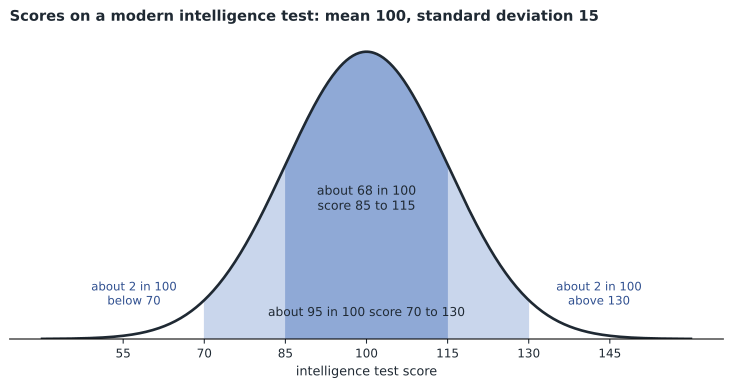
Marcus uses Python to find what proportion of people score in different ranges.
from statistics import NormalDist
iq = NormalDist(mu=100, sigma=15)
print("between 85 and 115:", round(iq.cdf(115) - iq.cdf(85), 3))
print("between 70 and 130:", round(iq.cdf(130) - iq.cdf(70), 3))
print("above 130:", round(1 - iq.cdf(130), 3))
print("score at the 90th position out of 100:", round(iq.inv_cdf(0.90)))between 85 and 115: 0.683 between 70 and 130: 0.954 above 130: 0.023 score at the 90th position out of 100: 119
Average scores on intelligence tests rose by about three points per decade across much of the twentieth century in many countries, a pattern called the Flynn effect after the researcher James Flynn. The rise was far too fast to be genetic and probably reflects improvements in nutrition, health, schooling and the abstract thinking demanded by modern life. Tests are periodically restandardized so that the average returns to 100. In some countries, the rise has slowed or reversed in recent decades, for reasons still being studied.
Genes, environment and intelligence
Twin and adoption studies, described in lesson 6, find that intelligence test scores are substantially heritable within the populations studied, with estimates rising from about 0.2 or 0.3 in infancy to about 0.5 or more in adulthood. Environment matters too. Severe deprivation in early childhood lowers scores, and intensive early education programs and adoption into more advantaged homes have been found to raise them. Schooling itself appears to raise intelligence scores by a few points for each additional year.
Average differences in test scores between some groups have been found, and Navarro stresses what lesson 6 showed: heritability within groups says nothing about the causes of differences between groups, which may reflect differences in education, income, health, discrimination and the experience of being tested. Research on stereotype threat, the worry that one's performance will confirm a negative stereotype about one's group, initially suggested large effects on test performance; later large replications have generally found the effects to be smaller and less consistent than first reported. Similarly, teaching students that intelligence can grow, a 'growth mindset', has been found in large studies to produce small average benefits, concentrated among students who are struggling.
Navarro ends the course where she began, with the scientific attitude. Each topic in the semester has had confident popular claims and careful research that complicated them. The point of an introductory course is not to memorize every finding, she says, but to leave with better questions: How do we know? Compared with what? How big is the effect? Has it replicated? Owen says he will use those questions every time he reads a comment section.
Common mistakes
MistakeThe bat costs a dollar and the ball costs ten cents.
InsteadIf the ball cost ten cents, the bat would cost 1.10 and the total 1.20; the ball costs five cents.
MistakeHeuristics are simply errors.
InsteadHeuristics are fast strategies that usually work but can produce predictable biases.
MistakePeople think only in words, so language determines thought.
InsteadStrong linguistic determinism is not supported, though language can influence perception and attitudes in smaller ways.
MistakeAn IQ score measures a fixed, total amount of a person's ability.
InsteadIQ tests measure some important abilities reliably, but scores change with education and environment and omit many valued qualities.
Summary and key terms
- Concepts organize knowledge, often around prototypes.
- Algorithms guarantee solutions; heuristics are fast shortcuts; confirmation bias and fixation block problem solving.
- Representativeness, availability, anchoring and framing shape judgments; slow, deliberate thinking can check them.
- Language has phonemes, morphemes and grammar; it develops from biological readiness and social experience.
- Language influences thought in limited ways; the strong Whorfian view is not supported.
- Intelligence includes a general factor and specific abilities; tests are standardized, reliable and moderately predictive.
- Intelligence scores are heritable within groups and responsive to environment; the Flynn effect shows large environmental change.
- Prototype
- A mental image or best example of a category.
- Heuristic
- A simple thinking strategy that is fast but can lead to errors.
- Confirmation bias
- The tendency to seek and favor information that supports existing beliefs.
- Availability heuristic
- Judging likelihood by how easily examples come to mind.
- General intelligence
- A factor, called g, underlying performance across many mental tests.
- Flynn effect
- The rise in average intelligence test scores over the twentieth century.
Practice problems
Work each problem on paper first, then reveal the answer to check.
Why is the answer to the bat-and-ball problem five cents?
Show answer
If the ball is x, the bat is x plus 1.00, and 2x plus 1.00 equals 1.10, so x is 0.05.
Give an example of the availability heuristic.
Show answer
Overestimating the risk of flying after news of a crash, or of shark attacks after a film.
What is the difference between a phoneme and a morpheme?
Show answer
A phoneme is the smallest unit of sound; a morpheme is the smallest unit of meaning.
On a test with a mean of 100 and a standard deviation of 15, what range includes about 95 in 100 people?
Show answer
70 to 130.
Lesson quiz · 5 questions
Score 60% or more to complete this lesson.
Create a free account to save your progress, take quizzes and earn a certificate.