
PLB-420 · Lesson 9 of 12 · 22 min
Low pressure, noise and water hammer
Mrs. Patel's complaint was simple: the shower upstairs turned to a trickle whenever anyone ran the kitchen tap, and the pipes banged when the washing machine filled. Her house was built in the 1950s and had been renovated twice. Grace explained to Maya that pressure and noise complaints are among the most rewarding service calls to solve, because the customer lives with the problem every day, and because the cause can be anywhere from the city main to a single clogged aerator. A systematic approach, starting with measurements, is the only reliable way through.
Pressure and flow are not the same
Customers say low pressure when they mean many things: low flow at one fixture, low flow everywhere, pressure that drops when another fixture is used, or hot water that runs weakly while cold is fine. Static pressure is the pressure with no water flowing. Residual or flowing pressure is the pressure at a point while water is flowing. Flow is the volume per minute delivered. A system can have good static pressure but poor flow if a pipe, valve or fitting is restricted, because the restriction only causes a pressure drop when water moves through it.
Typical municipal supply pressures range from about 40 to 80 psi. Many codes require a pressure-reducing valve when the supply exceeds about 80 psi, and fixtures need a minimum flowing pressure, for example about 8 psi at many faucets and higher at some valves and flush valves, to work properly.
Measure first
- Static pressure: fit a test gauge to a hose bibb or laundry tap near the meter, with all water off. Read it.
- Residual pressure: open a nearby tap or tub spout fully and read the gauge again.
- Flow at the complaint fixture: time how long it takes to fill a container of known volume (a bucket test).
- Hot and cold separately: if only the hot side is weak, the water heater, its valves, its dip tube or a mixing valve is suspect.
- Compare upstairs and downstairs, and front and back of the house, to see where the restriction lies.
- Ask about the neighbors: if they have the same problem, the cause may be the municipal main or a utility pressure issue.
Worked problem
A bucket test and a pressure drop
At Mrs. Patel's, the static pressure at the laundry tap is 55 psi. With the tub spout fully open, it falls to 20 psi, and the tub spout fills a 2.5 gal bucket in 45 seconds. Upstairs, the shower fills the same bucket in 90 seconds. What does this tell you?
Show solution
- \[Q_{\text{tub}} = \frac{2.5\ \text{gal}}{45\ \text{s}} \times 60 \approx 3.3\ \text{gpm}\]
- \[Q_{\text{shower}} = \frac{2.5\ \text{gal}}{90\ \text{s}} \times 60 \approx 1.7\ \text{gpm}\]
- \[\Delta P = 55 - 20 = 35\ \text{psi at only } 3.3\ \text{gpm}\]
Answer: The static pressure is fine, but the pressure collapses at a modest flow. That is the signature of a restriction between the main and the gauge, such as a partly closed or failed valve, a corroded galvanized service or a scaled pipe. The shower's low flow follows from it. The next step is to find where the drop happens.
Grace moved the gauge to a tap right after the meter. Static was the same, but the residual with the tub running was much higher there. The restriction was in the building, downstream of the meter. A quick look showed galvanized steel piping in the basement, original to the house, joined to copper at several renovations.
Common causes of low pressure and flow
| Symptom | Likely causes |
|---|---|
| Low flow at one fixture only | Clogged aerator, showerhead or cartridge screens; a partly closed stop valve; a kinked supply |
| Low flow everywhere, good static pressure | Corroded galvanized piping; a partly closed or failed main valve; an undersized service; a clogged filter or softener; a failed pressure-reducing valve |
| Low static pressure | Low municipal pressure, a failed pressure-reducing valve, a well system problem, or a house on high ground |
| Low hot flow only | Water heater inlet valve, dip tube fragments, scale in a tankless heater, a failed mixing valve or check valve |
| Low flow after work on the system | Debris lodged in aerators or cartridges, valves left partly closed, a crossover |
| Pressure fluctuates | A failing pressure-reducing valve, a well pump pressure switch or tank problem, or demand from other users on a shared service |
Galvanized steel was common for water piping until about the 1960s. Over decades, the inside corrodes and builds up scale and rust deposits, narrowing the bore until a 3/4 in pipe may have the opening of a pencil. It also leaches iron and can trap lead from old solder or service lines. Replacement with copper or approved plastic is the permanent fix. Grace proposed repiping the main runs and the upstairs branch, and showed Mrs. Patel a section of pipe she had cut from a previous job, nearly closed with rust.
# Flow test: estimate how the pressure drop grows with flow (friction drop ~ Q^1.85)
static = 55.0   # psi
tests = [(3.3, 20.0)]   # (flow gpm, residual psi) measured at the tub spout

q1, p1 = tests[0]
drop1 = static - p1
k = drop1 / q1 ** 1.85
print(f"Measured: {q1} gpm with a drop of {drop1:.0f} psi")
for q in (1.5, 3, 4.5, 6, 7.5):
    drop = k * q ** 1.85
    res = static - drop
    note = "" if res > 15 else "  <- too low for a shower plus another fixture"
    print(f"{q:4.1f} gpm -> drop {drop:5.0f} psi, residual {max(res, 0):4.0f} psi{note}")

# Same house after repiping: assume the restriction is gone and the drop at 3.3 gpm is 6 psi
k_new = 6 / q1 ** 1.85
print(f"After repiping, 7.5 gpm would leave about {static - k_new * 7.5 ** 1.85:.0f} psi")Measured: 3.3 gpm with a drop of 35 psi 1.5 gpm -> drop 8 psi, residual 47 psi 3.0 gpm -> drop 29 psi, residual 26 psi 4.5 gpm -> drop 62 psi, residual 0 psi <- too low for a shower plus another fixture 6.0 gpm -> drop 106 psi, residual 0 psi <- too low for a shower plus another fixture 7.5 gpm -> drop 160 psi, residual 0 psi <- too low for a shower plus another fixture After repiping, 7.5 gpm would leave about 28 psi
The script uses the fact that friction loss in pipe rises roughly with the flow to the power 1.85. A restriction that drops pressure sharply at a modest flow becomes far worse when two or three fixtures run together, which is exactly what Mrs. Patel experienced.
Pressure-reducing valves
A pressure-reducing valve (PRV) lowers high street pressure to a safe level for the building. When it fails, the symptoms are either low pressure (a clogged strainer or failed diaphragm holding it nearly closed) or creeping high pressure (a worn seat letting street pressure through when there is no flow). A gauge left on a hose bibb overnight, with a maximum-reading needle, shows whether pressure creeps up. A PRV creates a closed system, so thermal expansion from the water heater has nowhere to go; an expansion tank, sized and charged correctly, is needed. A dripping water heater relief valve is often the first sign of a closed-system problem.
Noise in water piping
- Banging when a valve closes quickly: water hammer, covered below.
- Rattling or knocking during flow: loose pipes moving against framing; secure them with proper supports and isolators.
- Whistling or squealing: a partly closed or worn valve, a worn washer in a stop or a faucet, or a pressure-reducing valve chattering.
- Ticking or creaking in hot lines: thermal expansion as pipes heat and cool, rubbing against wood or straps; provide room to move and isolating supports.
- Humming: a vibrating valve, toilet fill valve or a pump; sometimes very high pressure.
- Toilet fill valve foghorn: a worn fill valve diaphragm or washer vibrating; replace the fill valve.
Water hammer
Water hammer is the bang heard when water moving through a pipe is stopped suddenly, typically by a quick-closing solenoid valve in a washing machine, dishwasher or ice maker, or by a single-lever faucet slammed shut. The moving column of water has momentum. When it stops, the kinetic energy turns into a pressure wave that travels back along the pipe at the speed of sound in the water-filled pipe, reflecting back and forth until it dies out. The pressure spike can be many times the normal pressure, and over time it can loosen joints, damage valves and appliances and shake pipes loose.
The Joukowsky equation gives the size of the spike for an instantaneous stop. It depends on the water's density, the wave speed in the pipe and the change in velocity.
Worked problem
How big is the spike?
A washing machine's solenoid valve stops a flow of 6.5 ft/s in a copper line almost instantly. Take the wave speed in a water-filled copper pipe as about 4,000 ft/s. Estimate the pressure spike.
Show solution
- \[\Delta P = 1.94\ \text{slug/ft}^3 \times 4000\ \text{ft/s} \times 6.5\ \text{ft/s} \approx 50\,400\ \text{lb/ft}^2\]
- \[\Delta P \approx \frac{50\,400}{144} \approx 350\ \text{psi}\]
Answer: A spike of roughly 350 psi on top of the normal pressure, several times what the system sees normally. In practice, a valve takes a few milliseconds to close and some energy is absorbed, so measured spikes are lower, but still large enough to bang and to damage things over time.
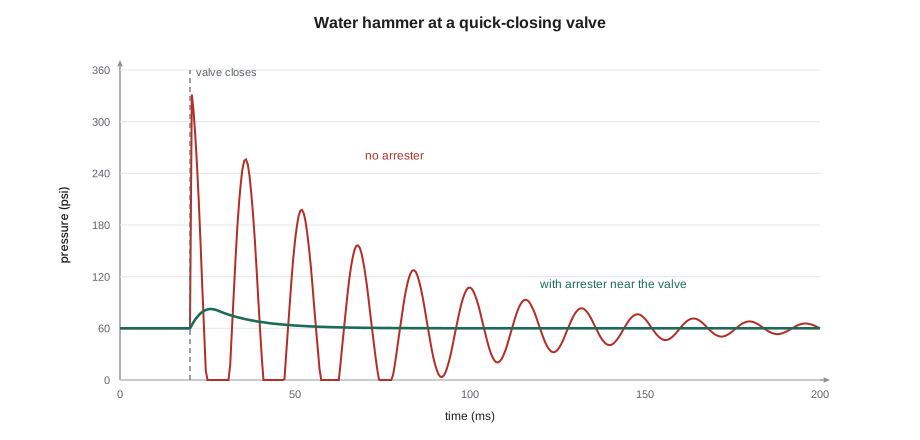
The equation shows the three ways to reduce hammer: reduce the velocity (larger pipe or lower pressure), slow the valve closure (slow-closing valves), or absorb the wave (an arrester). Lowering a high supply pressure with a PRV reduces velocity and the spike together.
- Water hammer arresters: sealed units with a gas cushion behind a piston or bellows, installed close to the quick-closing valve. They are sized by the fixture units or the manufacturer's rating and must be accessible where the code requires. Mechanical arresters do not waterlog the way old air chambers did.
- Air chambers: capped vertical pipe stubs found in older houses. They work until the air dissolves into the water, then do nothing. Draining the system recharges them temporarily.
- Pipe support: hammer is louder where pipes are loose. Secure them so they cannot move, using isolators where pipes pass through framing.
- Pressure: a PRV set to a reasonable pressure reduces hammer and saves water.
At Mrs. Patel's, Grace installed arresters on the washing machine supply and checked the static pressure, which was reasonable. Repiping the galvanized lines would also remove several loose old pipes from the joists. She explained that water hammer was not just a noise; the repeated spikes were shaking the old galvanized joints, which could start leaking.
Hammer in drains and vents
Banging or gurgling in drains is a different problem: air being pushed or pulled through traps, often because a vent is blocked or missing, or a long horizontal drain is flowing full. A sudden thump when a large volume is discharged, such as a bathtub, can be a pneumatic effect in a drain stack. The diagnosis follows the drainage methods in lessons 3 and 4: run fixtures one at a time, watch traps, and inspect the vent.
Low pressure on a well system
On a private well, the pressure is made by the well pump and stored in a pressure tank, controlled by a pressure switch that starts the pump at a cut-in pressure and stops it at a cut-out pressure, commonly 40 and 60 psi. Low pressure complaints on a well have their own list of causes: a pressure tank that has lost its air charge, so the pump short-cycles and the pressure swings rapidly; a pressure switch out of adjustment or with burned contacts; a clogged sediment filter; a worn pump or a falling water level in the well; or a leak in the drop pipe inside the well, which lets the pressure bleed back down when no water is used.
To check the tank, Grace turned off the pump, drained the tank, and measured the air charge at the tank's air valve with a tire gauge. It should be about 2 psi below the cut-in pressure. A tank with water coming out of the air valve has a failed bladder and must be replaced. Watching the pressure gauge with the pump off and no water running shows whether pressure bleeds down, pointing to a check valve or drop pipe leak.
Common mistakes
MistakeMeasuring only static pressure.
InsteadMeasure residual pressure and flow too; restrictions only show when water flows.
MistakeAssuming low pressure is the city's problem without checking at the meter.
InsteadMeasure at the meter and at the fixture to locate the drop.
MistakeAdding an arrester far from the quick-closing valve.
InsteadInstall arresters close to the valve that causes the hammer.
MistakeIgnoring a PRV's need for an expansion tank.
InsteadA PRV closes the system; provide expansion control sized for the water heater.
MistakeRecommending a booster pump for a restriction.
InsteadFind and remove the restriction first; a pump only raises static pressure.
Summary and key terms
- Static pressure, residual pressure and flow are different; measure all three.
- A large drop at modest flow means a restriction; locate it by measuring at several points.
- Corroded galvanized piping, failed valves, clogged screens, filters and PRVs are common causes of low flow.
- PRVs fail low or creep high; a maximum-reading gauge left overnight shows creep.
- Water hammer comes from sudden valve closure; the spike follows the Joukowsky equation.
- Reduce hammer with arresters near the valve, secure pipe supports and sensible pressure.
- Static pressure
- The pressure in a system with no water flowing.
- Residual pressure
- The pressure at a point while water is flowing.
- Bucket test
- Timing how long a fixture takes to fill a container of known volume to measure flow.
- Water hammer
- A pressure surge caused by suddenly stopping moving water.
- Water hammer arrester
- A sealed device with a gas cushion that absorbs pressure surges near a quick-closing valve.
Practice problems
Work each problem on paper first, then reveal the answer to check.
A shower fills a 2.5 gal bucket in 60 seconds. What is its flow?
Show answer
2.5 gpm.
Static pressure is 60 psi at the meter and at the fixture, but the fixture's residual pressure falls to 18 psi. Where is the problem?
Show answer
A restriction between the meter and the fixture, showing only when water flows.
Why does a PRV need an expansion tank?
Show answer
It makes the system closed, so thermal expansion has nowhere to go.
Name three ways to reduce water hammer.
Show answer
Slower valve closure, lower velocity or pressure, an arrester, secure supports.
Why do old air chambers stop working?
Show answer
The air dissolves into the water and the chamber fills with water.
Lesson quiz · 5 questions
Score 60% or more to complete this lesson.
Create a free account to save your progress, take quizzes and earn a certificate.