
PLB-420 · Lesson 3 of 12 · 22 min
Drain stoppages and drain cleaning equipment
Blocked drains are the bread and butter of service plumbing. In Maya's first month with Grace, nearly a third of their calls involved a stoppage: kitchen sinks full of grease, bathroom sinks packed with hair, toilets that would not flush, floor drains backing up in basements, and one restaurant whose dishwasher drain had turned into a solid plug of fat. Grace treated each one as a diagnostic problem first and a cleaning problem second. "Anyone can push a cable down a drain," she said. "The skill is knowing where the blockage is, what it's made of, why it happened, and which tool will clear it without damaging the pipe or yourself."
Why drains block
A drain carries water, waste and air downhill by gravity. It blocks when something reduces its flow area faster than flow can clear it. The causes fall into a few families, and recognizing the family helps choose the right tool and the right advice for the customer.
- Grease and fats. Fats, oils and grease are liquid when hot and solidify as they cool in the pipe, trapping food particles. They coat the pipe walls, especially in long horizontal runs and where the pipe is cold, and slowly narrow the opening. Kitchen sinks and commercial kitchens are the usual source.
- Hair and soap. Hair binds with soap scum into dense mats in bathroom sink and tub traps and in the first meter or two of the drain.
- Foreign objects. Toys, toothbrushes, phones, wipes, feminine products and paper towels catch in toilets, traps and fittings. So-called flushable wipes are a leading cause of toilet and building drain blockages because they do not break down quickly.
- Roots. Tree roots enter sewer laterals through cracked pipe and loose joints, especially in clay and cast iron pipe, and grow into dense masses.
- Scale, sludge and sediment. Cast iron and galvanized drains build up rust and scale that roughens the inside and catches debris. Sand and grit settle in low spots.
- Pipe defects. Sagging (bellied) sections, broken or offset pipe, collapsed sections and backwards-graded pipe let solids settle and catch.
Blockages in the fixture or its trap affect one fixture. Blockages in a branch affect the fixtures on that branch. Blockages in the stack or building drain affect everything upstream, and the lowest fixtures, usually the basement floor drain or a basement toilet, back up first because they are lowest relative to the blockage.
Finding the blockage before choosing the tool
Grace used the half-split method from lesson 1 on every stoppage. Which fixtures are affected? Where do their drains join? Is the problem in the trap, the branch, the stack or the building drain? She opened the closest accessible cleanout downstream of the affected fixtures. If water stood at the cleanout, the blockage was downstream of it; if the cleanout was dry while the fixture held water, the blockage was upstream.
Opening a cleanout on a drain with standing water above it releases that water, sometimes with force. Before opening a cleanout that may be holding back sewage, Grace placed a bucket and towels, wore a face shield, loosened the plug slowly to let water seep out, and stood to the side. If a basement toilet or floor drain was the lowest point, she sometimes removed the toilet and worked through the flange instead.
Plungers and hand tools
The plunger is still the first tool for many fixture stoppages. A flange plunger, with a fold-out cup, seals in a toilet outlet; a flat cup plunger seals on a sink or tub drain. Plunging works by pushing and pulling a column of water against the blockage. To work well, the overflow on a double sink or a tub must be blocked so that pressure is not lost, and there must be enough water to cover the cup. Plunging a sink after chemical drain cleaner has been used is dangerous, because the plunger can splash the chemical out of the drain.
A closet auger, a short hand cable inside a curved tube with a rubber boot, reaches through the trapway of a toilet without scratching the china. A small hand drum auger reaches six to eight meters into sink and tub drains. Removing and cleaning a P-trap by hand is often faster than cabling through it, especially for hair and grease in bathroom and kitchen sinks.
Drain cleaning machines
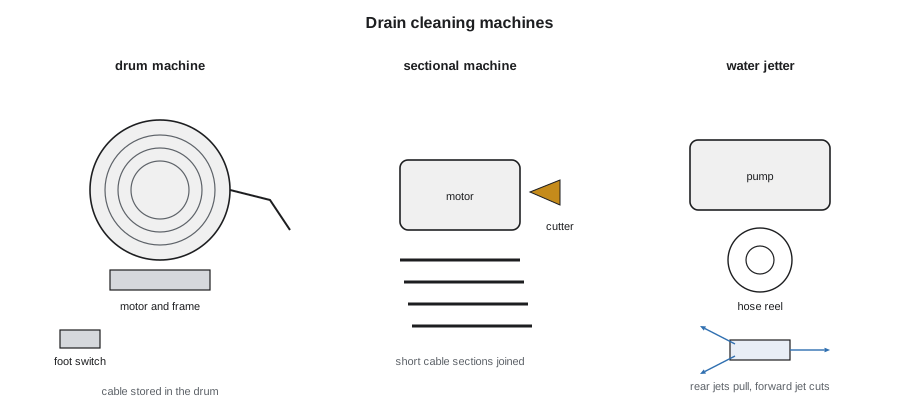
For anything beyond the trap, service plumbers use powered machines. They come in three broad types.
Drum machines store the cable coiled inside a rotating drum. Small drum machines with 1/4 in to 3/8 in cable handle sinks and tubs; larger ones with 5/8 in to 3/4 in cable handle 2 in to 4 in lines, such as floor drains and building drains from inside. The cable is fed out and pulled back by an automatic feed or by hand.
Sectional machines use short sections of cable, about 7 ft to 15 ft long, that are coupled together as they are fed into the drain. They are lighter to carry because the operator brings only the sections needed, and they suit 3 in to 10 in lines such as building drains and sewer laterals.
Water jetters use a high-pressure hose and nozzle. Rear-facing jets pull the hose forward and scour the pipe wall, and a forward jet breaks through blockages. Jetters are the best tool for grease, sludge, sand and soft blockages, and for cleaning a pipe wall rather than just punching a hole through a blockage. Root cutting heads on a jetter or cable remove roots.
| Line or fixture | Typical tool | Typical cutter or nozzle |
|---|---|---|
| Toilet | Closet auger; drum machine through the flange if the blockage is past the bowl | Bulb head |
| Sink and tub, 1-1/4 in to 1-1/2 in | Hand drum or small drum machine, 1/4 in to 5/16 in cable | Bulb or small spade |
| Kitchen and laundry branches, 1-1/2 in to 2 in | Drum machine with 3/8 in cable, or small jetter | Spade, grease cutter or jetter nozzle |
| Floor drains and building drains, 3 in to 4 in | Large drum or sectional machine, or jetter | Spear, spade, root cutter |
| Sewer laterals, 4 in to 6 in | Sectional machine or jetter | Root saw, chain knocker for scale |
Running a cable machine safely
Grace drilled Maya on the safety rules for cable machines until they were automatic. Most serious injuries happen when the cable is fed with the motor running and the cable binds, then builds up torque and whips or kinks around the operator's hand.
- Wear the leather mitts designed for the machine, safety glasses and close-fitting clothing; remove rings and watches.
- Set the machine so the cable has a short, straight path into the opening, ideally less than a meter, and use a guide hose or guide tube.
- Use the foot switch so that lifting the foot stops the machine instantly. Never tape or block the foot switch.
- Feed the cable only while it is rotating forward, and never force it. When it slows or binds, stop, reverse briefly to free the cutter, and advance again slowly.
- Never run the machine in reverse except briefly to free a stuck cutter; running in reverse can unwind and damage the cable.
- Keep a hand on the cable only through the mitt, and never grip the cable when it is building torque.
- Check cables for kinks and wear before each job and replace damaged cables.
On a toilet, a sink or a branch with a lot of fittings, a smaller, more flexible cable is safer and easier. On a long building drain, a heavier cable resists kinking but is harder to steer through tight fittings. The cutter head choice depends on the blockage: bulb heads for soft blockages and toilets, spade heads for grease and hair, spear heads to punch through and retrieve samples, root saws for roots and chain knockers for scale in cast iron.
Water jetting
A jetter does not just open a hole in a blockage; it can clean the full bore of the pipe. That makes it the preferred tool for grease and sludge, which a cable often only punches through so that the line blocks again within weeks. Grace's van carried a jetter that delivered about 4 gpm at up to about 4,000 psi, and her company also had a trailer jetter for larger lines.
Jetter performance depends on both pressure and flow. Pressure gives the jets their cutting force; flow carries debris away and pulls the hose. Small electric jetters for indoor sink lines may deliver 2 to 3 gpm at 1,500 to 2,000 psi; trailer jetters for sewers may deliver 18 gpm or more at 3,000 psi or higher. The nozzle must match the machine: its orifices are sized so the machine's flow produces the rated pressure.
Jetting has its own hazards. The water jet can cut skin and inject water under it, which is a serious medical emergency even if the wound looks small. Never point a nozzle at a person, never jet with the nozzle outside the pipe, mark the hose a meter or so back from the nozzle so you know when it is about to come out, and use a foot pedal or trigger that stops flow instantly. Jetting into a fixture or a small opening can blow back sewage, so a guide tube and splash guard are used.
Jetters must also be protected against backflow into the drinking water supply. When connected to a hose bibb, the jetter's water supply needs a backflow preventer, usually an air gap in the jetter's supply tank. Grace's jetter had an onboard tank with an air gap fill.
Worked problem
Jetter nozzle flow
A jetter delivers 4 gpm. Its nozzle has four rear jets and one forward jet, all the same size. How much flow goes through each orifice, and what share of the thrust comes from the forward jet?
Show solution
- \[q_{\text{jet}} = \frac{4\ \text{gpm}}{5} = 0.8\ \text{gpm}\]
- Rear jets pull the hose forward; the forward jet pushes back against that pull.
- Net forward pull comes from four rear jets minus one forward jet, about three jets' worth of thrust, before allowing for the rear jets' angle.
Answer: Each orifice carries about 0.8 gpm. A penetrating nozzle with a stronger forward jet breaks through blockages but pulls less; a cleaning nozzle with only rear jets pulls well and scours the wall.
# Jetter: how far does flow carry debris? Check pipe velocity behind the nozzle (illustrative)
import math

def velocity_ft_s(flow_gpm, pipe_in):
    area_ft2 = math.pi * (pipe_in / 12) ** 2 / 4
    return flow_gpm * 0.002228 / area_ft2

for machine, flow in (("small electric", 2.5), ("van jetter", 4), ("trailer jetter", 18)):
    for pipe in (2, 4, 6):
        v = velocity_ft_s(flow, pipe)
        note = "good scouring" if v >= 2.0 else "debris may settle"
print(f"{machine:15s} {flow:4.1f} gpm in {pipe} in pipe: {v:5.2f} ft/s {note}")small electric 2.5 gpm in 2 in pipe: 0.26 ft/s debris may settle small electric 2.5 gpm in 4 in pipe: 0.06 ft/s debris may settle small electric 2.5 gpm in 6 in pipe: 0.03 ft/s debris may settle van jetter 4.0 gpm in 2 in pipe: 0.41 ft/s debris may settle van jetter 4.0 gpm in 4 in pipe: 0.10 ft/s debris may settle van jetter 4.0 gpm in 6 in pipe: 0.05 ft/s debris may settle trailer jetter 18.0 gpm in 2 in pipe: 1.84 ft/s debris may settle trailer jetter 18.0 gpm in 4 in pipe: 0.46 ft/s debris may settle trailer jetter 18.0 gpm in 6 in pipe: 0.20 ft/s debris may settle
The output shows why a small jetter is excellent in a kitchen branch but cannot carry debris far in a large sewer: the water spreads out and slows. In large lines, the plumber jets in short passes and pulls debris back toward the opening, or uses a larger machine.
After the drain is open
Opening the drain is only part of the job. Grace always ran a large volume of water through the line afterwards, ideally hot water for grease, to confirm it flowed freely and to flush loose debris. She looked at what the cable or jetter brought back: grease, hair, roots, paper, scale or pieces of pipe each told a story. Roots or pieces of clay pipe meant the lateral was damaged and needed a camera inspection (lesson 4). Repeated grease blockages in a kitchen line meant the customer needed advice about grease disposal or, in a restaurant, an interceptor service problem. Wipes in a building drain meant a conversation about what can be flushed.
She also told customers honestly when a cleaning was a temporary fix. Clearing roots from a broken clay lateral restores flow, but the roots will grow back, often within a year. A camera inspection and a repair or lining is the permanent solution, and the customer deserves to know that before deciding.
Chemical and enzyme drain products
Customers often ask about drain cleaners. Strong caustic and acid cleaners can damage older pipes and fixtures, create heat and fumes, and make the plumber's job dangerous if they do not clear the blockage. Enzyme and bacterial products are gentle and can help keep grease from building up in kitchen lines when used regularly, but they do not clear a complete blockage. Grace's advice was to avoid chemical cleaners altogether, use a plunger or call a plumber, and use enzyme products only for maintenance.
Common mistakes
MistakePushing a cable through a grease blockage and leaving.
InsteadJet the line or clean it fully; a punched hole in grease reblocks quickly.
MistakeUsing a large cable in a small, fitting-heavy sink line.
InsteadMatch the cable to the line size; large cables jam and can crack fittings.
MistakeFeeding cable while it binds.
InsteadStop, reverse briefly to free it, and advance slowly; never force a binding cable.
MistakeOpening a cleanout with sewage standing above it without preparation.
InsteadPlace buckets and towels, wear a face shield, loosen slowly and stand aside.
MistakeIgnoring what comes back on the cutter.
InsteadRoots, pipe fragments or repeated grease point to a deeper problem that needs a camera or customer advice.
Summary and key terms
- Blockages come from grease, hair and soap, foreign objects, roots, scale and pipe defects.
- Find where the blockage is before choosing a tool; the lowest fixtures back up first.
- Plungers, closet augers and hand augers handle many fixture blockages.
- Drum and sectional machines and jetters handle branches, building drains and laterals; match the tool to the line.
- Cable machines need mitts, a foot switch, a short cable path and no forcing; jetters need care to avoid injection injuries and backflow.
- After clearing, flush, examine what came out and advise the customer honestly about permanent fixes.
- Drum machine
- A drain cleaning machine that stores its cable coiled inside a rotating drum.
- Sectional machine
- A drain cleaning machine that uses short cable sections coupled together.
- Water jetter
- A machine that cleans drains with a high-pressure water hose and nozzle.
- Closet auger
- A short hand cable in a curved tube for clearing toilets without scratching them.
- Belly
- A sagging section of drain where water and solids collect.
Practice problems
Work each problem on paper first, then reveal the answer to check.
Why do basement fixtures back up first when the building drain is blocked?
Show answer
They are the lowest fixtures upstream of the blockage.
Which tool is best for a grease-coated kitchen branch, and why?
Show answer
A jetter, because it scours the full pipe wall instead of just punching a hole.
What cable size suits a 1-1/2 in bathroom sink drain?
Show answer
A small drum machine or hand auger with about 1/4 in to 5/16 in cable.
What should you do if the cable binds while feeding?
Show answer
Stop, briefly reverse to free the cutter, then advance slowly without forcing.
A sewer cleaning brought back roots and clay pieces. What should you recommend?
Show answer
A camera inspection, because the lateral is likely cracked or broken, and roots will return.
Lesson quiz · 5 questions
Score 60% or more to complete this lesson.
Create a free account to save your progress, take quizzes and earn a certificate.