
PLB-420 · Lesson 8 of 12 · 21 min
Water heater troubleshooting: gas, electric and tankless
No hot water is one of the most urgent calls a service department receives. A family cannot shower, a restaurant cannot wash dishes, and a customer standing in a cold shower wants an answer quickly. Grace's approach to water heaters was the same as for everything else: listen to the complaint, look at the unit, test, and then fix or recommend. What changed with water heaters was the number of trades involved. The water side is plumbing; the gas side and the electrical side are regulated separately, and a service plumber must know exactly where their license ends. This lesson builds on the water heater installation covered in PLB-220 and the venting and combustion air covered in PLB-230, and focuses on diagnosis.
Know the limits of your license
In Ohio, gas piping and appliance work is controlled by the state's contractor licensing rules and by local jurisdictions such as Columbus, which may require a specific license or registration for gas work and permits for water heater replacement. Many plumbing contractors are licensed to install and service gas water heaters; others refer gas-side work to a licensed HVAC or gas contractor. A service plumber must know what their own license and employer allow before touching the gas valve, burner or venting. Replacing elements and thermostats on an existing circuit is generally treated as appliance repair, but any change to the circuit or wiring is electrical work for a licensed electrician.
Grace held both a plumbing license and a gas certificate. Maya, as an apprentice, worked on the water side and observed gas-side diagnosis under Grace's direct supervision. Whatever the license situation, the safety rules from lesson 2 apply: lock out electric heaters before opening panels, check for gas leaks and carbon monoxide, and never defeat a safety control.
First questions
- No hot water at all, or not enough? No hot water points to a failed burner, pilot, element, control or power supply. Not enough points to sediment, a failed dip tube, a failed lower element, an undersized heater, a thermostat set low, a crossover, or simply more demand than before.
- Has anything changed? New occupants, a new soaker tub, a recent power outage, a recent gas meter change, or work by another trade.
- Is the water too hot, rusty, smelly or noisy? Each points to a different cause.
- Is there water on the floor? Find out whether it is the tank, the fittings, the relief valve discharge or condensation.
- How old is the heater? The rating plate or serial number gives the date of manufacture. Tank heaters often last about 8 to 15 years depending on water quality and maintenance.
Gas tank heaters
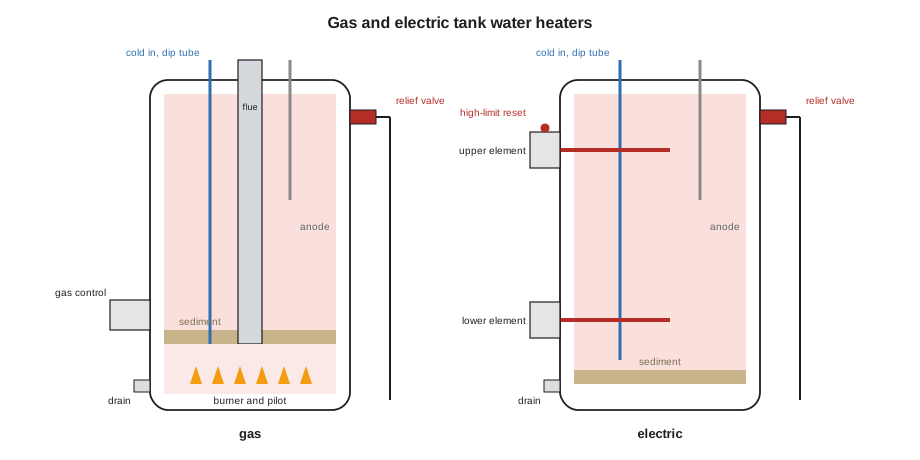
A standard atmospheric gas heater has a burner under the tank, a pilot or electronic ignition, a gas control valve with a thermostat, a flame safety device (a thermocouple or thermopile in older and many current units, a flame sensor in electronic ones), a flue through the tank with a baffle, and a draft hood at the top. Power-vent units add a blower and a pressure switch. Many newer heaters have a flammable vapor ignition resistant combustion chamber with a sealed bottom and a thermal cutoff that shuts the heater down if it detects high temperature in the combustion chamber.
- Pilot will not stay lit: a failed thermocouple or thermopile, a dirty pilot, a tripped thermal cutoff or high-limit, or a bad gas valve. A tripped flame arrestor or thermal cutoff is a symptom; find out why it tripped (blocked air intake screen, flammable vapors nearby, poor combustion air) before resetting or replacing.
- Burner lights but goes out: draft or venting problems, a weak flame sensor signal, or a power vent pressure switch fault.
- Flame is yellow, lazy or sooting: poor combustion air, a blocked burner or flue, or the wrong orifice. This can produce carbon monoxide; shut the heater down until it is corrected.
- Spillage at the draft hood: check with a smoke pencil or a mirror after the burner has run for a few minutes. Spillage means the vent is not drawing: blocked chimney, disconnected vent, depressurized room from exhaust fans or a negative-pressure furnace room. This is a serious hazard.
Many gas controls have a status light that flashes a diagnostic code. The code chart is usually on the heater's label. Grace read the code before doing anything else, because it often pointed straight to the fault.
Electric tank heaters
Most residential electric heaters have two elements, upper and lower, each with its own thermostat, wired so that only one element runs at a time (non-simultaneous). The upper thermostat has priority and includes the high-limit cutoff, often with a red reset button. When the top of the tank is cold, the upper element heats it first; once it is satisfied, power switches to the lower element.
- No hot water: check the breaker, then the high-limit reset. A tripped high-limit that trips again after reset points to a thermostat stuck closed, a grounded element or a loose connection; find the cause.
- Some hot water, but it runs out quickly: usually a failed lower element or lower thermostat. The upper element heats only the top part of the tank.
- Water very hot: a thermostat stuck closed, a thermostat not in contact with the tank, or settings too high. This is a scald hazard.
Testing must be done with power locked out for resistance checks, and only by a qualified person for live voltage checks. An element's expected cold resistance follows from its rating. A reading far higher than expected, or infinite, means an open element; a reading from either terminal to the tank or ground means the element is shorted to ground.
Before replacing an element, drain the tank below the element level (or completely if sediment is heavy), and refill completely with a hot tap open to purge air before restoring power. A dry-fired element burns out in seconds.
Tankless heaters
Tankless or on-demand heaters heat water as it flows through a heat exchanger. Gas units modulate the burner; electric units switch heating elements in stages. They need a minimum flow to activate, and they have a maximum temperature rise at a given flow.
- Hot water turns cold during use, then hot again: flow falling below the minimum activation flow (low-flow fixtures, a clogged inlet screen), or the cold water sandwich effect between draws.
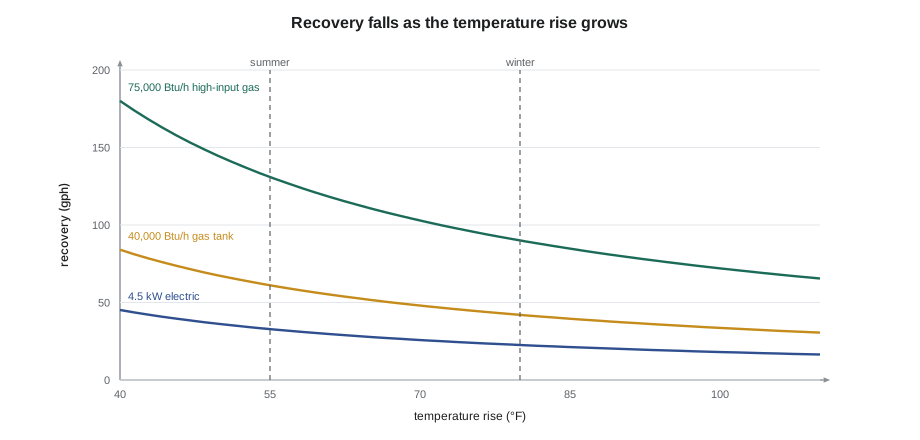
- Not hot enough in winter: the incoming water is colder, so the temperature rise needed is greater and the heater cannot deliver as much flow at the set temperature.
- Error codes for ignition, flame loss or venting: often caused by gas supply pipe or regulator that is too small for the heater's high input, by vent or condensate problems, or by scale in the heat exchanger.
- Scale: in hard water, tankless heat exchangers scale quickly. Most manufacturers require periodic descaling with an approved solution pumped through isolation valves, and some require water treatment where hardness exceeds a set level.
Gas supply is a common hidden problem with tankless heaters, because their input is several times that of a tank heater of the same household. Gas pipe sizing and venting belong to the gas side (PLB-230), so Grace checked the inlet gas pressure at full fire only within her certificate's scope, and the venting and condensate drain for blockages.
Recovery: is the heater doing its job?
Many complaints of not enough hot water come from a heater that is working correctly but cannot keep up with the demand. The recovery rate is the volume of water a heater can raise through a given temperature rise in an hour. It depends on the heat input and efficiency.
Worked problem
Comparing gas and electric recovery
A family's 40 gal tank runs out after two showers. Incoming water is 50 °F and the set point is 120 °F. Compare the recovery of a 4.5 kW electric heater (efficiency about 0.98) with an 40,000 Btu/h gas heater (efficiency about 0.70).
Show solution
- \[\Delta T = 120 - 50 = 70\ ^\circ\text{F}\]
- \[\dot{V}_{\text{elec}} = \frac{4500 \times 3.412 \times 0.98}{8.33 \times 70} \approx 25.8\ \text{gph}\]
- \[\dot{V}_{\text{gas}} = \frac{40000 \times 0.70}{8.33 \times 70} \approx 48\ \text{gph}\]
Answer: The gas heater recovers almost twice as fast. With an electric heater, a tank emptied by two long showers takes over an hour to recover, which matches the family's complaint. Larger storage, a higher input or a tempered higher set point with a mixing valve are the options.
A recovery test in the field compares the heater's actual performance with its rating. Grace drew hot water until the burner or element came on, closed the tap, and timed how long the heater took to raise the tank temperature, measured at a hot tap after a short draw. More practical still: with the heater running steadily and a hot tap flowing at a measured rate, she measured the outlet temperature rise. If the measured rise was well below what the input should give, the heater had a problem: sediment insulating the bottom of a gas tank, a failed element, a low gas input, or a broken dip tube letting cold water short-circuit to the outlet.
# Field recovery check: does the heater deliver its rated temperature rise at a measured flow?
def expected_rise(btuh_in, eff, flow_gpm):
    """Steady-state temperature rise (deg F) for heat input Btu/h at flow gpm."""
    return btuh_in * eff / (500 * flow_gpm)

tests = [
    ("electric 4.5 kW, 1 element", 4500 * 3.412, 0.98, 0.5, 58.0),
    ("gas 40,000 Btu/h tank",      40000, 0.70, 1.0, 50.0),
    ("gas tank with heavy sediment", 40000, 0.70, 1.0, 35.0),
]
for name, btuh, eff, flow, measured in tests:
    exp = expected_rise(btuh, eff, flow)
    ratio = measured / exp
    verdict = "OK" if ratio > 0.85 else "low - investigate"
print(f"{name:30s} flow {flow:.1f} gpm expected rise {exp:5.1f} measured {measured:5.1f} ({ratio:.0%}) {verdict}")electric 4.5 kW, 1 element flow 0.5 gpm expected rise 60.2 measured 58.0 (96%) OK gas 40,000 Btu/h tank flow 1.0 gpm expected rise 56.0 measured 50.0 (89%) OK gas tank with heavy sediment flow 1.0 gpm expected rise 56.0 measured 35.0 (62%) low - investigate
Other common complaints
- Rotten egg smell in the hot water only: sulfate-reducing bacteria react with the magnesium anode to make hydrogen sulfide. Options include an aluminum-zinc anode, a powered anode, or disinfecting the tank, following the manufacturer's instructions. Lesson 10 covers water quality causes.
- Rumbling or popping: sediment on the bottom of a gas tank, with steam bubbles forming under it. Flushing may help if done early; heavy sediment shortens tank life.
- Rusty hot water: a depleted anode and corroding tank, or corroded galvanized piping. If only the hot water is rusty, the tank is suspect.
- Relief valve discharging: excessive temperature (a control failure) or excessive pressure, often thermal expansion in a closed system with a check valve or pressure-reducing valve and no working expansion tank. Never cap or plug a relief valve discharge.
- Leaking tank: a leak from the tank itself, not a fitting, means the tank has failed and must be replaced.
- Pilot and burner problems after a power vent was added or a new furnace installed: check for shared venting and combustion air issues and refer as required.
Repair or replace
Grace considered the heater's age, the cost of the repair compared with replacement, the condition of the tank, the efficiency of the existing unit and the customer's needs. A thermocouple or element on a five-year-old heater is a repair. A leaking tank, a heater near the end of its expected life with a failed gas valve, or a heater too small for the household is usually a replacement. Replacement requires a permit in most jurisdictions, and it means meeting current code for relief valve discharge, expansion control, seismic or other strapping where required, venting and combustion air, and gas or electrical connections.
Common mistakes
MistakeWorking on the gas side without the right certificate.
InsteadKnow your license; refer gas or electrical work you are not licensed for.
MistakeResetting a tripped high-limit or thermal cutoff without finding why it tripped.
InsteadFind the cause: stuck thermostat, grounded element, blocked air intake or flammable vapors.
MistakeRestoring power before the tank is full.
InsteadRefill completely and purge air through a hot tap first, or the element will burn out.
MistakeReplacing parts on a heater that is simply too small for the demand.
InsteadCheck recovery against the household's use and explain the options.
MistakeIgnoring relief valve discharge.
InsteadFind the cause, usually thermal expansion or a control failure, and never plug the discharge.
Summary and key terms
- Know where the plumbing license ends on gas and electric heaters, and refer work outside it.
- Start with questions: none or not enough hot water, what changed, age, smell, noise and leaks.
- Gas heaters fail at the pilot, flame safety device, gas valve, thermal cutoff and venting; spillage and poor flames are hazards.
- Electric heaters fail at elements, thermostats and the high-limit; test elements with power locked out.
- Tankless heaters need minimum flow, adequate gas supply and venting, and descaling in hard water.
- Recovery calculations and field checks show whether the heater is underperforming or simply undersized.
- Recovery rate
- The volume of water a heater can heat through a given rise in one hour.
- Thermocouple
- A flame safety device that produces a small voltage when heated by the pilot flame, holding the gas valve open.
- High-limit
- A safety control that shuts off a heater if the water becomes too hot.
- Dip tube
- The tube that carries incoming cold water to the bottom of a tank heater.
- Anode rod
- A sacrificial metal rod in a tank that corrodes in place of the tank steel.
Practice problems
Work each problem on paper first, then reveal the answer to check.
An electric heater gives only a short burst of hot water. What is the likely fault?
Show answer
The lower element or lower thermostat.
What is the expected resistance of a 3,800 W, 240 V element?
Show answer
About 15.2 ohms (240² ÷ 3,800).
Why do tankless heaters often deliver less in winter?
Show answer
Colder incoming water needs a greater rise, reducing the flow at the set temperature.
What causes a rotten egg smell only in the hot water?
Show answer
Sulfate-reducing bacteria reacting with the magnesium anode.
A gas heater's flame is yellow and sooting. What should happen?
Show answer
Shut it down until the combustion problem is corrected, because it can produce carbon monoxide.
Lesson quiz · 5 questions
Score 60% or more to complete this lesson.
Create a free account to save your progress, take quizzes and earn a certificate.