
PLB-420 · Lesson 2 of 12 · 23 min
Safety in service work
Maya had spent three years on construction sites with hard hats, site orientations, safety coordinators and toolbox talks every morning. Her first week in service felt strangely informal by comparison. There was no site office, no orientation and no one checking her fall protection. "That's exactly why service is dangerous," Grace told her on day two, as they knelt beside a crawl space hatch in a 1920s house. "On a construction site, somebody has thought about the hazards before you arrive. In somebody's basement, you are the safety coordinator. You have to see the hazards yourself."
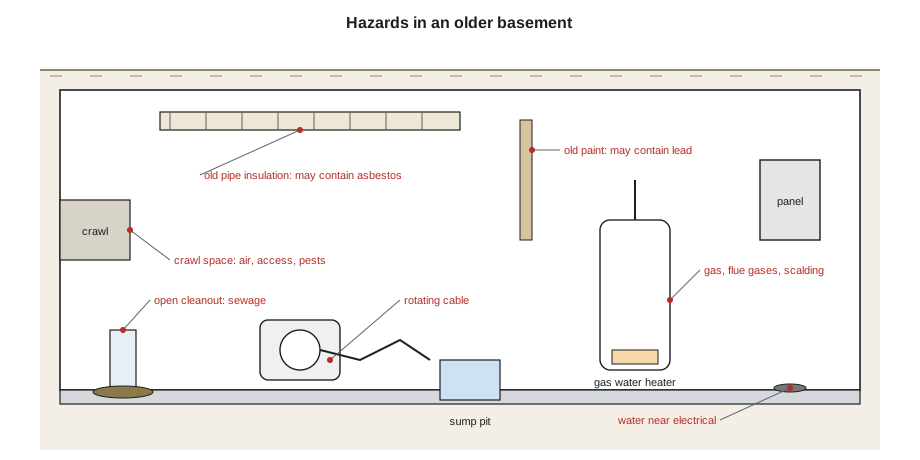
This lesson covers the hazards that service plumbers meet most often: biological hazards from sewage, sewer gas and confined spaces, asbestos, lead and mold in older buildings, electrical hazards near water, hot water and scalding, gas appliances, drain cleaning machines and chemicals, and the simple dangers of working alone in other people's homes. TRD-101 covered the basics of construction safety. Here the focus is on how those principles apply when every job site is different and you are often the only worker there.
A quick hazard assessment at every call
Grace began every call with the same short routine, which took less than a minute once it became habit. Before unloading tools, she looked around the work area and asked herself five questions. What could hurt me here? What could hurt the customer or their family? What is the worst thing that could happen with this repair? What do I need to control the hazards? Do I need help or a different trade? She did not fill out a form on every small call, but Northbridge's service app had a short field-level hazard checklist for anything involving drain machines, crawl spaces, gas, ladders or older buildings, and she completed it on those calls.
The routine is a field version of the hazard assessment process in occupational safety law. The federal OSH Act, which covers private employers in Ohio, places a general duty on employers to protect workers from recognized hazards, and expects workers to report hazards and use the equipment and procedures provided. For service plumbers, that means the employer must train them and provide equipment, and the plumber must actually use it, even when no one is watching.
Sewage and biological hazards
Drain cleaning, sewer repair and backflow cleanups expose plumbers to sewage, which carries bacteria, viruses and parasites. The main routes of infection are hand to mouth, splashes into the eyes, nose or mouth, and contact with cuts. Good practice is simple but must be consistent: nitrile gloves under heavy gloves for drain work, safety glasses or a face shield when opening cleanouts or running a machine, coveralls or sleeves, no eating, drinking or smoking until hands are washed, and covering any cuts. Grace kept a jug of clean water, soap and paper towels on the truck for job sites without a usable sink.
Most health authorities recommend that plumbers keep tetanus immunization up to date, and many employers offer hepatitis A and B vaccination for workers regularly exposed to sewage. Northbridge offered both. Tools and the drain machine cable are cleaned and disinfected after sewage work, and contaminated clothing is laundered separately.
When sewage has backed up into a finished basement, the plumber's job is usually to clear the blockage and restore flow. Cleaning and disinfecting the contaminated area, removing soaked drywall and carpet, and drying the structure is often work for a restoration company, especially where it is extensive. Grace explained to customers that sewage-soaked porous materials generally cannot be cleaned safely and must be removed.
Sewer gas and confined spaces
Sewer gas is a mixture that can include hydrogen sulfide, methane, carbon dioxide and ammonia. Hydrogen sulfide smells like rotten eggs at low concentrations, but at higher concentrations it deadens the sense of smell, so a worker may think the danger has passed just as it becomes lethal. Methane is flammable. Carbon dioxide displaces oxygen. In a basement with a single open cleanout, these gases usually disperse quickly. In a pit, a manhole, a large sump, an interceptor or a crawl space with poor ventilation, they can build to dangerous levels.
A confined space is a space not designed for continuous occupancy, with limited entry and exit, where hazards such as poor air can build up. The federal OSHA confined spaces in construction standard (29 CFR 1926 Subpart AA) and general industry permit-required confined spaces rule (29 CFR 1910.146) require hazard assessment, atmospheric testing, ventilation, entry plans, attendants and rescue arrangements before workers enter such spaces. The details are covered in TRD-101.
For service plumbers, the practical rule is that you never enter a manhole, deep sump, grease interceptor, septic tank or similar space without the training, equipment and procedures for confined space entry. Many service companies, including Northbridge, simply do not enter such spaces and subcontract that work to specialists. Grace's crew did their work from outside: cameras, jetters and cables can reach a long way. Crawl spaces are judged case by case. A dry, ventilated crawl space with good access is usually not treated as a confined space, but one with standing sewage, poor air or a single tight entry may be.
Grace's four-gas monitor read oxygen, carbon monoxide, hydrogen sulfide and the lower explosive limit. She clipped it on whenever she worked in a crawl space, near an open sewer connection in a small room, or around a sump. Its alarm points were factory set: oxygen below 19.5 percent, hydrogen sulfide at 10 ppm, carbon monoxide at 35 ppm, and combustible gas at 10 percent of the lower explosive limit. When it alarmed, the rule was to leave first and investigate later.
Worked problem
How long to ventilate a small pump room?
A 700 ft³ ejector room smells strongly of sewage, and the monitor reads hydrogen sulfide at 25 ppm. A portable fan moves 70 ft³ of fresh air per minute through the room, and the sewer opening has been sealed. Assuming good mixing, how long until the reading falls below 5 ppm?
Show solution
- \[C(t) = C_0\, e^{-Q t / V} \quad \Rightarrow \quad t = \frac{V}{Q} \ln\frac{C_0}{C}\]
- \[t = \frac{700}{70} \ln\frac{25}{5} = 10 \times 1.61 \approx 16\ \text{min}\]
Answer: About 16 minutes with perfect mixing, longer in practice because corners and low spots clear slowly and hydrogen sulfide is heavier than air. The monitor, not the clock, decides when it is safe, and if the source is not stopped the level will not fall at all.
Asbestos, lead and mold in older buildings
Much service work happens in buildings older than the plumber. Older buildings bring hazardous materials that were common when they were built. The plumber's job is to recognize them, avoid disturbing them, and stop work if they will be disturbed until they are assessed and handled properly.
- Asbestos was used in pipe insulation, boiler insulation, some cement drain and water pipes, vinyl floor tiles, joint compound, and ceiling textures, especially in buildings built before about 1990. White or gray corrugated wrap on old heating and hot water pipes is a classic example. Assume it may contain asbestos until a sample shows otherwise.
- Lead was used in solder for water piping until it was restricted in the late 1980s, in lead service lines in many older cities, in lead closet bends and lead caulked joints in cast iron drains, and in paint on older trim and walls.
- Mold grows wherever leaks keep materials wet, behind showers, under sinks, in basements with chronic dampness and around slow leaks in walls.
Under OSHA, work that disturbs asbestos is covered by the construction asbestos standard (29 CFR 1926.1101), which classifies work by risk and requires training and controls. Lead exposure in construction is covered by 29 CFR 1926.62, and work that disturbs paint in homes built before 1978 may also fall under the EPA's Renovation, Repair and Painting rule, which requires a certified firm and lead-safe practices. In practice, if a repair would disturb suspected asbestos insulation, the plumber stops, informs the owner, and the material is tested and, if positive, removed or repaired by trained workers before the plumbing work continues.
Cutting into a lead closet bend or melting out a lead caulked joint creates lead fumes and dust. Grace used mechanical methods instead, such as cutting the cast iron with a snap cutter and using approved transition couplings, which avoids heating lead at all. She wore a respirator with P100 filters when cutting old cast iron or lead and cleaned up with a HEPA vacuum rather than a broom.
Electrical hazards near water
Water and electricity meet constantly in plumbing: electric water heaters, sump pumps, ejector pumps, dishwashers, garbage disposers, recirculating pumps and the electrical bonding of metal water piping. Several hazards follow.
- Electric water heaters operate at 240 V. Before removing the element covers, turn off the breaker, confirm with a tester that the power is off, and lock or tag the breaker so no one turns it on while your hands are inside.
- Sump and ejector pumps are often plugged into receptacles near water. Unplug the pump before handling it, and check that receptacles in unfinished basements and near sinks are ground-fault protected as the electrical code requires.
- Metal water piping is often used as part of the building's electrical grounding and bonding system. Cutting out a section can interrupt that path and, if there is a fault, the two cut ends can be at different voltages. Before cutting metal pipe, install a temporary bonding jumper across the section, and when replacing metal pipe with plastic, make sure an electrician restores the bond.
- A tingle from a faucet or a shock from a shower valve means a serious electrical fault. Stop work, keep everyone away from the fixture and call an electrician.
Northbridge's service plumbers followed a written lockout procedure for any equipment with electrical power or stored energy. For a water heater, that meant breaker off, tested dead, a lock or tag on the breaker, and the water and, for gas units, the gas isolated before work.
Hot water, steam and pressure
Scalds are one of the most common injuries in service plumbing. Water heaters store water at 140 °F or higher, and a failed thermostat can push temperatures much higher. A relief valve or a drain valve opened on a hot tank releases a jet of scalding water and steam. Grace drained tanks with a hose run to a floor drain or outdoors, opened valves slowly while standing to the side, and let the water cool by running hot taps before opening a heater for repair when time allowed.
Water at 140 °F can cause a serious burn in a few seconds; at 120 °F it takes several minutes for an adult. That is why fixtures are protected with mixing valves and why the plumber checks delivered temperature after any water heater repair.
Pressure is another stored hazard. A closed system with a failed expansion tank can build high pressure when the water heater runs. Before opening any part of a pressurized system, close the supply, open a fixture downstream to release pressure, and only then loosen fittings.
Gas appliances
Water heaters, boilers and some dryers and ranges use natural gas or propane. A service plumber working on or near them must know their certification limits. In Ohio, gas piping and appliance work is covered by the state and local codes and requires the appropriate contractor license and local permits. PLB-230 covered these rules. Within those limits, the basic safety steps are: smell for gas on arrival, check with a combustible gas detector if anything seems wrong, shut off the gas at the appliance valve before disconnecting, test new or disturbed joints with leak detection solution, and check for proper venting and carbon monoxide after any repair.
If a strong gas smell is present when you arrive, do not operate switches or appliances, get everyone out, and call the gas utility's emergency line from outside. That is the utility's emergency, not a plumbing repair.
Drain cleaning machines and chemicals
Drain cleaning machines cause serious hand and arm injuries every year. The rotating cable can grab a glove, a sleeve or a finger and wrap it in an instant, and a cable that kinks under torque can whip violently. The rules are covered in detail in lesson 3: use the right machine and cable for the line size, wear the leather mitts made for the machine, never wear ordinary cotton gloves that can be caught, keep the cable guide close to the opening, use the foot switch so you can stop instantly, and never force the cable.
Chemical drain cleaners present a separate hazard. Customers often pour strong caustic or acid cleaners into a blocked drain before calling a plumber. The trap may then be full of a corrosive liquid that splashes when a plunger, cable or wrench is used. Grace always asked whether anything had been poured into the drain, and if so, she wore goggles and chemical gloves, worked slowly, and in some cases waited and flushed before opening the trap.
Working alone and in customers' homes
Service plumbers often work alone, and the jobs are in places no one else on the crew has seen. OSHA expects employers to address the hazards of working alone as part of their general duty. Northbridge's check-in system required each plumber to mark arrival and departure in the app, with a call from the dispatcher if a check-in was missed. Grace also told Maya about the less obvious hazards: aggressive dogs, unsafe stairs, hoarding conditions, people who are angry or impaired. The answer was the same as for any other hazard: recognize it, control it if you can, and leave if you cannot.
Common mistakes
MistakeTreating every crawl space and pit the same.
InsteadAssess each one; spaces with poor air, sewage or tight access may be confined spaces that need a full entry procedure or a specialist.
MistakeCutting old pipe insulation to get to a valve.
InsteadAssume older insulation may contain asbestos; stop and have it tested before disturbing it.
MistakeCutting a metal water pipe without a bonding jumper.
InsteadInstall a temporary jumper first and make sure the electrical bond is restored afterwards.
MistakeOpening a trap after the customer used chemical drain cleaner, without protection.
InsteadAsk what was used, wear goggles and chemical gloves, and work slowly.
MistakeWearing cotton gloves on a drain machine.
InsteadUse the leather mitts designed for the machine; loose gloves can be caught by the cable.
Summary and key terms
- Every service call starts with a short hazard check, because no one else has assessed the site.
- Sewage work needs gloves, eye protection, hygiene and up-to-date immunization.
- Sewer gas can kill; pits, sumps and interceptors may be confined spaces that need a full entry procedure or a specialist.
- Older buildings may contain asbestos, lead and mold, which must not be disturbed until assessed.
- Electrical hazards need lockout, testing, bonding jumpers and a call to an electrician for faults.
- Hot water, stored pressure, gas, drain machines, chemicals and working alone each need specific controls.
- Confined space
- A space not designed for continuous occupancy, with limited entry and exit, where a hazardous atmosphere can develop.
- Hydrogen sulfide
- A toxic sewer gas that smells like rotten eggs at low levels and deadens the sense of smell at higher levels.
- Bonding jumper
- A temporary cable that keeps electrical continuity across a section of metal pipe being cut or removed.
- Lockout
- Isolating and securing an energy source so equipment cannot start while it is being worked on.
- Four-gas monitor
- A portable instrument that measures oxygen, carbon monoxide, hydrogen sulfide and combustible gas.
Practice problems
Work each problem on paper first, then reveal the answer to check.
Why is hydrogen sulfide especially dangerous?
Show answer
At higher concentrations it deadens the sense of smell, so a worker may think it is gone when it is at a lethal level.
What should a plumber do before cutting a metal water service pipe?
Show answer
Install a temporary bonding jumper across the section and make sure the electrical bond is restored.
A homeowner poured drain cleaner into a blocked sink an hour ago. What precautions should you take?
Show answer
Ask what was used, wear goggles and chemical gloves, work slowly and consider flushing before opening the trap.
Name three materials in older buildings that a plumber should not disturb until assessed.
Show answer
Asbestos insulation, lead solder or lead joints, and moldy materials.
What are the steps before working on an electric water heater element?
Show answer
Turn off the breaker, test that power is off, lock or tag the breaker, and isolate the water.
Lesson quiz · 5 questions
Score 60% or more to complete this lesson.
Create a free account to save your progress, take quizzes and earn a certificate.