
PLB-420 · Lesson 10 of 12 · 21 min
Water quality problems and treatment equipment
Some service calls start with a complaint about the water itself, not the plumbing: white crust on the faucets, orange stains in the toilet, water that smells of rotten eggs, blue-green stains in a sink, or a worry about lead after a news story. A plumber is often the first person a homeowner calls. Grace explained that the plumber's job here is to recognize the common problems, know how they are tested, explain the treatment options fairly and install equipment properly. The plumber is not a laboratory, and a recommendation is only as good as the test it is based on. This lesson covers hardness, iron and manganese, odors and tastes, corrosive water, lead, and the equipment used to treat them.
Municipal water and private wells
Municipal water in Canada and the United States is treated and tested by the utility to meet drinking water standards at the point it enters the distribution system. Problems in a house on city water usually come from the house's own plumbing (lead service lines, old solder, corroded galvanized pipe, a water heater anode), from the characteristics of the supply that are not health risks (hardness, chlorine taste), or occasionally from the distribution system. Private wells are the owner's responsibility, and their water can contain anything the ground holds: hardness, iron, manganese, hydrogen sulfide, bacteria, nitrate, arsenic and more. A well owner should test regularly through an accredited laboratory, and public health units often offer bacteriological testing.
Grace's first question on any water quality call was whether the house was on city water or a well. Her second was whether the problem was in the hot water, the cold water, or both, because that separates water heater causes from supply causes.
Hardness
Hard water contains dissolved calcium and magnesium. It is not a health hazard, but it forms scale in water heaters, tankless heat exchangers, faucets and showerheads, reduces soap lathering and leaves spots and crusts. Scale insulates heat exchange surfaces, lowering efficiency and shortening equipment life. Hardness is reported as calcium carbonate equivalent, in milligrams per liter (mg/L) or in grains per gallon (gpg). One grain per gallon equals 17.1 mg/L.
| Classification | mg/L as calcium carbonate | Grains per gallon |
|---|---|---|
| Soft | below 60 | below 3.5 |
| Moderately hard | 60 to 120 | 3.5 to 7 |
| Hard | 120 to 180 | 7 to 10.5 |
| Very hard | above 180 | above 10.5 |
Many municipal supplies are moderately hard to hard. Wells in limestone regions can be very hard. Hardness is easy to test with a titration kit or test strips, and the utility publishes its typical hardness in its annual water quality report.
Water softeners
A water softener exchanges hardness ions for sodium or potassium ions using a bed of ion exchange resin. When the resin is exhausted, the control valve runs a regeneration cycle: backwash to loosen the bed, brine draw from the salt tank, slow rinse, fast rinse and refill of the brine tank. Demand-initiated (metered) controls regenerate based on water used rather than on a timer, saving salt and water.
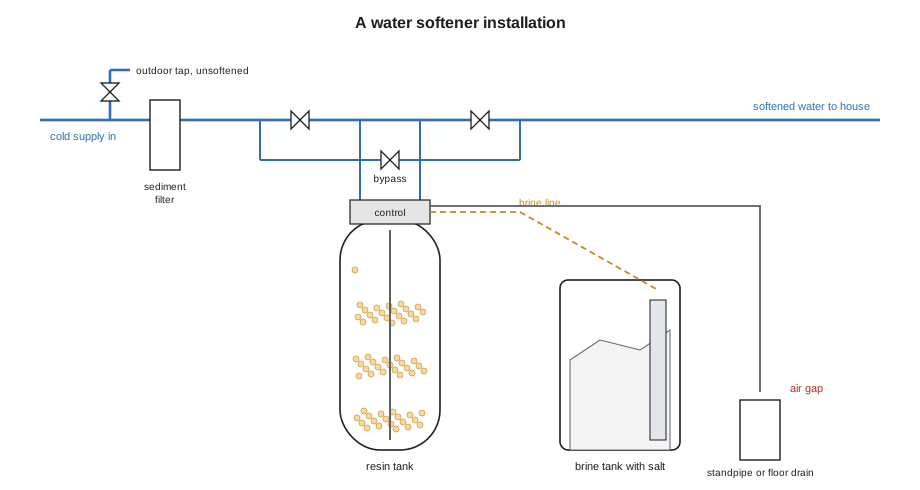
- Install a bypass valve so the softener can be serviced without shutting off the water.
- Run the drain line to an approved indirect connection with an air gap, as the code requires; never connect it directly to a drain.
- Leave outdoor taps and, often, a kitchen cold tap for drinking unsoftened if the customer prefers, and where the local code or guidance suggests it, because softening adds sodium.
- Protect the softener from freezing and from the water heater's heat; do not install it downstream of the heater.
- Check the local rules on softener discharge to septic systems and sewer bylaws; some areas restrict brine discharge or favor high-efficiency units.
Softeners are sized by the hardness to be removed each day and the capacity of the resin between regenerations. Iron in the water fouls resin and is usually added to the hardness at a rate set by the manufacturer, often around 3 to 5 grains per gallon of compensated hardness for each mg/L of iron.
Worked problem
Sizing a softener for a well
A family of four on a rural well has hardness of 340 mg/L and iron of 0.8 mg/L. They use about 75 gal per person per day. Using a compensation of 4 gpg per mg/L of iron and a 7-day regeneration interval, what resin capacity in grains is needed?
Show solution
- \[\text{Hardness} = \frac{340}{17.1} \approx 19.9\ \text{gpg}\]
- \[\text{Compensated} = 19.9 + 4 \times 0.8 = 23.1\ \text{gpg}\]
- \[\text{Use} = 4 \times 75 = 300\ \text{gal/day}\]
- \[\text{Capacity} = 23.1 \times 300 \times 7 \approx 48\,500\ \text{grains}\]
Answer: About 48,000 grains of capacity between regenerations. Softeners are rated in grains at a given salt dose, and the practical capacity at an efficient salt setting is lower than the maximum rating, so Grace would look at a unit rated well above this, then set the salt dose and regeneration from the manufacturer's tables.
# Hardness conversions and a simple softener sizing check
GPG = 17.1   # mg/L as CaCO3 per grain per gallon

def to_gpg(mg_l):
    return mg_l / GPG

def softener_capacity(hard_mg_l, iron_mg_l, people, gal_per_person, days, iron_factor=4):
    comp = to_gpg(hard_mg_l) + iron_factor * iron_mg_l
    gal_day = people * gal_per_person
    return comp, gal_day, comp * gal_day * days

for mg in (60, 120, 180, 340):
    print(f"{mg:4d} mg/L = {to_gpg(mg):5.1f} gpg")

comp, gal_day, cap = softener_capacity(340, 0.8, 4, 75, 7)
print(f"Compensated hardness {comp:.1f} gpg, use {gal_day:.0f} gal/day, capacity needed {cap:,.0f} grains")
# Practical capacity is often about 60-70 percent of the maximum rating at an efficient salt dose
print(f"Choose a unit with a maximum rating of at least {cap / 0.65:,.0f} grains")60 mg/L = 3.5 gpg 120 mg/L = 7.0 gpg 180 mg/L = 10.5 gpg 340 mg/L = 19.9 gpg Compensated hardness 23.1 gpg, use 300 gal/day, capacity needed 48,474 grains Choose a unit with a maximum rating of at least 74,576 grains
Iron and manganese
Iron causes orange-brown stains and a metallic taste; manganese causes black or dark brown stains. Both are common in well water, where they are often dissolved (clear water that stains after standing) or already oxidized (water that comes out cloudy or colored). Iron bacteria form slimy, rust-colored deposits in toilet tanks and can cause odors. Red water on city supply usually comes from corroded galvanized piping, a water heater, or a disturbance in the main after a hydrant flush or a break.
- Low levels of dissolved iron can be removed by a softener, but the resin fouls over time.
- Oxidising filters use air injection, chlorine, potassium permanganate or a catalytic media to oxidize iron and manganese so they can be filtered out, with a backwash cycle like a softener.
- Iron bacteria need shock chlorination of the well and plumbing, and sometimes continuous treatment.
Grace never sized iron treatment without a lab analysis, because the right equipment depends on the iron level, the manganese level, the pH, the presence of hydrogen sulfide and the presence of bacteria.
Odors and tastes
| Complaint | Where it appears | Likely cause | Typical remedy |
|---|---|---|---|
| Rotten egg | Hot water only | Bacteria reacting with the water heater magnesium anode | Change the anode type, disinfect the tank |
| Rotten egg | Hot and cold | Hydrogen sulfide in well water, or sulfur bacteria | Aeration, oxidising filter, chlorination; test first |
| Rotten egg | One drain only | A dry trap or a drain problem, not the water | Refill the trap, check vents and drains |
| Chlorine or swimming pool | City water | Disinfectant residual from the utility | Point-of-use carbon filter |
| Musty or earthy | City or well water | Algae by-products, organic matter, or a drain smell | Carbon filter; check the drain first |
| Metallic | Often first draw | Iron, copper or low pH water dissolving pipe | Test pH and metals; treat the cause |
Many smell complaints come from drains rather than water. Grace filled a glass at the tap and walked away from the sink to smell it. If the water itself had no smell, she looked at the drain and trap instead.
Corrosive water
Water with a low pH, low alkalinity or high dissolved oxygen can dissolve copper and other metals. Signs include blue-green stains below faucets and in tubs, pinhole leaks in copper pipe, and a metallic taste. Corrosive water can also dissolve lead from old solder, brass fittings and lead service lines. On well water, an acid neutralizer filter (calcite or a blend with magnesium oxide) raises pH, or a chemical feed system adds soda ash. On city water, the utility controls corrosion through treatment, and blue-green stains or pinholes should be reported to the utility as well as investigated in the house.
Lead
Lead has no known safe level in drinking water, and children and pregnant people are most at risk. Lead enters water from lead service lines, lead solder used on copper pipe before it was banned for potable water, and some older brass fittings and faucets. It is not removed by the utility once water passes through a lead service line on the way into the house.
US federal rules set a health goal of zero for lead and use an action level, measured at taps sampled by the water system, that triggers corrective action: 0.015 mg/L under the long-standing Lead and Copper Rule, lowered to 0.010 mg/L under the 2024 Lead and Copper Rule Improvements, which phase in over several years and also require utilities to replace lead service lines. Columbus has inventoried service line materials and runs a lead service line program, so homeowners can find out the material of their service and how replacement works.
A plumber can identify a lead service line by its dull gray color, its soft metal that scratches easily to a shiny silver, and its wiped or bulbous joints, and by the fact that a magnet does not stick to it. When Grace found one, she told the homeowner, recommended testing through the utility or an accredited lab, explained the replacement program, and pointed out that flushing the tap after water has sat for several hours and using cold water for drinking and cooking reduce exposure until the line is replaced. Filters certified for lead reduction are an interim measure.
Other treatment equipment
- Sediment filters catch sand and particles ahead of other equipment.
- Activated carbon filters reduce chlorine taste, some organic chemicals and odors. Point-of-use carbon block filters certified for lead reduction are common at kitchen sinks.
- Reverse osmosis systems at a kitchen sink remove most dissolved solids, including lead, nitrate and arsenic, with a storage tank and a drain connection through an air gap.
- Ultraviolet disinfection units kill bacteria and viruses in clear water; they need pre-filtration and annual lamp replacement, and they leave no residual disinfectant.
- All treatment equipment that contacts drinking water should be certified to the applicable NSF/ANSI standard for what it claims to remove, and installed with the manufacturer's instructions and the plumbing code's backflow and drain requirements.
Grace's rule was to treat what the test shows, not what a sales brochure promises. She explained what each piece of equipment would and would not do, and that it all needs maintenance: filters changed, salt added, lamps replaced, resin cleaned. Equipment left without maintenance can make water quality worse.
Testing and disinfecting a private well
When a homeowner on a well reports a change in taste, color or smell, or when a well has been flooded, repaired or opened for service, the water should be tested for bacteria before it is trusted for drinking. Public health agencies recommend bacteriological testing of private wells several times a year, and a broader chemical analysis every few years or when something changes. The sample is taken from a cold tap with the aerator removed, after running the water, into the sterile bottle the laboratory supplies, and delivered within the time the laboratory specifies.
Shock chlorination disinfects the well and the plumbing after a positive bacteria test or after work on the system. Unscented household bleach or a chlorine product approved for wells is added to the well, the water is recirculated back into the well through a garden hose until a strong chlorine smell appears, then every tap in the house is opened in turn until chlorine is smelled, and the system is left to stand, often overnight. The chlorinated water is then flushed out to the ground well away from septic systems, lawns and watercourses, never into a septic system in large volumes, and the water is retested after the chlorine is gone. Water treatment equipment such as softeners and carbon filters is bypassed during the shock and serviced afterwards according to the manufacturer.
Grace was careful to separate her role from the laboratory's. She could take a sample correctly, deliver it, and explain the results the laboratory reported, but the decision that water was safe to drink came from the test, not from her opinion of how it looked or smelled.
Common mistakes
MistakeRecommending treatment without a water test.
InsteadTest first, through the utility report or an accredited laboratory, and treat what the test shows.
MistakeTreating a hot-water-only odor with whole-house equipment.
InsteadA hot-only rotten egg smell is usually the water heater anode.
MistakeConnecting a softener or RO drain directly to a drain.
InsteadProvide an approved air gap or indirect connection.
MistakeIgnoring a lead service line.
InsteadTell the homeowner, recommend testing and explain the replacement program.
MistakeInstalling equipment and leaving no maintenance plan.
InsteadExplain the maintenance schedule and leave it in writing.
Summary and key terms
- Separate city water from well water and hot-only from hot-and-cold problems first.
- Hardness is reported in mg/L as calcium carbonate or gpg; 1 gpg equals 17.1 mg/L.
- Softeners are sized by compensated hardness, daily use and regeneration interval.
- Iron, manganese and hydrogen sulfide need lab analysis before treatment is chosen.
- Corrosive water causes blue-green stains and pinholes and can dissolve lead.
- Lead service lines must be identified, reported and replaced; filters certified for lead are an interim measure.
- Hardness
- Dissolved calcium and magnesium in water, reported as calcium carbonate.
- Grain per gallon
- A unit of hardness equal to 17.1 mg/L as calcium carbonate.
- Ion exchange
- The process in a softener that swaps hardness ions for sodium or potassium.
- Reverse osmosis
- A treatment that forces water through a membrane, removing most dissolved substances.
- Lead service line
- A water service pipe made of lead, common in older homes.
Practice problems
Work each problem on paper first, then reveal the answer to check.
Convert 205 mg/L of hardness to grains per gallon.
Show answer
About 12 gpg (205 ÷ 17.1).
A rotten egg smell is in the hot water only. What is the likely cause?
Show answer
Bacteria reacting with the water heater's magnesium anode.
How can you identify a lead service line?
Show answer
Dull gray soft metal that scratches shiny, bulbous joints, and a magnet will not stick.
Why should a softener drain have an air gap?
Show answer
To prevent backflow of drain water into the softener and the water supply.
Blue-green stains appear in sinks. What water condition does this suggest?
Show answer
Corrosive water dissolving copper.
Lesson quiz · 5 questions
Score 60% or more to complete this lesson.
Create a free account to save your progress, take quizzes and earn a certificate.