
PLB-420 · Lesson 7 of 12 · 20 min
Faucet, valve and toilet repair
Most service calls are not dramatic. They are a dripping kitchen faucet, a toilet that runs for a few seconds every hour, a shower that will not get hot enough, a shutoff valve that will not close. These small jobs are the bread and butter of service plumbing, and doing them well builds the customer's trust. Grace told Maya that the most expensive mistake on a small repair is not identifying the part correctly: driving to the supply house twice, or forcing the wrong cartridge into a valve body, costs more time than the repair itself. This lesson covers how faucets, valves and toilets work, how to diagnose them, and how to decide between repair and replacement.
How faucets control water
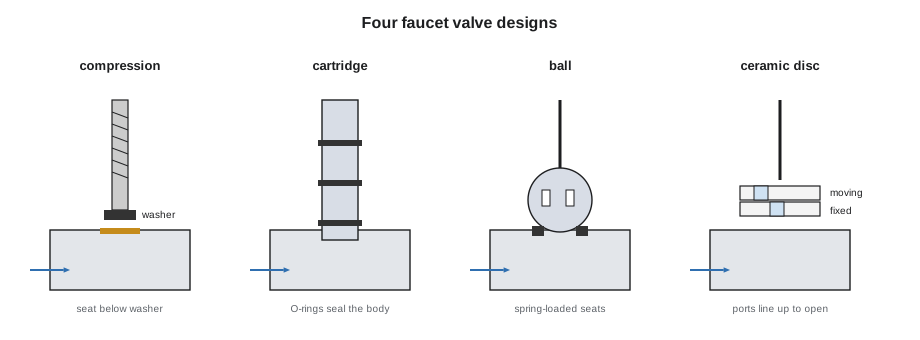
Every faucet has a valve that opens and closes the water flow and, in a mixing faucet, a way of blending hot and cold. The main designs are compression, cartridge, ball and ceramic disc. Identifying the design comes before buying parts.
| Design | How it works | Typical failures |
|---|---|---|
| Compression | A stem screws down to press a rubber washer against a seat | Worn washer or seat causes drips; worn packing leaks at the stem |
| Cartridge | A sliding or rotating cartridge with O-rings controls flow; one or two handles | Worn O-rings or cartridge seals drip or leak at the spout; stiff handle |
| Ball | A slotted ball rotates over spring-loaded rubber seats in a single-handle faucet | Worn seats and springs drip; worn O-rings leak at the spout base |
| Ceramic disc | Two polished ceramic discs slide over each other to open ports | Debris or scale on disc faces, worn inlet seals, cracked discs |
Diagnosing a dripping faucet
A drip from the spout means the valve is not sealing when closed. On a two-handle faucet, feel whether the drip is warm or cold, or close one stop valve at a time to see which side stops it. On a single-handle faucet, the cartridge or seals are the usual cause. A leak around the handle or base when the faucet is on points to stem packing or O-rings. Water under the sink may be from the supply connections, the spray hose, the drain or the faucet body itself; dry everything and watch.
- Close the stop valves under the sink, open the faucet to relieve pressure, and plug the drain so small parts cannot fall in.
- Remove the handle carefully; decorative caps often hide the screw. Take a photo before disassembly.
- Take the old cartridge or stem to the supply house, or identify it by the manufacturer's markings and part number. Many cartridges look similar but are not interchangeable.
- Inspect the seat on compression faucets. A pitted seat will chew through a new washer quickly; replace it with a seat wrench or reface it with a seat dresser.
- Clean scale and debris from the valve body, lubricate O-rings with a silicone grease suitable for potable water, and reassemble.
- Flush the faucet with the aerator off before reinstalling it, because debris loosened during repair often lodges in the aerator.
When the faucet is old, the parts are no longer available, the body is corroded or cracked, or the cost of the cartridge approaches the cost of a new faucet, replacement is usually the better value. Grace gave the customer both prices and a recommendation, and let them choose.
Shower and tub valves
Shower valves in most homes built in recent decades are pressure-balancing or thermostatic. A pressure-balancing valve uses a spool or diaphragm to keep the hot-to-cold ratio steady when pressure on one side changes, such as when a toilet is flushed. A thermostatic valve senses the mixed water temperature and adjusts the mix to hold it. Both are required to limit scald risk, and both have an adjustable rotational limit stop that sets the maximum hot position. The plumbing code limits the maximum outlet temperature of a shower or tub valve, commonly to 120 °F.
Common shower valve complaints and causes:
- Not hot enough: the limit stop is set too low, the cartridge is worn or clogged, the water heater is undersized or failing, or a crossover somewhere is mixing cold into hot.
- Too hot or temperature swings: the pressure-balancing spool is stuck with scale, or the limit stop was never set.
- Low flow: scale or debris in the cartridge or the screens at its inlets, or a clogged showerhead.
- Drips from the showerhead after shutoff: some water draining from the arm is normal for a few seconds; a steady drip means a worn cartridge or seals.
After any shower cartridge replacement, Grace checked the outlet temperature with a thermometer at full hot and set the limit stop so it did not exceed 120 °F. She wrote the measured temperature on the work order.
Valves: stops, mains and specialty valves
Shutoff valves fail by not closing fully, leaking at the stem, or seizing. Multi-turn stop valves with rubber washers harden with age and stop sealing; quarter-turn ball valves are more reliable. Gate valves on older main shutoffs often seize half open, or the gate breaks off the stem, so the main cannot be shut off at all. When a homeowner's main valve fails, the municipal curb stop may be the only way to shut off the water, and in most municipalities only the utility may operate it.
- Never force a seized old valve hard enough to break it; plan for the curb stop or a pipe freeze kit before working on it.
- When replacing a valve, choose a full-port quarter-turn ball valve for main shutoffs, approved for potable water and the local code.
- Pressure-reducing valves, backflow preventers, temperature and pressure relief valves and mixing valves each have their own service procedures and, for testable backflow preventers, testing by a certified tester.
A main shutoff that works is one of the most valuable things a plumber can leave a homeowner with. Grace often recommended replacing a seized main valve while the water was off for another repair, and showed the homeowner where it was and how to close it.
How a toilet works
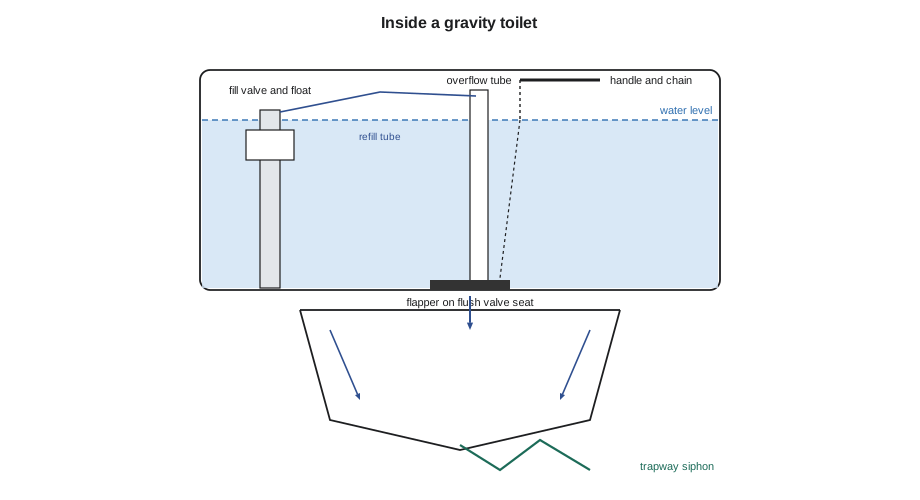
A gravity toilet stores water in the tank. When the handle is pressed, the flush valve opens (a flapper lifts, or a canister rises), water rushes into the bowl and starts a siphon in the trapway that pulls the bowl contents into the drain. When the tank empties, the flapper closes, and the fill valve refills the tank, with a small stream sent through the refill tube into the overflow tube to refill the bowl to its trap seal level. The fill valve's float shuts off flow when the tank reaches its set level.
Diagnosing a running toilet
A running toilet has one of two causes: water is leaking out of the tank through the flush valve into the bowl, or water is flowing in too high and spilling into the overflow tube. Each has a quick test.
- Look at the water level. If it is at or above the top of the overflow tube, the fill valve is not shutting off: adjust the float lower, or replace the fill valve if adjustment does not help.
- If the water level is below the overflow, put a few drops of food coloring or a dye tablet in the tank and wait 15 minutes without flushing. Color in the bowl means the flapper or flush valve seal is leaking.
- Check the chain: too short holds the flapper open; too long can tangle under it.
- Check the flapper and seat: a warped, hardened or scaled flapper, or a rough flush valve seat, will not seal. Clean the seat and replace the flapper with one that matches the flush valve size and type.
- A toilet that refills by itself every so often (a phantom flush) is slowly leaking through the flapper.
- Water on the floor at the base can be a failed wax ring or seal, a cracked bowl, sweating, or a leak from the tank bolts or supply connection; dry everything and use dye or tissue to find the source.
Replacing a flapper or fill valve takes a few minutes. Replacing a wax ring requires removing the toilet, cleaning the flange, checking that the flange is secured and at the right height, and resetting the toilet level and tight without over-tightening the closet bolts, which can crack the china.
Worked problem
How much does a leaking flapper waste?
Dye shows a toilet flapper leak, and the tank refills for 12 seconds every 20 minutes. The fill valve delivers about 2.4 gpm. How much water does the leak waste per day and per year?
Show solution
- \[\text{Refills per day} = \frac{24 \times 60}{20} = 72\]
- \[V_{\text{refill}} = 2.4\ \text{gpm} \times \frac{12}{60}\ \text{min} = 0.48\ \text{gal}\]
- \[V_{\text{day}} = 72 \times 0.48 \approx 35\ \text{gal}, \quad V_{\text{year}} \approx 35 \times 365 \approx 12\,600\ \text{gal}\]
Answer: About 35 gallons a day, or about 12,600 gallons a year, for a part that costs a few dollars. A flapper that leaks constantly, without the fill valve cycling, can waste much more.
# Toilet and faucet leak waste: daily and yearly volume and cost (illustrative water rate)
RATE_PER_KGAL = 15.00   # combined water and sewer rate, dollars per 1,000 gallons (assumed)
leaks = {
    "flapper, refill 12 s every 20 min (2.4 gpm fill)": 2.4 * 12 / 60 * (24 * 60 / 20),
    "faucet drip, 1 drip per second":                   0.25 * 86400 / 3785,
    "faucet stream, thin thread (about 0.13 gpm)":      0.13 * 1440,
    "toilet running constantly (0.5 gpm)":              0.5 * 1440,
}
for name, gal_per_day in leaks.items():
    year_gal = gal_per_day * 365
print(f"{name:50s} {gal_per_day:6.1f} gal/day {year_gal:8,.0f} gal/yr about {year_gal / 1000 * RATE_PER_KGAL:6.0f} dollars/yr")flapper, refill 12 s every 20 min (2.4 gpm fill) 34.6 gal/day 12,614 gal/yr about 189 dollars/yr faucet drip, 1 drip per second 5.7 gal/day 2,083 gal/yr about 31 dollars/yr faucet stream, thin thread (about 0.13 gpm) 187.2 gal/day 68,328 gal/yr about 1025 dollars/yr toilet running constantly (0.5 gpm) 720.0 gal/day 262,800 gal/yr about 3942 dollars/yr
Numbers like these help a customer see why a small repair is worth doing, and help Grace explain a high water bill. A constantly running toilet is often the hidden reason behind a bill that has doubled.
Other toilet problems
- Weak or incomplete flush: water level set too low, flapper closing too early, partially blocked rim holes or siphon jet (scale), a partial blockage in the trapway or drain, or a blocked vent.
- Slow refill: a clogged fill valve screen, a partly closed stop valve, or low supply pressure.
- Gurgling or bowl level dropping: a partial drain blockage or a vent problem causing siphonage.
- Pressure-assist and dual-flush toilets: follow the manufacturer's service procedures; their flush valves and cartridges are specific to the model.
- Wobbling toilet: loose closet bolts, a broken flange or a rotted subfloor. A wobbling toilet will eventually break the wax seal, so fix the cause, not just the shimming.
Repair or replace
Customers often ask whether to repair or replace. Grace weighed the age and condition of the fixture, the availability and cost of parts, how much water the existing fixture uses compared with a new low-consumption model, the customer's plans for the room and the labor involved. For an old toilet using far more water per flush than a modern one, with a cracked tank or a corroded flush valve, replacement is often better value. For a good-quality faucet with an available cartridge, repair usually is. Either way, she explained the choice in plain terms and left the decision to the customer.
Common mistakes
MistakeBuying a cartridge by guesswork.
InsteadTake the old part or identify it by brand and model before buying.
MistakePutting a new washer on a pitted compression seat.
InsteadReplace or reface the seat, or the drip will return quickly.
MistakeForcing a seized gate valve on an old main.
InsteadPlan for the curb stop or a freeze kit before touching it.
MistakeReplacing a shower cartridge without checking the outlet temperature.
InsteadMeasure at full hot and set the limit stop to the code maximum.
MistakeReplacing a flapper when the water is running into the overflow.
InsteadCheck the water level first; an overfilling tank is a fill valve problem.
Summary and key terms
- Identify the faucet design (compression, cartridge, ball or disc) before buying parts.
- Drips from the spout mean the valve is not sealing; leaks at the handle mean stem seals or O-rings.
- Pressure-balancing and thermostatic shower valves limit scald risk; set and record the limit stop temperature.
- Seized main valves need a plan; a working full-port main shutoff is valuable to the homeowner.
- A running toilet is either a leaking flush valve (test with dye) or an overfilling tank (check the level).
- Help the customer weigh repair against replacement with clear prices and reasons.
- Compression faucet
- A faucet that closes by pressing a washer onto a seat with a threaded stem.
- Cartridge
- A replaceable valve unit in a faucet or shower valve that controls flow and mixing.
- Flapper
- The rubber valve at the bottom of a toilet tank that opens to flush and seals to hold water.
- Fill valve
- The valve in a toilet tank that refills the tank and shuts off at the set level.
- Limit stop
- An adjustable stop on a shower valve that limits the maximum hot position.
Practice problems
Work each problem on paper first, then reveal the answer to check.
A two-handle faucet drips warm water. Which side do you repair first?
Show answer
The hot side.
What does dye in the tank appearing in the bowl show?
Show answer
A leaking flapper or flush valve seal.
Why plug the sink drain before taking a faucet apart?
Show answer
To stop small parts from falling into the drain.
Why check the toilet flange when replacing a wax ring?
Show answer
A broken, loose or low flange will make the new seal fail.
Name two causes of a shower that is not hot enough.
Show answer
A low limit stop setting, a worn or clogged cartridge, a failing water heater, or a crossover.
Lesson quiz · 5 questions
Score 60% or more to complete this lesson.
Create a free account to save your progress, take quizzes and earn a certificate.