
PLB-420 · Lesson 5 of 12 · 21 min
Sewer lateral problems and repair options
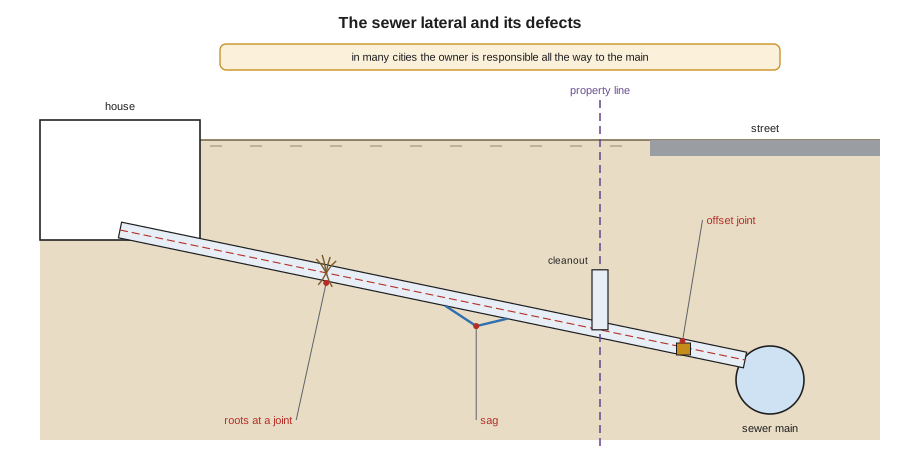
Mr. Okafor's video showed three defects in his clay sewer lateral: a cracked joint with roots at 6 meters, a sag from 9 to 11 meters and an offset joint where his pipe met the city's connection at 14 meters. He had three questions. Who is responsible for each part? What are my options? What will it cost? This lesson answers those questions in general terms. It covers how sewer laterals are built and why they fail, who owns which part, the main repair methods from spot repairs to full replacement and trenchless lining or bursting, and how a service plumber helps a customer choose.
The sewer lateral
The sewer lateral, also called the building sewer or the sanitary service connection, is the pipe that carries wastewater from the building to the public sewer main, usually under the front yard and the street. In the plumbing codes, the part inside the building is the building drain, and the part outside is the building sewer. The connection to the main is often made with a wye or a saddle on the main, sometimes with a cleanout or inspection chamber at the property line.
Laterals have been built from many materials over the decades: vitrified clay pipe with mortar or rubber-gasketed joints, cast iron, asbestos cement in some areas, bituminous fiber pipe (often called Orangeburg) in the mid-twentieth century, and plastic (ABS and PVC) since about the 1970s. Each material has typical failures. Clay joints let roots in and break under settlement. Cast iron corrodes from the inside, especially along the bottom. Bituminous fiber pipe softens and deforms into an oval shape. Older plastic installations may have been poorly bedded and sag.
Why laterals fail
- Roots. Trees seek water and nutrients, and fine roots enter through the smallest crack or open joint, then grow into dense masses that catch solids. Roots are the most common cause of recurring lateral blockages in older neighborhoods.
- Settlement and poor bedding. Soil under a pipe that was not compacted or bedded properly settles over time, creating sags where water and solids collect, and stressing joints until they crack or separate.
- Corrosion. Hydrogen sulfide from sewage forms sulfuric acid on the pipe crown in some conditions, and cast iron rusts, especially along the invert where water runs.
- Ground movement and frost. Freeze-thaw cycles, construction nearby and heavy vehicles can crack and shift pipe.
- Damage during other work. Utility work, landscaping, fence posts and driveway replacements sometimes break laterals.
- Grease and misuse. Grease, wipes and other materials catch on any roughness or defect and accelerate blockages.
A single defect rarely appears alone. A clay lateral with one cracked joint usually has other joints that are aging the same way. That is why a full camera inspection is valuable even when the customer's immediate problem has been solved.
Who owns the lateral
Ownership and responsibility for laterals vary by city, and the plumber must know the local rules. In many US cities the property owner is responsible for the entire building sewer, all the way to the main, including the part under the street; in others, the city maintains the part in the right-of-way. In Columbus, the sewer lateral from the house to the main is generally the property owner's responsibility, while the main itself belongs to the city. Some cities require the homeowner to report backups to the city first so crews can check whether the main is surcharged or blocked.
When a camera shows a defect at or beyond the property line, Grace explained the local rule to the customer and helped them report it to the municipality, with a copy of the video and the measured distance. She never assumed which side was responsible without checking, because getting it wrong could cost the customer thousands of dollars.
Repair options
Once the defects are known, there are several ways to deal with them. The right choice depends on the type and number of defects, the pipe material and condition, the depth, what is above the pipe (lawn, driveway, mature trees, a garage), access, local rules and the customer's budget.
| Option | What it involves | Best for |
|---|---|---|
| Maintenance cleaning | Regular cabling or jetting, sometimes with root treatment | Minor root intrusion when repair is not affordable yet |
| Spot repair (dig and replace) | Excavate at a single defect and replace a short section with new pipe and couplings | One or two isolated defects in otherwise sound pipe |
| Point liner (sectional liner) | A short resin-soaked liner pulled or pushed to the defect and inflated until it cures | Isolated cracks or root joints without major sag |
| Cured-in-place pipe (full liner) | A resin-soaked liner installed along the whole lateral and cured to form a new pipe inside the old one | Many cracks and root joints in pipe that is still round and properly graded |
| Pipe bursting | A bursting head pulled through the old pipe breaks it outward while pulling new plastic pipe in behind it | Badly broken pipe that needs full replacement with minimal digging |
| Open-trench replacement | Excavate the full length and install new pipe on proper bedding | Severe sags, back-grade, collapsed pipe, or when access for trenchless methods is poor |
Spot repairs
A spot repair excavates directly over a defect located by the camera and replaces a short section of pipe. The plumber cuts out the damaged section, installs new pipe of the same size, and joins it to the old pipe with shielded rubber couplings rated for the materials on each side. The new section must be bedded properly and the backfill compacted in layers, or the repair itself will sag. Spot repairs are economical when there are one or two defects in otherwise good pipe. They are a poor choice when the camera shows many failing joints, because the next one will fail soon.
Excavations 5 ft or deeper must be sloped, benched or shored under OSHA's excavation standard (29 CFR 1926 Subpart P), unless they are in stable rock, and trench work needs utility locates and protection of the public. Many service companies subcontract deep excavation to a contractor with the right equipment and training.
Trenchless lining
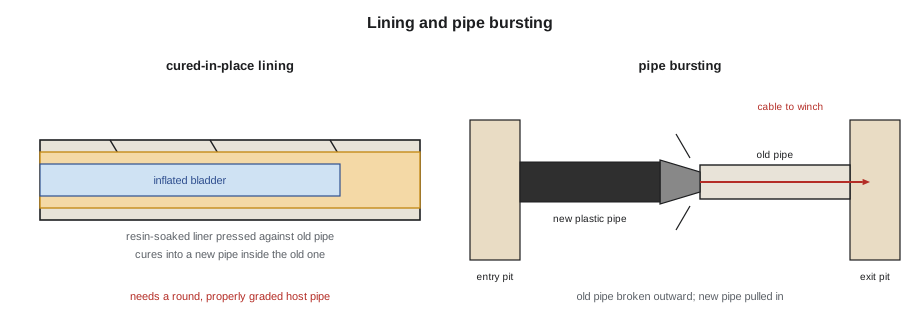
Cured-in-place pipe, often called CIPP or lining, installs a new pipe inside the old one without digging up the whole length. A flexible tube of felt or fiberglass is saturated with resin, then pulled into the old pipe or turned inside out into it with air or water pressure. A bladder inflates it against the old pipe's walls, and the resin cures with heat, steam, hot water or ultraviolet light. When the bladder is removed, a smooth, jointless pipe remains inside the old one. Connections from other branches are reopened from inside with a robotic cutter, and the ends are sealed.
Lining works well when the old pipe is still roughly round, properly sloped, and continuous enough to support the liner. It cannot fix a sag; the liner will follow the sag. It reduces the inside diameter slightly. It needs clean pipe, so the line is cleaned thoroughly first, often with a descaling tool in cast iron. Point liners use the same idea on a short section to seal one cracked joint.
Styrene-based resins used in some CIPP products give off strong odors during curing and must be handled with ventilation and care, especially indoors. Many residential lining products now use epoxy resins or other low-odor systems. Installers follow the manufacturer's procedures, and many municipalities require approved products and post-installation video.
Pipe bursting
Pipe bursting replaces the lateral by pulling a cone-shaped bursting head through it. The head, pulled by a cable or rod from a winch at one end, cracks the old pipe outward and expands the soil around it, while new high-density polyethylene pipe attached behind it is pulled into the space. It needs only an entry pit and an exit pit, and it can install pipe the same size as or slightly larger than the old pipe. Bursting suits broken clay, cast iron and bituminous fiber pipe. It is not suitable where the pipe is very shallow under a slab or foundation that could heave, where other utilities run close alongside, or where the line has severe sags, because the new pipe tends to follow the old path.
Open-trench replacement
Sometimes digging is still the best answer. Where the lateral has a severe sag or a back-graded section, where it has collapsed, or where the slope must be corrected, open-trench replacement is the only way to install new pipe at the correct grade. It costs more where the pipe is deep or under hard surfaces, and it disrupts landscaping, but it gives a fully new pipe on proper bedding. Replacement also gives an opportunity to install a property-line cleanout and, where required or advised, a backwater valve (lesson 11).
New building sewers must meet the plumbing code: minimum size (commonly 4 in for a house), minimum slope (commonly 1/8 in per foot for 4 in pipe, with 1/4 in per foot preferred), approved materials, proper bedding and backfill, cleanouts at required intervals and changes of direction, and an inspection before backfilling. A permit is required.
Worked problem
Comparing repair options by cost
Mr. Okafor's 50 ft clay lateral has root-cracked joints at 20 ft and at two other places, a 6 ft sag at 30 to 36 ft, and a slightly offset joint at the main. The lateral is 6 ft deep under a lawn with one mature tree. Which options make sense?
Show solution
- Three root-cracked joints suggest the whole clay pipe is aging; spot repairs would leave other joints to fail.
- The sag rules out a full liner as a complete fix, because the liner would follow the sag and solids would still settle.
- Pipe bursting would also tend to follow the sag.
- Open-trench replacement corrects the grade but means excavating a lawn and working around the tree's roots.
- A hybrid is possible: dig and replace the sagging section at the correct grade, then line the remaining sections.
- A new 4 in sewer at 1/4 in per foot needs this much fall over the 50 ft run:
- \[\Delta h = 50\ \text{ft} \times 0.25\ \text{in/ft} = 12.5\ \text{in}\]
Answer: Full open-trench replacement or a hybrid of a dug section at the sag plus lining elsewhere. Maintenance cleaning would only delay the problem. Grace prices both main options and explains the trade-offs.
# Rough life-cycle comparison of lateral options over 20 years (all costs illustrative)
options = {
    "annual cleaning only":       {"now": 0,     "per_year": 350, "risk_per_year": 0.30, "backup_cost": 5000},
    "spot repair at 20 ft":       {"now": 3500,  "per_year": 200, "risk_per_year": 0.20, "backup_cost": 5000},
    "dig sag + line rest":        {"now": 11000, "per_year": 0,   "risk_per_year": 0.02, "backup_cost": 5000},
    "full open-trench replace":   {"now": 13500, "per_year": 0,   "risk_per_year": 0.01, "backup_cost": 5000},
}
years = 20
for name, o in options.items():
    expected = o["now"] + years * (o["per_year"] + o["risk_per_year"] * o["backup_cost"])
print(f"{name:26s} expected 20-year cost about {expected:7,.0f} dollars")annual cleaning only expected 20-year cost about 37,000 dollars spot repair at 20 ft expected 20-year cost about 27,500 dollars dig sag + line rest expected 20-year cost about 13,000 dollars full open-trench replace expected 20-year cost about 14,500 dollars
The figures are invented, but the method is useful: an option that looks cheapest today can cost more over time once the expected cost of repeat cleanings and basement backups is included. Customers often find this kind of comparison helpful, as long as it is presented honestly and the assumptions are clear.
Permits, inspections and the municipality
Most lateral repairs and replacements need a plumbing permit and an inspection before backfill. Work in the road allowance or right-of-way, such as reconnecting to the main or replacing the city's portion, usually needs a separate permit from the municipality's roads or utilities department, traffic control and, often, a contractor approved by the city. Some municipalities have grant or loan programs that help homeowners replace laterals, add backwater valves or disconnect downspouts and foundation drains. Lesson 11 returns to these programs.
Grace kept copies of the before-and-after videos, the permit, the inspection result and the materials used in the job file. She gave the homeowner a copy, explaining that it would be useful when selling the house, for insurance claims and for any future work.
Common mistakes
MistakeSpot-repairing one joint in a clay lateral with many aging joints.
InsteadLook at the whole video; several failing joints point to lining or replacement.
MistakeLining a lateral with a significant sag.
InsteadA liner follows the sag; correct the grade by excavation first or choose replacement.
MistakeAssuming the homeowner owns the lateral right to the main.
InsteadCheck the municipality's rules; ownership often changes at the property line.
MistakeDigging deep trenches without sloping or shoring.
InsteadFollow the excavation rules, get locates and use a qualified excavator if needed.
MistakeChoosing the cheapest option today without explaining long-term costs.
InsteadCompare options over their life, including repeat cleanings and backup risk.
Summary and key terms
- Laterals connect the building drain to the public sewer and have been built of clay, cast iron, bituminous fiber and plastic.
- Roots, settlement, corrosion, ground movement, damage and grease cause most failures.
- Responsibility for the lateral varies by municipality; check before advising the customer.
- Options range from maintenance cleaning to spot repair, point and full lining, pipe bursting and open-trench replacement.
- Lining needs round, properly graded pipe; bursting replaces broken pipe through small pits; trenching corrects sags.
- Repairs need permits and inspections, and the customer needs a clear, honest comparison of options.
- Sewer lateral
- The pipe from a building to the public sewer main, also called the building sewer.
- Cured-in-place pipe
- A resin-soaked liner installed inside an old pipe and cured to form a new pipe.
- Pipe bursting
- Replacing a pipe by pulling a head through it that breaks it outward while new pipe is pulled in behind.
- Spot repair
- Excavating and replacing a short section of pipe at a single defect.
- Bituminous fiber pipe
- A mid-twentieth-century pipe of wood fiber and pitch that deforms with age.
Practice problems
Work each problem on paper first, then reveal the answer to check.
Why does a single root-cracked joint in clay pipe often lead to recommending more than a spot repair?
Show answer
Other joints of the same age are likely failing too.
Why can't a full liner fix a sag?
Show answer
The liner follows the existing pipe, so the sag remains.
Name two situations where pipe bursting is unsuitable.
Show answer
Very shallow pipe under slabs or foundations, utilities close alongside, or severe sags.
What does a spot repair need to avoid creating a new sag?
Show answer
Proper bedding and compacted backfill in layers.
Why keep before-and-after camera videos in the job file?
Show answer
They document the defect and the repair for the customer, insurers, inspectors and future work.
Lesson quiz · 5 questions
Score 60% or more to complete this lesson.
Create a free account to save your progress, take quizzes and earn a certificate.